Investors were also taking profits on gold after its recent run up, said Daniel Ang, investment analyst at Phillip Futures in Singapore. “I think the safe-haven appeal of gold is tapering off a bit and investors are looking at other havens such as the Japanese yen,” Ang added.
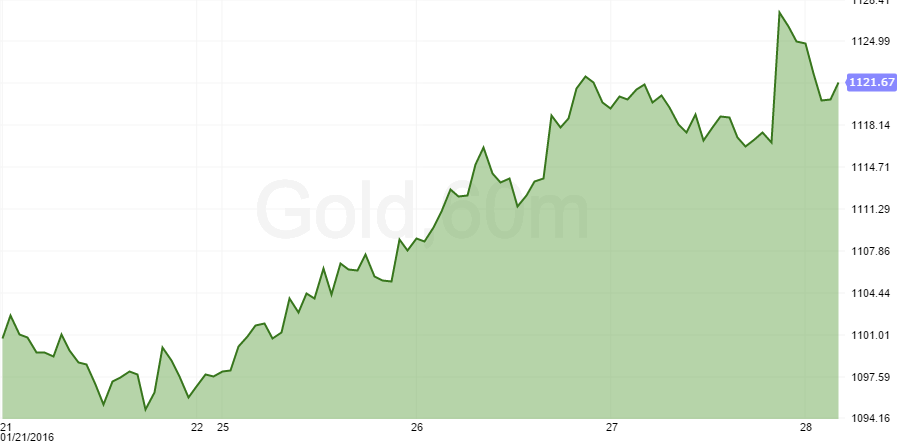
After its initial fall this morning Asian traders started to buy up the commodity after it eased. Gold edged off 12-week highs on Thursday, after the US Federal Reserve acknowledged a challenging global economy, but signaled it was unlikely to be deterred from raising interest rates this year. The less dovish tone of the Fed’s statement weighed on gold, which had gained on global uncertainties from China to Europe.
After keeping US interest rates unchanged as expected, Fed policymakers said the economy was still on track for moderate growth and a stronger labor market even with “gradual” rate increases, suggesting its concern about global events had diminished but not squashed chances of a rate hike in March.
Gold supply dropped seven per cent in the December 2015 quarter owing to a four per cent fall in global mine output, according to GFMS Thomson Reuters’ Gold Survey: Q4 2015 Review and Outlook, released on Wednesday. This is the largest quarterly reduction since 2008 and an all-time high for fourth quarter demand. Producers and mines that hedge selling future production when they see prices falling have started de-hedging.
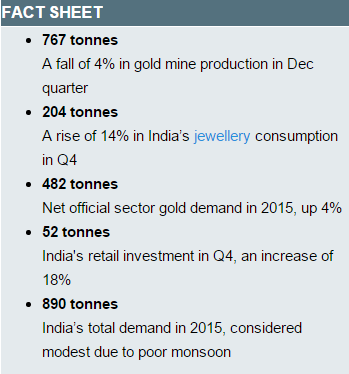
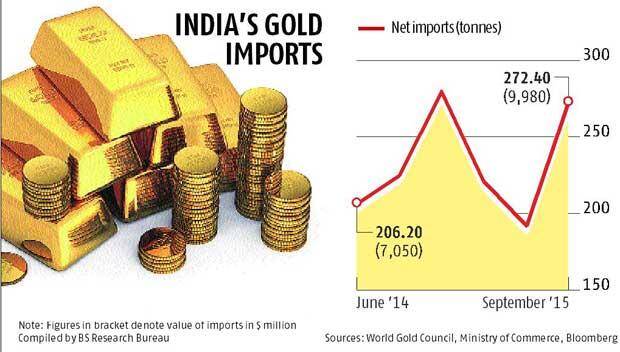
India’s jewelry consumption increased 14 per cent year-on-year (y-o-y) to 204 tonnes in the fourth quarter of 2015. Meanwhile, retail investment rose 18 per cent, y-o-y, to 52 tonnes, the highest since the fourth quarter of 2013.
India’s aggregate jewelry (703 tonnes) and investment demand (187 tonnes) in 2015 gained six per cent to 890 tonnes. This nominal rise in demand, despite the annual average price declining six per cent, can be attributed to the poor monsoon. Gross annual imports for the whole year were 904.5 tonnes, 10 per cent higher than that of 2014.
China will continue with gold purchases this year and the central bank will probably scoop up more than 200 metric tons as the country seeks to diversify its reserves, according to an estimate from Barclays Plc.
Bullion purchases by the People’s Bank of China in recent months have been very steady, which is “particularly impressive given that China’s total forex reserve has recorded large declines,” analyst Feifei Li said in an e-mailed report. In 2016, buying may average about 17.9 tons a month, or 215 tons over the full year, she wrote.
Central banks led by China, Russia and Kazakhstan have been adding bullion to their reserves, helping to support prices that have been lifted this year by increased haven demand amid a global rout in stocks. Annual purchases of more than 200 tons by the PBOC would exceed the entire holdings of all but about 20 countries worldwide, according to data from the World Gold Council.