


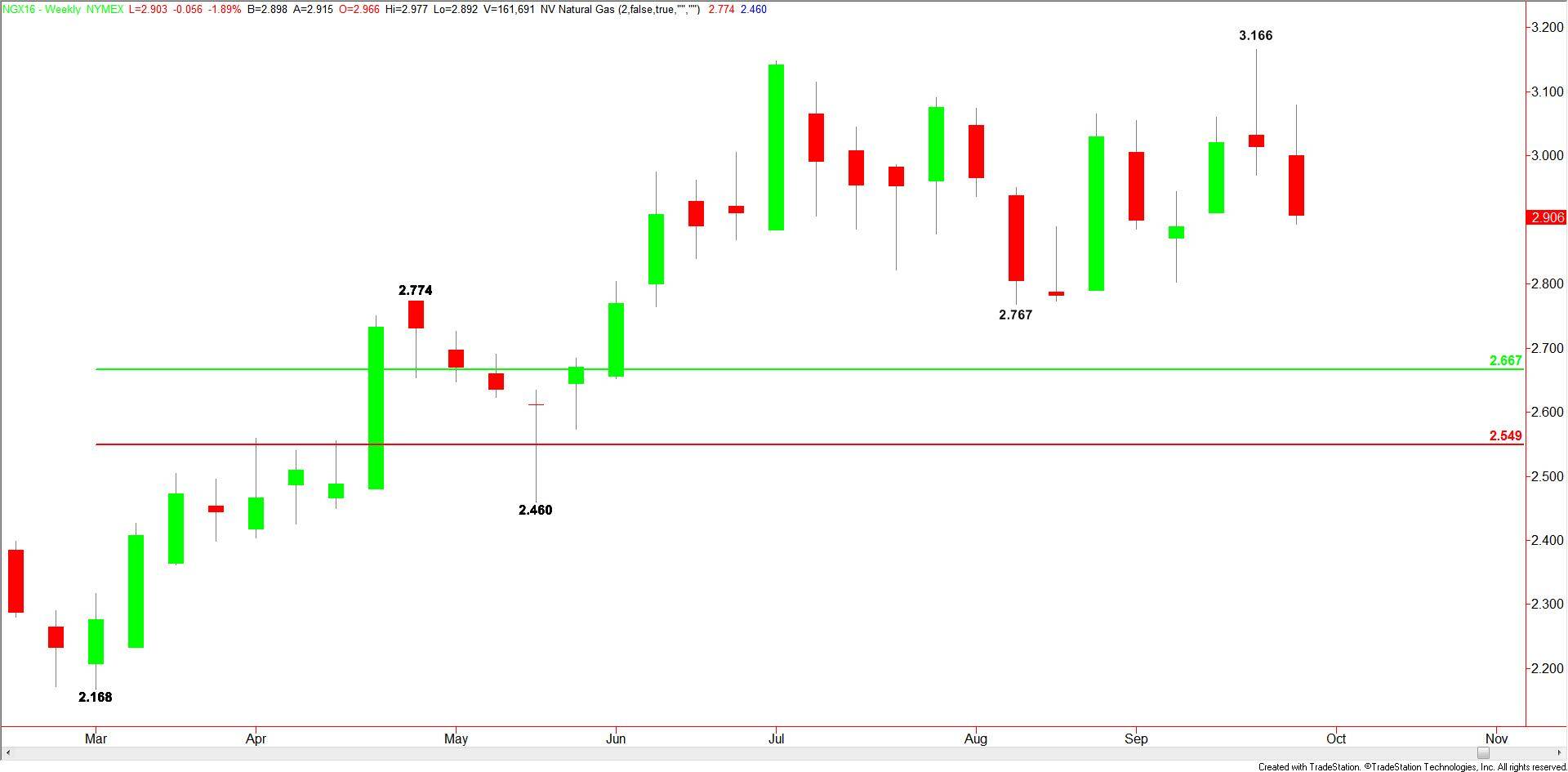
After rallying to a multi-month high the previous week, natural gas futures were hit by a wave of selling pressure and aggressive long liquidation last week. Some of the move was triggered by a change in the short-term weather forecast. Some was positioning for a rally that could occur in November or December, depending on which winter weather forecast you are following. At the end of the week, the November Natural Gas futures contract was trading at $2.906, down $0.107 or -3.55%. This was well above the two major bottoms at $2.802 and $2.767, but over 62% off the $3.166 multi-month high.
Last week, the U.S. Energy Information Administration (EIA) reported that U.S. natural gas stocks increased by 49 billion cubic feet for the week ending September 23. This was better than the 55 billion cubic feet estimate, but the market sold-off anyway because speculators had bet big on the above average hot temperatures continuing. These hopes were squashed when the weather forecast was changed to cooler temperatures.
The five-year average for the week is an injection of around 97 billion cubic feet, and last year’s storage addition for the week totaled 96 billion cubic feet. So this was bullish news on paper, however, investors were a little ahead of the weather. It’s pretty unusual to have a heat-related weather issue in late September or early October and the price action suggests that speculators were ill-prepared for the reaction.
FORECAST
Now that the summer cooling season is mostly behind us, demand is expected to continue to drop until the winter heating season begins around November 1. Storage additions are expected to continue to remain low because of production cuts. With storage additions well below year-ago levels and the five-year average for this time of year, the market could be set up for a winter rally.
However, prices aren’t likely to rise this week unless they are driven by short-covering position-squaring and profit-taking after last week’s rout. This is because it’s still too early to be thinking about the winter cold. Additionally, stockpiles still remain about 2.6% above their levels of a year ago and 6.5% above the five-year average. In other words, we’re not out of the woods yet since the U.S. physical storage limit of 4.3 trillion cubic feet could still be threatened if production rises in the next few weeks.
This week, most of the U.S. will be blanketed with comfortable temperatures. Because of this, natural gas demand is expected to remain low. Prices may stabilize however because last week’s price action suggests this news may have already been priced into the market.
We’re looking for prices to stabilize due to technical factors and until the next weather forecast is released. Additionally, we’d still like to continue to see below average injections. We expect demand to drop so that won’t be a surprise. However, if you are thinking about a bull market rally in the winter, you have to hope that injections remain low.

Look for an early downside bias, but not the relentless selling we saw last week. If the long speculators were driven out last week then prices should stabilize this week as investors try to establish a support base. I don’t expect to see a strong rally, however, unless the above average temperatures return to the key demand areas.


