


There are very few emerging countries in the world that have a few key overlaps that are necessary for me to consider investing in them. They must have free markets, domestic economic liberty, growing demographics, and access to nearby large capital markets. Enter Indonesia, tracked with the IDX Composite Index (JKSE), or my favorite tool for the trade, the iShares MSCI Indonesia ETF (EIDO), which fits all of those categories. Moreover, they are incredibly unloved by the market right now, down nearly 20% YTD, as the looming oil crisis caused by the U.S.-Iran War has obliterated faith in their market. We have a near-perfect setup for a medium-term bottom in Indonesian stocks.
Breaking From The Flying Geese
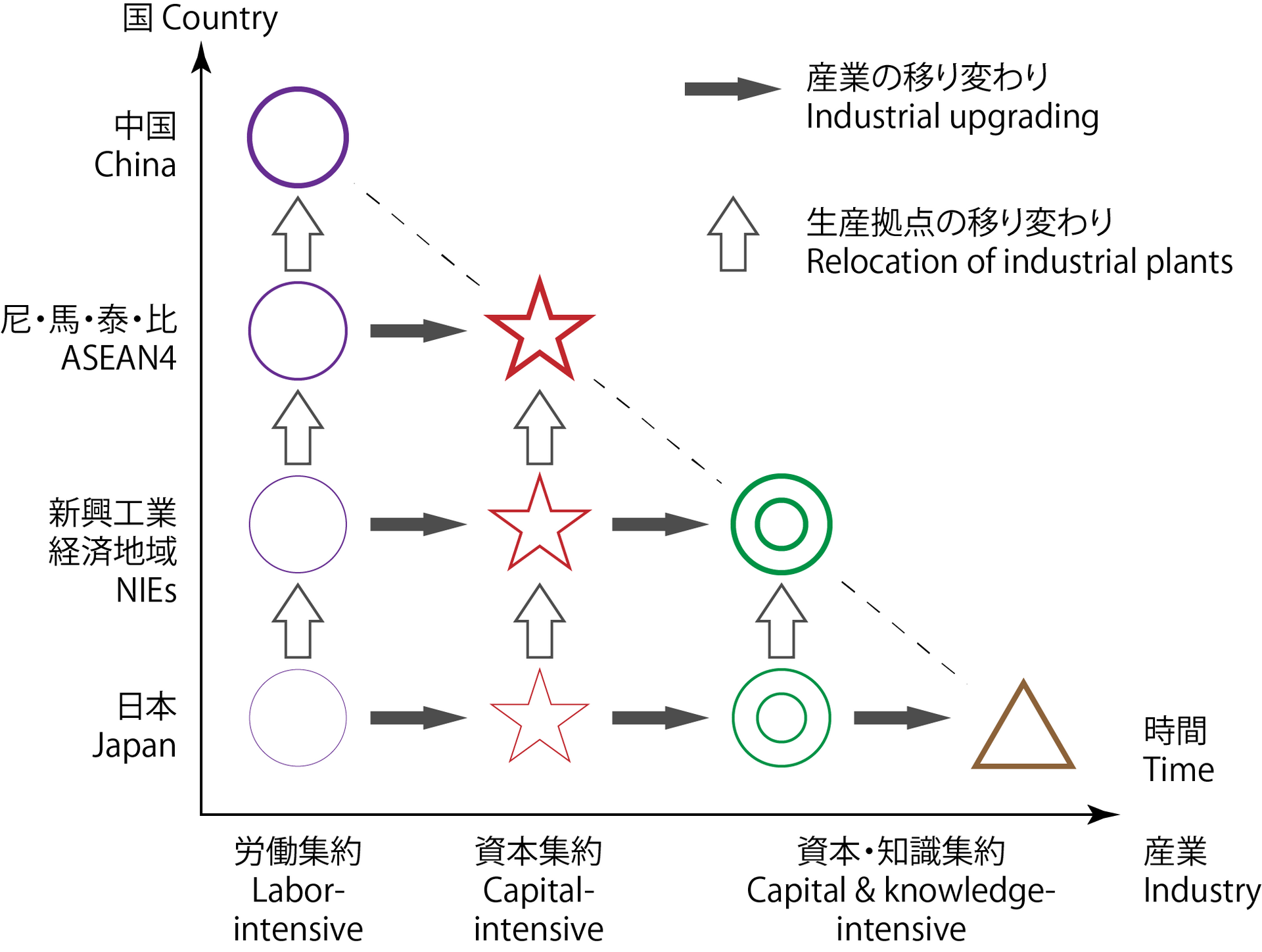
First, a bit of context on the Indonesian economy. Indonesia is one of the major Asian nations by population, holding a little over 3.4% of the world’s population and much of the world’s younger population compared to most economies in the West or Northeast Asia. They industrialized late, becoming one of the “flying geese,” or part of the economic model Asian economies used to industrialize from the 1960s through today.
As they advance through difficulties of manufacturing (textiles to chemicals to steel to automobiles to electronics), they pass on the economic burden of production to the next economy down the line. This has meant that smaller, younger economies like Indonesia have quickly picked up demand left by the other, more developed Asian economies as they advance onto higher-margin, more advanced production techniques. This chain has recently broken, with China, as it began to automate low-margin manufacturing instead of offshoring it to the next economy down the line.
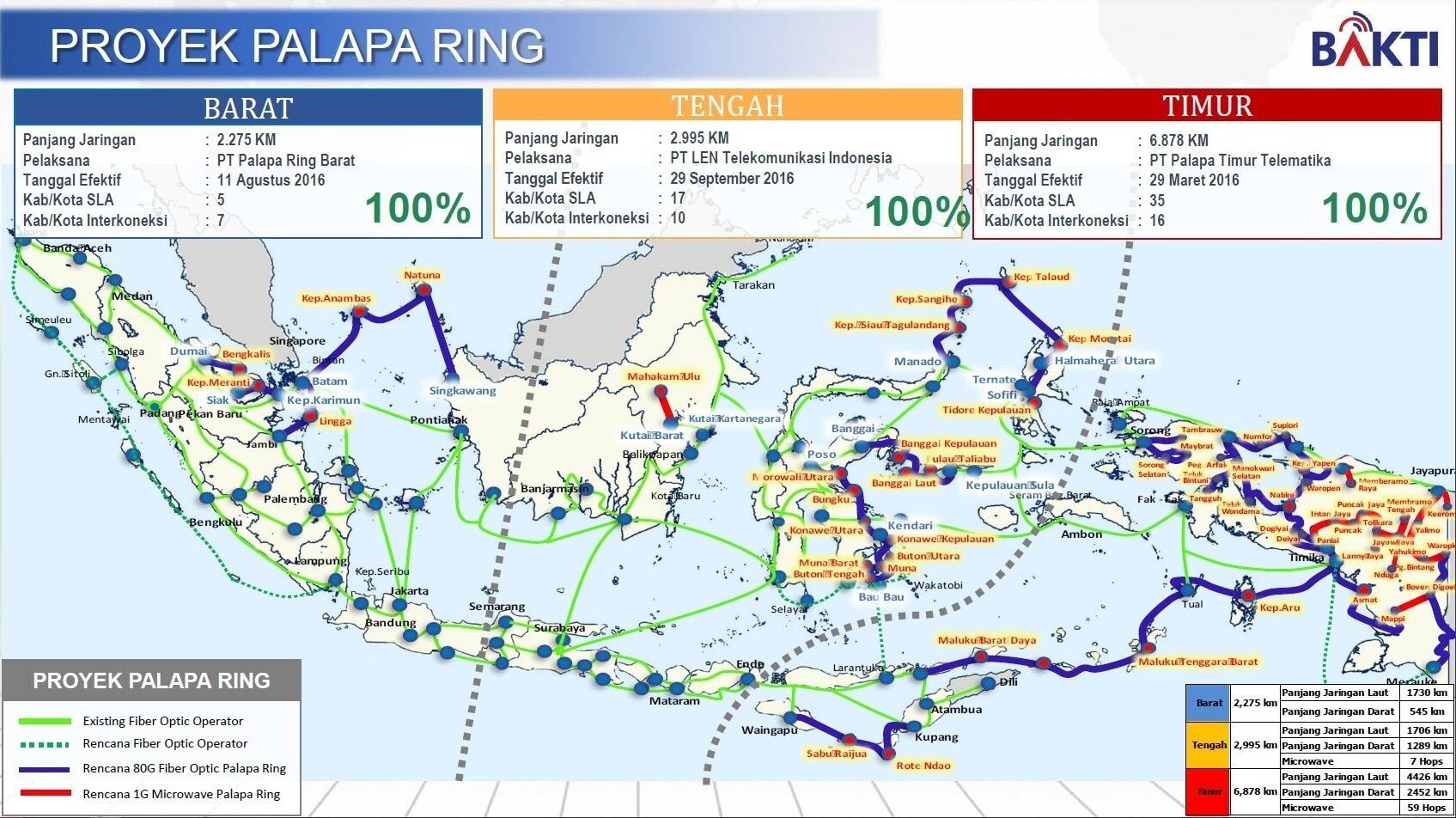
Indonesia’s response has been innovation. The Internet era is changing this model, and now Indonesia can harness its sheer demographic weight (~290M people) to create opportunity using the global Internet. The last few years have seen massive digital infrastructure buildouts in Indonesia, including significant fiber deployments over a geography that is not so forgiving. It’s not easy being a nation of non-contiguous territories and having to connect them all with digital infrastructure, but large-scale projects over the last few years have proven successful in increasing Indonesian digital connectivity. What used to be a bifurcated economy of digital haves and have-nots has, in the last few years, narrowed quickly. Internet access for emerging economies is, in many ways, a great equalizer. Indonesia understood that and acted accordingly.
Being connected to the global Internet is a huge deal for a massive emerging democracy like Indonesia. As their services labor rates are very competitive, their domestic capacity to consume is consistently expanding due to rising wages that come alongside Internet access and its associated productivity boosts. Getting hired for the job is easier since your rates are lower, and your rates can be lower because they go further for you in your economy. It’s a similar model that the Philippines used to try to modernize their economy as well, although their economy is just so much smaller by comparison.
Thankfully, they also have nearby Singapore, a very advanced service economy that can benefit greatly from digital integration into Indonesia. See how an app like Grab Holdings (GRAB) has become a superpower in Southeast Asia. Using the short geographic distance to financial capital hubs like Singapore and Hong Kong, Indonesia can very effectively bring in productivity-boosting and job-creating digital tools from nearby markets.
Using the newly laid fiber and other Internet infrastructure like cell towers, the massive but previously isolated Indonesian economy is getting more and more connected as time goes by. They are creating a different model from the Flying Geese and are skipping the low-margin manufacturing development, heading right toward electronics and services. We can see it in the index.
The Index Is Reshaping
Currently, the Indonesian index is filled with the same kind of firm that most emerging markets are: banks. Financials control over 40% of the index, which is to be expected. Banks are necessary for the creation of the rest of an advanced economy. You cannot develop a modern economy without a credit or banking system of some kind, although in Muslim-majority countries (Indonesia’s government is officially secular), banking can sometimes be tricky due to cultural customs around charging interest.
But there is a quiet rotation going on under the surface. Consider that a year ago, financials made up ~50% of the index. It is losing share quickly, partially to the commodities sector (commodities have done very well at the same time), but also to the services and technology sectors. The weights of the technology services and consumer services sectors have doubled in the last year. Here are the current weights, still very favourable to banks, but heading in favour of services and technology.
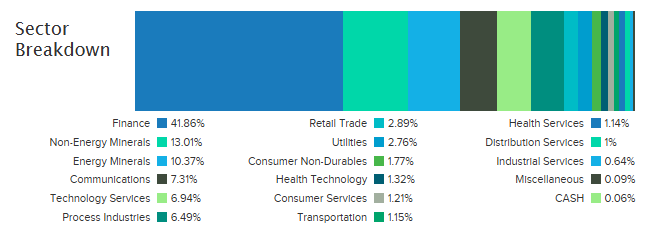
So a bet on Indonesia through a fund like EIDO is a bet that this acceleration will continue, and demographically large, free emerging economies like Indonesia are going to skip some harsh manufacturing stages of their development. Their industrial sectors have been stagnant valuation-wise over the last year, as their push toward digitization has squarely benefited the growing services sector.
Of course, EIDO’s top holdings are still squarely sat in banks. Every year, when the fund reconstitutes, I expect it to hold more and more weight in the rising tech sector, which should provide a new overall growth trajectory for the index. That’s a long-term catalyst, of course, and will take significant time to play out, but it sets the stage for me to say that over time, I expect the mix of the index to shift toward higher-growth industries.
I wanted to set up the bullish story behind the index and why I’m interested in it before I show the chart, because the chart is not pretty.
The EIDO Chart is Rough
The Indonesian market has been in an overall downtrend for the last five years. While the index is down ~45% in the past five years. Nearly half of that was driven by losses of the rupiah against the dollar. While further currency erosion is one risk to consider (and one that can be hedged, thankfully), it’s also important to consider that this has meant we are now at lows not seen since the April 2025 crash. We are close to the absolute lows of the March 2020 crash.
Note that I am using EIDO as that’s what I would use to trade Indonesian stocks. However, one could consider index derivatives if they have access or an alternative Indonesian-focused ETF like the VanEck Indonesia Index ETF (IDX), which has slightly different holdings and expenses.
Here’s the 10yr chart with monthly candles for reference of where we are in the big picture:
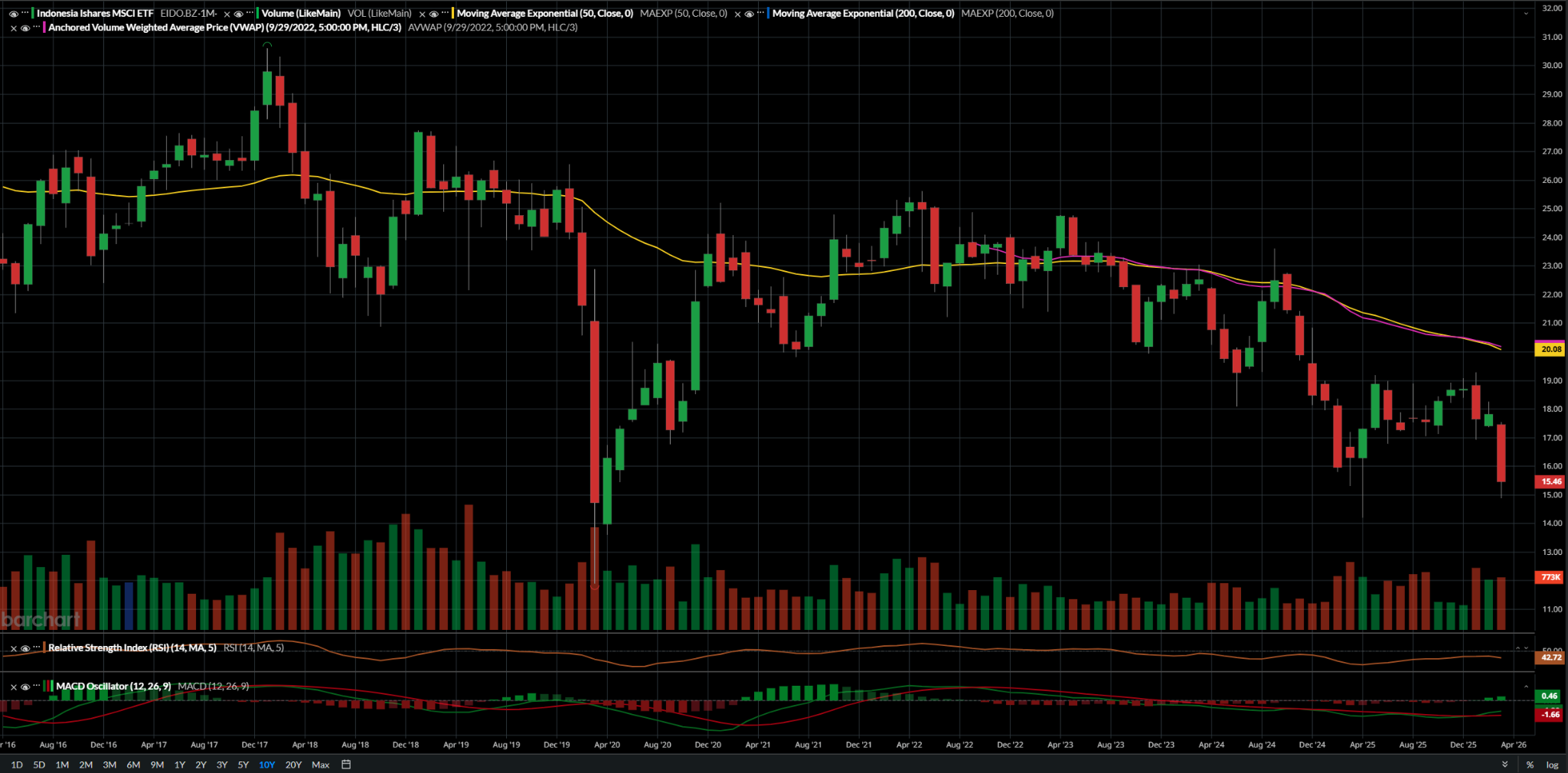
This gives us some context for the chart I’d actually trade with, using weekly candles. It’s a textbook downtrend, with both the institutional support/resistance levels (50- and 200-day EMAs) well above current prices.
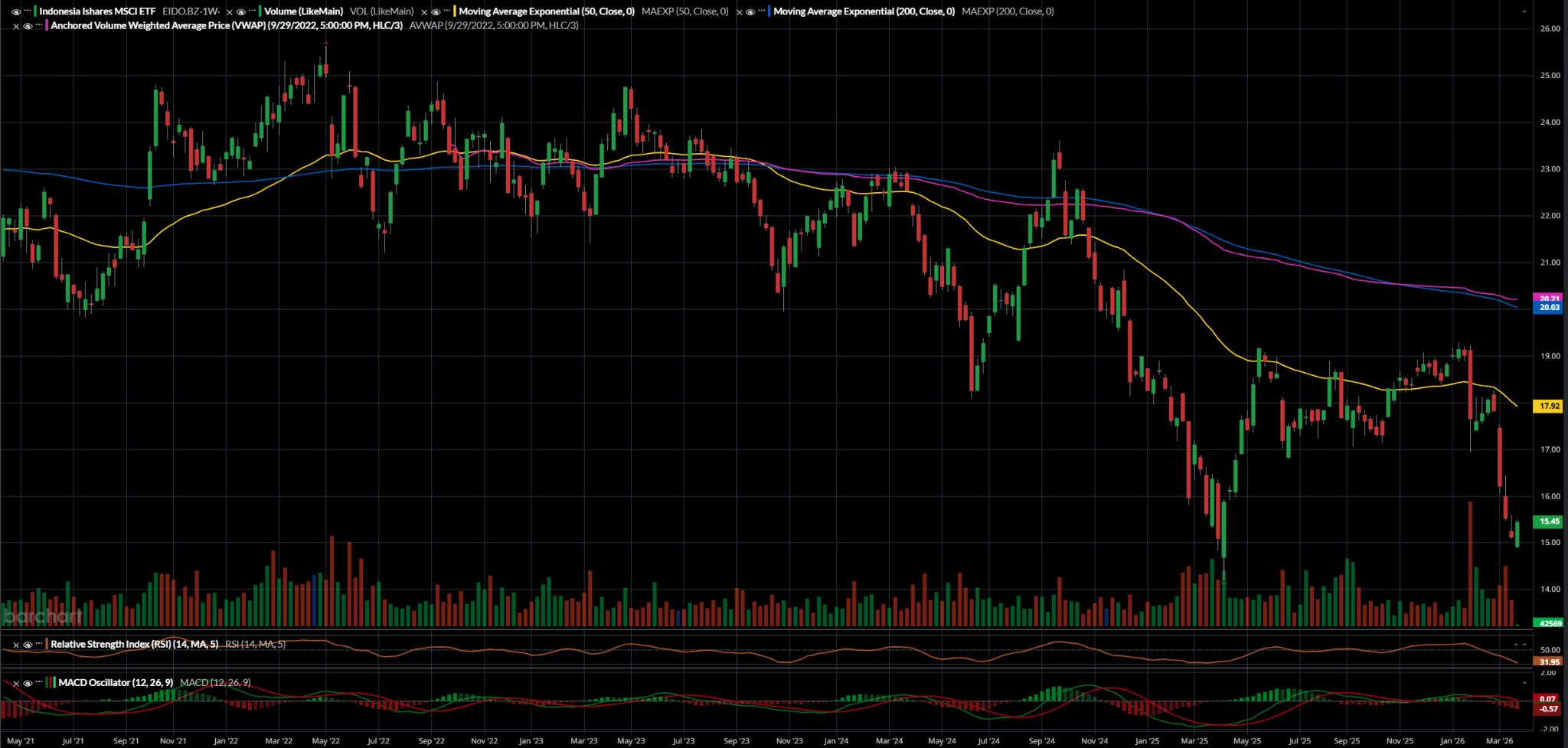
Bears own the show, especially recently (more on that in the next section). The sell-off that started the March crash had to be institutions going risk-off, as retail panic doesn’t generally create that kind of volume. There was a bounce attempt at the ~18 area, rejected at 18.31, touching the 50 EMA. The sell-off accelerated, and now, after a bounce off a similar low to April 2025, we may be seeing the new bottom.
The RSI has collapsed, going from healthy buying pressure to nearly oversold, now at ~32. Momentum in general is bearish, but I believe it is primarily driven by geopolitics at the current moment, given their situation.
Invalidation would be the price cutting below 14, which would be the last resistance that it’s made, and below that, new lows await. On the flip side, if EIDO can overtake the 17.50 area, it has a clear channel up toward 20, where it will have to contend with the 200 EMA resistance.
Geopolitics Is the Greatest Risk & Catalyst
Despite all the positive rhetoric about the trajectory of the rapidly digitizing economy, Indonesia does have a few things going against it right now.
The first is what was mentioned earlier: currency woes. A strengthening dollar is generally bad for emerging market currencies. While the dollar has been in a downtrend, it recently turned on news of the U.S.-Iran war and took the rupiah with it. If the dollar is strong moving forward and fully breaks its prior trend, then returns could be eroded down by currency loss.
The second is very related, and that’s that the recent sell-off is primarily motivated by the lack of oil making its way to Asian economies. Unlike more developed economies like South Korea and Japan, Indonesia does not have large stockpiles of oil and gas to release to their economies in times of need. While these other economies can keep everything moving normally while they wait for the fate of the Strait of Hormuz to be settled, Indonesia is rapidly running out of fuel. It was estimated that they had a little over 20 days worth at the beginning of the month, likely less now as fuel has not been flowing through the strait. Further closure will be a negative catalyst for Indonesia, as they will be forced to stall their economy one way or another (they can’t buy oil because it’s too expensive, or that expensive oil took all the margins; both result in no profit past a certain price).
However, I expect the opposite to be true as well. News of de-escalation, like that we got on Monday, when President Trump said progress had been made on a peace deal. EIDO jumped 2% in reaction.
Conclusion
If real de-escalation comes, it will come suddenly. I would expect that to be a massively positive catalyst for the iShares MSCI Indonesia ETF (EIDO), one of the least loved Asian economies at the current moment. There is good reason to be bearish here, as the looming energy crisis caused by the U.S.-Iran war is starving the country of oil, and it has few reserves.
I believe that the sell-off is now at levels where EIDO warrants inspection from investors willing to take a chance that trends will reverse. There is a great bull case for Indonesia as a growing Southeast Asian economy, given its population size, digitization efforts, and expanding technology and consumer services sectors. These sectors are bypassing some older economic models that call for Indonesia to start manufacturing cars soon. The index is increasingly less filled with banks and slower-growing businesses, so what matters may not be growth prospects but getting in at the right price. And we are seeing a price today that we have only seen twice before, both during sudden crises.