



The Swiss franc has gained 14% against the dollar since 2025. While it’s been flat against a rising dollar in 2026, the franc has tacked on another 2.5% against the euro YTD. Exports are rising, but only mildly. The SNB is still holding its policy rate at 0%, and forecasters expect it to stay there until at least 2027, though projections aren’t for much movement beyond then to account for uncertainty. Swiss inflation is running at 0.3%, so there is little need for the central bank to budge. By every domestic metric, this is a country that should have a stable currency. But it is the strongest in the G10, and it looks like it’s going to keep pushing the trend upward on both its fundamental and technical fronts.
Not only is foreign capital buying gold, but they are also loading up on the currency that has higher expected real returns than the dollar moving forward, given that inflation expectations are increasingly elevated. This fear became elevated after the last inflation reading came in at 0.9% MoM, the largest jump since 2022. While both countries’ inflation rates are inflecting upward, Switzerland’s is far less impacted. A growing gap between the dollar and the franc in this regard favors the franc’s continued strength.
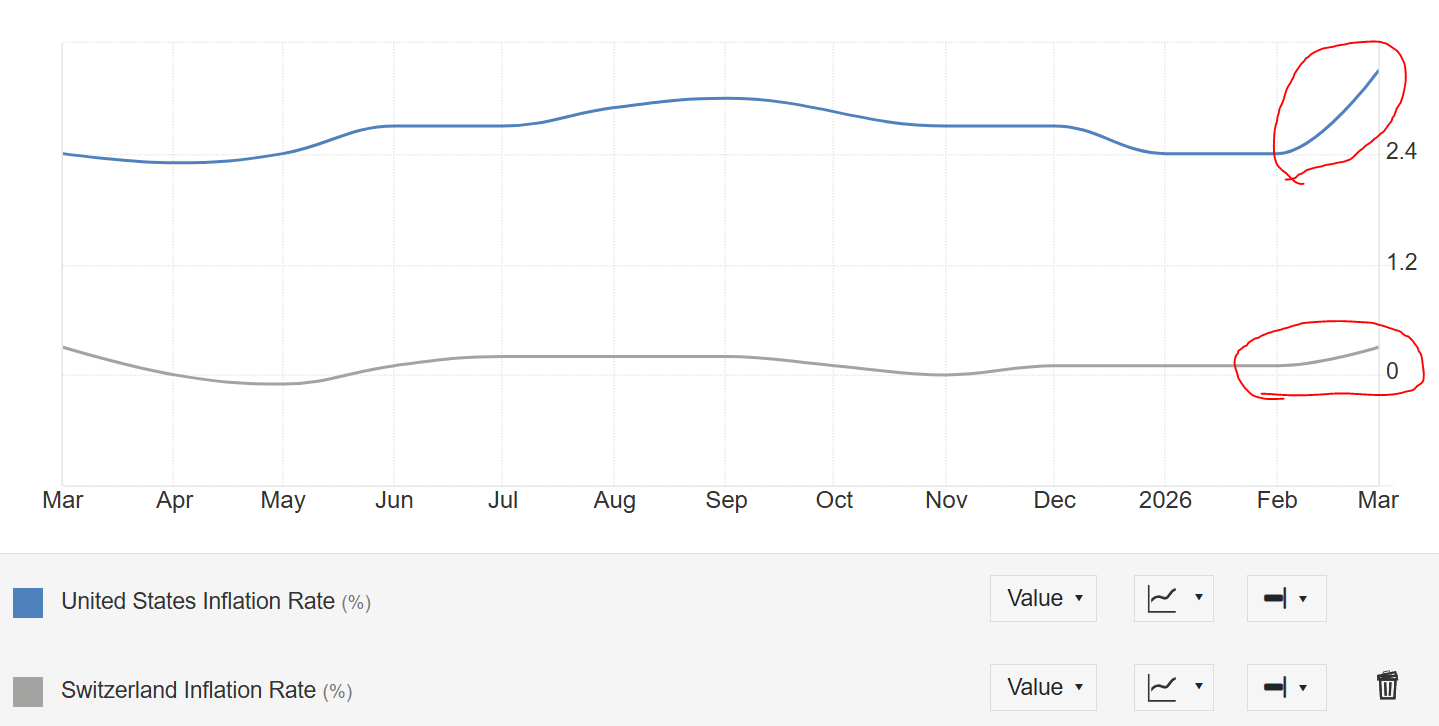
The gap appears structural, not cyclical. Switzerland imports a meaningful share of what it consumes, and a strong franc makes those imports cheaper in real time, reinforcing a feedback loop that will continue so long as the dollar sells off. The currency is doing the disinflationary work the SNB would otherwise have to do itself.
The U.S. has the opposite setup. A weakening dollar makes imports pricier at exactly the moment tariffs are also contributing, and the Fed has limited room to lean against it without choking off a labor market that’s already softening. The franc is currently absorbing the ongoing energy-related inflation shock; the dollar is amplifying it.
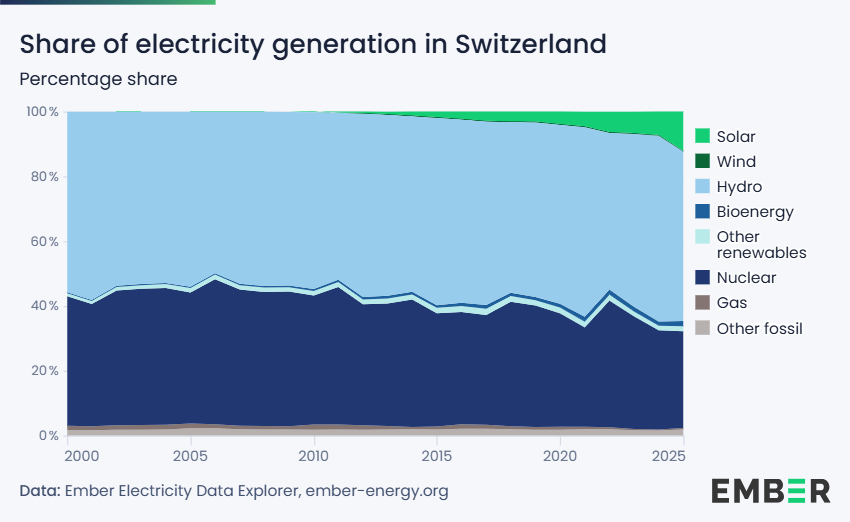
This dynamic is reinforced by the fact that Switzerland imports very little oil for power generation purposes. So, it is less affected than many of its European neighbors by the looming energy crisis born from the closure of the Strait of Hormuz. Swiss electricity is nearly entirely generated through clean means, namely hydroelectric and nuclear power, which means that higher fuel prices don’t affect them nearly as much as the U.S., which has natural gas coming in at 40% of all electricity generated.
The central bank has a problem that will compound this divergence. Let’s start with what the SNB can’t do. The policy rate has been pinned at 0% since the central bank’s last cut, and that March Reuters poll mentioned earlier found all but one of 29 forecasters expect it to stay there through year-end. Negative rates are off the table; Chair Schlegel has been explicit that the bar is high, citing the “undesirable side effects” of the 2014–2022 experiment. The only lever that they have left is direct currency intervention, which the SNB has been hesitant to do much of following the franc sales in 2025 that caused tension with Washington.
So the central bank that should be the natural seller of franc strength is boxed in, having made a deal not to intervene as heavily. Meanwhile, the buyers have started to show back up, causing a bounce off a key technical level last week.
Swiss Francs Technical Outlook
After the selloff from the outbreak of the U.S.-Iran War, the Swiss franc has stabilized, and now looks poised to run again. It is about to test another key level, and a reclaiming of that would confirm the breakout for the bulls.
For reference, I am using the currency pair to chart this trade because it is far more liquid and so it’s easier to use the volume meaningfully. Investors could use the Invesco CurrencyShares Swiss Franc Trust (FXF) if they were looking for an ETF format, and the levels would map over.
Here is the 1-year daily chart:
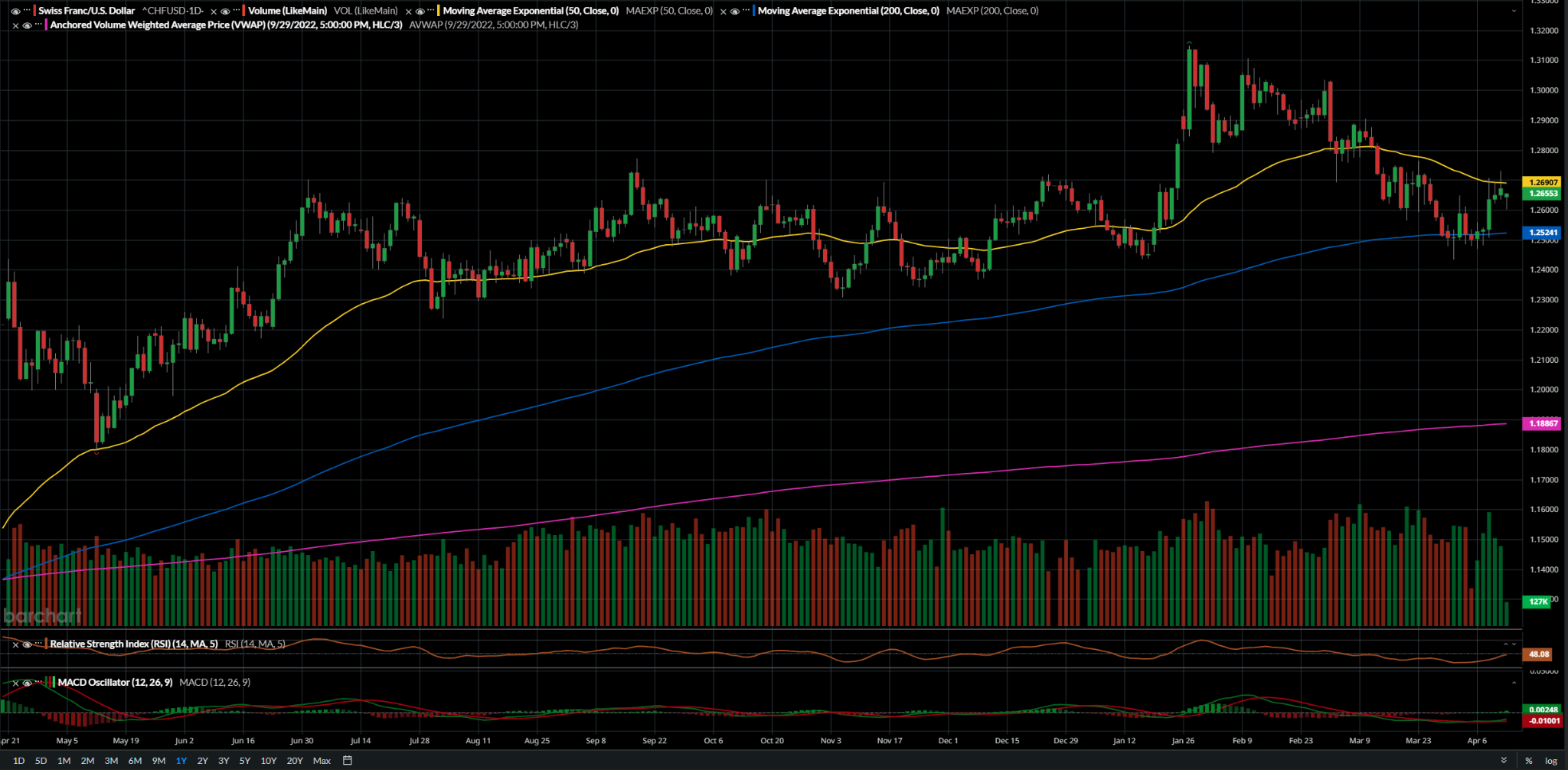
The franc respecting the 200-EMA at the 1.2520 zone was a pivotal moment and one that showed that bulls were willing to defend that level after failing to hold the 50-EMA back at 1.28 on 3/11. That failure was confidence-shaking, but that confidence was restored when the 200-EMA held. Now the 50-EMA is acting as resistance at 1.2690, and the franc is testing it. The first touch above failed, which is common on the first test of an institutional resistance level, and no candle has been able to break out above that line yet.
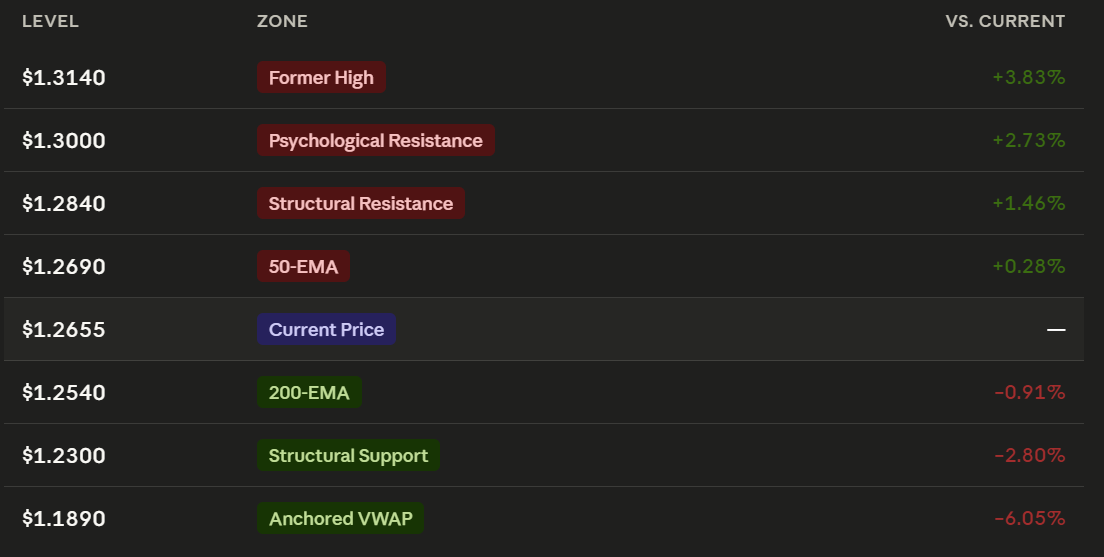
For the bulls, confirmation of breaking above 1.2690 by opening and closing a daily candle above it means we could drive back up to the structural resistance zone at 1.2840 and then the psychological resistance zone at 1.3000. Beyond that, the franc would meet resistance at its old high of 1.3149 before escaping into thin air. That’s far above current levels, so consider the highs of that scenario fairly rosy given the current moment.
Of course, bouncing off the 50-EMA could simply be rejection, which means we could easily be headed lower. We’d be first heading back to the 200-EMA before retesting it. The weak existing momentum would need to reverse. That’s very possible, and a retest at 1.2540 would be a line in the sand for bulls. Failing that puts the bears in full control, with the next support not until ~1.2300 structurally, and then there isn’t a major support from there until 1.1890 at the anchored VWAP.
Here are the major levels to watch:
Conclusion
The franc trade is as much a bet on Switzerland as it is a bet that the United States keeps doing what it has been doing: running hot inflation into a softening labor market, weakening the dollar at exactly the moment tariffs and energy costs are making imports pricier, and leaving the Fed without a clean response.
Switzerland is the mirror: a currency that absorbs inflation rather than amplifying it, a central bank that cannot cut and has agreed not to intervene, and an energy mix that sidesteps the Strait of Hormuz problem entirely. The divergence in the inflation rate uptick made this clear, and the bounce in the franc is heading straight for a test that the bulls could easily win if volume holds.
The technical setup lines up with the macro. The franc held the 200-EMA, and it is now pressing the 50-EMA at 1.2690 for a second test. A daily candle above that level confirms the breakout and opens up 1.2840, then 1.3000, then the old high at 1.3149. A rejection sends the franc back to 1.2540, and that is where the bull case has to be defended. Below it, the next real support is not until 1.2300, and there is nothing meaningful between there and 1.1890 at the anchored VWAP.
Prudent traders will wait for confirmation of the breakout, as rejection is still on the table. But the macro and fundamentals of the situation present favorably, and volume favors the bulls.