



Two exchanges spent this week telling opposite stories about the same metal. London copper cash settled at $14,850 a tonne on 17 August, $535 over three-month, the widest that spread has been since 2021. The next session the front cracked: cash gave back $515, the spread halved to $255, and COMEX copper settled down nearly 2% at $6.49 a pound. Below, I will lay out why those two facts are one fact, and why the London squeeze is a story about geography.
The Squeeze Has a Start Date, and It Is 24 July
I went looking for the day the copper curve turned and found it exactly. On 17 July the LME cash settlement was $13,373.50 against three-month at $13,415. Cash was $41.50 under the forward. That’s contango, the ordinary shape of a market holding enough metal. On 24 July both legs settled at $13,617. Dead level. From there the front end never looked back: $34 backwardated on 31 July, $69 on 3 August, $138 on 10 August, $203 on 13 August, then $411 on 14 August and $535 on 17 August.
There’s a ceiling on this, and it is written into the rulebook. Since 19 October 2021 the LME has prohibited tom-next orders in copper at a price above 0.5% of the previous day’s cash price, and it compels any holder of 80% or more of on-warrant stock to lend at 0.25% of that price. Both rules run through a deferred delivery mechanism, and the LME amended them again in 2026 under Decision Notice 26/049. Half a per cent of the $13,617 cash settlement is $68, so that is the most tom-next may print in a single session. Then I put the dates side by side. The LME’s August prompt date fell on Wednesday 19 August.
The spread reached $203 on Thursday 13 August, $411 on Friday the 14th and $535 on Monday the 17th. Three sessions into a prompt date. That’s what shorts who can’t deliver look like. It isn’t what a shortage looks like. And on 17 August, in Westmetall’s republication of the exchange’s settlements, LME warehouse stock rose to 207,825 tonnes from 204,975. The first build after a long draw. Metal came back on the day the backwardation hit its extreme. A shortage that deepens while inventory rebuilds is not a shortage of copper. The 18 August session said it louder. Another 15,725 tonnes hit the sheds, stock reached 223,550, and cash-to-three-month snapped from $535 to $255 in one day. That is the unwind arriving early.
The Metal Went West
Refined cathode never got its tariff. The Section 232 proclamation of 30 July 2025 put 50% on semi-finished and derivative copper products from 1 August 2025 and left refined cathode out, directing Commerce instead to report by 30 June 2026 on a phased duty of 15% from 1 January 2027 and 30% from 2028. Refined copper is roughly half of all US copper imports. The report came and went. Nothing’s been signed since.
Copper Price Forecast
Every new Copper analysis as it publishes, today's technical signal and key levels, live price — on one page.
See all Copper forecastsAn unsigned tariff has turned out to be more powerful than a signed one. For more than a year it’s paid to ship cathode into the United States ahead of a duty that may never arrive, and the trade did exactly that. A reported 200,000-plus tonnes landed in US ports in July alone. COMEX registered and eligible stocks reached 735,470 short tons by 14 August, against London’s 204,975. One pile, two continents.
Set that against the shortage everyone is trading. The 2026 refined market is forecast to run a deficit near 35,000 tonnes, and COMEX alone holds nineteen times it. ING calls the episode “a geographic redistribution of available metal driven by tariff arbitrage.” I’d put it more plainly. There’s no missing copper. There is copper in the wrong country.
The Curve Says the Front End Is Alone
I went into this expecting the whole curve to be bid. It isn’t. I took the settlements for the eleven sessions from 31 July to 17 August and ran both legs. Cash went $13,834 to $14,850, up 7.34%. Three-month went $13,800 to $14,315, up 3.73%. Cash beat the forward by 3.61 percentage points over the same eleven days. A market that believed in scarcity bids all of it. This one bid two days. Two. Three-month copper at $14,080 converts to $6.39 a pound, below where COMEX itself settled on 18 August. The forward curve has been arguing with the spot panic the whole way up. I’m taking the curve’s side.
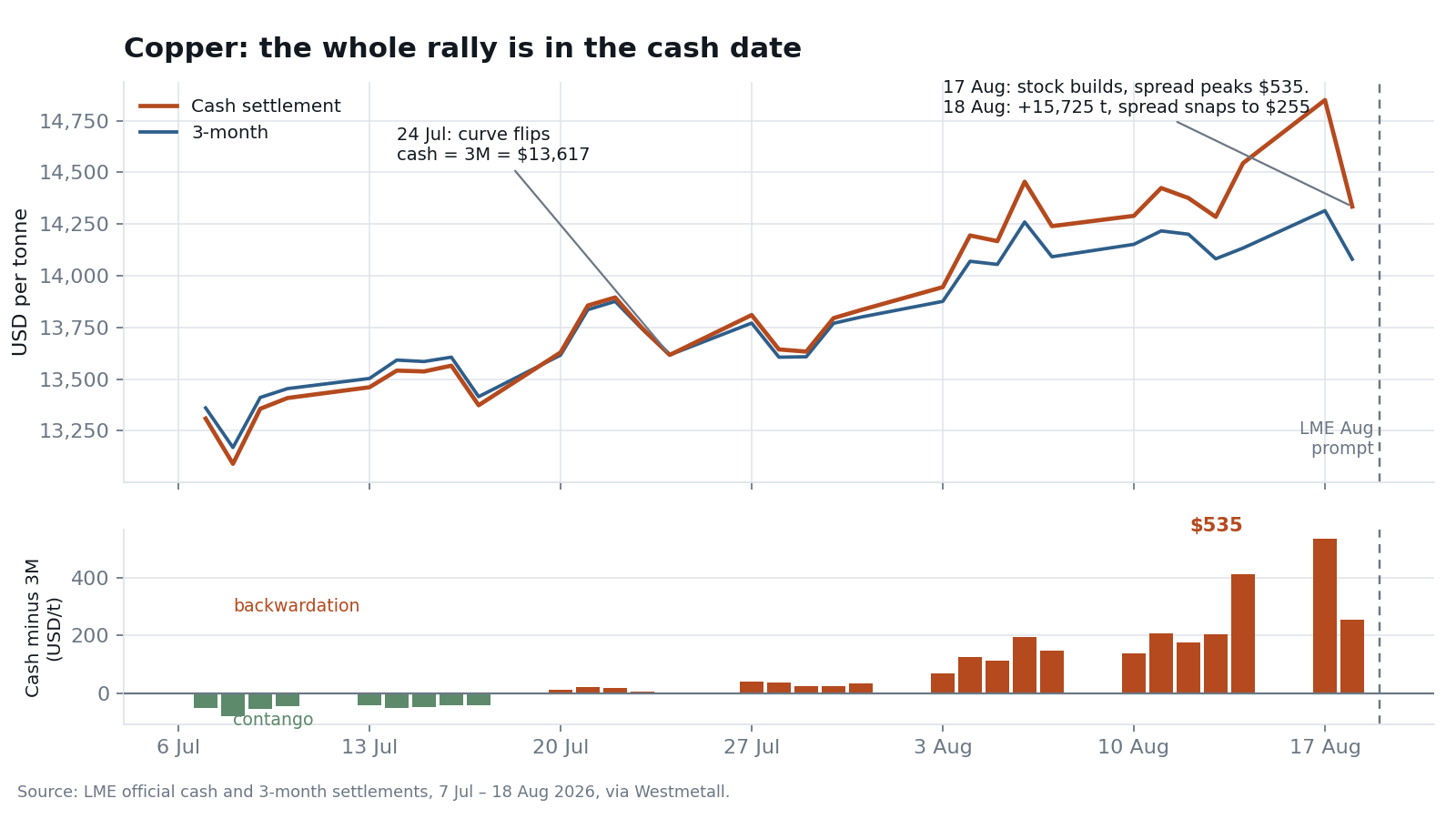
LME copper cash-to-three-month backwardation peaked at $535 before narrowing to $255. Source: LME official settlements via Westmetall.
The Tariff Premium Has Already Left
I take COMEX minus LME three-month and watch what is left. It’s collapsed. At the peak of tariff positioning it was reported near $600 a tonne, and in early August at 19.2 cents a pound, some 8.4 times its 2005–2025 average. I worked out where it sits now, on the 18 August settlements of both legs. COMEX at $6.49 against LME three-month at $6.39 is 10.6 cents, about $234 a tonne, against a 28-year mean of $33. Then I ran it against the duty on the table.
Fifteen per cent of $14,080 metal is $2,112 a tonne, so a $234 premium is paying for roughly an 11% chance of the tariff landing. I checked that against ING, who pull 14.6% out of the forward structure for the 15% arriving in January 2027. I’m not going to pretend those are the same number. Mine uses the three-month and theirs a delivered basis, so the gap is method, not disagreement. Both land in the same place. Two-thirds of a million tonnes crossed an ocean on that premise. At $234 against a $2,112 duty value, the market has stopped paying for it.
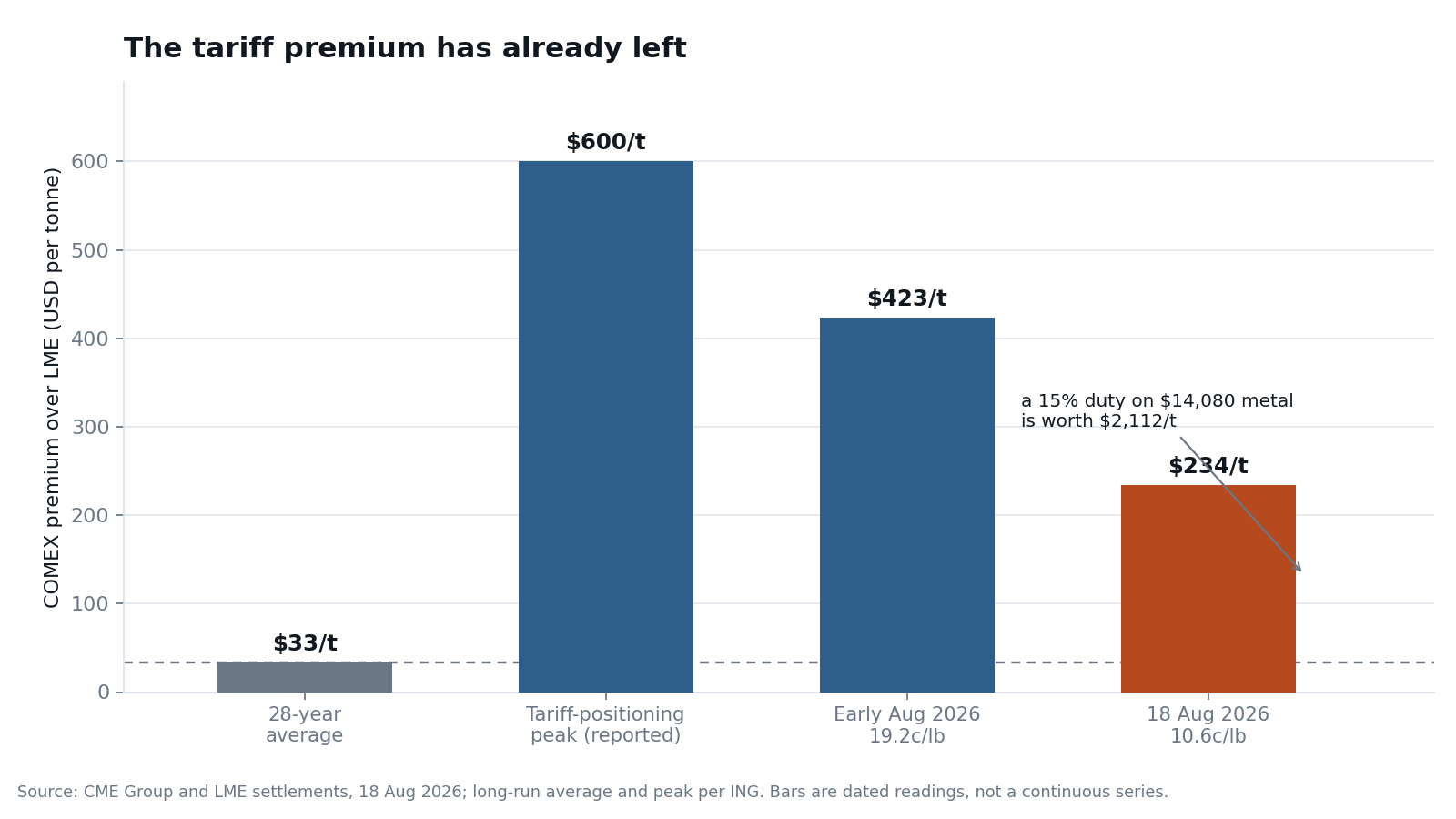
The COMEX premium over LME copper fell to $234 per tonne on August 18 from a reported $600 tariff-positioning peak. Source: CME Group, LME and ING.
Everyone Is Already Long
The last thing to test is whether any of this is still available to be paid for. The CFTC’s own report answers it, and the size of the answer surprised me. On 11 August non-commercial accounts held 114,462 COMEX copper contracts long against 34,074 short. Net 80,388 contracts. At 25,000 pounds each I make that 911,585 tonnes. That is more copper than the LME and COMEX hold between them. The other side matters as much.
Commercials, meaning the miners, smelters and merchants who own the physical, were net short 91,246 contracts, better than a million tonnes, and they added 13,001 shorts that week while speculative shorts fell by 3,107. The people holding the metal are selling the rally to the people holding the paper. There is a dated precedent and it is recent. Net length last stretched to a 20-week high of 73,523 contracts in the week ended 12 May 2026. Copper printed its record within days, then spent a month going the other way. The 11 August reading sits 9.3% above that peak.
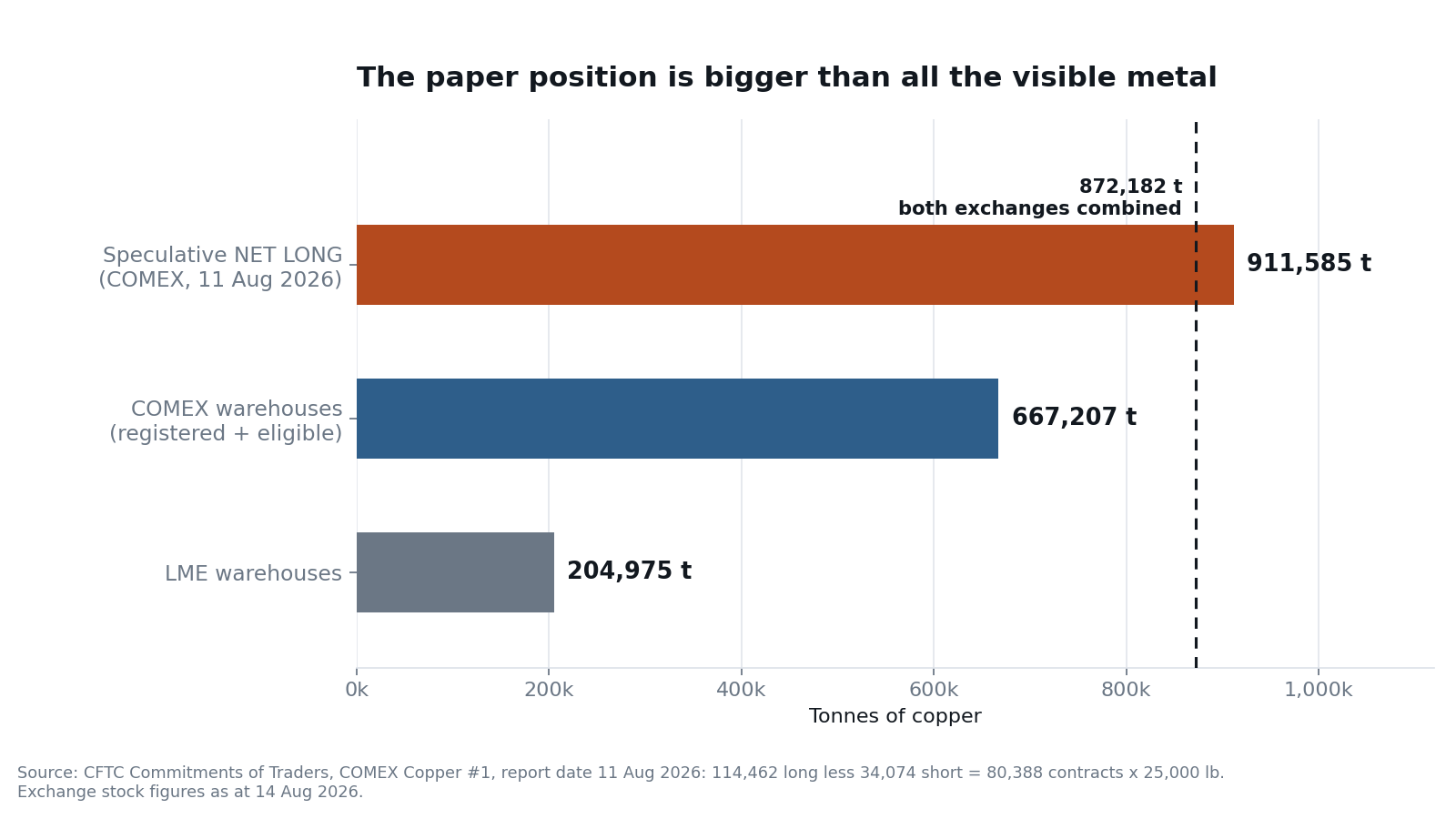
COMEX speculative net longs exceeded visible copper stocks across COMEX and LME. Source: CFTC, CME Group and LME.
One caveat I owe the bulls here. This is a Tuesday snapshot, and it covers COMEX alone. It tells me nothing about how London or Shanghai are positioned.
COMEX Copper Targets $6.30 as the Squeeze Unwinds
In my view the wrong instrument to own into a London warrant squeeze is COMEX copper, and on 18 August the tape stopped disagreeing. My base case is lower. I take $6.30 a pound as the first target into the 16 September LME expiry, because that is the shelf cash was standing on at $13,945 on 3 August before the final leg carried it away. Second comes $6.18, into Q4 and only on a formally extended refined-cathode exemption, because $13,617 on 24 July is the session this curve inverted and I don’t expect it to settle above the level it broke from. Normalisation starts at the front end.
What I’m watching for is cash-to-three-month back inside $150, and the exchange’s own backwardation cap should do most of that work. Fair entry for the bear case I put at $6.70 to $6.80, 3 to 5% above the $6.49 settlement, because that is where August congestion sat and I would rather sell strength than chase weakness. I should be straight about where I sit relative to the desks. Those desks turned bearish months ago and stayed there. Goldman Sachs Research carries fair value near $11,500 a tonne with Q4 at $11,200, and Morgan Stanley carries $10,650. Copper printed records through the summer anyway. My targets sit nowhere near theirs, and that’s deliberate. What I’m calling is a distorted front end normalising, and I’m not calling a deficit model that’s been run over since June.
Now the uncomfortable part. I’m wrong if Washington signs. A signed proclamation restarts the American bid the same session, and it makes the 667,200 tonnes already inside the wall worth more instead of less. London wouldn’t see any of it back. The bulls hold a genuinely good card in the warrants too. Roughly 58% of LME stock is reported cancelled, and on that number freely available London metal is closer to 87,000 tonnes. Two days of world consumption. Their supply list I take seriously as well.
A boiler failure closed PT Smelting’s 342,000-tonne Gresik plant on 8 August. Freeport’s Manyar line doesn’t come back before September. The DRC banned concentrate exports. July storms left Chilean output near 5.5 million tonnes. Here is my answer. Every item on that list is a mine or a smelter, and mines and smelters move refined supply on a horizon of quarters. The 667,200 tonnes in American sheds is cathode. It moves in a shipping cycle. Invalidation is any one of three. Washington signs the refined-copper proclamation, COMEX closes above $6.90, or the COMEX-LME premium re-expanding through 20 cents a pound. Any of the three and the mechanism I have described is not the one operating.
A cheaper test than any of those arrives first. That date settles it: the 19 August prompt. I wanted cash-to-three-month back inside $300 once that date passed, and the market answered a session early: $255 on 18 August. The test that remains is the re-widening. Back through $300 after the prompt and this was never an expiry, and the people calling it a shortage read it right. I’d rather find that out in a week than in October.
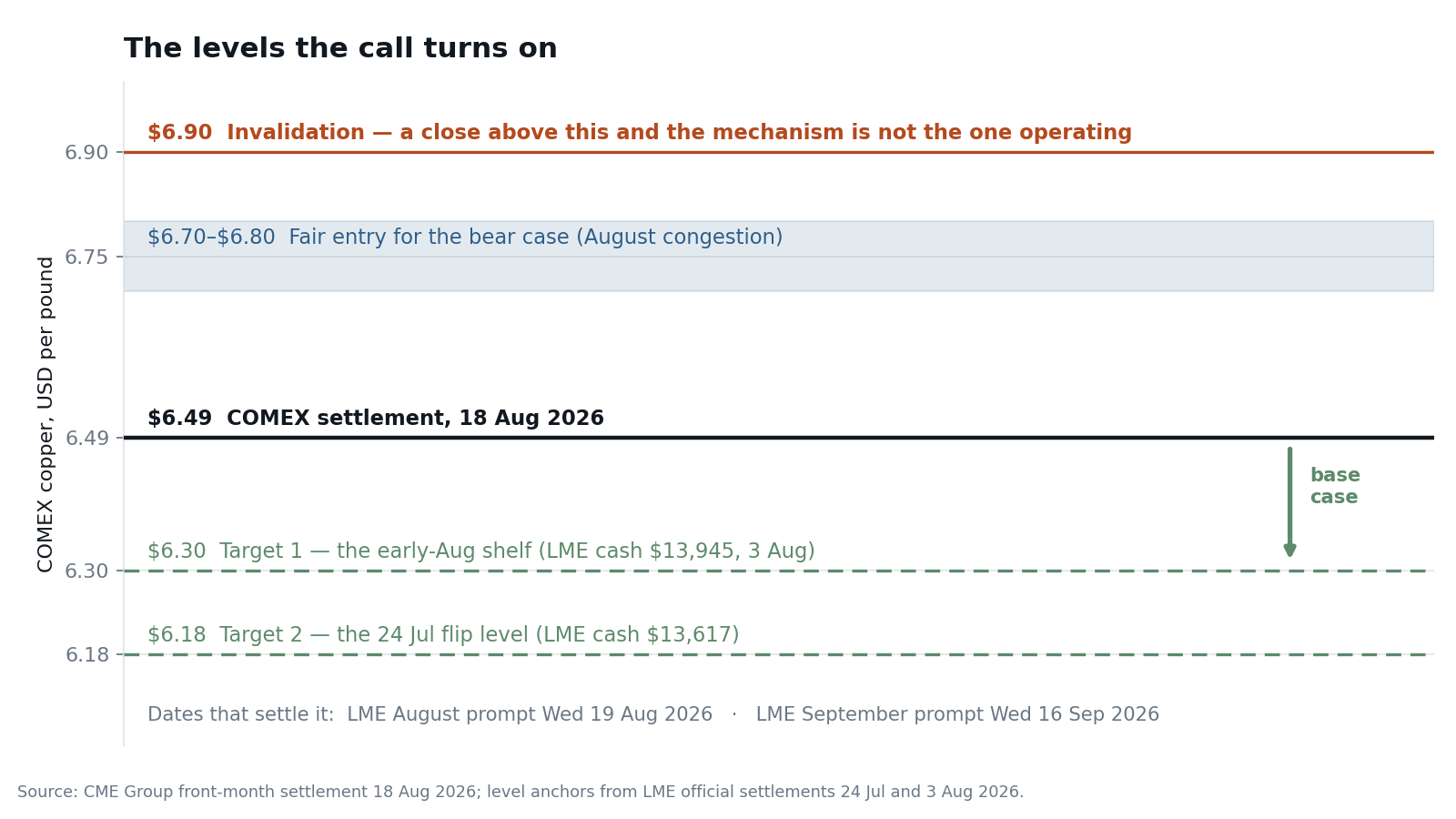
COMEX copper bearish setup targets $6.30 and $6.18, with $6.90 as the invalidation level. Source: CME Group and LME.
The Spread Is the Thing to Watch
I called $6.70 on this market on 30 July, on the tariff premium. It got there. What I didn’t expect was that the premium would be two-thirds gone by the time the price arrived, and that’s why I’ve turned. The spread is the thing to watch. The larger question runs past this trade. Twelve to eighteen months out, the thing worth studying is where policy lets metal rest.
A duty that’s been pending for over a year has already relocated two-thirds of a million tonnes and inverted the world’s oldest metals curve, and nobody has signed it. LME aluminium stock fell to 246,925 tonnes on 18 August, the lowest since the series began in January 1998, and inside a month its curve ran from a $12 cash discount to a $91.50 cash premium and back to a $15 discount. Whether the same cause sits behind that one, I haven’t worked out yet.
The Section 232 docket is the calendar item. I’ll be watching the spread.