


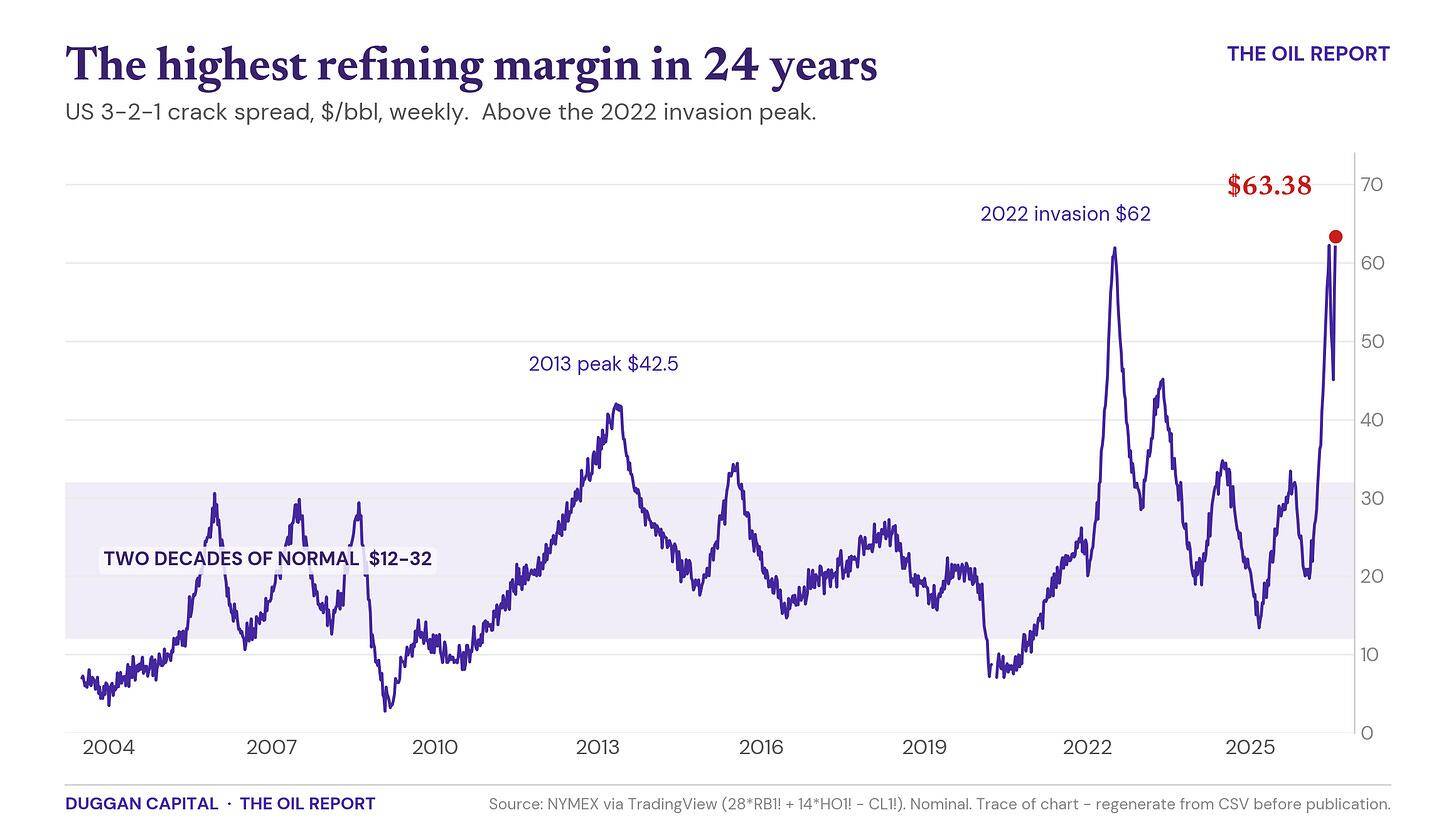
A second round of hot war has duly become a tailwind for upside on oil prices since last week. What has perhaps been hiding in plain sight is the rally in refiners margins. Pre-war, the refiners profit range was $20 to $27. It is now trading at $63. The last time refining margins looked like this, Russia had just invaded Ukraine and Europe was scrambling for diesel. That was the record. We have never been at refiners margins this high.
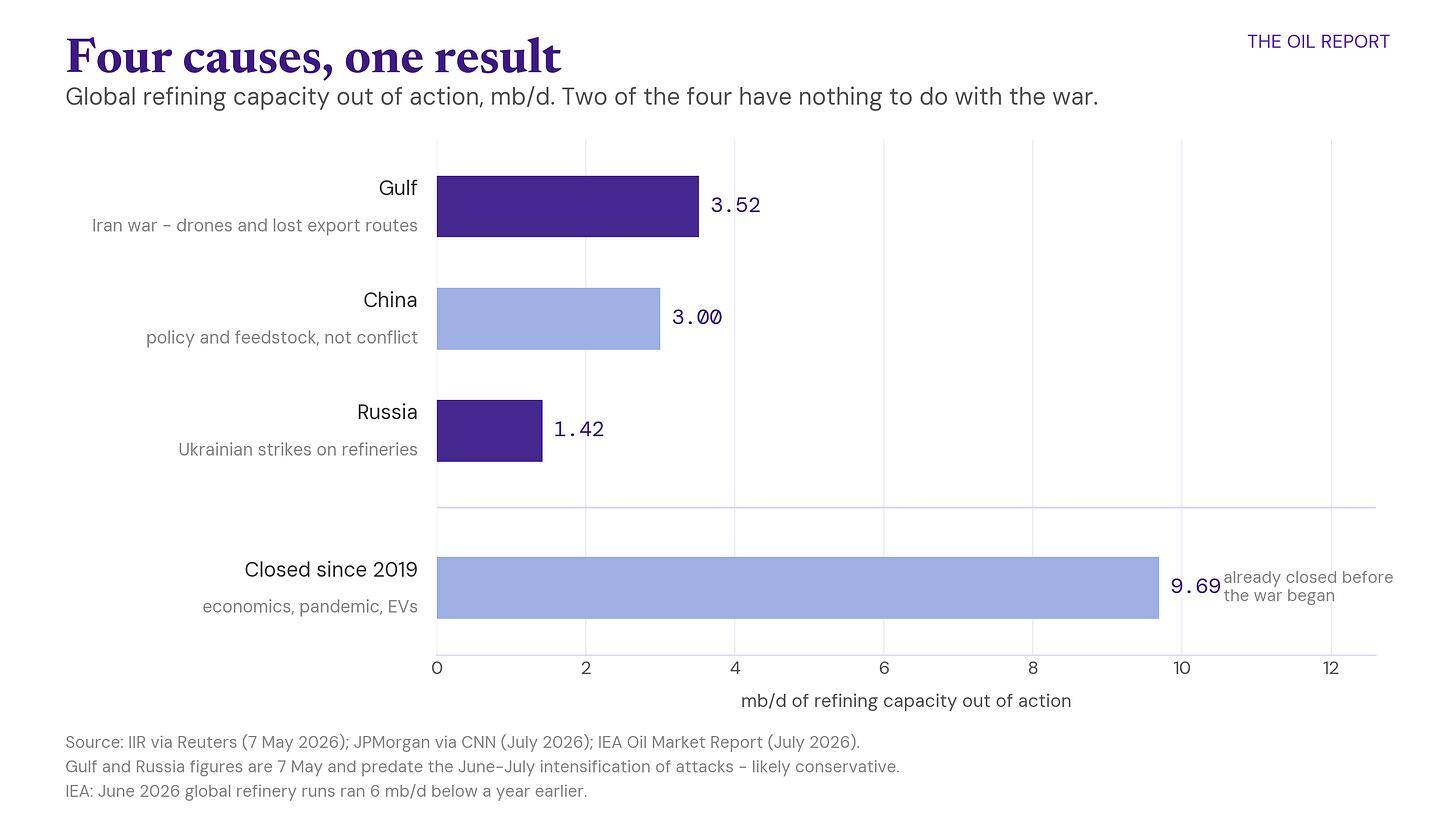
Nine percent of global capacity is out across the Gulf, Russia and China, on top of the 9.7 Mb/d the industry had already closed since 2019. The refining margin has tripled. That gap is what the consumer pays.
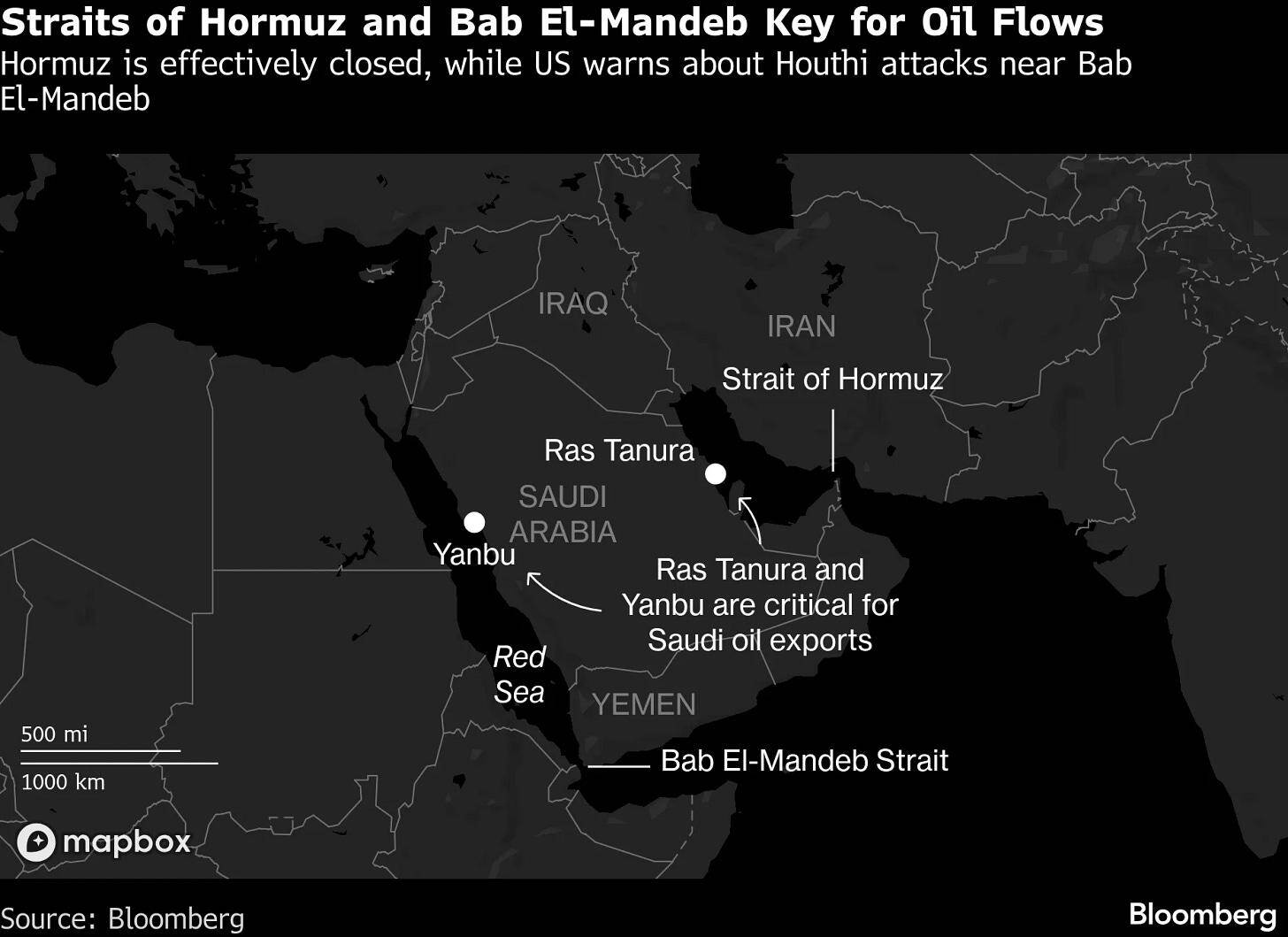
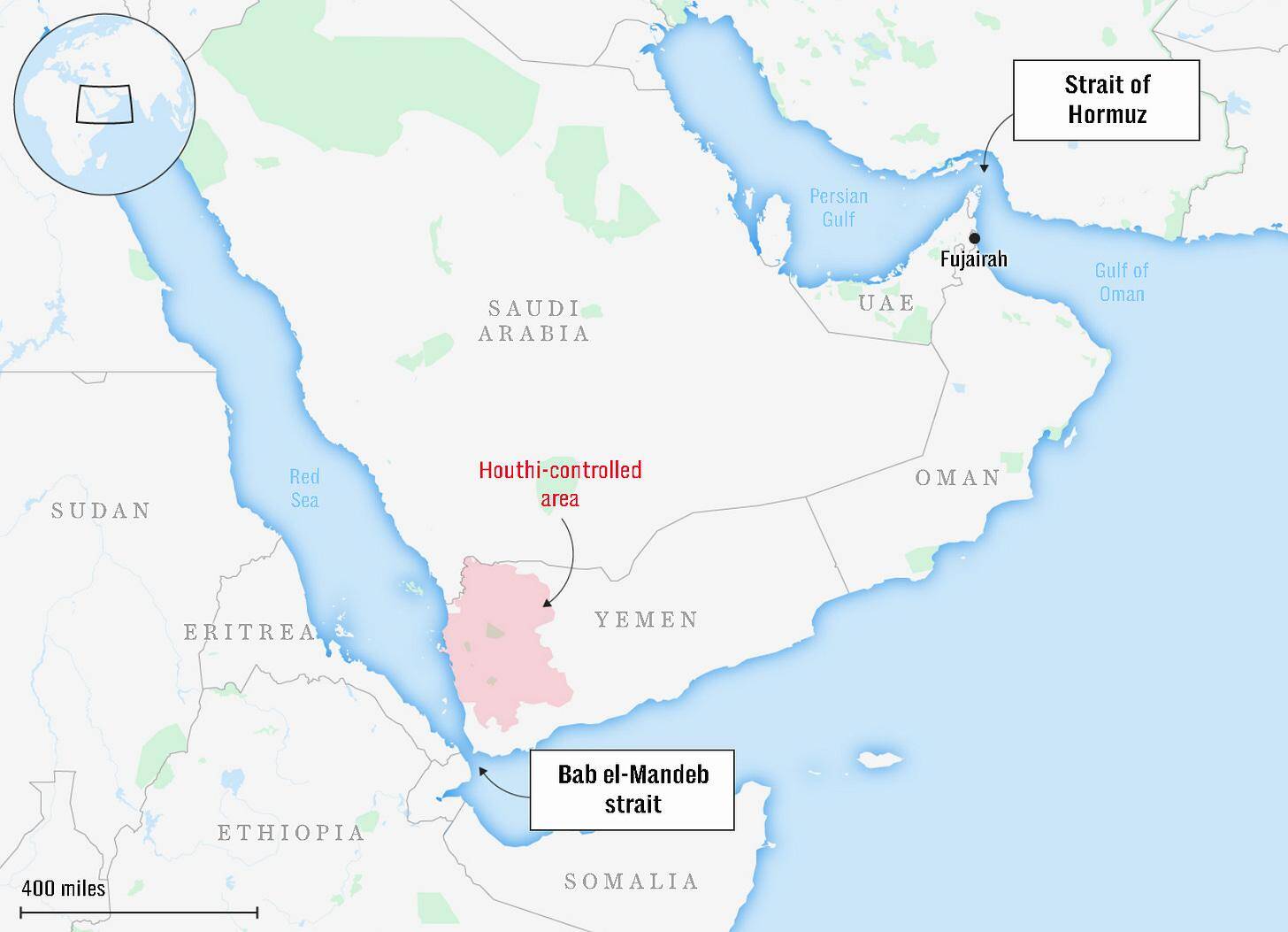
Adding fuel to the fire, The Houthis just announced they are enforcing a naval blockade on Saudi Arabia. They are an Iranian backed political and military group from Yemen. They are the small and nimble nightmare that The US navy will now have to deal with on one major front, The Bab el-Mandeb Strait (BEM). Roughly 7% (7mb/d) of global oil output transited BEM in June.
The war now has two naval fronts, where The US navy will have to maintain safe passage across The entire Arabian Peninsula, an approximately 3000 km-5000km stretch. 8
Refining Is the Headline
The refining margin has never been higher in 24 years of data.
‘‘The reduction in crude throughput has cut fuel production by about 10%,” – Natasha Kaneva, head of global commodities research at JPMorgan. “The question now is not when crude supply will resume, but how quickly the global refining system can process crude oil.” According to JPMorgan’s tally, global refining throughput has fallen by 8.4 million barrels per day compared to pre-Iran war levels.
Industrial Info Resources, whose plant-level database is the source of record for refinery outages globally, has Kuwait’s Mina Abdullah still under shutdown – 454 kb/d, dark since March. Mina Al-Ahmadi at 346 kb/d and Al-Zour at 615 kb/d are both running at reduced capacity. In Bahrain, drone attacks caused severe damage to the diesel hydrotreater at Sitra Refinery and restart is not expected until November. Qatar shut Ras Laffan as a precaution in Q2, and it is still at reduced throughput.
Iran has attacked 30 refining facilities across the Middle East during the war, according to JPMorgan, covering a region that holds 11.7 mb/d of crude refining capacity. Normalisation, JPMorgan notes, will be difficult without restoration of crude supply chains.
Russia is the variable the market is not watching. Ukraine has struck 19 Russian refining facilities over the past two months, with a combined processing capacity of 4.9 mb/d. Russia’s diesel production has fallen by roughly a third. Russia was the world’s second-largest diesel exporter before any of this happened, moving 800 kb/d a day, about 12% of global diesel exports, according to Lipow Oil Associates. That is now under an export ban.
JPMorgan puts Russia at one fifth of the world’s total lost refining throughput. You will see 70%-80% of capacity struck cited as a figure. That measures sites hit, not sites down. The number that does not get quoted is China. JPMorgan has 3 mb/d switched off there and not a single drone was involved. Beijing ramped coal, pushed EVs, drew down reserves and cut the gasoline and diesel it had been exporting to Southeast Asia.
“While it is understandable that the market’s attention is focused on Hormuz,” JPMorgan’s Natasha Kaneva said, “one of the most important variables determining global refining supply and demand may now lie nearly 2,000 miles to the north.” The industry came into this year having already closed 9.69 mb/d since 2019. The last significant refinery built in the United States was Garyville, Louisiana, in 1977. There was nothing in reserve.
Brent Oil Price Forecast
Every new Brent Oil analysis as it publishes, today's technical signal and key levels, live price — on one page.
See all Brent Oil forecastsChina: The Signal the Market Overlooks
Read below for where China are in their return to the markets and prices at the pumps in EU and US.
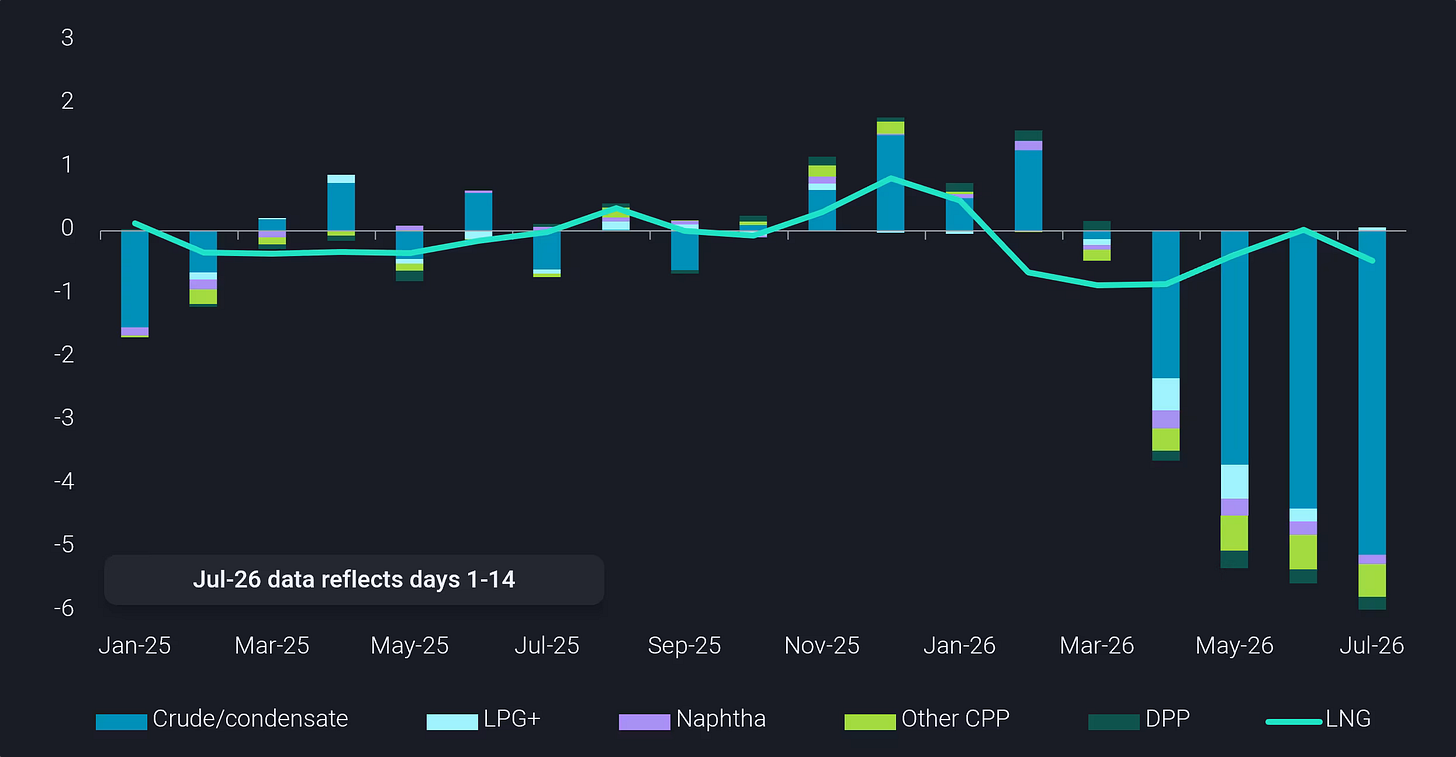
Here is the signal nobody is talking about. China lifted its fuel export ban in early July after more than three months of severely constrained motor fuel exports. It sounds like relief. It is not straightforward.
Beijing attached one condition: refiners must maintain product inventories at or above end-February levels before shipping anything out. They cannot draw stocks to fill export cargoes. They have to make the product first. To make the product, they have to run refineries harder. To run refineries harder, they have to buy crude they have spent four months avoiding.
Vortexa has Chinese seaborne crude arrivals at just over 6 mb/d in June, the lowest since at least 2016, against a 2025 average of roughly 10.4 mb/d. That buying has to start now if refiners want to export in August. It is not in the price. China coming back into the crude market at four ships a day through Hormuz is not a bearish story. It is the demand signal and the supply constraint arriving at the same moment.
JPMorgan’s Natasha Kaneva put the Russia point cleanly. She is right about Russia. She is also about to be right about China.
The Situation at the Pump
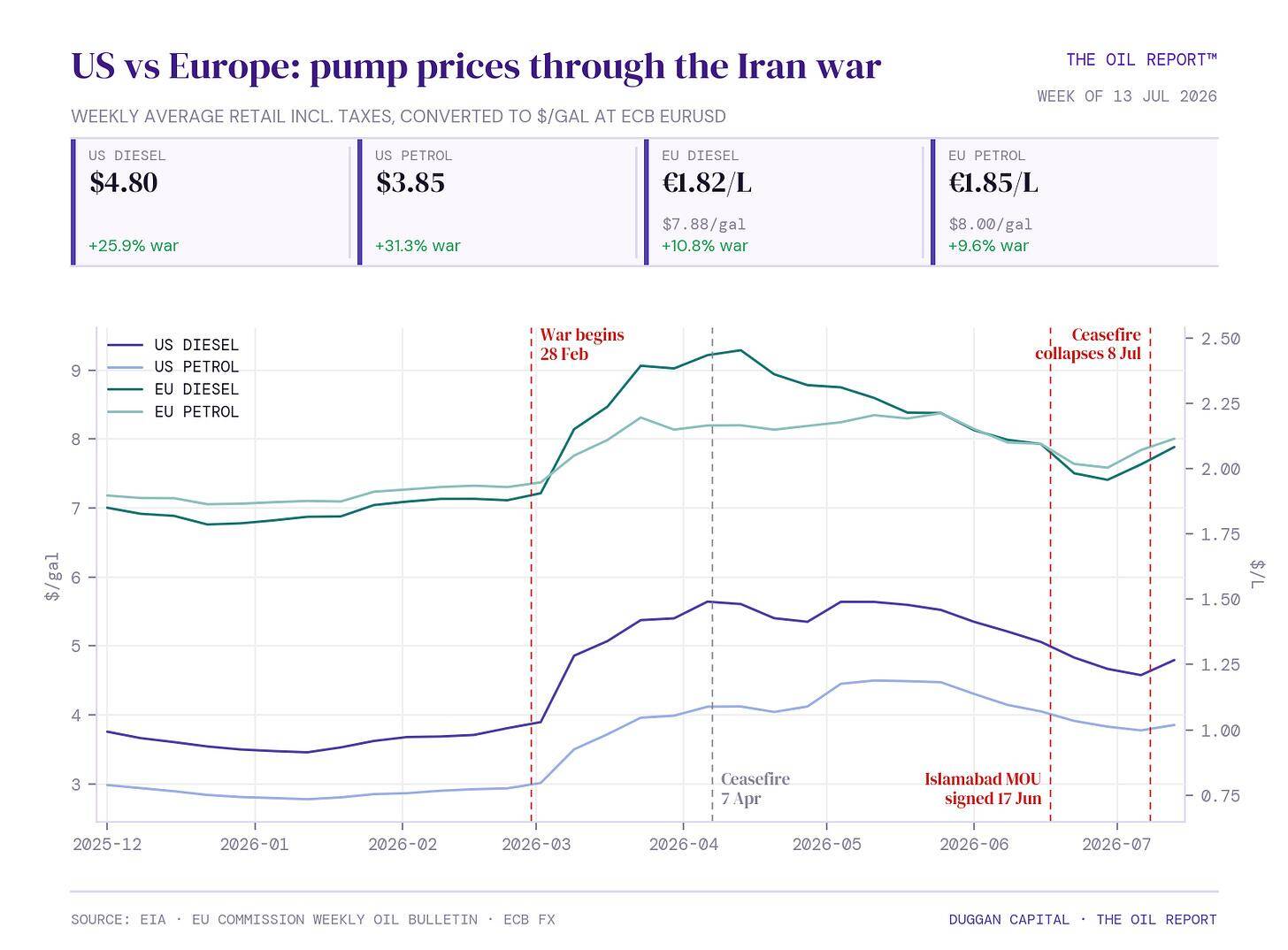
Prices at the pump have normalised somewhat since the Islamabad MOU, however due to refinery and delivery lags, the easing has been slight. These prices are now inflecting back up. Coupled with only 4 weeks left of EIA’s strategic release, the real truth of war is now to be seen in all its glory on the refinery margin chart as above.
It is my view the crack spread ie. refiners margin may inflect much higher, but the real tailwind for higher product prices will be when the strategic reserves release ends in August. It is already tapering off.
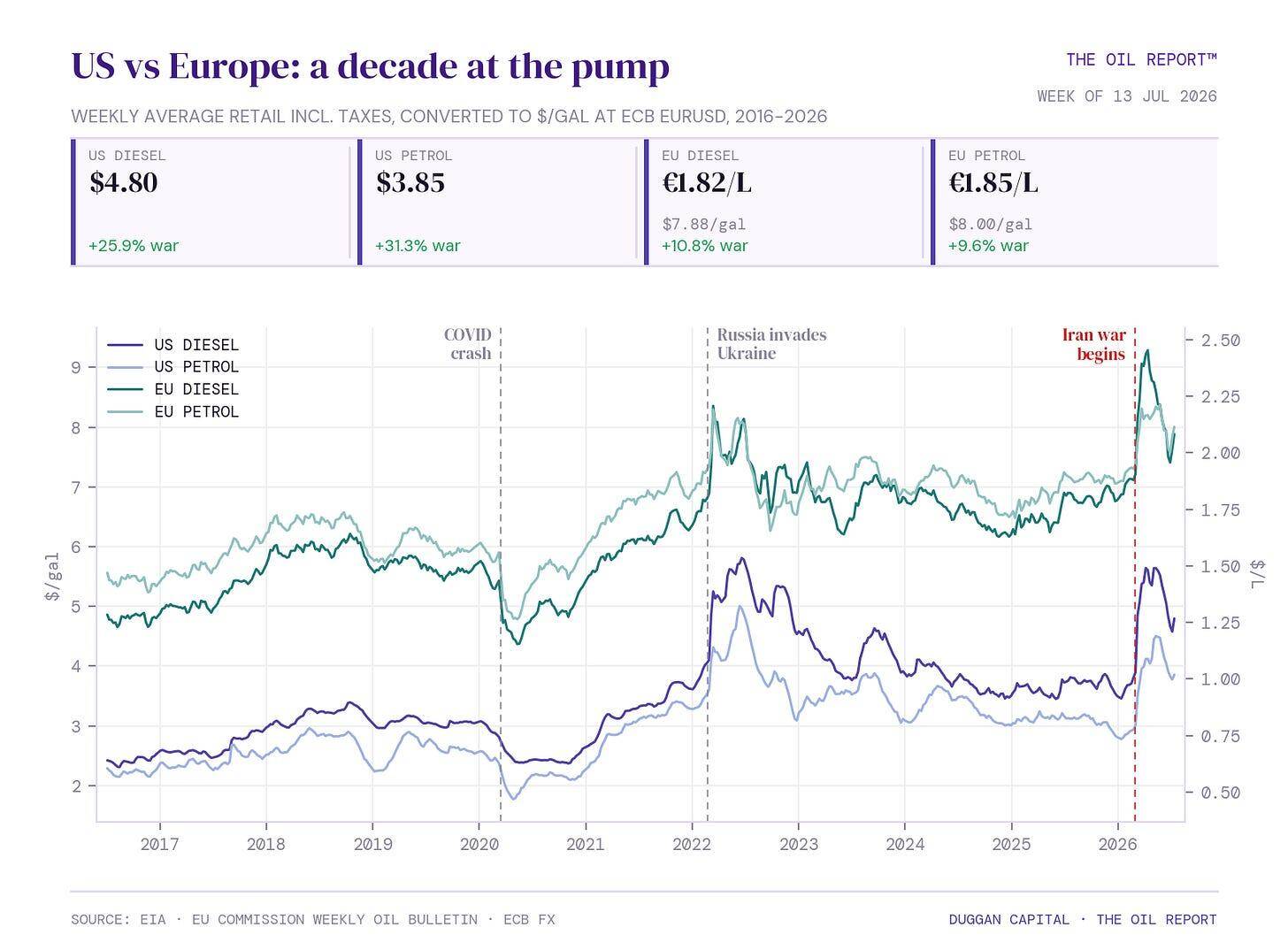
We currently sit around the Russia/Ukraine levels on price. It is my view that this situation is 10x worse than that. I’m not alone, as Mr. Brio from IEA has said this is the worst crisis in oil history. And unfortunately, The Houthis just doubled the risk.
The Net Net
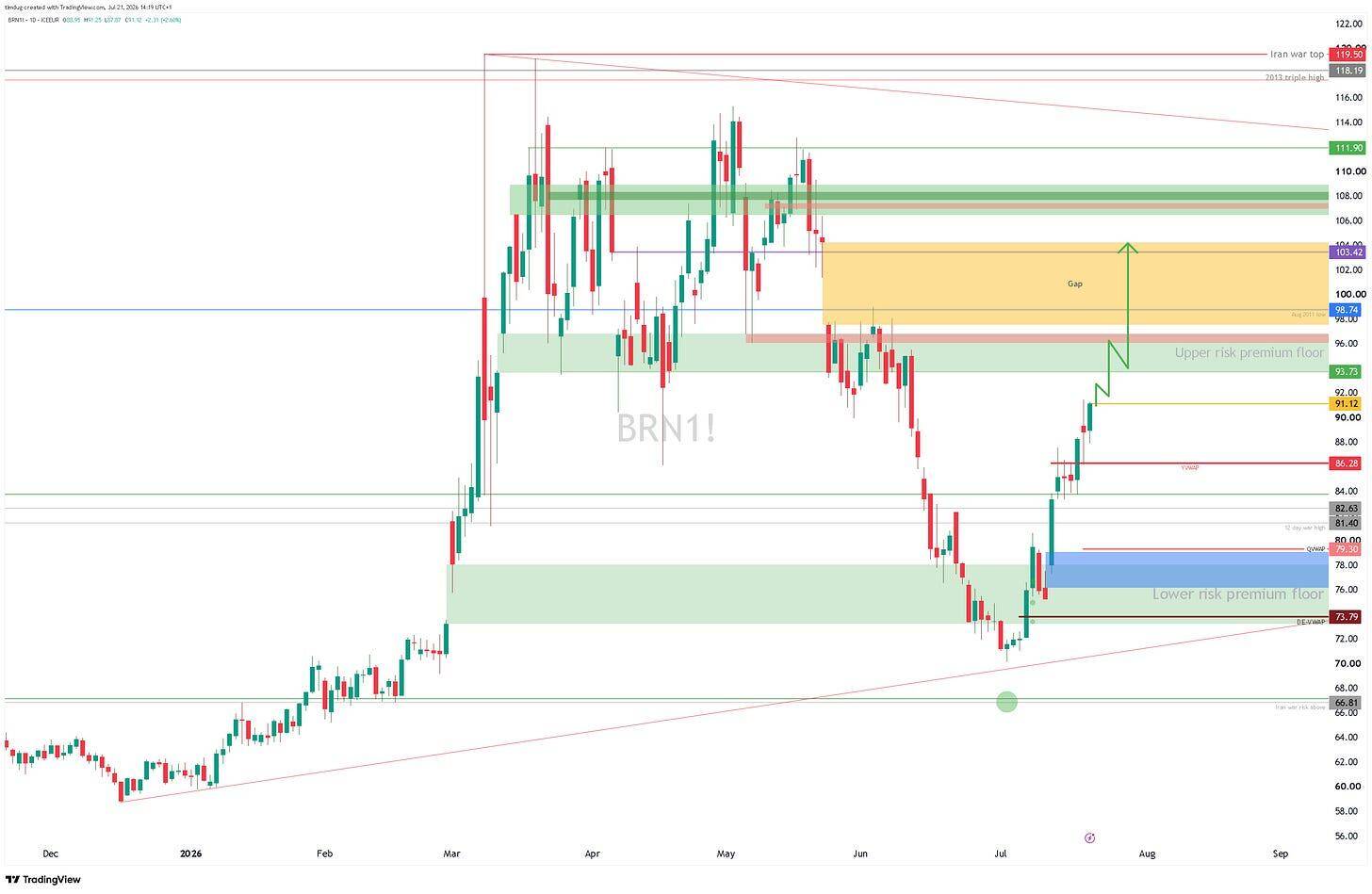
I was late with this week’s report as I didn’t want to fill airspace where it seemed full. The situation has done a 180 since the MOU, and coverage of the escalation is widespread. The upside to prices is clear and obvious to those that are participating, and my trade call over the last 2 weeks has been clean.
We need to now understand that this re-escalation is pricing in with more to come. The Houthis just went to work on Saudi blockades. Then, if we see China actually starting to increase loadings, we know they are buying again and this will be a pinch to the bears. If China comes back to market while the IEA strategic reserves are reaching an end, we will have perfect upside conditions. The trouble with this will be that China do not want expensive barrels above $100 Brent.
‘We still have the 80% in the pocket if and when needed, our member countries I am sure will be happy to release those stocks’’
– Fatih Birol, IEA Chief
As Jeff Currie has said, “be long the beta”, referencing the individual stocks and funds: XLE, USO, XOP etc. The futures space is not for the faint-hearted risk models! I’m staying long.
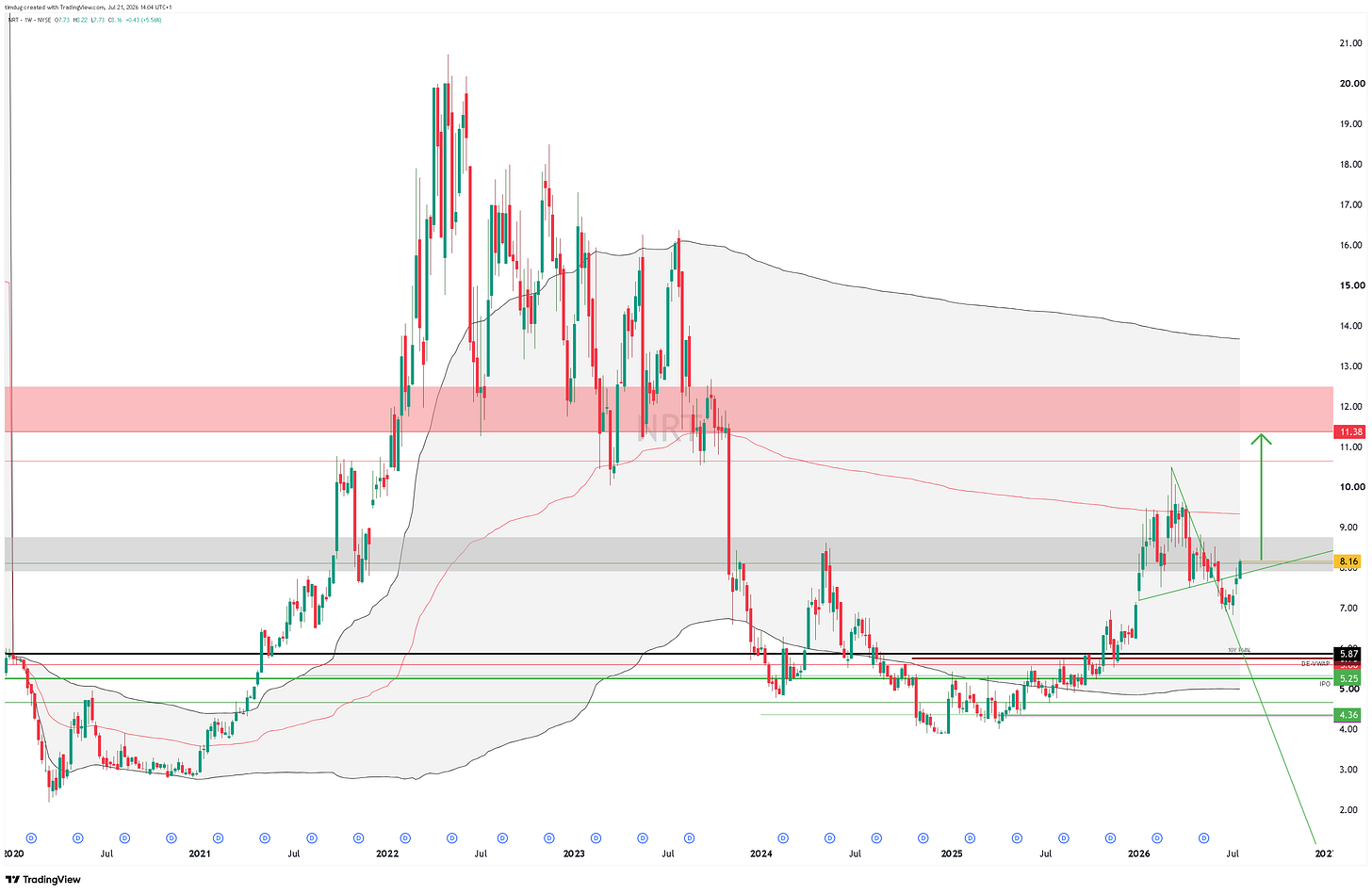
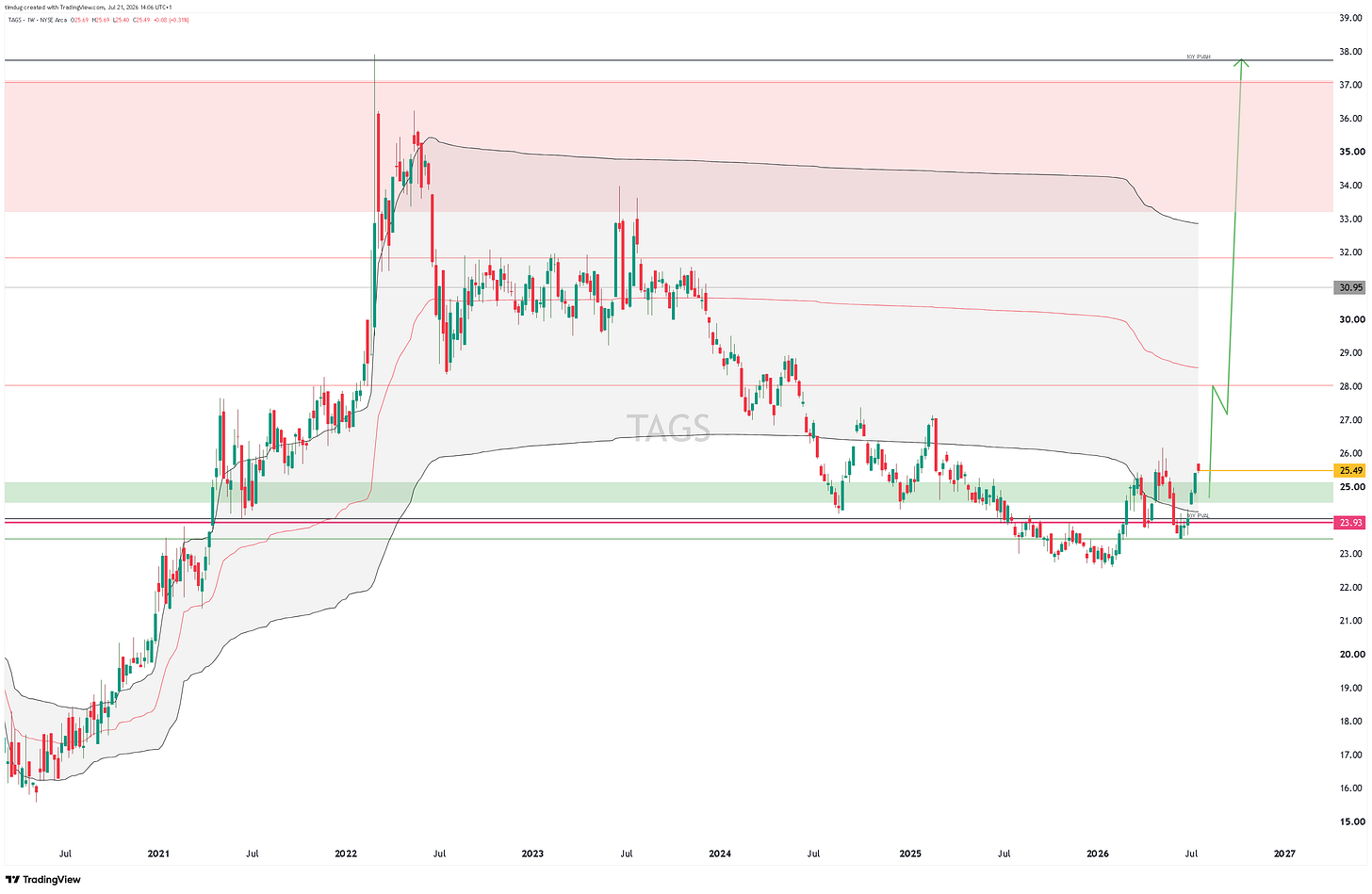
NRT 0.00%↑ continues to be the largest position in my book. And TAGS -0.47%↓ is my macro play.
Commitment Of Traders Report
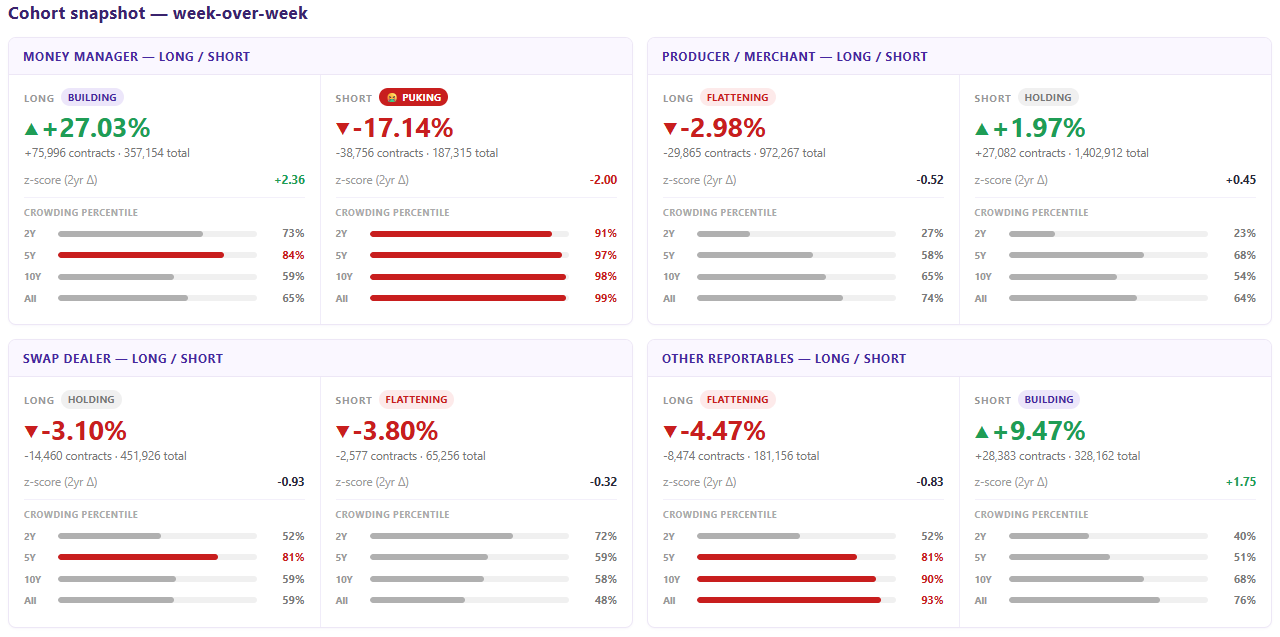
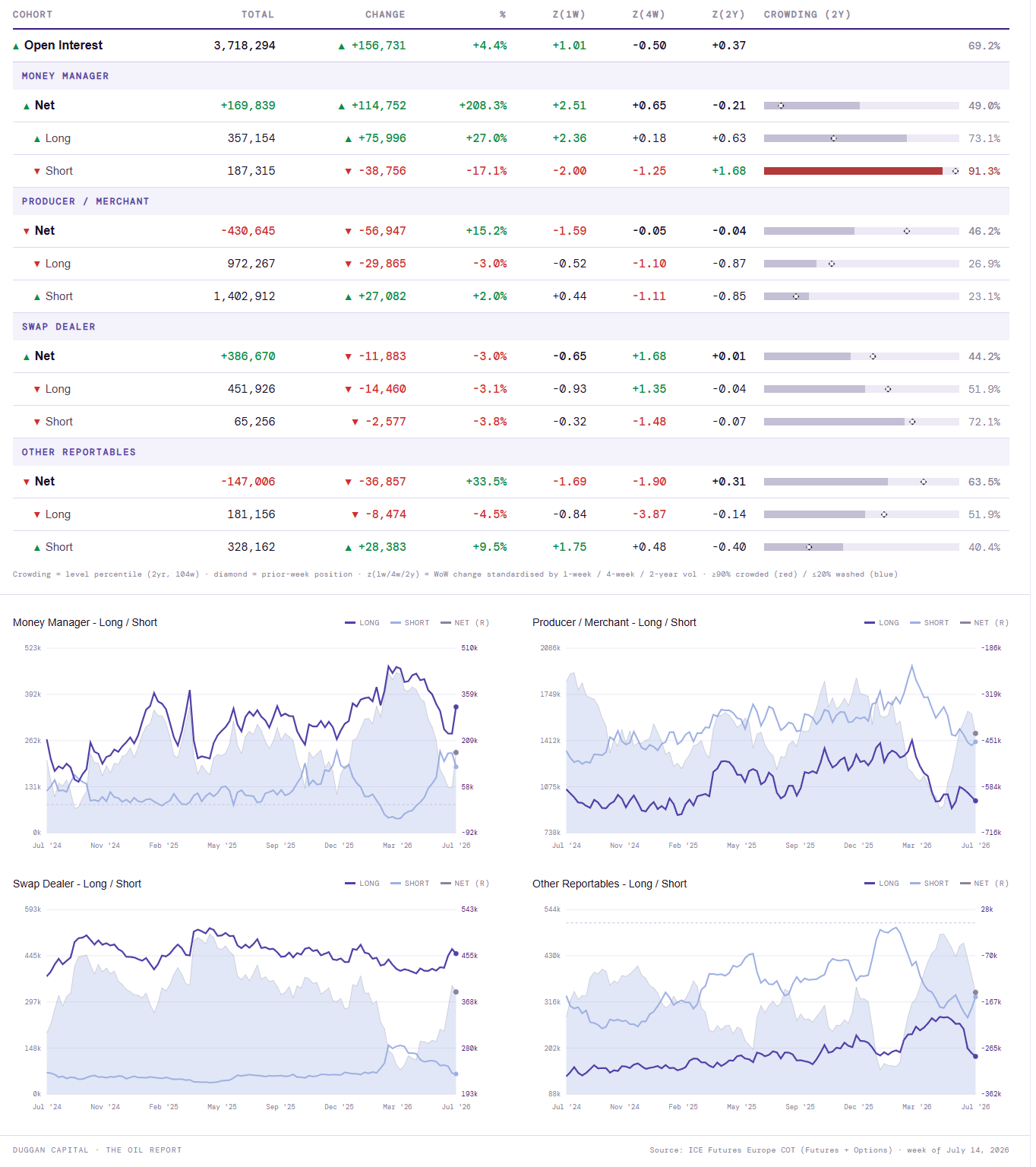
MM Puked 17.14% of their shorts as of last Tuesday. Joining the Swap dealers who also puked 24% of their shorts in the prior week. I love a good position puke session! OR Seem to be spending good money after bad and are increasing their shorts in the last week 9.47%. I see these folks about to get completely run over.
Keep in mind that we are up 17% on Brent in the last week and 4.5% 2 weeks ago. It’s got to hurt! Unfortunately, with OR Shorts only at 40% crowded, they will most probably martingale into this upside move more. This move higher will continue, regardless of any renewed MOU headlines.
What’s the Next Move?
Further upside will happen. The IEA SPR window closes in 4 weeks and draws area already reducing. Lets see what this situation looks like without 1 Maxi SPR draws and 2. With China buying. Thats the real upside catalyst.
What would break this? If China do not turn up or if Red Sea exports do not get affected by The Houthis actions.
That’s the report!