


By any rationale, an effective three-month closure of the Strait of Hormuz should have already triggered widespread panic across global markets. After all, roughly 20 million barrels of crude oil typically moves through the narrow waterway every day, representing around 20% of global oil supply. Yet energy markets have remained remarkably calm. Despite the scale of the disruption, oil prices have risen only modestly and broader financial markets continue to behave as though the crisis is negligible. The apparent resilience of the system, however, may be creating a dangerous illusion.
Why Markets Have Stayed Calm
The reason markets have avoided outright panic is not because the loss of Hormuz exports is insignificant. Rather, it is because the global energy system has thrown virtually every available buffer into absorbing the shock. Several emergency mechanisms have combined to soften the impact:
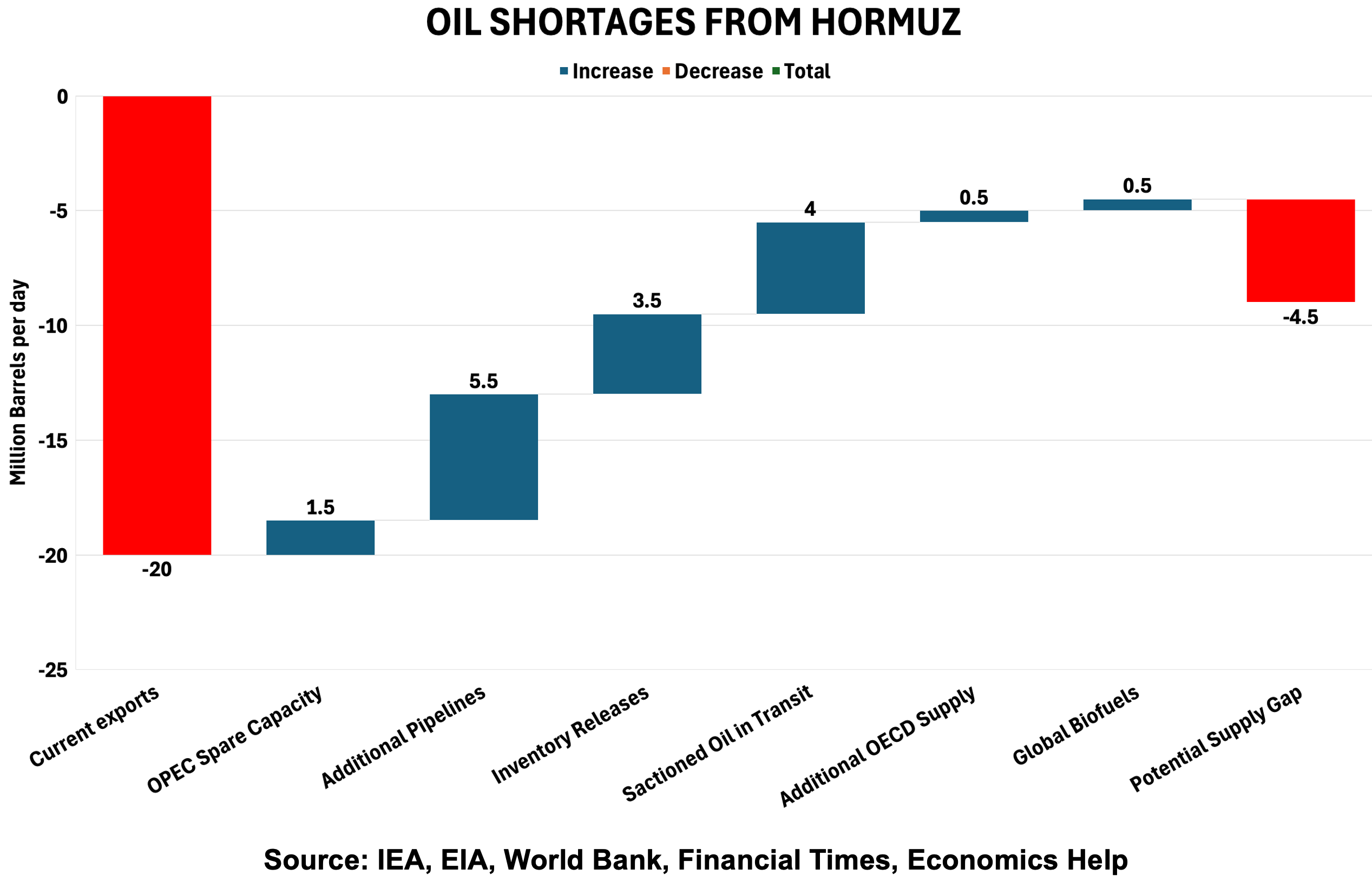
- Spare OPEC production capacity has contributed around 1.5 million barrels per day.
- Pipeline rerouting has replaced roughly 5.5 million barrels per day.
- Inventory releases have provided approximately 3.5 million barrels per day.
- Sanctioned and unofficial flows have added around 4 million barrels per day.
- Additional OECD production has contributed another 0.5 million barrels per day.
- Biofuel substitution has supplied roughly 0.5 million barrels per day.
Taken together, these measures have generated around 15.5 million barrels per day of temporary offsets. As a result, the visible supply disruption has been reduced to approximately 4.5 million barrels per day, or around 4.5% of global oil supply. That has been enough to prevent a full-scale panic. But there is nonetheless a major concern.
The Buffers Are Temporary
Inventories are not a permanent solution. They are merely a bridge between the initial shock and whatever ultimately replaces the lost supply. And increasingly, that bridge is beginning to crumble. U.S. gasoline and distillate inventories have been declining rapidly. Volumes of crude stored on tankers and “oil on water” are falling. Strategic petroleum reserves are also being drawn down aggressively.
Brent Oil Price Forecast
Every new Brent Oil analysis as it publishes, today's technical signal and key levels, live price — on one page.
See all Brent Oil forecastsEventually, one of the largest components supporting the system will, if the war continues, disappear altogether. Inventory releases, currently contributing around 3.5 million barrels per day, cannot continue indefinitely. Once they become depleted, that contribution falls to zero.
At that point, the effective supply shortfall no longer remains at 4.5 million barrels per day. Instead, the gap widens to approximately 8 million barrels per day, equivalent to around 8% of global oil supply. And then the situation becomes substantially more dangerous.
Structural Damage Could Make the Crisis Worse
Oil production is not a simple tap that can be turned on and off without consequences. As exports remain blocked, storage facilities across the Persian Gulf move closer to capacity. If tanks become full, major producers including Iraq, Kuwait and the UAE could be forced to shut down wells.
Such shutdowns are not costless. Reservoir pressure can be damaged, infrastructure can deteriorate and restarting production can prove difficult and expensive. Some estimates suggest that between 4 and 6 million barrels per day of production could still be lost, even after shipping routes reopen. In other words, the damage caused by a prolonged closure is not going to disappear overnight.
Physical Markets Are Already Showing Signs of Stress
Perhaps the most striking aspect of the current environment is the disconnect between physical and financial markets. Physical oil markets are already signalling tightening conditions. Spot prices have moved above futures prices, creating backwardation and indicating immediate scarcity.
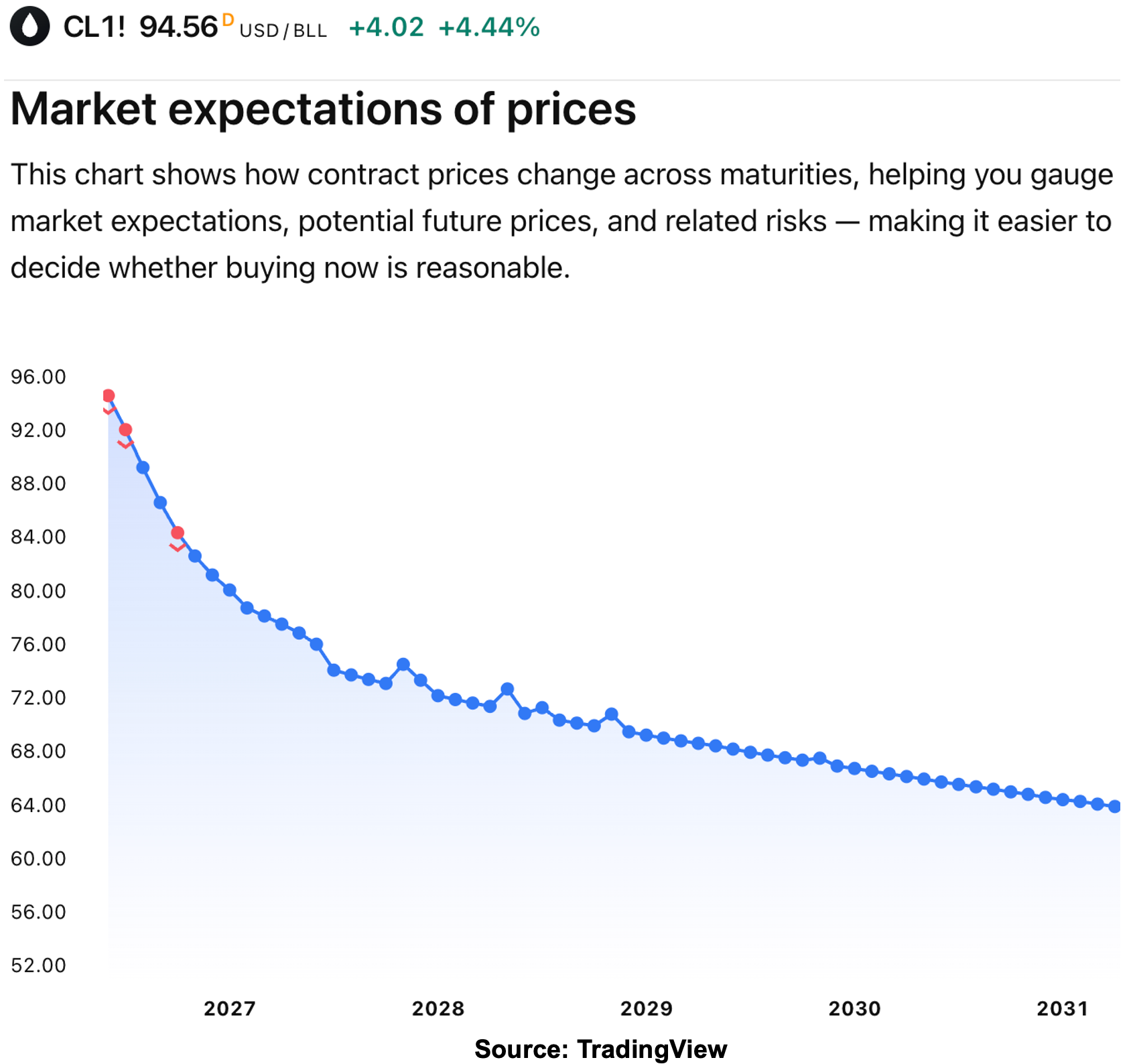
Localised shortages are beginning to emerge. Refiners are increasingly competing for available supplies. Yet financial markets continue to price in a relatively benign outcome. Investors appear to be assuming that the disruption will soon be resolved, despite the fact that no such resolution has materialised in three months. In effect, paper markets are betting on a normalisation that physical markets are increasingly questioning.
History Suggests Markets May Be Underestimating the Shock
Since 1971, oil disruptions have produced a remarkably consistent pattern:
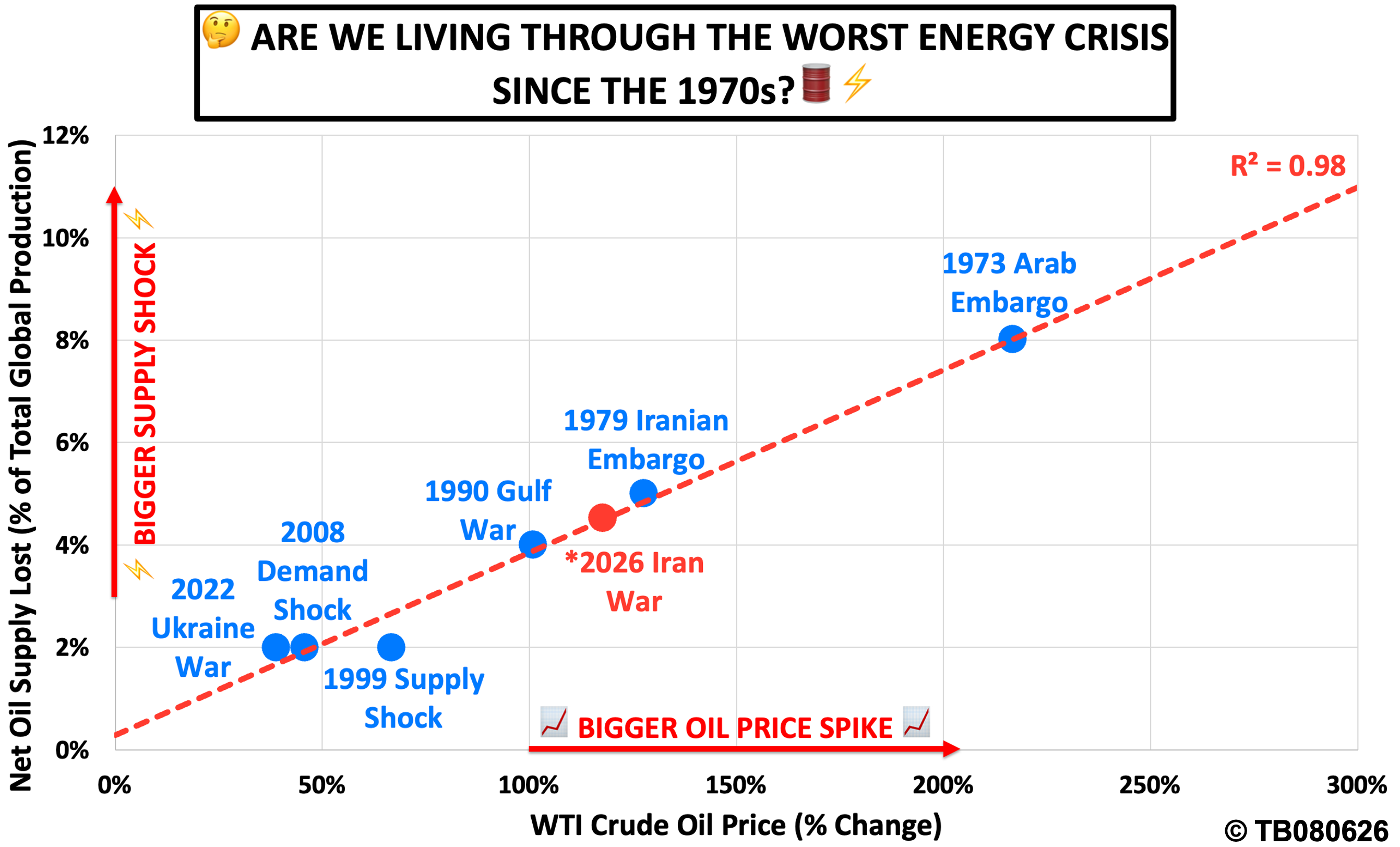
- During the 1973 Arab embargo, an 8% loss of global supply contributed to a 217% increase in prices.
- The 1979 Iranian embargo resulted in a 5% supply disruption producing a 128% price spike.
- The 1990 Gulf War generated roughly a 4% supply loss and oil prices surged 101%.
- The 1999 supply shock saw a 2% supply loss accompanied by a 67% increase in prices.
- The 2008 demand shock produced a 46% increase.
- The 2022 Ukraine War generated a 39% rise.
Across multiple cycles and several decades, the relationship has been surprisingly stable. On average, every 1% reduction in global oil supply has historically translated into approximately a 27% increase in oil prices.
Applying That Framework to Today
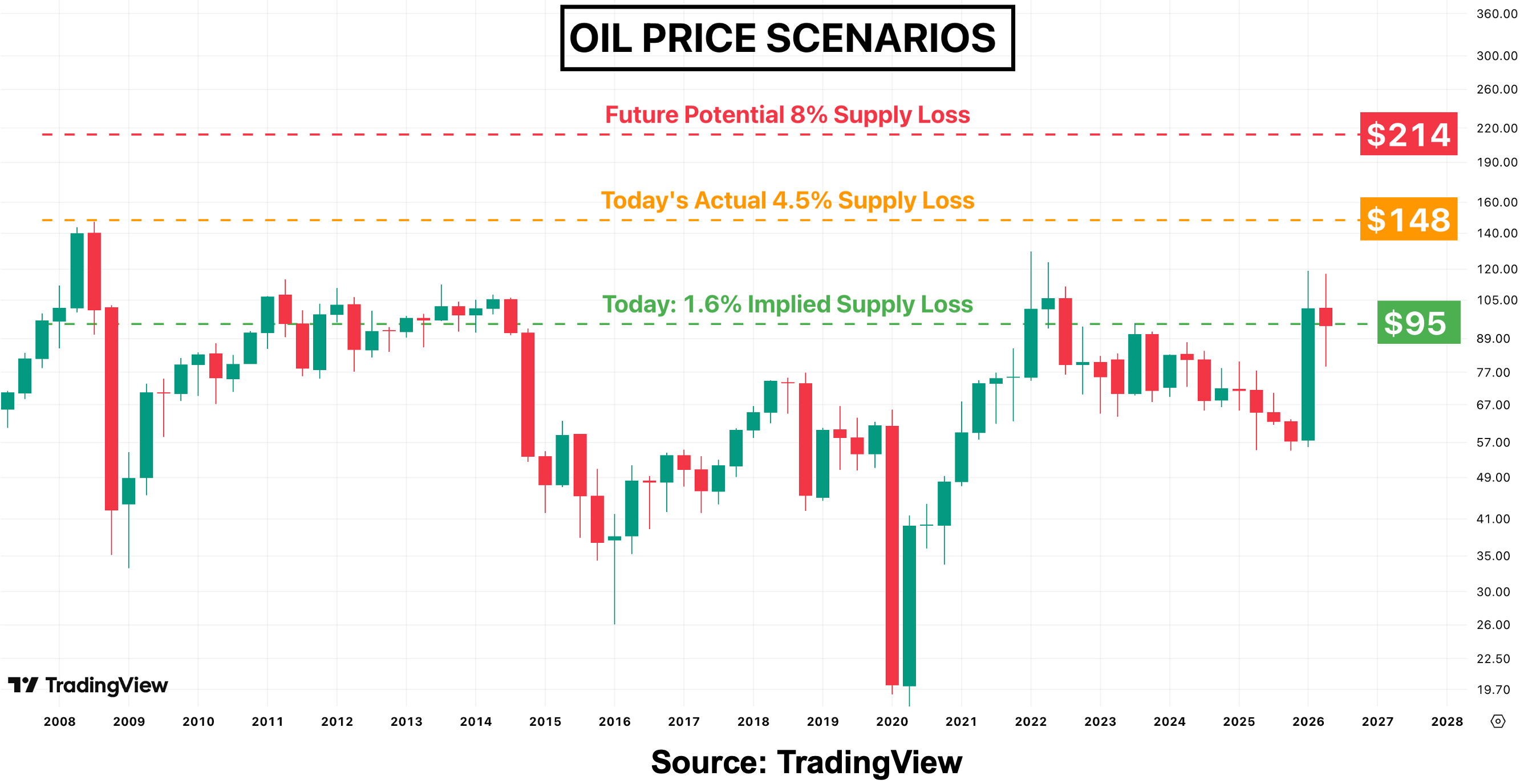
Before the conflict, crude traded near $68 per barrel. Today, prices around $95 imply a supply disruption equivalent to roughly 1.6%. Yet the actual disruption currently appears closer to 4.5%.
Past relationships between supply and disruption suggest oil prices at $148 per barrel would be consistent with that level of scarcity. And if inventory buffers disappear and the effective shortfall expands toward 8%, historical precedents imply prices could approach $214 per barrel. In other words, markets may currently be pricing in only about one-third of the underlying shock.
Demand Destruction May Become Inevitable
Should the supply gap move toward 8 million barrels per day, supply itself cannot solve the problem. Instead, the market would be forced to rebalance through demand destruction. Historically, this process has been painful.
Higher prices reduce fuel consumption, businesses cut activity, consumers spend less, economic growth slows and industrial output declines. Ultimately, recessions become the mechanism through which oil demand is brought back into equilibrium.
Bottom Line
For now, the system is being held together by a combination of temporary workarounds, depleting inventories and, for me, an irrational confidence that a quick resolution remains possible. But all of these pillars are threatening to crumble.
As inventories fall, emergency supply measures become exhausted, optimism fades and the market could be forced to confront a much larger imbalance than current prices imply. If several supports weaken simultaneously, the adjustment may not be gradual. It could all boil over.