


The ceasefire is dead. President Trump declared before a NATO summit that the U.S. agreement with Iran is “over” and that he has no interest in engaging with Tehran. Tankers are turning around at the Strait of Hormuz, Iranian forces struck U.S. military positions in Bahrain and Kuwait, and the export license that kept Iranian crude on the global market has been revoked. The traders who spent the last month building short positions on the assumption that peace would flood the market with supply are now covering into a rally that has more room to run. What looked like a market preparing for oversupply seventy-two hours ago is now repricing for disruption.
Trump Killed the Deal in One Sentence
August WTI crude oil futures surged $4.06, or 5.76%, to $74.50 at 09:02 GMT Wednesday. September Brent crude oil futures jumped $4.15, or 5.60%, to $78.31, extending Tuesday’s nearly 3% advance that followed Treasury’s revocation of the general license allowing Iranian crude sales.
The market spent the last month pricing in a post-truce world. Funds sold crude aggressively, short positions swelled, and the assumption was that Iranian barrels were coming back. Trump reversed that entire thesis before boarding a plane.
Speaking ahead of the NATO summit, Trump said the agreement was “over” and added that he did not want to engage with Tehran. “The latest developments have effectively thrown the future of the 60-day negotiation process into doubt,” SEB chief commodities analyst Bjarne Schieldrop said.
Schieldrop sees more upside. “In my view, a price closer to $80 a barrel is more consistent with current market fundamentals than $70,” he said.
Brent Oil Price Forecast
Every new Brent Oil analysis as it publishes, today's technical signal and key levels, live price — on one page.
See all Brent Oil forecastsTankers Are Turning Around at the Strait
The Strait of Hormuz is where this trade gets dangerous. Traffic through the waterway has not returned to pre-conflict levels and now it’s getting worse.
CENTCOM launched airstrikes after Iranian attacks on three commercial vessels transiting the Strait. Iran’s Revolutionary Guards said they targeted U.S. military positions in Bahrain and Kuwait. That’s an escalation cycle, not a single incident.
“Four oil and gas tankers have reportedly either decided not to transit the strait or been forced to turn around after Iran declared that the only safe shipping route through the Strait of Hormuz is the one designated by Tehran,” PVM analyst Tamas Varga said.
The damage is spreading beyond military targets. A Qatari LNG tanker was struck by a drone that started a fire in its engine room. A Saudi-flagged crude tanker took damage off the coast of Oman. Iran denied responsibility but Qatar blamed Tehran for the LNG strike.
Iran wants tankers hugging its coastline. Washington says the waterway stays open on international terms. Neither side is backing down and that standoff is worth premium in every barrel moving through the Strait.
“This current conflagration is a reminder to the market of how fragile passage through the Strait still is,” MST Marquee head of research Saul Kavonic said.
Shorts Are Covering Into the Rally
Every fund that sold crude after the truce is watching this rally eat into their position. The bet was simple: peace brings Iranian barrels back, prices drop. That thesis died overnight and the covering is adding momentum on top of the geopolitical bid.
Kavonic called the disruption “a contrary indicator to the prevailing sentiment that the market could be flooded into oversupply, which may scare some of the record short positioning to cover.” He warned that if tanker traffic stays well below normal, supply constraints could push prices even higher.
API data gave the bulls a number to work with. U.S. crude inventories fell again last week against an expected draw of about 2.4 million barrels. Stockpiles are shrinking at a time when the supply picture just flipped.
“While the revocation doesn’t fundamentally change oil market dynamics, it’s important from a sentiment perspective. It heightens the risk of a breakdown in the temporary deal between the U.S. and Iran,” ING commodity strategists said.
WTI Cleared the 200-Day Resistance
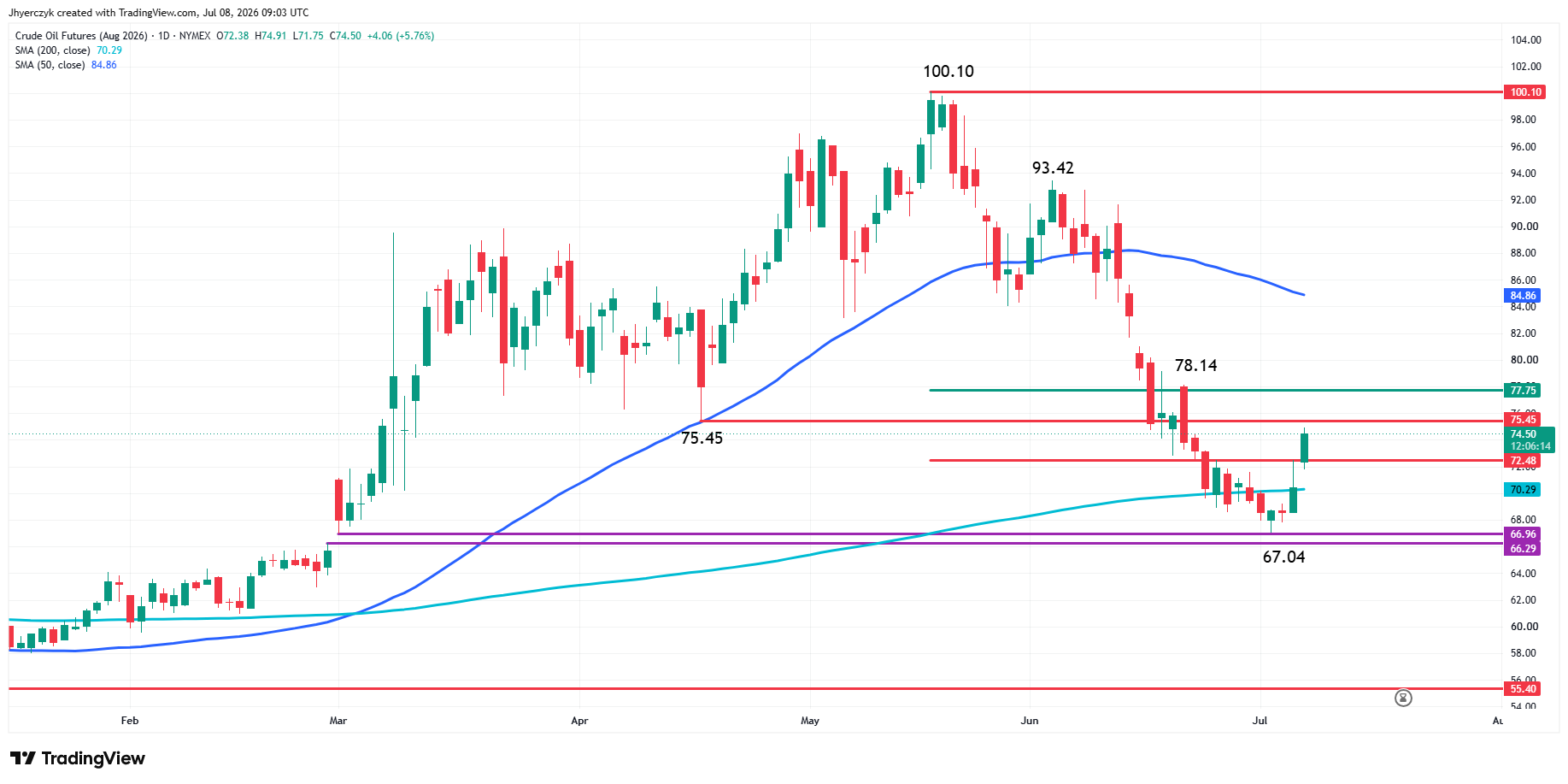
August WTI crude oil futures are sharply higher overnight. After surviving a test of the February/March gap at $66.96 to $66.29 late last week, the U.S. benchmark surged through 200-day moving average resistance at $70.29 on Monday.
Follow-through buying on Wednesday overtook a 61.8% level at $72.48, re-establishing support and putting the market in a position to challenge a previous bottom at $74.45 and more importantly a major 50% level at $77.75.
Overtaking the 50% level and the swing top at $78.14 could trigger an acceleration to the upside, putting the 50-day moving average at $84.87 back on the radar.
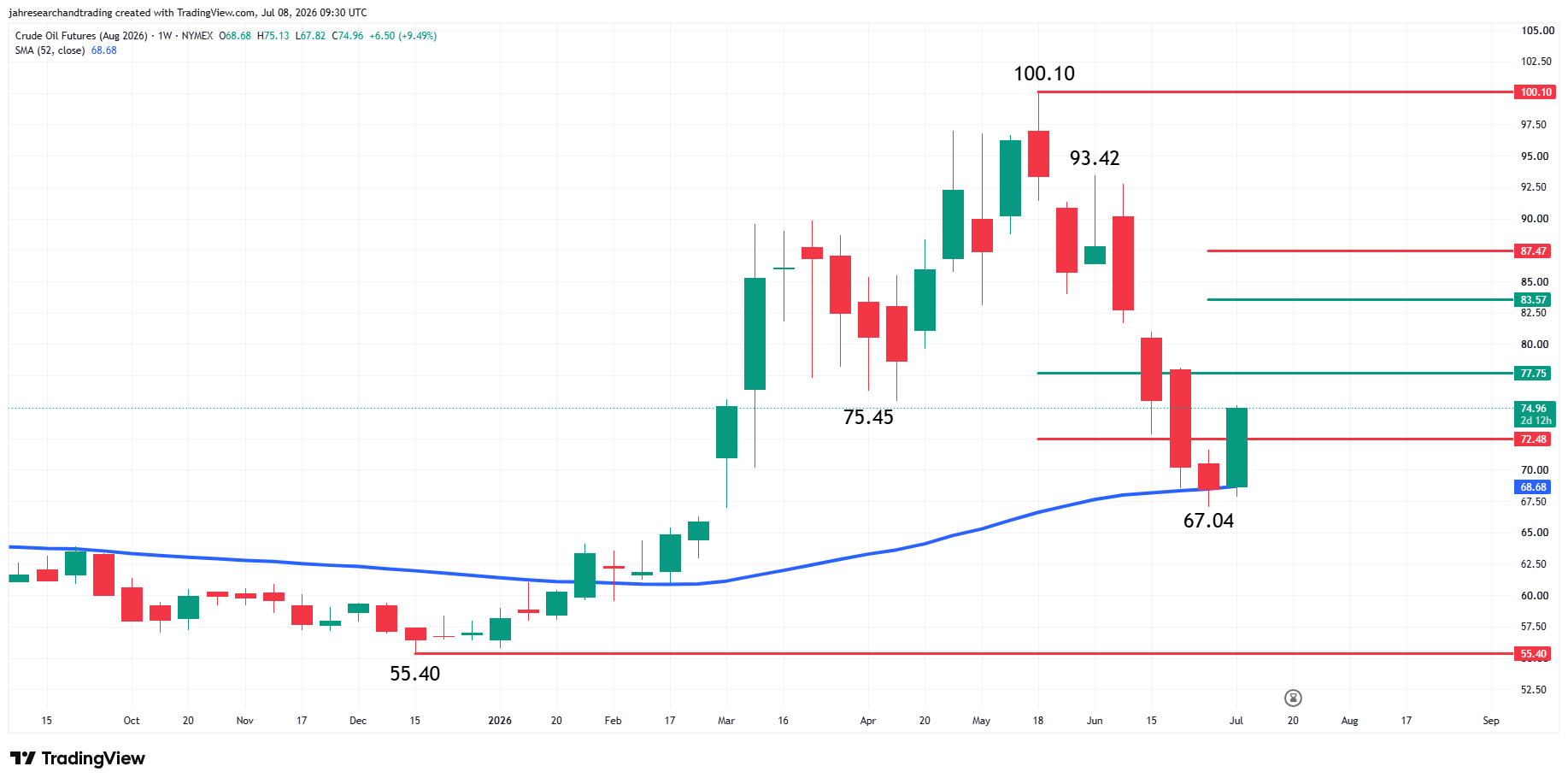
On the August WTI crude oil futures weekly chart, new support has been established at the 52-week moving average at $68.68. The developing rally is still facing headwinds, but if the upside momentum is sustained, a test of the retracement zone at $83.57 to $87.47 is a strong possibility.
Brent Following the Same Breakout Path
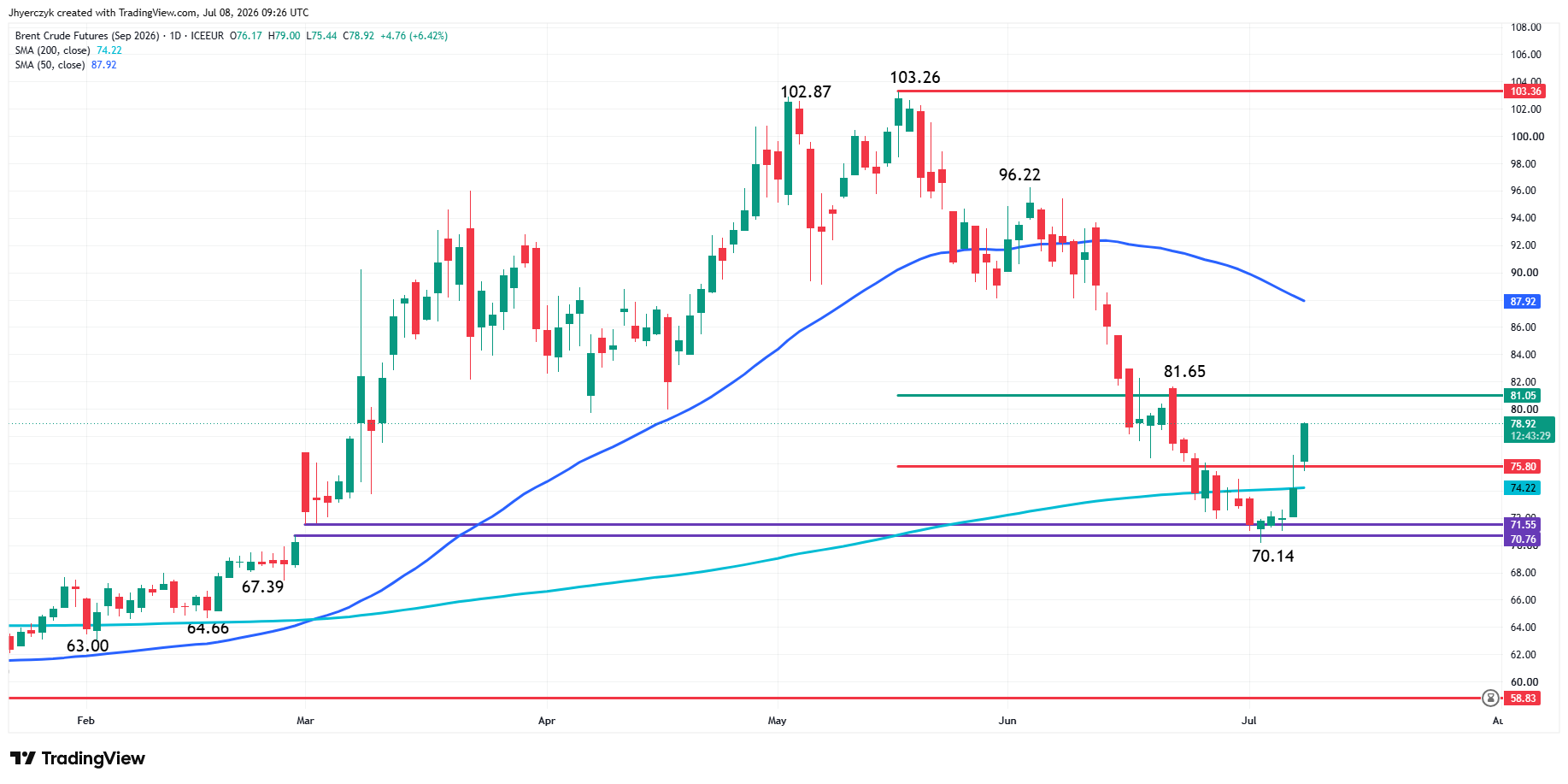
September Brent crude oil futures are following the same path as the WTI futures contract. It successfully navigated a multi-month gap at $71.55 to $70.76 last week. This created the upside momentum needed to overtake the 200-day moving average at $74.22. This move is fueling today’s surge over a Fibonacci level at $75.80, making it new support.
More importantly, the market now has enough upside momentum to challenge the major 50% level at $81.05 and the swing top at $81.65. This price is a potential trigger point for a near-term support into the 50% level at $87.93.
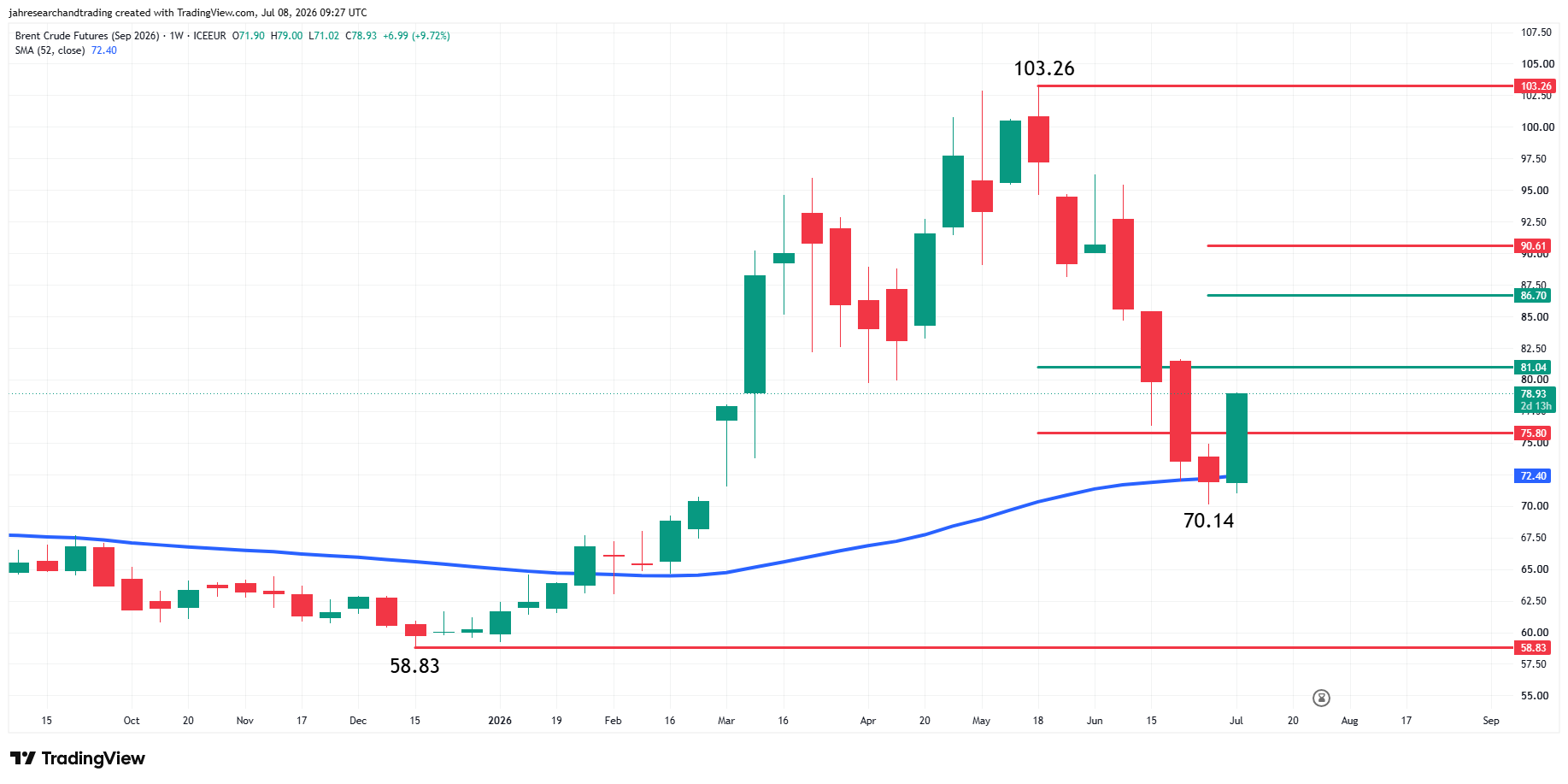
The Weekly September Brent crude oil chart shows the international benchmark has crossed to the strong side of its 52-week moving average at $72.40, making it new support and putting the major retracement zone at $86.70 to $90.61 in focus.
What to Watch
Trump declared the deal over and the short sellers who rode crude down to $66 are paying for it. Tankers are turning around at the Strait rather than transit under Iranian conditions, the export license is revoked, and U.S. inventories are still drawing. Forced short covering into a supply disruption with shrinking stockpiles is how crude produces its fastest moves. The diplomatic foundation the bearish trade was built on no longer exists.
WTI cleared the 200-day and the 50% level at $77.75 is the next major test. Brent is pressing toward $81.05. Both benchmarks crossed above their 52-week moving averages for the first time since the truce, and that puts the upside retracement zones in play.
If you’d like to know more about how to trade crude oil, please visit our educational area.