



USD/JPY trades Japan’s 2-year now and nothing American: at weekly horizons the t-statistic reads -3.2 against 0.1 for the US 2-year, on 33 windows in 2026. I found that looking for the Japanese long bond behind a pair the Fed’s hike had taken from 153.27 on September 9 to above 156. Tokyo’s step is priced. Speculators turned net long yen at 154, and I’m looking for 156.80 by the end of September.
The Fed Hiked and the Long End Did Not Follow
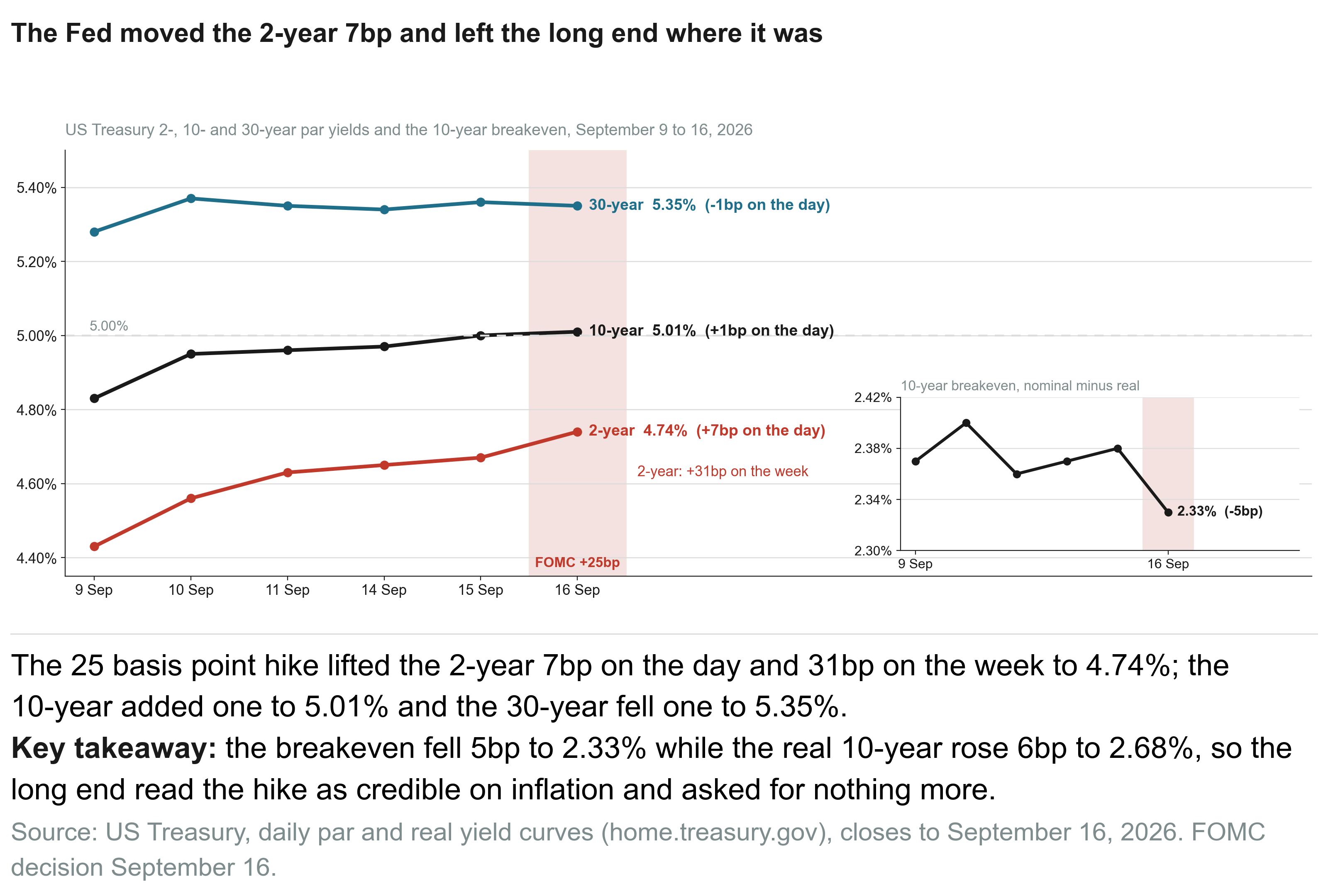
The FOMC statement of September 16 took the range to 3.75-4.00%, and its projections put twelve participants at a 4.125% midpoint for the end of 2026, four at 4.375% and two at the new 3.875%.
The curve believed it. On Treasury’s par curve the 2-year closed at 4.74%, up 7 basis points on the day and 31 across the week, while the 10-year added one basis point to 5.01%, its second close at or above 5% since July 19, 2007, and the 30-year slipped one to 5.35%. Treasury’s real curve had the 10-year real yield up 6 basis points to 2.68%, so the breakeven fell 5 to 2.33%. I read that as a long end that believed the hike on inflation.
The yen sold. ECB reference rates, crossed from the euro pairs at about 14:10 Frankfurt, put USD/JPY at 155.05 on September 16, before the decision, and the Bank of Japan’s Tokyo sheet has 154.97 at 17:00. By Tokyo’s open on September 17 the pair was above 156, and FX Empire’s own quote had it at 155.62 by 06:50 UTC.
Where the Yen Actually Came From
USD/JPY printed 163.91 on July 28 on the ECB reference cross, its 2026 high, and 153.27 on September 9. I make that 10.6 yen, in two legs.
USD/JPY Price Forecast
Every new USD/JPY analysis as it publishes, today's technical signal and key levels, live price — on one page.
See all USD/JPY forecastsLeg one has a receipt. Japan’s Ministry of Finance reports ¥15,399.3 billion of intervention between July 30 and August 26. That one window is larger than any full quarter on a record that begins in 1991. The pair fixed at 160.16 on September 1, so the receipted leg bought about four of the 10.6 yen.
Leg two has no receipt. I think it has a different cause. Takata Hajime, who voted for 1.25% in July, gave a speech in Sapporo on September 2 saying that in 2026 “rate hikes will not be carried out at a fixed pace but will instead be conducted in a nimble manner.” Japan’s 2-year had risen 16 basis points over the five sessions to that close, 1.696% to 1.854%, five of them on the speech day, and the pair fixed at 159.60 on September 2, 156.01 on September 3 and 153.27 five sessions later.
I will not claim the ministry bought those sessions until its release at the end of September says so. On the 2026 weekly beta 16 basis points is worth about four yen, and the pair gave up four to September 3; the 2.7 yen after that came with the 2-year flat, from speculators covering shorts. Treasury’s readout of the Secretary’s August 30 meeting with Governor Ueda records “strong support for Japan’s decisive market and monetary steps to address the substantial undervaluation of the yen.” A seller sits above my target. I price that seller as the ceiling on this call.
Financial Analysis
What the Yen Trades Against, 2025 Versus 2026
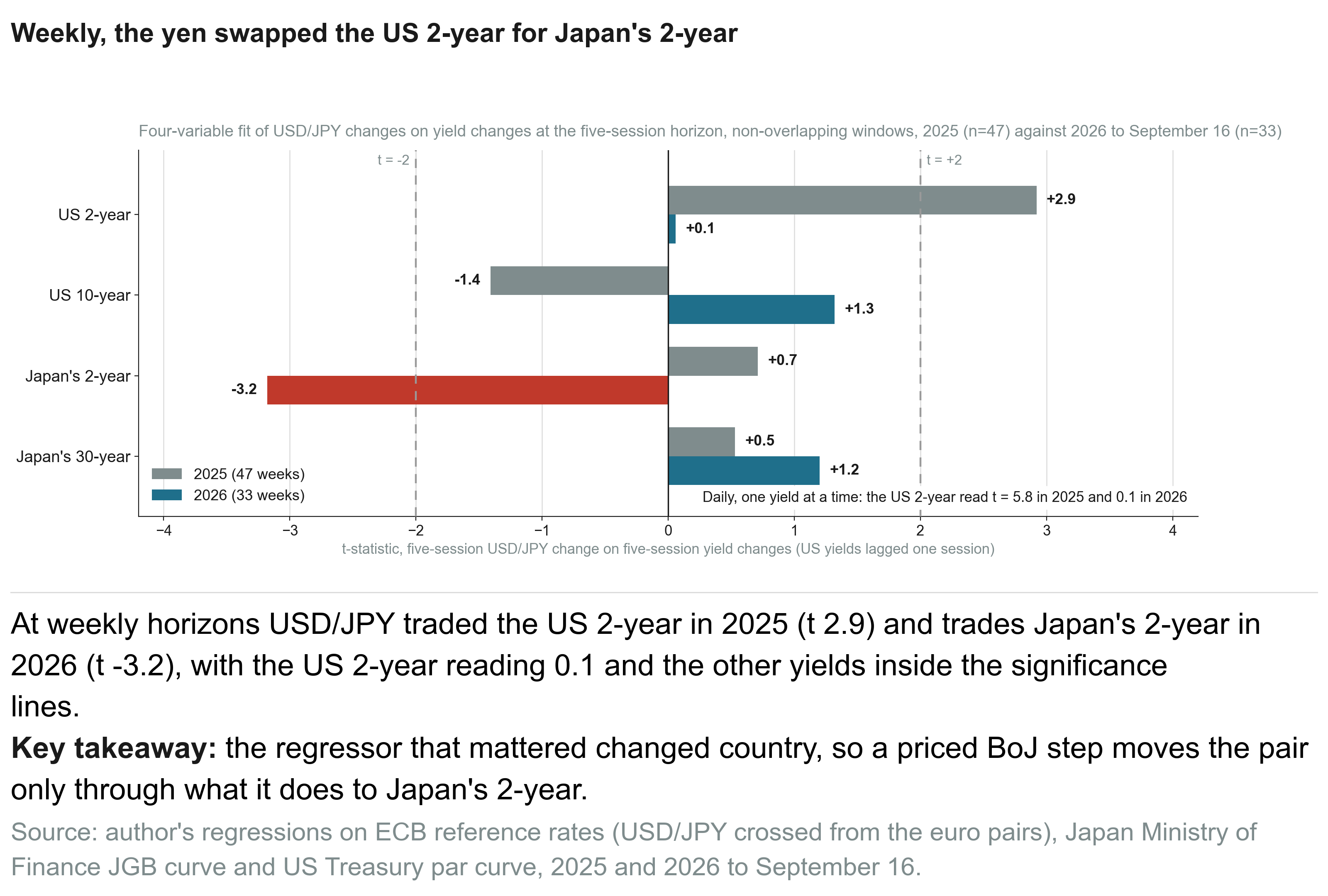
I ran my Nikkei piece’s test of September 3 on the currency: USD/JPY changes against changes in the 2-year, 10-year and 30-year on each side, US yields lagged a session. I expected the Japanese 30-year to carry the pair the way it carries the index.
On daily data it does, faintly. In 2025, across 237 sessions, a 10 basis point rise in the US 2-year went with a 0.44% weaker yen, t-statistic 5.8. Across 169 sessions of 2026 to September 16, the US 2-year on its own reads 0.1. In the fit with all four yields the Japanese 30-year reaches a t of 2.4 while the other three stay under 1, and the fit explains 4% of daily variance against 14% in 2025.
Then I lengthened the window to five sessions. The story changed. Across 33 windows of five sessions in 2026, none overlapping, the coefficient that dominates is Japan’s 2-year: -1.7% on the pair per 10 basis points, t-statistic -3.2, in a fit that explains 30% of weekly variance. Nothing else reaches 2. The US 2-year reads 0.1, the US 10-year 1.3 and the Japanese 30-year 1.2. Run on 2025, the same test gave the US 2-year 2.9 and Japan’s 2-year nothing. Weekly, Tokyo’s front end has replaced Washington’s, and the week to September 3, the 2-year up 15 basis points and the pair down 2.1%, is what that looks like on a screen. Drop any one window and the t stays past 2; without the Takata week it is -2.3.
One week cuts against me. Put the FOMC week’s 31 and 18 basis points through the 2025 joint fit and it predicts a 1.44% rise. Spot rose 1.16% to the fix before the decision and more after it, while the 2026 fit predicts a fall, because Japan’s 2-year added 2 basis points. I read the week as the September 8 longs meeting a committee they had not priced; one week against 33 leaves the question closed. Either reading puts the pair higher while Japan’s 2-year holds.
The Bid That Took It to 153 Has Been Spent
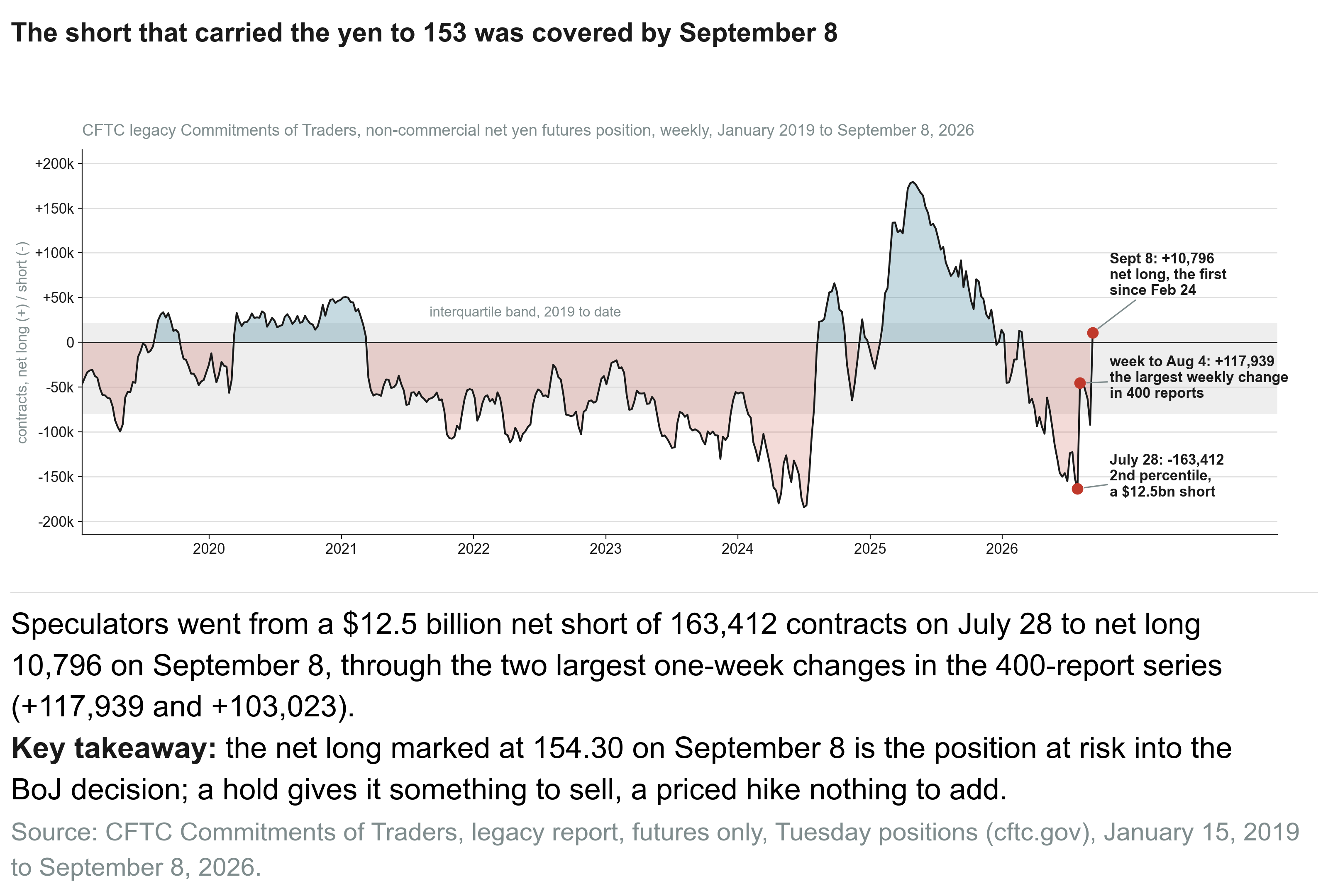
CFTC’s legacy report has non-commercial traders net short 163,412 yen contracts on Tuesday, July 28, a $12.5 billion short. August 4’s report cut that short by 117,939 contracts, it rebuilt to 92,227 by September 1, and the week to September 8 cut it by another 103,023, 61,622 of them new longs. Both weeks rank first and second for one-week change in the 400 reports since January 2019, and the second took the position to net long 10,796 for the first time since February 24.
From 154.30 on September 8 the pair went to above 156 at the Tokyo open. Marked from that fix, the net long is underwater. A priced hike gives the new longs nothing to add on; the one thing that pays them is a Bank that out-hawks its own strip, and on a hold I count them as the first sellers.
Position and Risk
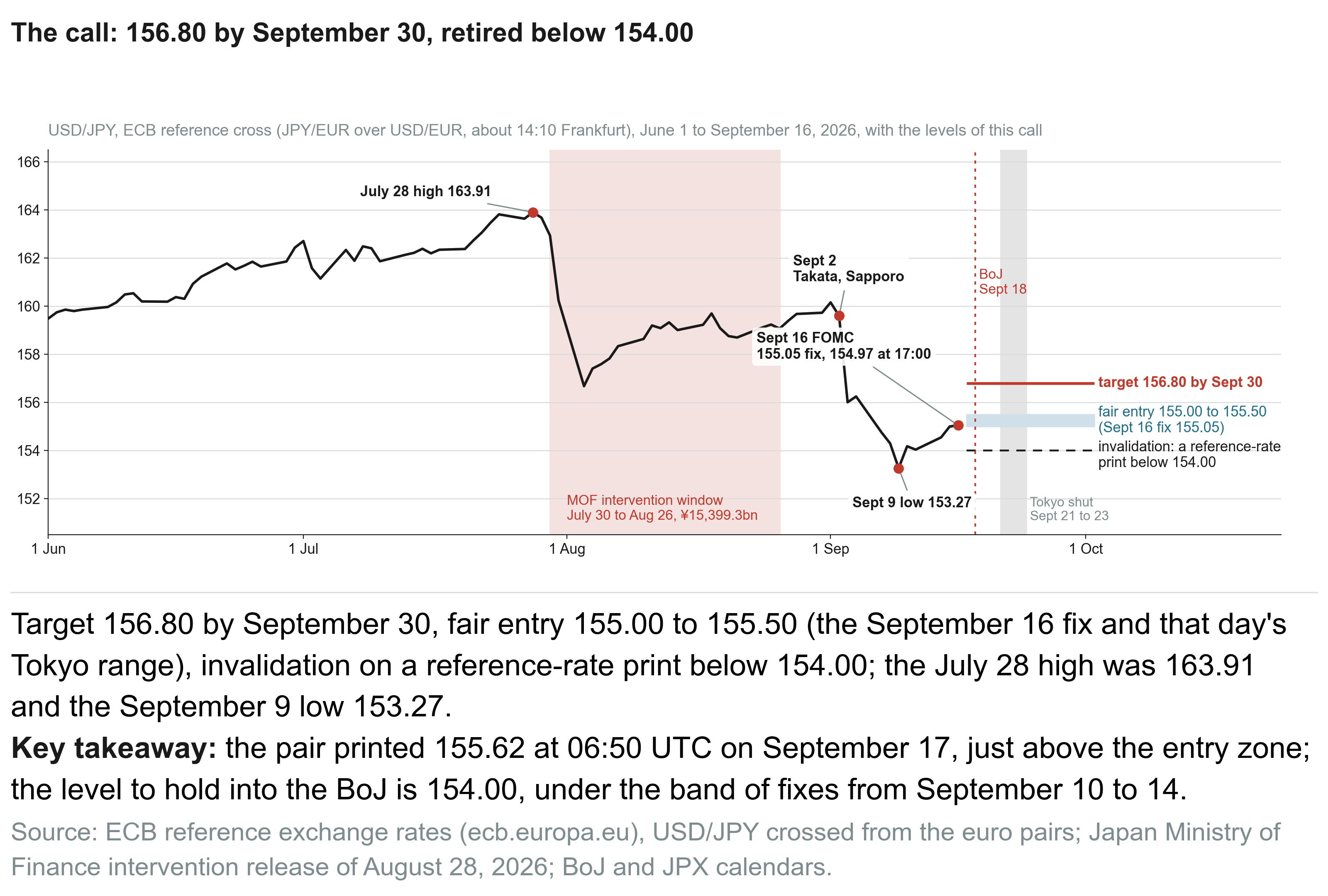
My asset is USD/JPY, spot. Direction is higher. My target is 156.80 by September 30. Fair entry is 155.00-155.50, the fix before the decision and the 155.48 top of that day’s Tokyo range. A reference-rate print below 154.00 invalidates the call, under the band of fixes from September 10 to 14, because a pair back there with the hike delivered means Tokyo’s front end has won. Japan’s 2-year closing 10 basis points or more above the 1.852% of September 16 through the meeting, with the pair not falling, is the other way I’m wrong.
The target is a base rate. Measured from the reference fix on the session before each BoJ decision to the tenth fix after it, the two of this cycle’s five hikes the market had priced, December 2025 and June 2026, read +0.43% and +1.05%. Averaged, that is 0.74%, which from the 155.62 on FX Empire’s own quote at 06:50 UTC on September 17 is 156.77. I’m calling 156.80. At the eighth fix, where September 30 falls, the two read +0.74% and +1.04%, a quarter of a yen more; from the fix on decision day instead, December reads -0.44% and June 1.28%, an average of 0.42%. Two episodes is a thin base. I’m not dressing it up.
The strip is the other half. Tokyo Financial Exchange daily statistics have the September TONA contract settling at 98.780 on September 16, an implied 1.220% for a window running to mid-December that holds both the September 18 and the October 30 meetings, against 0.978% on the June contract that expired that day at a 1.0% policy rate. Price a September step alone, with TONA fixing about 2 basis points under the guideline, and the window averages 1.21%: the contract carries one September step and almost nothing for October. December’s contract at 1.475% holds the second step; December 2027 at 2.154% carries the rest. Only guidance that names October moves the 2-year 10 basis points.
The named risk is a hold. Eight of nine voted to hold in July, with Takata asking for 1.25%, and a hold against that strip hits a market that’s long yen for the first time since February and tells the long end the Bank won’t lean against a 30-year that closed at 4.131% on September 1. Each pushes the pair up, fast, and a hold is the one path that brings the ministry back. The adverse case is the mechanism in reverse: Takata’s pace written into the guidance, Japan’s 2-year up 10 basis points, the pair down 1.7% on the 2026 weekly beta, 153.0 from 155.62. The nine-session moves of 2026 put the tenth percentile at 150.8, and a move that size needs the ministry, which hasn’t sold dollars under the 159.79 of April 29, 2026. Tokyo is shut from September 21 to 23, and the ministry has used a Tokyo holiday before: on Showa Day 2024 it sold ¥5,918.5 billion of dollars. That tail is thin and real.
Conclusion
I’m looking for 156.80 by the end of September, from the 155.00-155.50 I’d want to pay, and a print below 154.00 retires it. On August 4 I called 148-150 by mid-October from 156.68. Spot reached 153.27 on September 9, 3.4 yen of the 7.7 to the middle of that range, and I’m retiring the rest a day early. My 2024 analogue needed a short base to run on. That base is gone.
The October meetings sit two days apart again, the 27th to 28th and the 29th to 30th, and over six to twelve months my question is whether the yen keeps trading Takata’s pace against Ueda’s. I’ll be watching Japan’s 2-year on September 18, and the ministry’s release at the end of the month for what the first week of September cost, if anything.