



The Strait of Hormuz carried 18 million barrels per day before the war. It is moving about 2 million now. The ceasefire expired Monday. No talks are scheduled. Iran says the waterway is shut. Washington says it is open. Shipowners stopped listening to both sides weeks ago. They are avoiding the route and the rest of the oil market is repricing around them. Brent held above $91 overnight. WTI is near $86. The premium is not about a headline anymore. It is about a supply system that nobody has a plan to restore.
At 11:30 GMT, September WTI crude oil futures were trading at $85.66, up $0.72 or 0.85%. October Brent crude oil futures were at $91.67, up $0.65 or 0.71%.
Daily September WTI Crude Oil Futures Technical Analysis
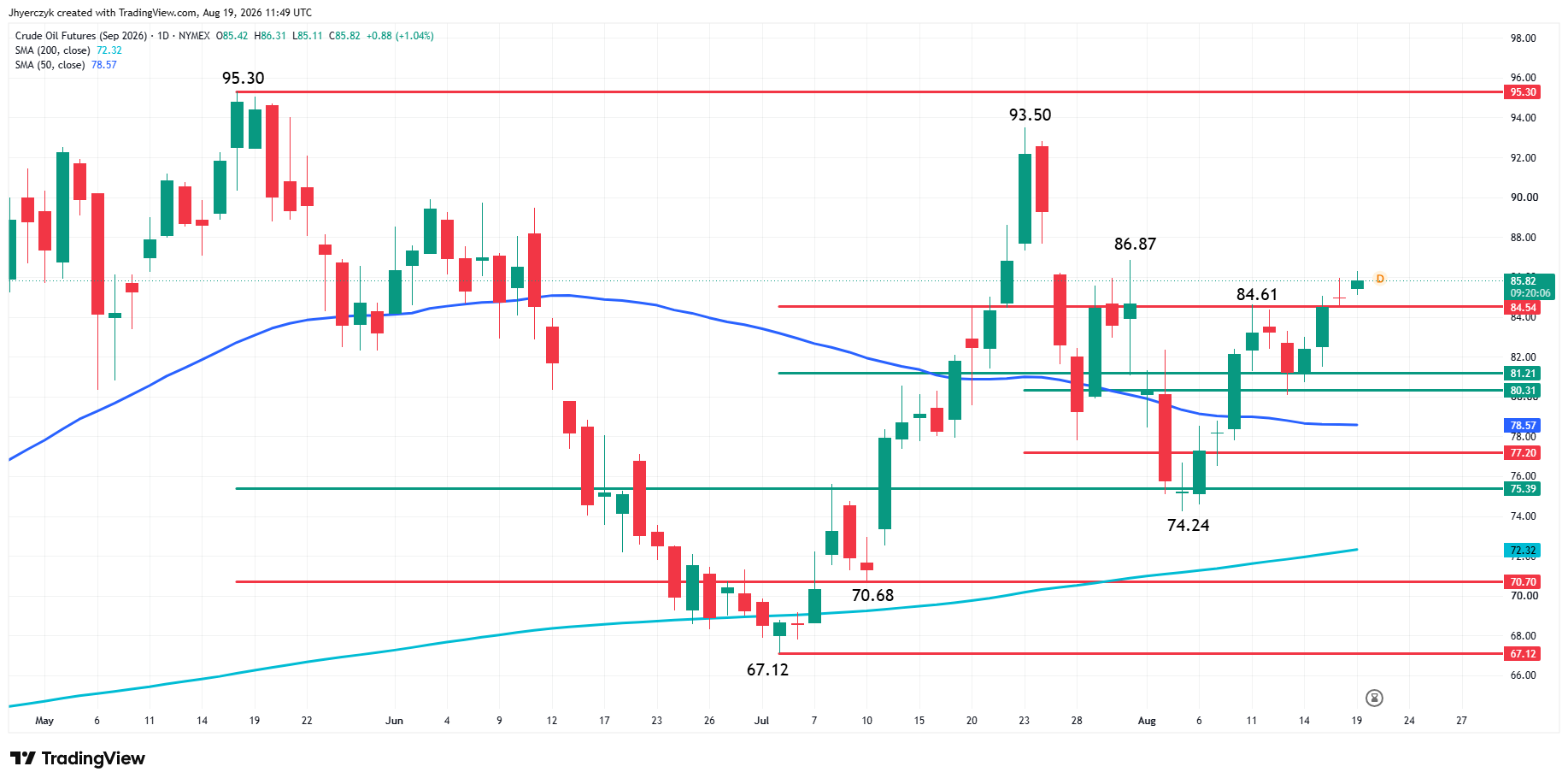
September WTI crude oil futures are edging higher on Wednesday as it navigates above a previous top at $84.61 and key Fibonacci support at $84.56 and $83.87. Buyers appear to be cautious as the market slowly approaches the next resistance at $86.87. This could also be the trigger point for an acceleration toward the two main tops at $93.50 and $95.30.
Trader reaction to $84.54 is likely to set the tone. Holding above it while building a new higher support base will indicate the presence of buyers. Falling back below it and sellers could reemerge with downside targets a pair of 50% levels at $81.21 and $80.31. The 50-day moving average at $78.57 remains the major support and short-term trend indicator.
Daily October Brent Crude Oil Futures Technical Analysis
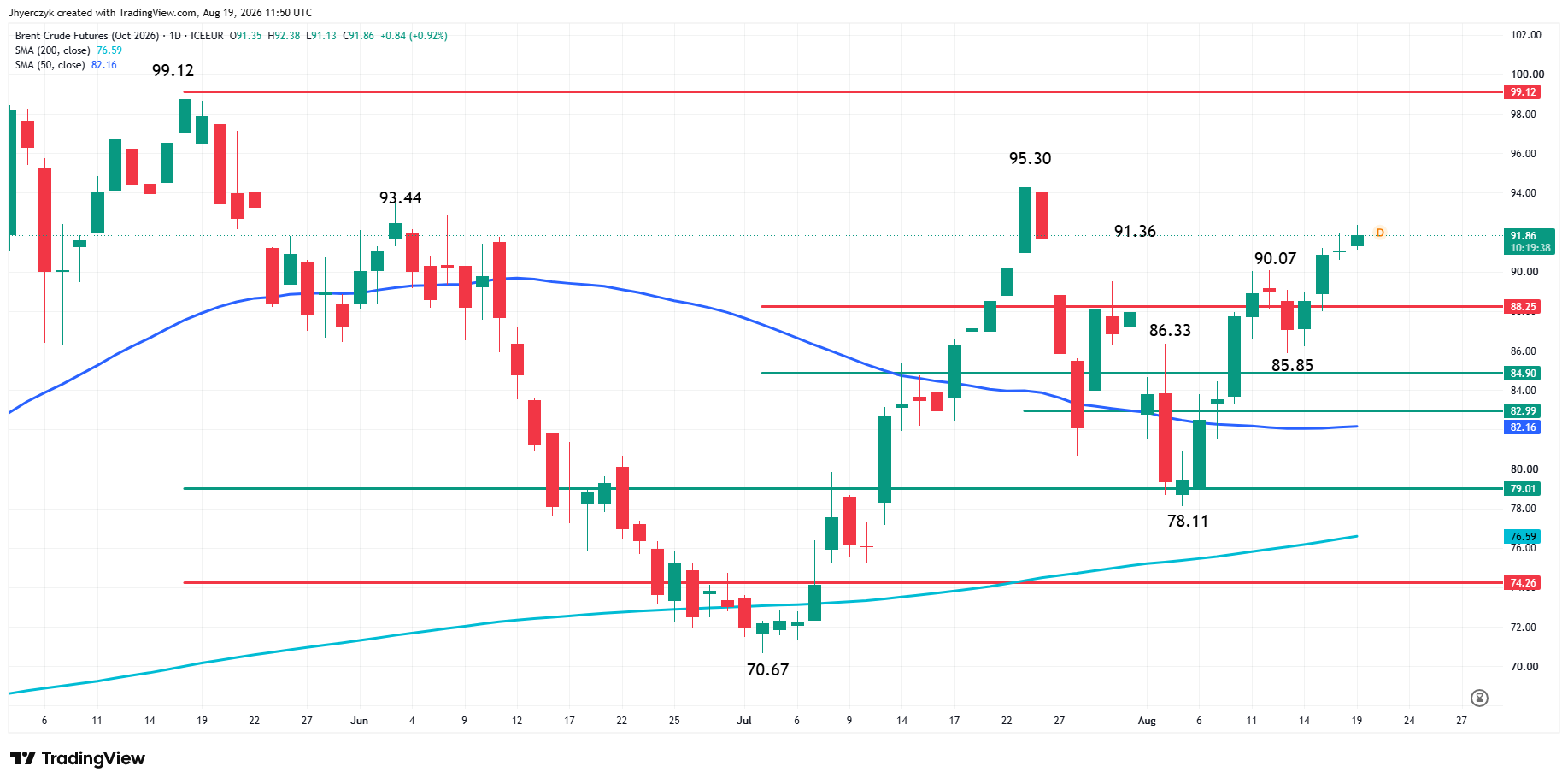
October Brent crude oil futures are in a strong position early Wednesday as bullish traders look to expand the current weekly gains with a breakout over the July 31 main top at $91.36. The buying appears to be controlled and without the volatility we’ve seen previously. This suggests new longs are taking control. Previous rallies have been a combination of speculative buying and short-covering.
A sustained move over $91.36 will put the two main tops at $95.30 and $99.12 on the radar. The key support level is $88.25. A trade under this level won’t change the trend to down, but it should shift momentum to the downside.
Brent Oil Price Forecast
Every new Brent Oil analysis as it publishes, today's technical signal and key levels, live price — on one page.
See all Brent Oil forecastsHormuz Traffic Has Not Recovered and Nobody Is Pretending It Will
Flows of crude and refined products through the Strait averaged about 18 million barrels per day before the conflict. They fell to 4.8 million barrels per day in July and have averaged near 2 million barrels per day so far in August, according to Kpler. That is not a disrupted shipping lane. That is a shipping lane that has effectively shut down for commercial purposes.
Some cargoes are still getting through. The UAE increased exports from Fujairah outside the Gulf. Saudi Arabia is moving more barrels through Red Sea outlets. Iraq approved a three-month mechanism beginning September 1 to export crude through specialized companies and multiple routes. Those workarounds are keeping some barrels moving. They are not replacing Hormuz.
The interim ceasefire agreed in June has collapsed. The 60-day negotiating period expired. Iran warned it would escalate if Washington did not honor the arrangement. Trump said the pact was over and no talks were scheduled. There were no reported strikes Tuesday, but the absence of a strike did not calm the crude market. The market has moved past trading each individual headline. It is pricing a disruption that can last months.
Dark Tankers Are Moving Barrels the Market Cannot Count
Middle East exports have averaged about 9.5 million barrels per day this month, less than half the 21 million barrels per day seen in 2025, according to Kpler. Yet UAE crude exports have averaged 3.38 million barrels per day in August, above the 3.2 million barrels per day average in 2025.
The gap between those two numbers is the shadow fleet. More Gulf crude appears to be moving on vessels that disable tracking systems while passing through Hormuz and Bab el-Mandeb. The UAE has reportedly built a network of dark tankers that move cargoes through Hormuz before transferring them in the Gulf of Oman.
That leaves traders with a problem they cannot solve from a screen. They know supply has been disrupted. They do not know how much oil is reaching final buyers. Some barrels may be delayed. Some may be sitting in floating storage. Some may be arriving through channels that public shipping data does not capture. The uncertainty is the reason the premium holds. The market cannot price a recovery it cannot verify.
Reported attacks on tankers linked to ADNOC are putting pressure on the UAE’s ability to keep its export channels running. The Houthis have threatened shipping through Bab el-Mandeb, which is the route that was supposed to reduce the region’s dependence on Hormuz. Two chokepoints under threat at the same time is why freight, refined products and crude are all moving together.
The Refined-Product Market Is Tighter Than Crude
Global refinery throughput averaged about 81 million barrels per day in July, nearly 5 million barrels per day below the year-earlier level, according to the IEA. Lost capacity in the Middle East and damage to Russian facilities from Ukrainian drone attacks are cutting into the supply of diesel, gasoline and other fuels.
American refiners are running at or near record utilization rates. U.S. fuel exports have increased. That support has limits. Seasonal maintenance is approaching. Hurricane risk remains in front of the Gulf Coast refining system.
Global observed oil stocks fell by 2.4 million barrels per day in the second quarter, the largest quarterly draw in at least a decade, according to the IEA. U.S. diesel inventories are at their lowest seasonal level in three decades. Gasoline stocks are at their weakest seasonal level since 2012. Higher diesel costs are already reaching farmers, trucking companies, manufacturers and power generators.
Freight Rates Confirm What the Diplomats Will Not Say
VLCC rates from the Middle East to China have climbed from about $300,000 per day in early July to $490,000 per day, according to LSEG. That works out to roughly $5 per barrel, almost 10 times the level at the start of the year.
Shipowners want more money to enter conflict zones. Importers are reaching for longer routes and more distant supply from the United States and Brazil. The barrels still move. They arrive later and cost more. A refinery paying elevated freight, insurance and replacement costs does not need an outright shortage to raise the price of fuel. The longer this runs, the more the global oil trade reorganizes around routes that cost more and take longer. That is not a temporary disruption. It is a new cost structure.
U.S. Inventories Offer a Near-Term Test
The API reported a 328,000-barrel draw in U.S. crude inventories for the week ending August 14. That followed a 9.07 million-barrel build the prior week. The EIA report is due at 14:30 GMT. Analysts expect a draw of about 600,000 barrels.
U.S. commercial crude stocks have fallen by more than 49 million barrels over the past 18 weeks, according to the API. The domestic picture is not offering much relief while the international market is paying a widening risk premium.
What to Watch
Hormuz is moving 2 million barrels per day. It moved 18 million before the war. That gap is the entire trade. The EIA inventory report lands at 14:30 GMT and 49 million barrels of U.S. crude draws over 18 weeks tells you the domestic side is not offering a cushion. The refined-product shortage is already in the industrial economy through diesel costs hitting truckers, farmers and manufacturers.
Brent above $91. WTI near $86. VLCC freight from the Middle East to China at $490,000 per day. Dark tankers running barrels through channels the market cannot verify. Two chokepoints under threat. Diesel inventories at 30-year seasonal lows. The bulls are not waiting for a headline. They are holding a position the supply data supports every day the strait stays restricted.
If you’d like to know more about how to trade crude oil, please visit our educational area.