



The buffer is gone. Strategic reserves and commercial inventories got burned down to multi-decade lows during the 2026 drawdowns and nobody has refilled them. Washington cannot decide if it is negotiating with Tehran or bombing it. That matters a lot more now than it did a year ago because there is nothing left in storage to throw at the next disruption. The war premium everyone said was gone is already coming back. Here is what is actually driving this market.
Empty Storage Changes the Math on Every Barrel
Governments spent their reserves keeping the market from breaking during the crisis. It worked. It also left the cupboard bare. A disruption that barely moved August WTI crude oil when the Strategic Petroleum Reserve was full can move it five or six dollars now because there is no emergency supply to dump onto the market. Traders used to price risk against a comfortable stockpile sitting in salt caverns along the Gulf Coast. Now they are pricing it against air.
Iran Knows the Strait Is Worth More Now
Roughly 20% of the world’s crude moves through the Strait of Hormuz every single day. Tehran has been demanding service fees from commercial vessels passing through and threatening to shut the waterway down entirely. That is not new. What is new is the market’s inability to absorb it. Freight costs jump. Insurance premiums spike. Delivery schedules get wrecked. And there is no strategic reserve sitting behind the spot price ready to fill the gap. A Hormuz threat used to cost fifty cents a barrel. Now it costs two or three dollars and nobody blinks because the math actually supports it.
Ceasefire Came and Went Faster Than Anyone Expected
August WTI crude oil dropped into a $60 to $77 range after the June 2026 ceasefire because the market assumed the worst was over. That assumption lasted about as long as the ceasefire did. Fresh U.S. strikes hit. Iranian attacks on commercial vessels followed. The risk premium came right back and it came back fast.
President Donald Trump made the whole thing harder to trade by flipping between declaring Iran negotiations dead and hinting a new deal was still possible. Sometimes both in the same week. The policy is not the problem. The unpredictability of the policy is the problem. Traders cannot hedge what they cannot predict.
Brent Oil Price Forecast
Every new Brent Oil analysis as it publishes, today's technical signal and key levels, live price — on one page.
See all Brent Oil forecastsChina Sitting on 1.3 Billion Barrels Is Not Permanent
Goldman Sachs, Citigroup, and Energy Aspects all see a potential glut forming in 2027. That does absolutely nothing for the market sitting here today with empty reserves and live geopolitical risk. Rebuilding stockpiles takes years of steady production growth and zero disruptions. Nobody is getting zero disruptions right now.
China stayed out of the bidding war during the tightest stretches of 2026 because Beijing had an estimated 1.3-billion-barrel stockpile already in hand. That kept one massive buyer off the market when supply was thin. But China is not staying on the sidelines forever. When Chinese buyers come back, and they will, that demand hits at the exact same time every other country is trying to refill depleted reserves. More buyers chasing the same barrels while storage is empty is not how a glut forms.
Daily August WTI Crude Oil Futures Technical Analysis
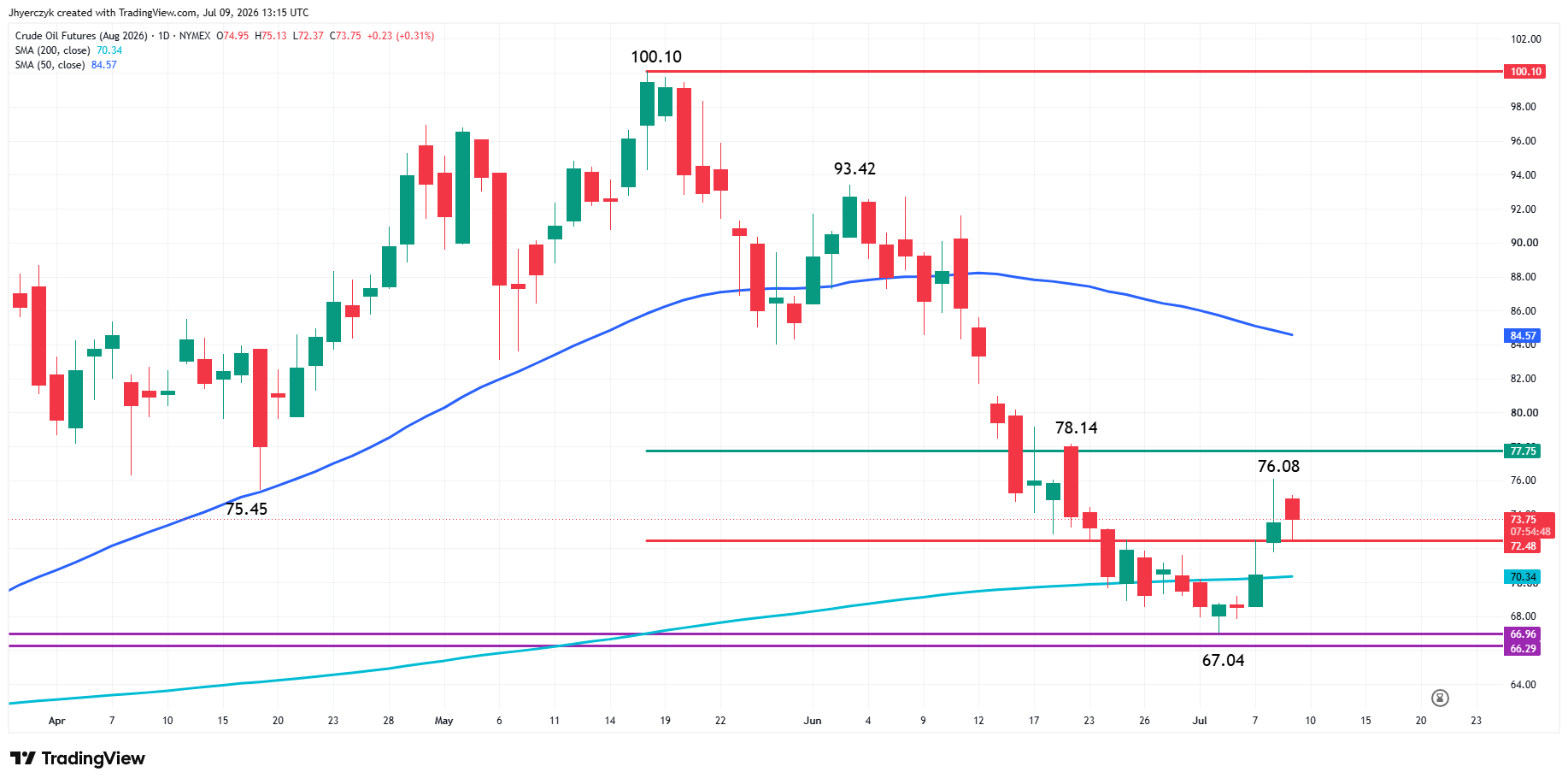
August WTI crude oil futures are edging lower on Thursday after the two-day short-covering rally stalled at $76.08. The price action suggests a retracement of the four-day rally from $67.04 is likely, making a pullback to the 200-day moving average at $70.34 a strong possibility. Trader reaction to that pullback will then set the tone over the near-term.
Bullish traders are going to try to form a new higher bottom over the 200-day MA in the hopes of building a strong support base. Their upside target is the 50-day MA at $84.54. Bearish traders want to push the market back under the long-term moving average and re-establish resistance.
Daily September Brent Crude Oil Futures Technical Analysis
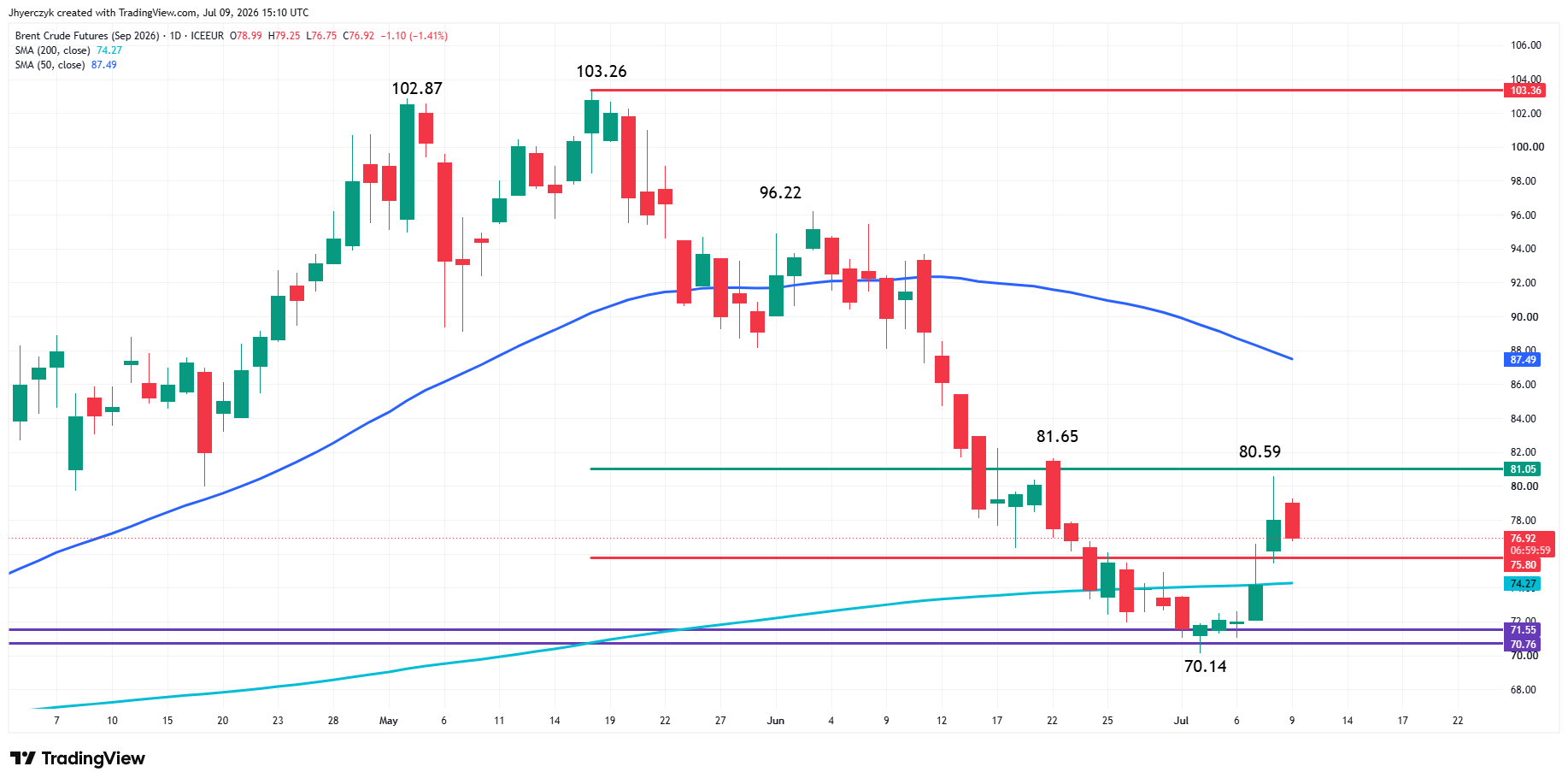
The September Brent crude oil futures contract is pausing after a rally to $80.59. The key to sustaining the four-day rally, which began at $70.14, is staying above the 200-day MA at $74.27. There are still resistance levels at $81.05, $81.65 and the 50-day MA at $87.49 to overcome, but establishing a major bottom is more important, in my opinion.
What to Watch
Three things are still hanging over this market and not one of them is getting fixed before the next session. Strategic reserves cannot be rebuilt in months. The Strait of Hormuz stays a problem until Tehran decides it is not, and there is no sign of that. President Donald Trump keeps the Iran trade alive by contradicting his own diplomatic signals on a rolling basis. Traders are not sitting in August WTI crude oil because the fundamentals demand it right now. They are sitting in it because the next disruption hits a market running on fumes and everybody in the room knows it.
The 200-day moving average at $70.34 on August WTI crude oil futures is the level that tells you where this goes from here. Holding above it and building a higher bottom opens the path toward the 50-day moving average at $84.54. Losing it hands control back to sellers and puts $67.04 back in play. On September Brent crude oil futures the 200-day moving average at $74.27 is where the four-day rally gets tested. The pullback from $80.59 needs to hold above that average or the rally was just short covering that ran its course.
If you’d like to know more about how to trade crude oil, please visit our educational area.