



Gold prices saw an increase on Thursday as escalating conflicts in the Middle East heightened the metal’s safe-haven allure, which outweighed the dampening effect of prolonged high U.S. interest rates. This dynamic offers a critical backdrop to the current financial landscape.

Geopolitical Tensions Influence Market Dynamics
Israel’s Prime Minister Benjamin Netanyahu emphasized the nation’s autonomy in defense decisions amid rising international calls for restraint. This stance follows recent aggressive exchanges with Iran, reinforcing gold’s status as a refuge during geopolitical upheavals.
U.S. Monetary Policy Impacts on Gold
Federal Reserve Chair Jerome Powell recently hinted that interest rates might remain elevated longer than previously anticipated. Current market data suggests a conservative forecast for rate cuts in 2024, with less than a 50-basis point reduction expected, and the initial cut potentially not occurring until September. High interest rates typically lessen the attractiveness of non-yielding assets like gold, but the ongoing global uncertainty continues to bolster its appeal.
Forthcoming Economic Indicators
Several key U.S. economic indicators are due for release, including:
- Unemployment Claims, which are slightly up to 215K from 211K,
- The Philly Fed Manufacturing Index showing a minor decline.
- Reports from FOMC members that might provide more insights into future monetary policies,
- Data on Existing Home Sales and the CB Leading Index, both crucial for economic sentiment analysis.
As these economic events unfold, the XAU/USD price may experience fluctuations.
Gold Prices Forecast
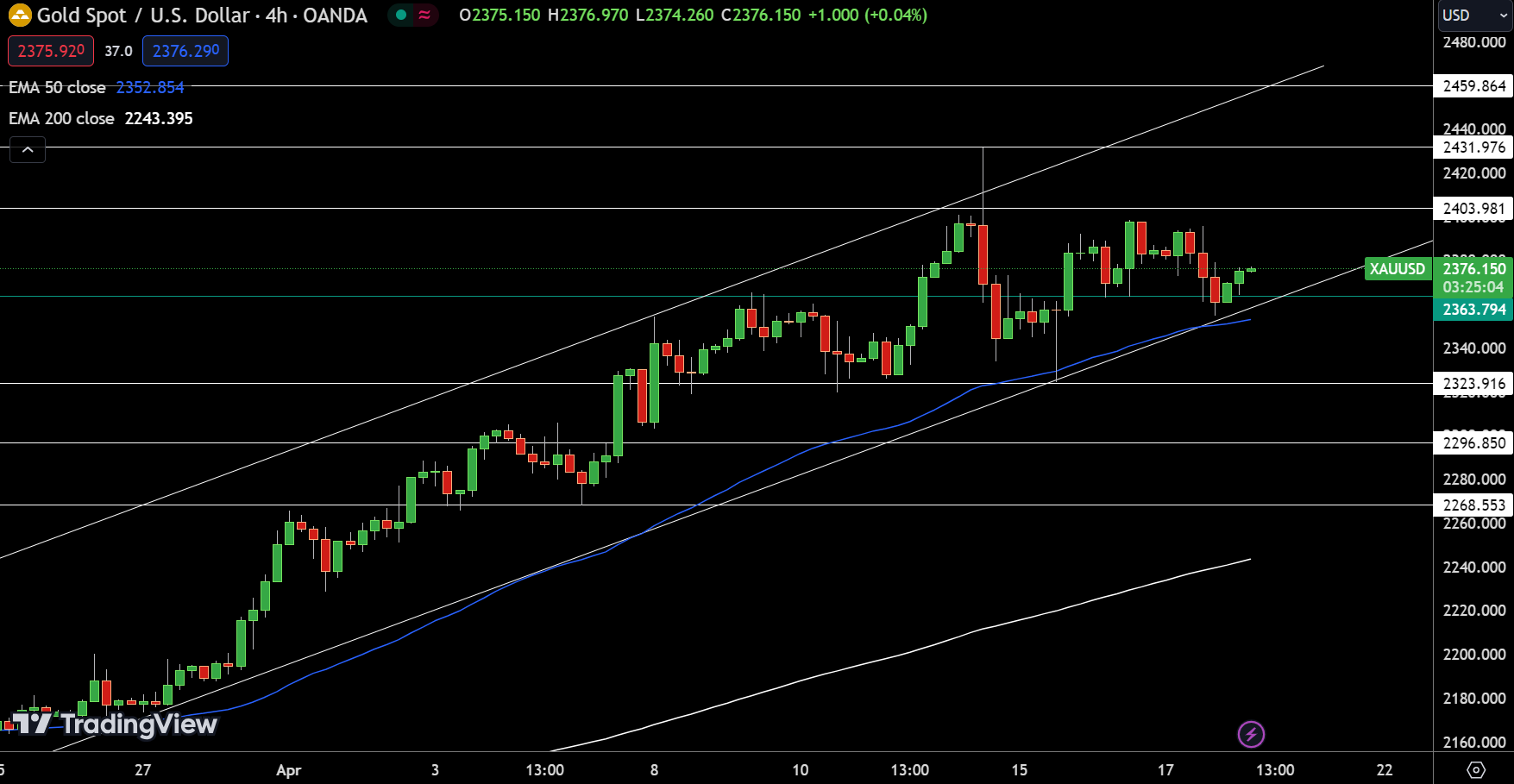
Gold is currently priced at $2,376.15, showing a rise of 0.63%. The metal is trading above its pivot point at $2,363.79, suggesting bullish momentum. Resistance is observed at $2,403.98, with further hurdles at $2,431.98 and $2,459.86. Conversely, support levels are marked at $2,323.92, followed by $2,296.85 and $2,268.55.
Conclusion: Gold remains in a bullish phase above $2,363.79. However, any movement below this critical threshold could prompt a sharp sell-off, indicating a significant shift in market sentiment.


