



After a quiet start to the week, the Eurozone’s economy was back in focus this morning.
Economic data included 2nd estimate GDP numbers and March trade data for the Eurozone.
First Quarter Growth
In the 1st quarter, the Eurozone economy contracted by 0.6%, quarter-on-quarter. Year-on-year, the economy contracted by 1.8%. Both were in line with 1st estimates.
Please see here for the Eurostat report.
Trade
In March, the Eurozone’s trade surplus narrowed from €17.7bn to €15.8bn.
According to Eurostat,
- Exports to the rest of the world increased by 8.9% to €212.1bn in March 2021, when compared with March 2020.
- Imports from the rest of the world jumped by 19.2% to €196.3bn, however, when compared with March 2020.
- In March 2020, the trade surplus had stood at €29.9bn.
- Intra-euro area trade surged by 27.5% to €199.0bn in March 2021, when compared with March 2020.
- In January to March 2021, euro area exports to the rest of the world fell by 0.6% to €564.0bn, however, when compared with the same period in 2020.
- Imports increased by 0.3% to €514.4bn, leading to a trade surplus of €49.5bn compared with a surplus of €54.6bn in January-March 2020.
- Intra-euro area trade increased by 6.2% to €514.2bn in January to March 2021, when compared with January to March 2020.
Market Impact
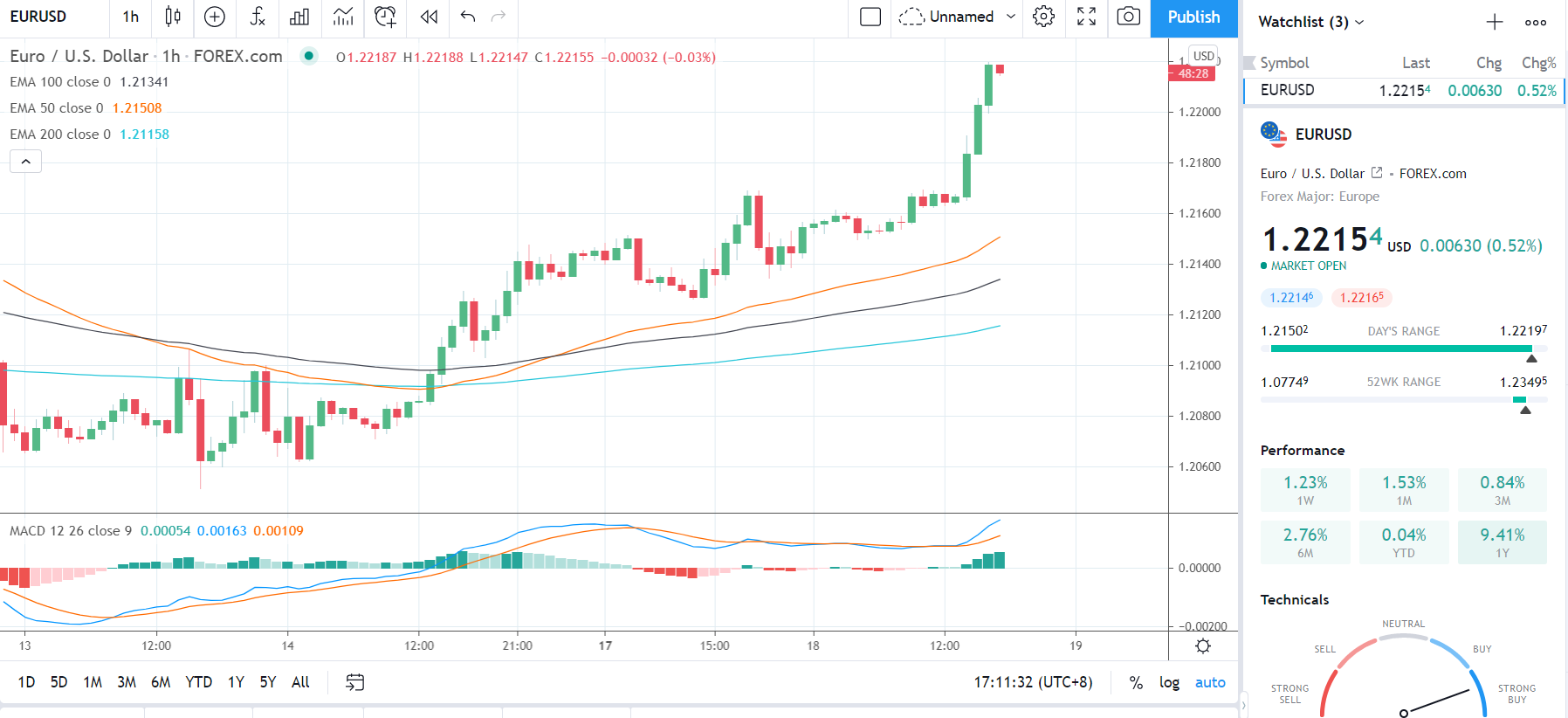
Ahead of the numbers the EUR had risen from a pre-stat and current day low $1.21502 to a pre-stat and current day high $1.22197.
In response to today’s stats, the EUR rose to a post-stat high $1.22187 before easing back to a post-stat low $1.22152.
At the time of writing, the EUR was up by 0.52% to $1.22154.
Next Up
Housing sector figures from the U.S…