


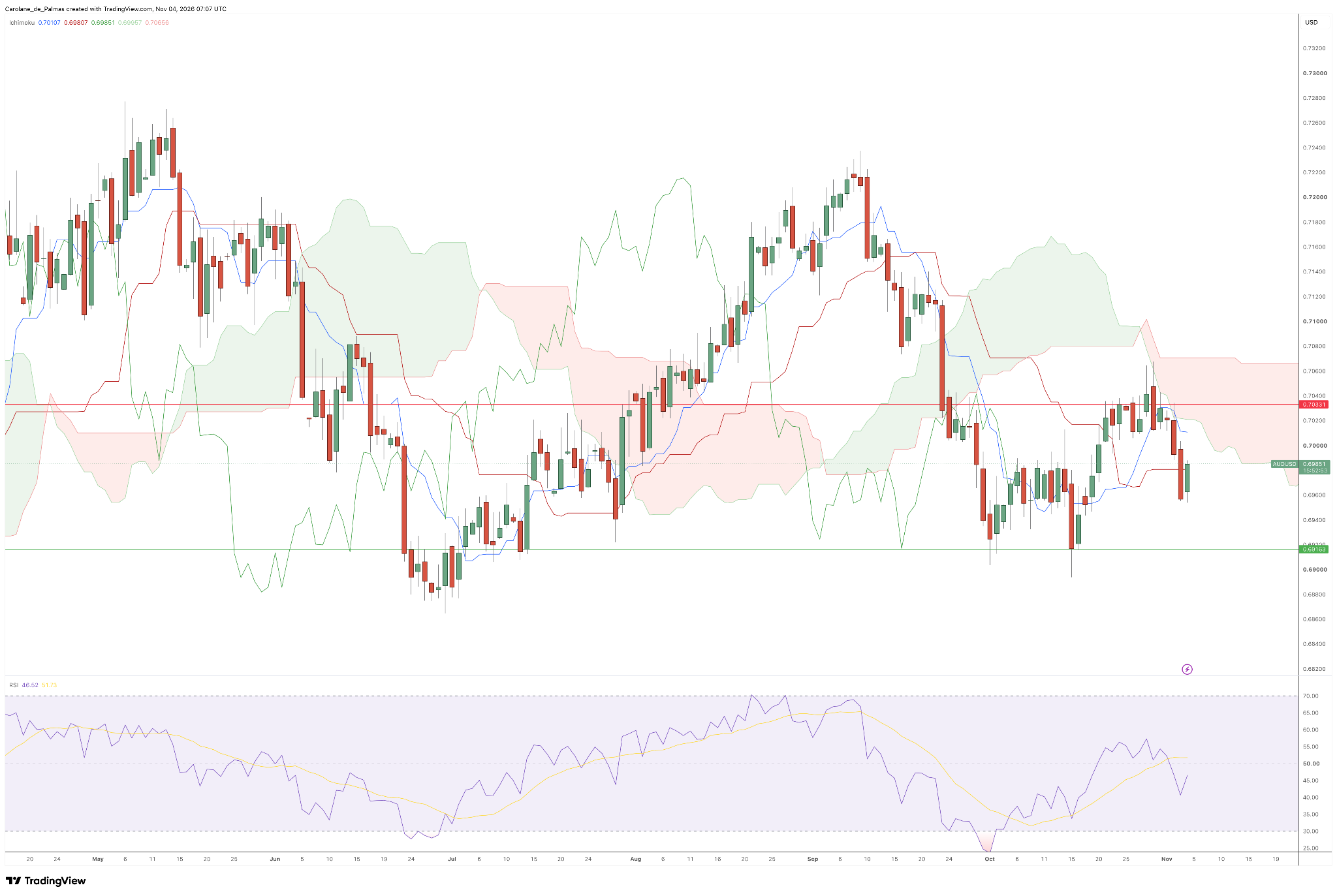
The combination is raising concerns about household spending, employment and economic growth, potentially complicating the outlook for the Australian dollar. On November 3, the RBA increased its official cash rate by 25 basis points to 4.85%, marking its fifth rate hike of 2026. However, the decision was accompanied by a surprisingly divided 6-3 vote, with three policymakers favouring no change. The Australian dollar initially climbed above US$0.70 before reversing its gains, suggesting that investors were more interested in the implications for future monetary policy than the rate increase itself.
For AUD traders, the key question is whether Australia’s relatively high interest rates can continue supporting the currency, or whether mounting pressure on the property market and domestic economy will eventually force the RBA to reconsider its restrictive stance.
Australia’s Housing Market Downturn Puts the Economy Under Pressure
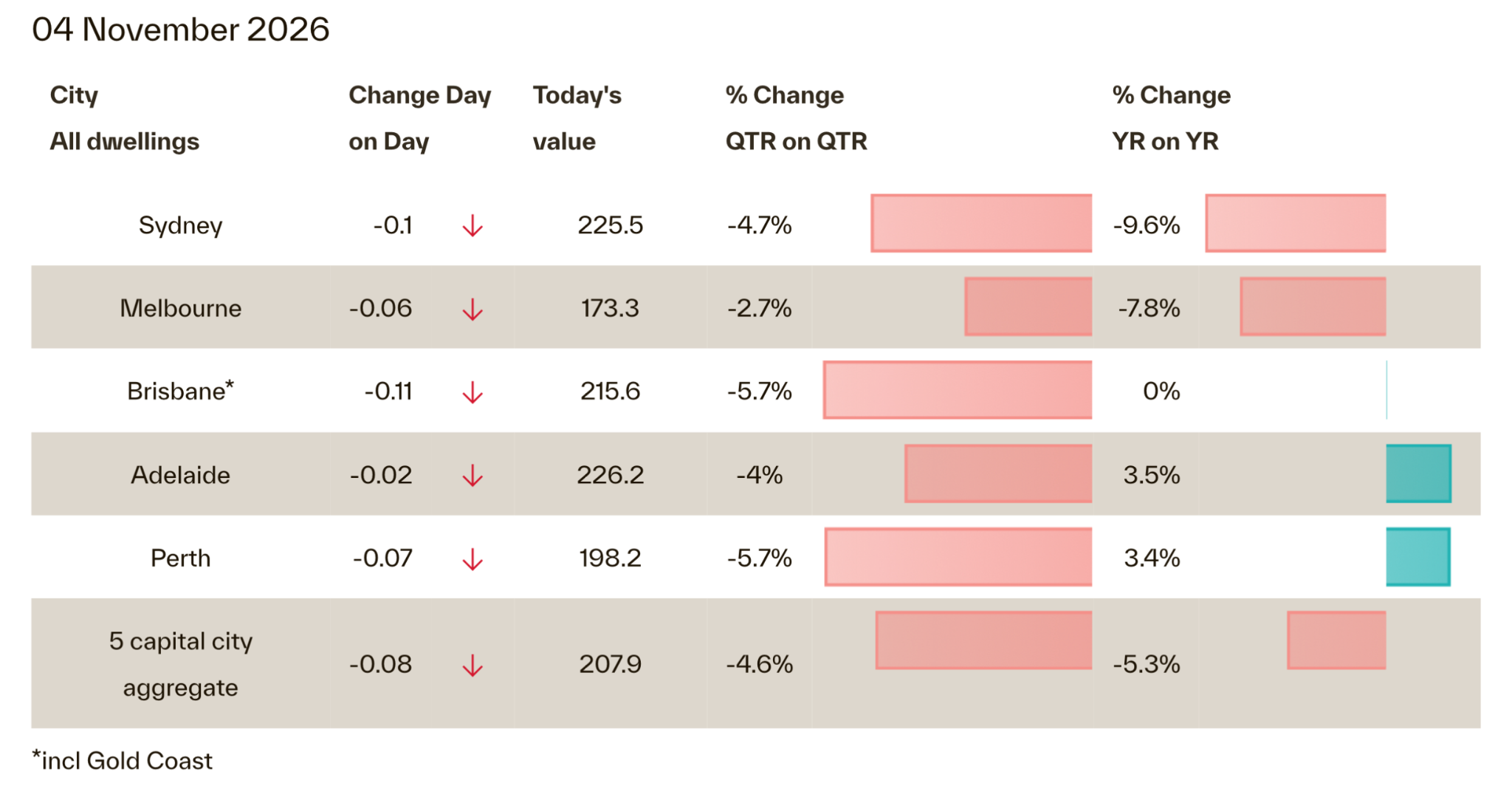
Australia’s property market has become an increasingly important source of concern for policymakers. According to Cotality’s latest Home Value Index, national dwelling values fell by 1.2% in October, extending the decline to seven consecutive months. Prices are now 6.7% below their March 2026 peak, while combined capital-city values have fallen by 8.1% over the same period. Cotality described the pace of the correction as the fastest in four decades.
The downturn reflects several overlapping pressures. Higher mortgage rates have reduced borrowing capacity and increased repayment costs, while persistent cost-of-living pressures and weaker consumer confidence have discouraged prospective buyers. Changes to property investment tax incentives announced in the federal budget have also contributed to weaker investor demand.
The correction is particularly significant because Australian households have substantial exposure to residential property. Falling valuations can generate a negative wealth effect, encouraging homeowners to save more and postpone discretionary purchases. This could weigh on retail sales, services activity and overall household consumption, which is an important component of Australian GDP.
The consequences extend beyond homeowners and mortgage borrowers. A prolonged decline in property transactions could affect real estate agencies, construction-related businesses, mortgage brokers and other industries dependent on housing turnover. If falling prices eventually discourage residential construction and investment, the impact on economic activity could become more pronounced.
The RBA’s November economic projections already reflect some of these concerns. The central bank expects GDP growth to remain below potential over the forecast period, with weaker housing conditions, higher interest rates and reduced household purchasing power acting as headwinds. Unemployment is projected to rise to 5.1% by the end of 2028.
Nevertheless, a housing correction does not automatically translate into a financial crisis. According to the RBA, most borrowers would retain positive equity even if residential property prices declined by 20%. The more immediate concern for the Australian economy is therefore the cumulative effect of higher debt-servicing costs, weaker household confidence and reduced spending.
AUD/USD Price Forecast
Every new AUD/USD analysis as it publishes, today's technical signal and key levels, live price — on one page.
See all AUD/USD forecastsWhy the RBA Continues Raising Rates Despite Falling House Prices
The RBA’s November decision highlights the difficult balance facing Australian policymakers. While housing conditions are deteriorating and unemployment is rising, inflation remains too high to justify an immediate shift towards monetary easing.
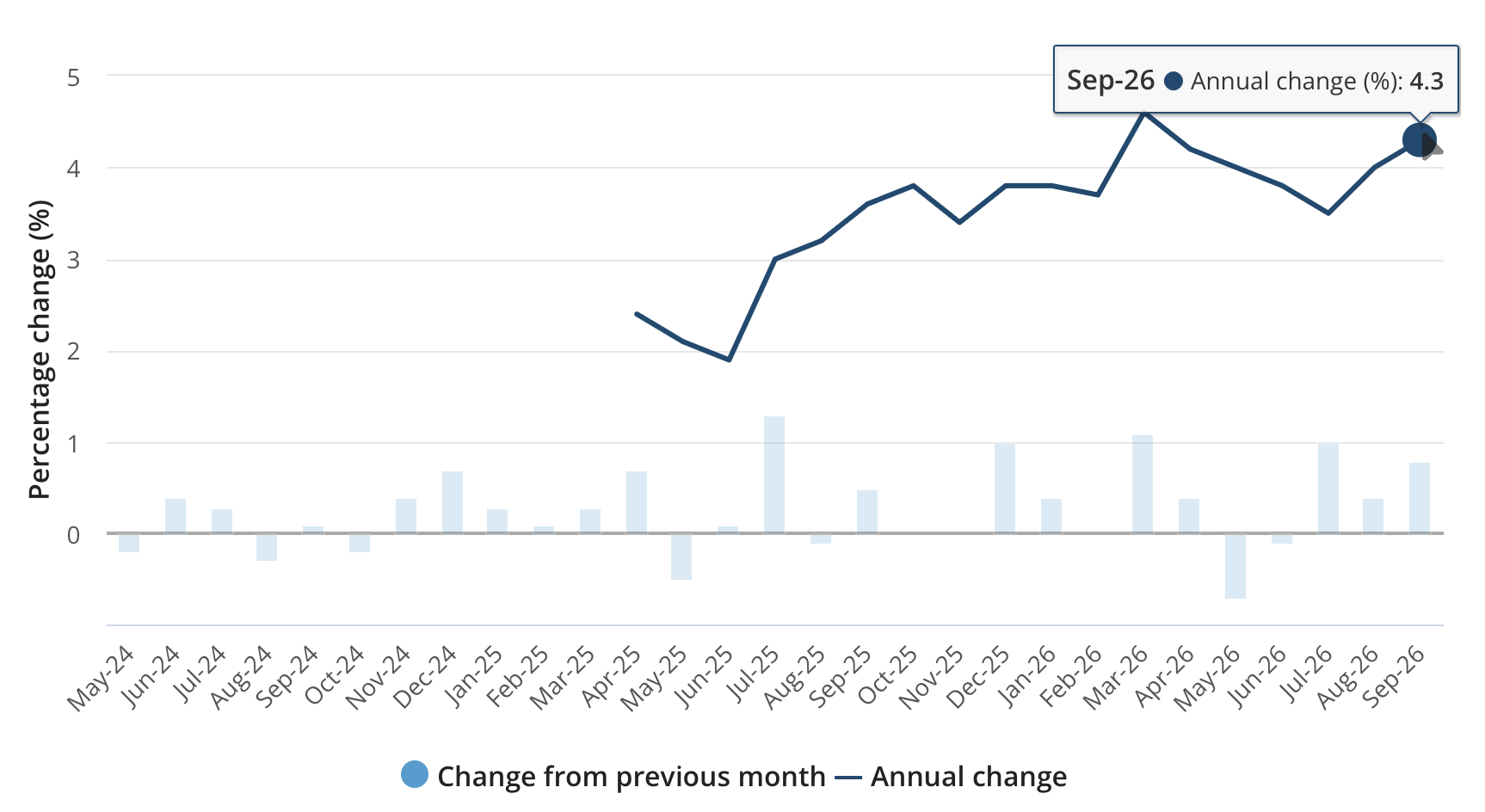
The Australian Bureau of Statistics reported that consumer prices increased by 4.3% over the 12 months to September 2026, compared with 4.0% in August. Trimmed mean inflation, which excludes unusually large price movements and provides a measure of underlying inflation, increased to 3.6%. Both measures point to persistent price pressures.
The RBA’s quarterly assessment also highlighted the persistence of underlying inflation, with trimmed mean inflation reaching 3.7% in the September quarter. The central bank expects headline inflation to peak at 4.5% in the December quarter of 2026, partly reflecting higher energy prices and the pass-through of fuel costs into other goods and services.
This creates a policy dilemma. Cutting rates prematurely could undermine the RBA’s efforts to bring inflation back towards its 2–3% target range. However, maintaining restrictive monetary conditions for too long could amplify the housing downturn, weaken consumption and increase unemployment.
The November vote illustrates these divisions. Although six board members supported the 25-basis-point increase, three favoured keeping rates unchanged. Governor Michele Bullock also indicated that the next move was uncertain and that policymakers needed time to assess the effects of previous tightening.
Importantly for currency markets, the RBA removed an explicit reference to the possibility of further increases from its policy statement. This helped fuel expectations that November’s decision could mark the end of the tightening cycle, even though inflation risks remain tilted to the upside.
AUD Outlook: Higher Interest Rates Versus Weaker Economic Growth
From a foreign exchange perspective, higher Australian interest rates can support the AUD through interest-rate differentials. When Australian yields become more attractive relative to those available in other developed economies, international investors may increase their exposure to Australian dollar-denominated assets.
This can also improve the appeal of carry trades, in which investors borrow in a lower-yielding currency to invest in a higher-yielding one. However, the attractiveness of such strategies depends on more than nominal interest rates. Expected exchange-rate movements, volatility and the cost of hedging currency exposure also matter.
Australia’s latest rate increase initially appeared supportive of the currency. However, the AUD subsequently weakened as investors interpreted the divided vote and less explicit forward guidance as signs that the RBA could be approaching the end of its tightening cycle. Reuters reported that the currency fell approximately 0.3% to US$0.6977 following the decision.
This reaction illustrates an important distinction for traders: a rate increase is not necessarily bullish for a currency if markets have already priced it in or if the accompanying communication is less hawkish than expected.
The housing downturn could become a more important bearish factor if it starts feeding into weaker consumption, employment and business investment. A deterioration in domestic economic conditions would increase the likelihood of a future shift towards monetary easing, potentially reducing the AUD’s yield advantage.
However, the relationship is not straightforward. If inflation remains elevated despite weaker growth, the RBA may be reluctant to cut rates. Such a scenario could leave Australia with relatively high interest rates but increasingly fragile domestic economic conditions. The resulting uncertainty could limit the AUD’s upside, particularly if investors become more concerned about the risk of a recession.
Sources: RBA, Reuters, ABS, The Wall Street Journal, Cotality, ABC News