
We are getting closer to the end of 2025, and what a roller coaster kind of year it has been for Bitcoin (BTC) investors.
From lows of around $75,000 in April to a new all-time high of $126,000 in October and now down again to $80,000, you needed discipline not to succumb to the FOMO and stomach not to sell at the bottom.
President Donald Trump’s hostilities with China on the trade front, plus some uncertainty on the macroeconomic front, contributed to this spike in volatility.
At the time of writing, the top crypto is sitting on year-to-date losses of 1.6% while a handful of altcoins like XRP (XRP) and BNB (BNB) have done better, with the latter making new all-time highs at $1,360 just a few weeks ago.
What could we expect from Bitcoin (BTC) by year’s end? Let’s dive into the most relevant on-chain metrics, fundamentals, and technical indicators that could paint the picture of what we could expect for the next few days.

Bitcoin’s DeFi Ecosystem is Now the 4th Largest in the Market
Bitcoin’s DeFi ecosystem has experienced a boost this year as decentralized applications like Babylon Protocol, Lombard Finance, and the Threshold Network have experienced an increase in usage.
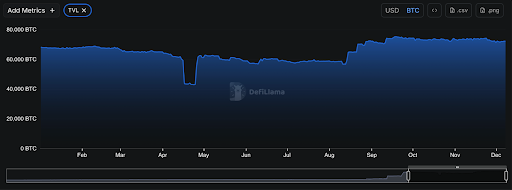
Bitcoin Blockchain Total Value Locked (TVL) (In BTC) – Source: DeFi Llama
The total value locked (TVL) of these three apps combined currently stands at 82,616 BTC tokens, worth approximately $7.4 billion at the time of writing. These protocols offer access to liquid staking, yield-farming, and lending solutions that offer attractive yields to investors without forcing them to leave the Bitcoin blockchain.
By leveraging other networks and cross-chain protocols, they can lock up their BTC tokens and maintain custody of their assets but receive the corresponding assets on a faster and cheaper L1 or L2 to access this growing list of DeFi applications.
Shortly, Bitcoin has become the 4th largest chain in the DeFi ecosystem with a TVL of $6.5 billion, already stepping on the hills of the Binance Smart Chain (BNB). Meanwhile, the network’s TVL, expressed in BTC, rose by 6% since the year started.
Investors may increasingly realize that they can earn yield on their assets safely, meaning that BTC would transform into more than just digital gold, as it will now be able to generate passive income for token holders.
This favors a bullish BTC price prediction for the long-term, as new use cases are being unlocked as we speak.
On the ETF front, these vehicles have grown to become the indisputable titans of the industry. BlackRock’s iShares Bitcoin Trust ETF (IBIT) spearheads the market with total assets under management of $72 billion.
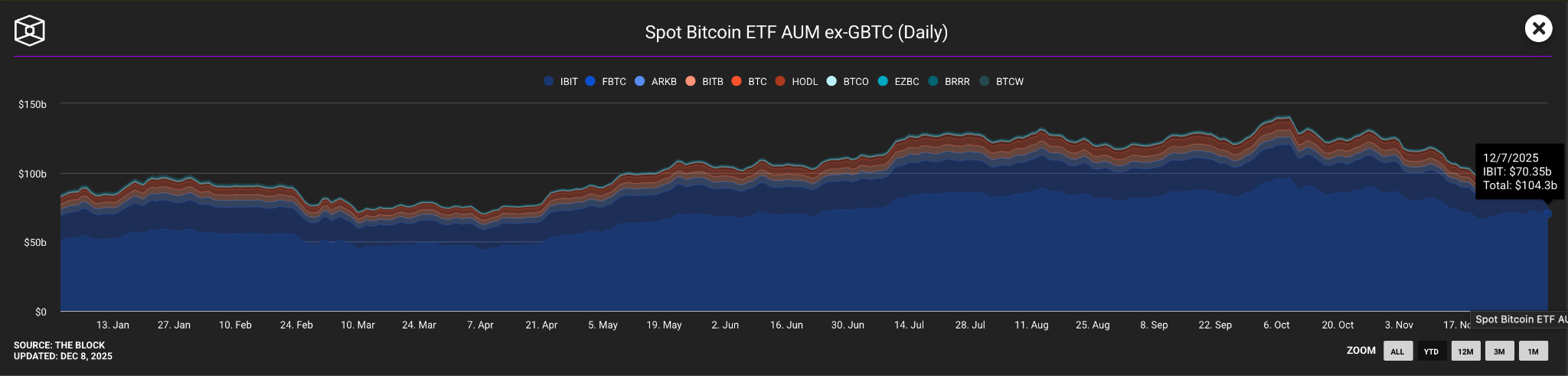
Bitcoin Spot ETFs AUM – Source: The Block
This vehicle has become the 27th largest ETF in the U.S. market, flipping long-standing vehicles like the iShares Gold Trust (IAU), which offers exposure to the precious metal, by $7 billion. Is this a sign of the times?
Overall, the combined assets under management of BTC-linked ETFs currently sits at $104 billion, resulting in a $20 billion (23%) increase thus far in 2025.
Growing retail and institutional adoption is a tailwind for Bitcoin at the time. In addition, the Trump administration is in favor of including digital assets on 401(k)s.
This would be huge for cryptos, especially for BTC, as billions of dollars would flow to the token rapidly once the Labor Department creates the necessary guidelines to get this going.
Bitcoin Price Forecast
Every new Bitcoin analysis as it publishes, today's technical signal and key levels, live price — on one page.
See all Bitcoin forecastsBitcoin Has Dropped by More than 50% Every Time This Happens
Now heading to the charts, let’s start with a high time frame for Bitcoin. The weekly has sent an interesting sell signal lately that could anticipate a huge breakdown.
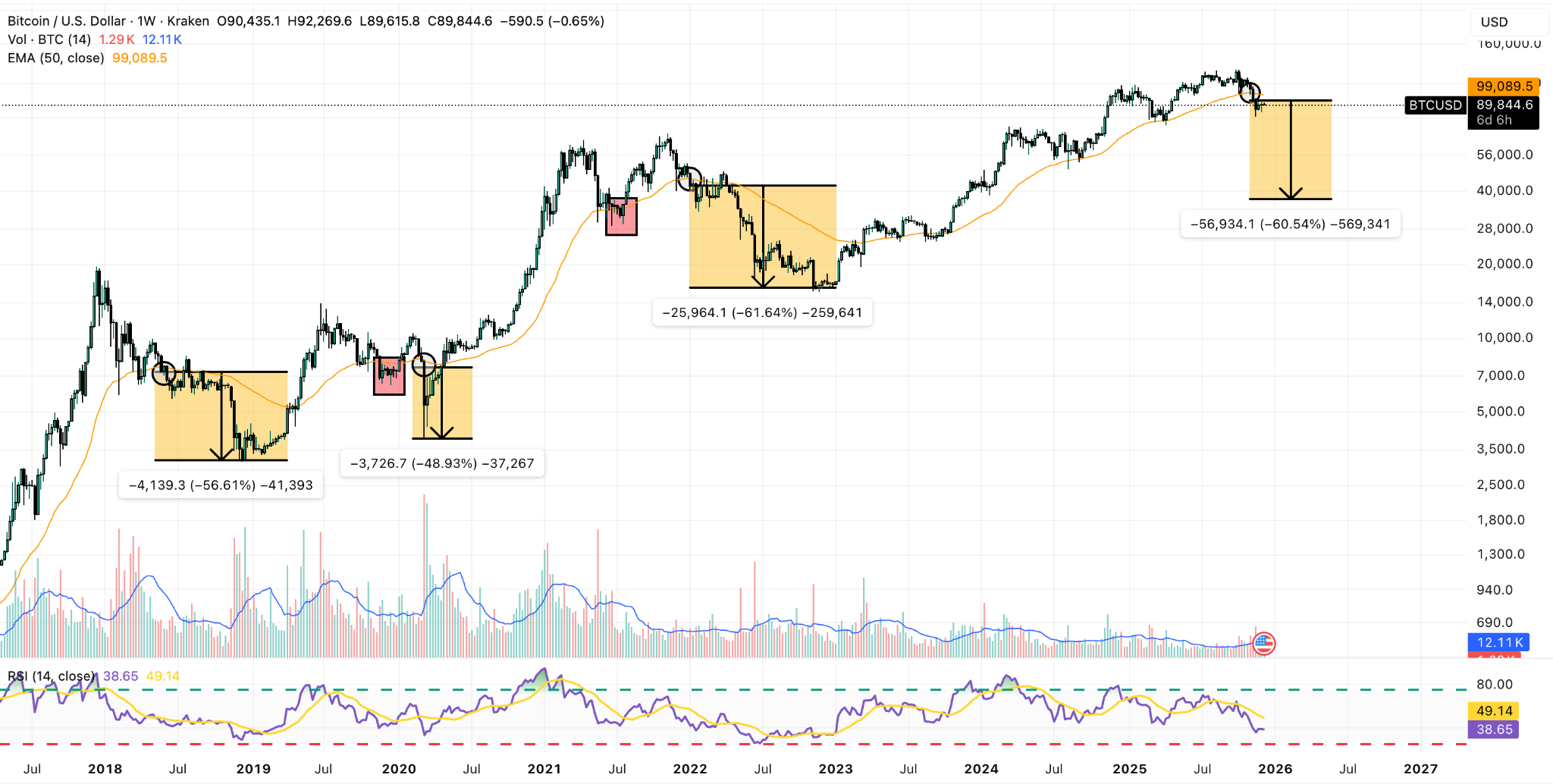
BTC/USD Weekly Chart (Kraken) – Source: TradingView
BTC broke below its 50-week exponential moving average (EMA) and could risk a major drop if historical patterns repeat. The last time that BTC dropped below this key line, it resulted in a 60% loss.
If history repeats, our mid-term target for Bitcoin would be around $36,000.
Meanwhile, this bearish breakout has happened three times in the past 7 years. Almost every time, it has resulted in a big drop for the top crypto. The milder loss of all these three previous instances was 50%, measured right after the breakout occurred.
Is this time any different? In 2020, it was the pandemic. In 2022, it was interest rates.
What exactly justifies that Bitcoin loses 60% of its value this time? Not much is there to drive that kind of price decline.
Also, there have been some false positives along the way. One in late 2019 and the other between June and August 2021. In those two instances, we got a false breakout, and then the market went on to rally and actually retest its previous all-time high just a few weeks after in 2021.
I lean toward this scenario more than the 60% catastrophic drop just because we don’t really have a macro catalyst that justifies such a move.
Bitcoin Forms Uptrend But Risks Persists
Looking closely at the daily chart, we can see that the downtrend has started but a couple of strong support areas stand in the way for that bearish target to be hit in 2026.
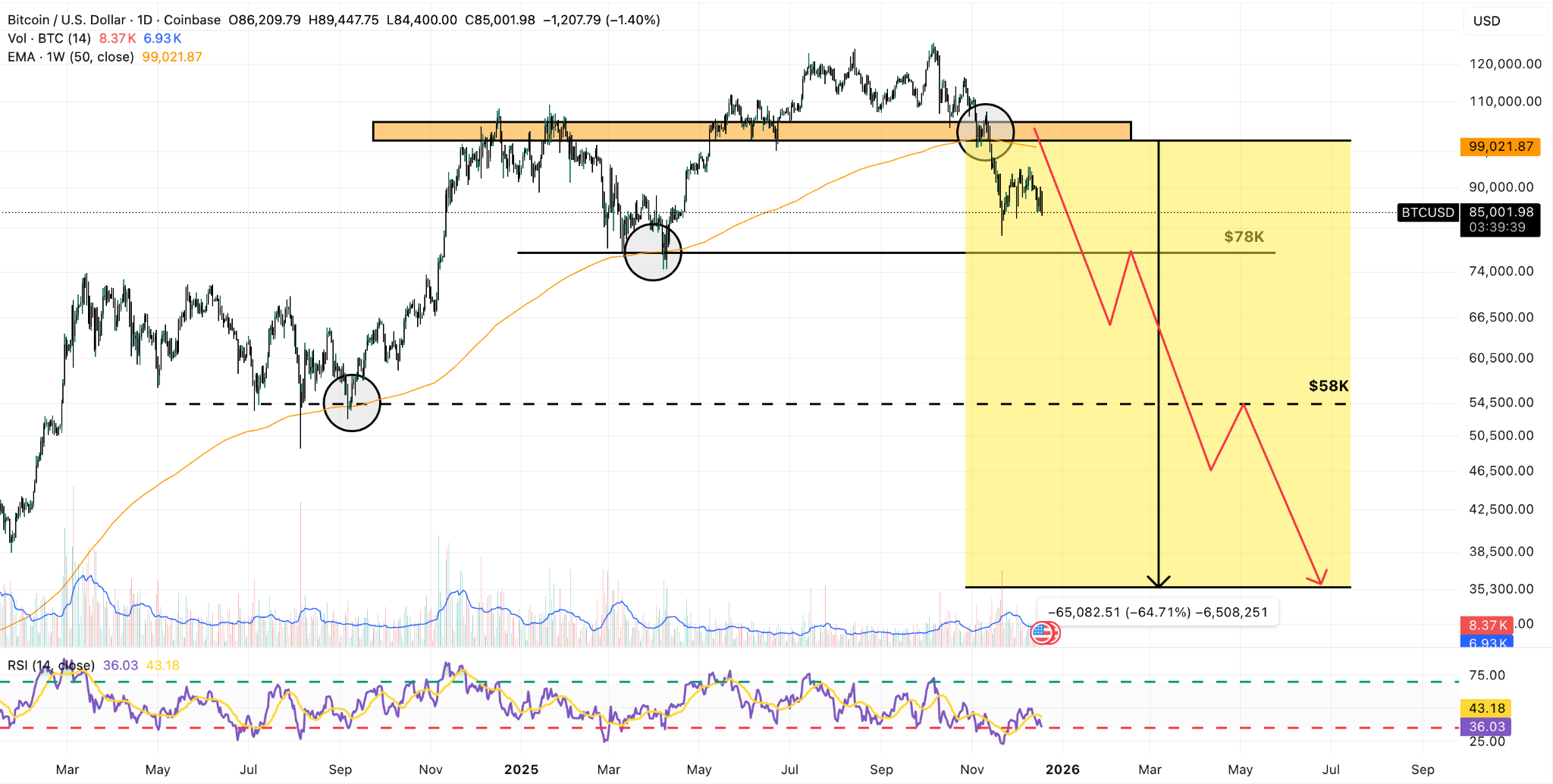
BTC/USD Daily Chart (Coinbase) – Source: TradingView
The first one sits at $78,000, a level from which BTC bounced in April this year. Back then, sentiment was quite similar to right now. The Fear and Greed Index had reached a low of 15 and open interest (OI) in the futures market showed low participation.
These two metrics are commonly interpreted as contrarian signals, meaning that when they are down big, the market tends to be close to hitting a local bottom. Shortly after bouncing off this level, BTC hit a new all-time high.
This support area must be broken somewhere during the first quarter of 2026 if the downtrend will continue toward our bearish target.
Market conditions are not necessarily supporting that kind of downside, so the price will likely bounce strongly after hitting that mark. We could expect some sideways trading after that, followed by a definite breakout to $58,000.
Keep in mind that this bearish outlook is based on historical patterns that will not necessarily repeat exactly the same. The magnitude of BTC’s losses after dropping below the 50-week EMA may be smaller compared to previous cycles.
Nonetheless, what the charts do confirm is that BTC has started a bearish cycle. Whether that takes us to $78,000, $58,000, or $36,000, that will depend on whether we get strong price drivers that accelerate the downtrend, or not.