
Bond ETFs Ideal Tools for Tapping Vast Fixed Income Market
Many investors focus on equities on because stocks are more transaction than bonds, but those market participants don’t realize that the global bond market is significantly larger than its equity counterpart.
As of mid-2025, data from the Securities Industry and Financial Markets Association (SIFMA) indicate the total global equity market capitalization is $115 trillion. A big number to be sure, but one dwarfed by the $140 trillion size of the bond market. By some estimates, the fixed income market could approach $161 trillion by 2030.
Obviously, the size of the global bond market is noteworthy. So is the fact that exchange traded funds (ETFs) account for just a silver of that heft — $2 trillion to be precise. That’s a scant percentage of the $140 trillion mentioned above and dispels the notion that ETFs are disrupting some corners of the bond market in negative fashion.
What’s not up for debate is the fact bond ETFs are some of the fastest growing ETFs and fixed income products of any stripe. By 2030, global fixed income ETF assets under management could triple to $6 trillion, according to BlackRock. Point is the bond market is growing and fixed income ETFs are going along for the ride confirming that investors need to understand bond ETF mechanics as well as concepts such as credit and duration.

A Glance at Bond ETFs
The bond ETF universe spans several distinct segments, and each has its own risk/return trade‑off and role in a portfolio. To set the stage for the rest of this primer, the table below summarizes the major families – Treasuries, TIPS, investment‑grade corporate, high‑yield and municipal – along with their typical credit quality and why investors use them. Keeping the focus on keywords rather than long sentences helps you quickly compare the categories.
| ETF family | Typical credit quality | Why investors use them |
| Treasuries (nominal) | AAA/AA – backed by the U.S. government | Core holdings and “flight‑to‑safety” anchor; lowest credit risk |
| TIPS (inflation‑protected Treasuries) | AAA/AA – principal adjusts with inflation | Hedge against rising inflation; preserve real purchasing power |
| Investment‑grade corporate | BBB to AAA depending on issuer | Enhance income versus Treasuries; moderate credit risk |
| High‑yield (junk) | BB and below | Maximise carry and potential upside; higher default risk |
| Municipal | AA/A on average | Tax‑exempt income for high‑tax investors; low default rates |
Some bond ETFs also invest in specialized backed securities, such as asset-backed securities (ABS) and mortgage-backed securities (MBS), which are supported by pools of loans or mortgages.
Understanding which sleeve you’re accessing – and why – makes it easier to choose the appropriate fund and manage the trade‑off between yield, credit risk and duration. The credit quality and risk of a bond ETF depend on the bond issuer, whose ability to meet interest and principal payments is assessed by credit rating agencies. Bond ETFs allow investors to build a diversified portfolio by holding a broad bond portfolio across issuers, sectors, and maturities. Some bond ETFs focus on longer maturities, which can increase duration and make them more sensitive to interest rate changes.
Benefits of Bond ETFs
Bond ETFs offer investors a powerful combination of diversification, flexibility, and transparency that can be hard to match with traditional bond funds or individual bonds. By investing in a single bond ETF, you gain exposure to a broad mix of bonds—such as U.S. Treasuries, corporate bonds, and municipal bonds—helping to balance risk across different issuers, sectors, and maturities. This built-in diversification can reduce the impact of any one bond defaulting or underperforming, making it easier to manage risk in your fixed income portfolio.
Another key advantage is flexibility. Because bond ETFs trade on major exchanges just like stocks, investors can buy or sell shares throughout the trading day at market prices. This intraday liquidity means you can respond quickly to changing market conditions, unlike traditional bond funds, which only transact at the end of the day. The ability to trade ETFs on the secondary market also helps investors manage their exposure to interest rate risk and credit risk more efficiently.
Transparency is another hallmark of bond ETFs. Most funds disclose their holdings daily, so you always know exactly which bonds you own and can monitor the credit quality and sector allocation of your investment vehicle. This level of visibility is a significant improvement over many traditional bond funds, which may only report holdings monthly or quarterly.
Bond ETFs are also generally more tax efficient than mutual funds. Because ETFs do not have to sell underlying bonds to meet investor redemptions, they can help minimize capital gains distributions, making them a tax-efficient choice for many investors. Whether you’re seeking to generate income, balance risk, or simply want a low-cost way to access the bond market, bond ETFs offer a compelling solution for both new and experienced investors.
Understanding Credit, Duration, Interest Rate Risk and Effects on Bond ETF Prices
All bonds, be they debt issued by countries, cities or corporations, are rated or graded. The three major ratings agencies are Fitch Ratings, Moody’s Investors Service and S&P Global Ratings. Their ratings systems are easy to understand.
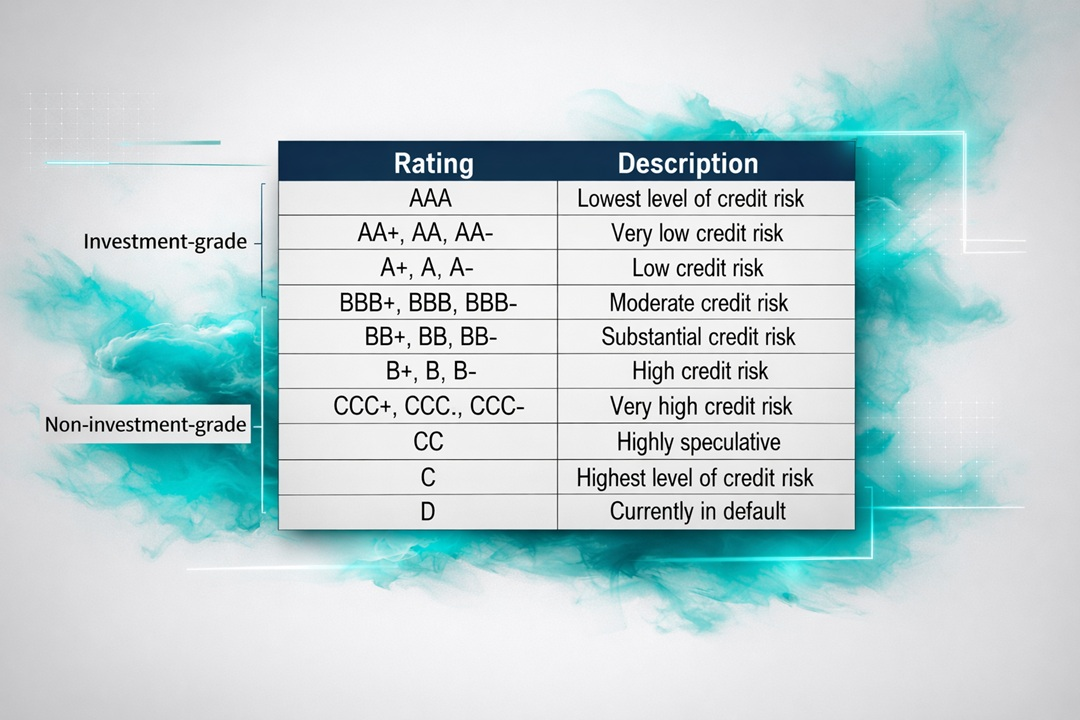
Ratings affect yields, which move inversely to bond price. Translation: When a bond price increases, its yield declines and vice-versa. Another point pertaining to bond yields investors must acknowledge is that the higher a bond’s rating is, the lower its yield will be.
That’s because bond yields also reflect the credit risk an investor is taking on. Let’s use a real world ETF example. The iShares 7-10 Year Treasury Bond ETF (IEF) only holds U.S. Treasuries with durations of seven to 10 years. Because that ETF only holds debt issued by the U.S. government – arguably the most trustworthy issuer in the world – all of its holdings are rated “AA” and the ETF yields 3.84%. The market price of a bond ETF like IEF can differ from its net asset value (NAV) due to supply and demand, sometimes trading at a premium or discount.
On the other hand, the iShares iBoxx $ High Yield Corporate Bond ETF (HYG) holds junk-rated corporate bonds – an asset class viewed as riskier than sovereign debt. Nearly 88% of that ETF’s holdings are rated “BB” or “B” and another 10% sport highly speculative “CCC” grades, but investors are compensated for that risk in the form of a 6.30% yield.
As noted above, understanding duration is equally central to bonds as are credit ratings. In simple terms, duration measures a bond’s sensitivity to changes in interest rates. The longer a bond’s duration is, the more responsive it will be, in both directions, to rate fluctuations. Bond prices tend to rise when interest rates fall and decline during periods of rising interest rates. Look at the table below, courtesy of BlackRock, it’s applicable to both individual bonds and fixed income ETFs.

Investors must also understand that a bond’s coupon – the rate at which returns cash to investors – and duration are intertwined. The lower a bond’s coupon, the longer its duration and vice versa.
Unlike individual bonds, most bond ETFs do not have a set maturity date or principal payments at maturity. Individual bonds have a specific maturity date and repay principal payments at maturity, while bond ETFs typically do not. For example, a 5-year zero coupon bond may be more sensitive to interest rate changes than a 7-year bond with a 6% coupon,” according to BlackRock. “By comparing the bonds’ durations, you may be able to anticipate the degree of price change in each bond assuming a given change in interest rates. Accordingly, duration calculations may help you more precisely structure your portfolios against the backdrop of their overall investment objectives and risk tolerance.”
Understanding Treasuries and TIPS (Government Bonds)
Just as ETFs do with stocks, these products eliminate the need for market participants to select individual securities in the bond market where that task is no easier than it is in the world of equities. Just look at the depth of the Vanguard Total Bond Market ETF (BND). It holds 11,410 bonds – a deep bench to be sure.
BND is what’s known as an aggregate bond ETF, meaning it holds U.S. bonds across multiple segments, but the bulk of its holdings are U.S. government issues. These funds hold a wide range of debt securities, including Treasuries, agency bonds, and other fixed income instruments. The value of the ETF is based on its underlying securities, which determine its net asset value (NAV) and influence its market price. The deep benches found in ETFs such as BND are testament to prolific issuing activity of the U.S. government, which makes Treasuries the largest, most liquid fixed income market in the world.
Given that the U.S. Treasury holds 300 or more auctions per year, a dizzying amount of new Treasury supply comes to market annually, making ETFs appealing for investors that want exposure to broad baskets of high-quality government debt. Aggregate bond ETFs provide a convenient way to access diversified bond investments, allowing investors to benefit from professional management and broad exposure without having to select individual bonds.
Don’t Forget TIPS: Inflation‑Protected Treasuries
Alongside “nominal” Treasuries sits a special subset of government bonds known as Treasury inflation‑protected securities (TIPS). These bonds are indexed to the Consumer Price Index so their principal value and semi‑annual interest payments adjust higher when inflation accelerates and reset lower when deflation occurs. Because of this built‑in adjustment, TIPS typically offer lower starting yields than comparable nominal Treasuries, but they help preserve real purchasing power over long holding periods. TIPS are a valuable tool for fixed income investing, especially for those seeking protection against inflation. Investors are guaranteed to receive at least their original principal back at maturity, even if there’s a bout of deflation.
TIPS come in five‑, 10‑ and 30‑year maturities and are backed by the full faith and credit of the U.S. government. You can buy them directly through TreasuryDirect or gain diversified exposure via ETFs such as iShares TIPS Bond ETF (TIP) or Vanguard Short‑Term TIPS ETF (VTIP). Be mindful that inflation protection is not a short‑term hedge: like all bonds, TIPS can lose value when interest rates rise and are best suited for investors seeking long‑term protection against rising living costs.
Speaking of government bonds, Uncle Sam is far from the only game in town and that also speaks to the advantages of ETFs. That’s especially true for fixed income investors looking for yield opportunities outside the developed world. Take the case of the iShares J.P. Morgan USD Emerging Markets Bond ETF (EMB), one of the oldest and largest ETFs of its kind.
As its name implies, EMB holds bonds issued by governments in developing economies. That’s a tantalizing, but potentially perilous asset class for income investors. Tantalizing because those bonds often yield well in excess of comparable developed markets fare. For its part, EMB yields 5.54%. Perilous because the buyer of an individual country’s debt could, absent adequate due diligence, be subject to considerable country-specific risk. Argentina anyone?
Bottom line: Emerging markets debt is worth examining for many bond investors, but it can be a minefield of asset class when going country-by-country. ETFs ease that burden while providing above-average yields and cost efficiencies.
Corporate Bond ETFs: Excellent Tools for Income Hunters
Though dwarfed by Treasuries, the U.S. corporate bond market is massive in its own right. As of June 30, 2025, the outstanding value of the U.S. corporate debt space was a staggering $11.4 trillion with daily dollar volume of $58.6 billion, implying many of the ETFs addressing this arena are sufficiently liquid as to keep spreads and total cost of ownership. In fact, corporate bonds, particularly those with the junk label, are prime examples of the advantages of the ETF wrapper and its ability to source liquidity.
“ETFs’ robust secondary market allows investors to tap into market liquidity more easily than they can with single-CUSIP bond holdings,” according to State Street Investment Management. “This enables them to reallocate portfolios quickly across asset classes or meet investor redemptions by selling an ETF position into the market without having to sell single-CUSIP bonds. Fixed income ETFs are also more liquid than mutual funds, as ETFs trade intraday and mutual funds are typically transacted end of day.” Investors can choose from a wide range of fixed income products, including different types of bond ETFs, to suit their portfolio needs.
Corporate bonds and the related ETFs are appealing to investors because they generally feature higher yields and better return potential than equivalent Treasury funds and that’s true even with investment-grade corporate debts. Remember the iShares 7-10 Year Treasury Bond ETF (IEF) mentioned earlier? The Vanguard Intermediate Term Corporate Bond ETF (VCIT), which has a similar duration, has beaten the Treasury ETF by a margin of almost 2-to-1 over the past three years. As highlighted below, corporate bonds of both stripes have enviable performance histories in the U.S. Among corporate bonds, convertible bonds are a unique type that can be converted into company stock before maturity, offering potential for higher returns through conversion, though they typically have lower coupons compared to regular bonds.
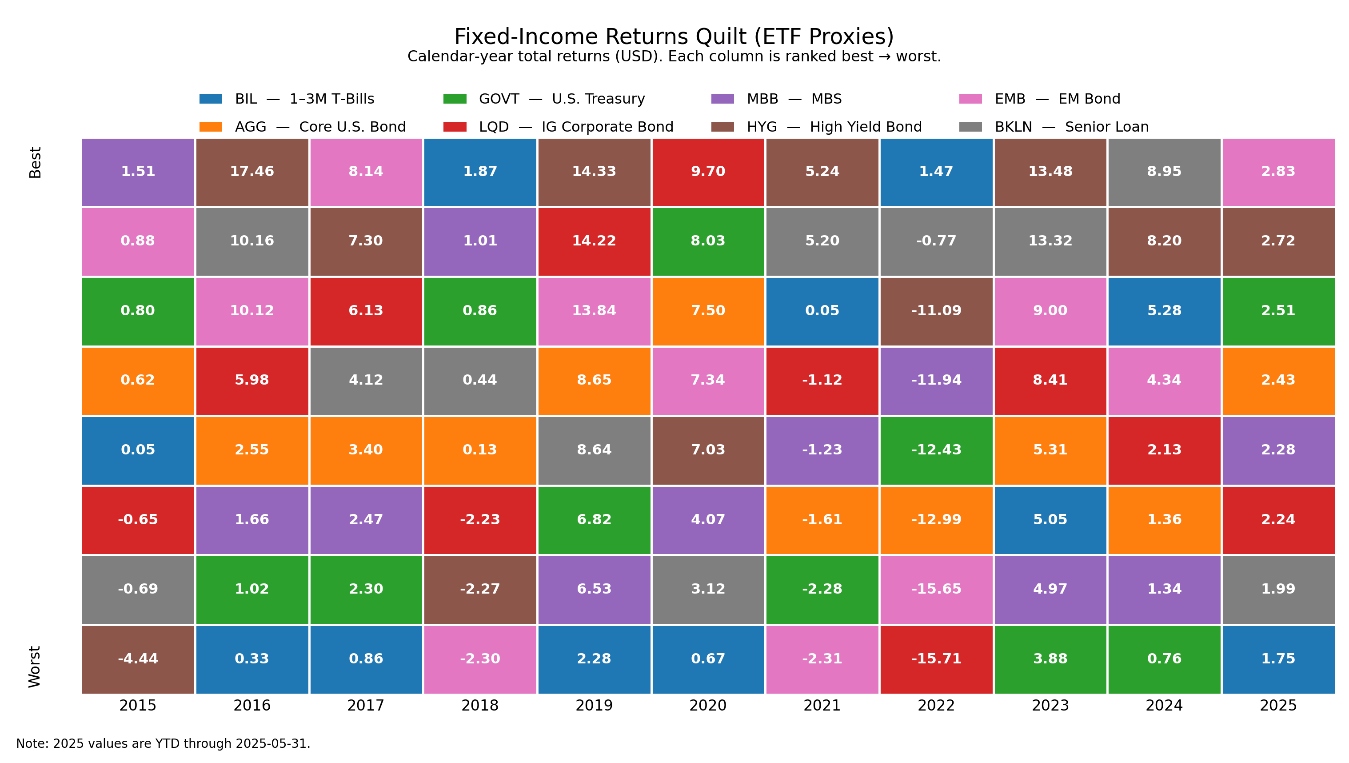
Where corporate bonds and thus the related ETFs differ from their sovereign counterparts is that investors must be mindful of both credit and rate risk. Longer-dated corporate bonds sensitive to interest rate changes, but that sensitivity wanes as investors move down the duration ladder.
What doesn’t wane is the specter of credit risk, particularly with junk bonds. They’re junk for a reason, though those bonds and the related ETFs compensate investors for the higher risk profiles with higher yields. Hence the term “high-yield.” Certain preferred securities have generally lower credit ratings than the bonds issued by the same company, reflecting their subordinate position in the capital structure.
That’s not to say default risk is high. It’s not. Only a scant percentage of corporate bond issuers ultimately default, but if they’re big issuers, meaning they’ve taken on large weights in passive funds, those defaults can wreak havoc on passive strategies.
“Unlike active portfolios, market indices don’t consider an issuer’s declining credit rating or default risk. This risk tends to be more prevalent in slowing economies, when credit risk typically rises,” notes American Century. “Passive strategies with investment-grade mandates may have to sell securities with declining credit ratings as their prices are falling.” When comparing passive bond ETFs to actively managed funds, it’s important to note that actively managed funds often have higher expenses and a different management style, while bond ETFs generally offer lower expenses and greater transparency.
Translation: Active management is can be impactful with corporate bonds because that management style, which is accessible via growing number of ETFs, can guard against credit and rate risk while unearthing credit opportunities for investors. Bond ETFs often have low expense ratios compared to other investment vehicles, which can help maximize income. Additionally, investors should consider the past performance of bond ETFs before investing, as historical returns can provide insight into management effectiveness. Bond ETFs also offer tax efficiency and tax advantages over other investment vehicles, helping investors optimize after-tax returns.
Be Mindful of Municipal Bonds
Relative to corporate and emerging markets debt, municipal bonds come across as boring, but that lack of excitement shouldn’t belie the utility of this fixed income segment.
The size of the U.S. municipal bond market is large – $4.3 trillion at the end of the second quarter – and that’s the result of the variety of issuers that participate in the space. Those include cities, states, school and water districts and more. In short, municipal bonds are issued to pay for projects intended to benefit the public at large, such as hospitals, roads and schools.
Municipal bonds are usually issued in one of two forms: general obligation or revenue bonds. The former are backed by the “full faith and credit” of the issuer while the latter are supported by the revenue generated by the project the bonds are being issued to support. For example, municipal bonds sold to build a toll road would be classified as revenue bonds.
While there have been instances of U.S. municipal defaults, they’re few and far between, reminding investors of the fact that credit ratings are high and default is low in this asset class. As a result, individual municipal bonds and the related ETFs often carry low yields. That’s the price investors pay when taking on reduced risk in the bond market. When investing in municipal bond ETFs, investors may also incur brokerage commissions when buying or selling shares, which can affect overall returns.
However, what munis lack in terms of exotic features and high yields, they make up for with tax benefits, making this part of the bond market ideal for older investors, particularly retirees, and those in the high-net-worth category. The reason being is that in many cases, the interest received by muni investors can be deducted from federal income taxes. In some instances, that interest can also be deducted from state and local taxes, creating favorable tax-equivalent yield (TEY) scenarios.
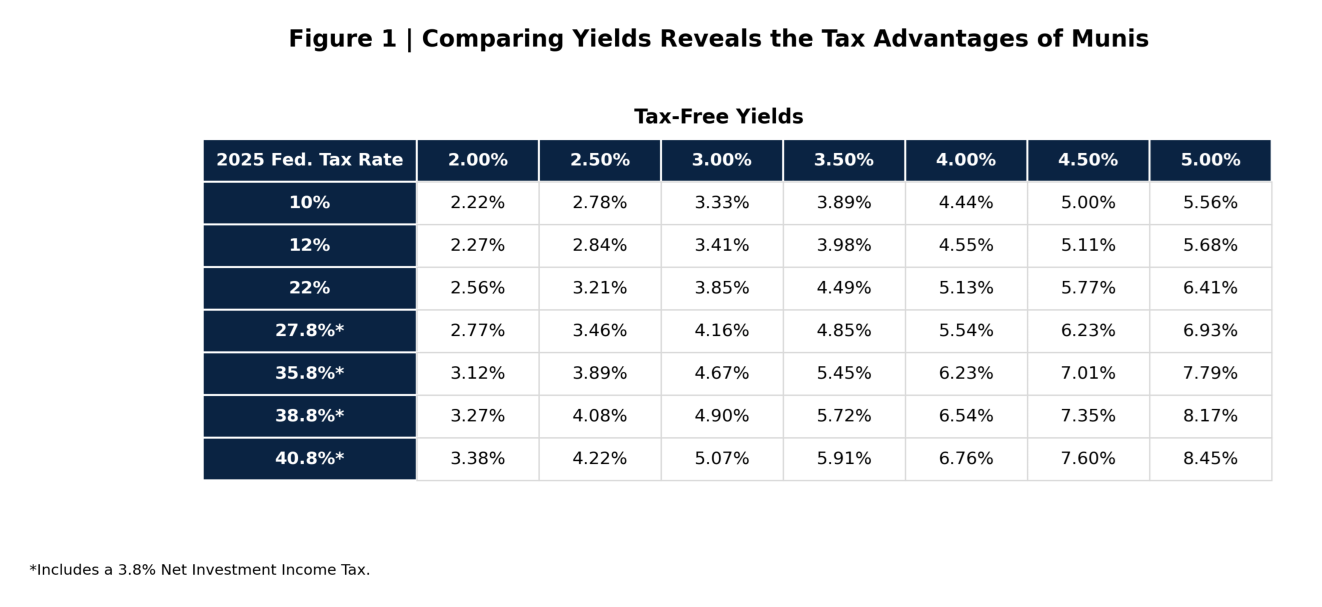
Those tax benefits are especially relevant to wealthy investors living in high-tax states, such as California and New York. Say you’re in that situation and you own a Treasury or corporate bond yield 5%. After Uncle Sam and the state take their share, that yield suddenly looks a lot less attractive.
Bottom line: Taxes are certain, but investors can mitigate some of their federal and state obligations with municipal bonds – a feature that’s not available with other fixed income segments.
Before investing in municipal bond ETFs, investors should carefully review the summary prospectus and consider the fund’s investment objectives, risks, charges, and expenses.
Bond ETF Benchmark Tracking
Most bond ETFs are designed to track a specific benchmark or index that represents a segment of the fixed income market. These benchmarks are typically constructed based on factors such as credit quality, maturity, sector, or geographic region, allowing investors to target their exposure to the areas of the bond market that best fit their investment objectives.
To replicate the performance of their chosen benchmark, bond ETFs use one of two main strategies: full replication or sampling. Full replication means the ETF holds every bond in the index, matching the benchmark as closely as possible. However, because many fixed income benchmarks contain thousands of individual securities—some of which may be illiquid or difficult to trade—most bond ETFs use a sampling approach. This involves holding a representative subset of bonds that closely mirrors the risk and return characteristics of the full index.
The goal of benchmark tracking is to provide investors with returns that closely match the benchmark, while also managing risk and keeping costs low. By using sampling, most bond ETFs can efficiently track their index, maintain high credit quality, and offer investors broad exposure to the fixed income market. This approach allows investors to benefit from the diversification and risk management that come with index investing, without the complexity of buying individual bonds.
Emerging Markets and Currency Risk
Bond ETFs that invest in emerging markets can offer attractive opportunities for higher yields and long-term growth, but they also come with unique risks that investors should understand. Emerging markets are often more volatile and less liquid than developed markets, which can lead to greater price swings and increased risk of losses. Additionally, these markets may have lower credit quality, meaning the risk of default by bond issuers is higher compared to investment grade bonds from developed countries.
One of the key risks in emerging market bond investing is currency risk. When you invest in a bond ETF that holds debt denominated in foreign currencies, changes in exchange rates can impact the value of your investment. If the local currency weakens against the U.S. dollar, for example, the value of your bond holdings may decline even if the bonds themselves perform well in their home market.
To help manage these risks, many emerging market bond ETFs are actively managed. This means a professional management team can adjust the portfolio in response to changing market conditions, credit risk, and currency fluctuations. By carefully selecting bonds with higher credit quality and diversifying across different countries and issuers, these funds aim to balance risk while seeking higher yields and long-term growth potential. For investors willing to accept the added volatility, emerging market bond ETFs can be a valuable addition to a diversified fixed income portfolio.
Active and Passive Management
When it comes to bond ETFs, investors can choose between actively managed and passively managed funds, each with its own set of advantages. Actively managed bond ETFs are overseen by a professional management team that selects securities and adjusts the portfolio in real time to pursue specific investment objectives. This hands-on approach can help the fund respond to changing market conditions, manage risk, and potentially deliver higher returns—though it often comes with higher fees and increased risk.
On the other hand, passively managed bond ETFs aim to replicate the performance of a specific benchmark or index. These funds typically have lower expense ratios and are more tax efficient, as they trade less frequently and are less likely to generate capital gains. While passive bond ETFs may not outperform their benchmarks, they offer a straightforward, low-cost way for investors to gain exposure to the fixed income market.
Choosing between active and passive management depends on your investment objectives, risk tolerance, and time horizon. If you’re seeking to maximize returns and are comfortable with higher fees and some additional risk, an actively managed bond ETF may be appropriate. If you prefer a more hands-off, cost-effective, and tax-efficient approach, a passive bond ETF could be the better fit. Either way, understanding the differences can help investors make informed decisions that align with their financial goals.
Basket‑vs‑Share Liquidity, Net Asset Value, and Premium/Discount Dynamics
One of the most confusing aspects of fixed income ETFs is the notion that the fund’s shares can trade more frequently than the underlying bond basket itself. Most bonds trade over the counter (OTC) in a decentralised marketplace. By contrast, ETF shares trade on exchanges all day long, often changing hands at volumes that dwarf the turnover of their component securities. This secondary‑market liquidity is a key advantage of the ETF wrapper: investors can enter and exit positions without forcing the fund manager to buy or sell individual bonds.
At the heart of this structure is the creation/redemption mechanism. When an ETF’s share price drifts above the value of its underlying holdings (a premium), authorised participants (APs) can deliver the bond basket to the fund sponsor and receive new shares; when the share price falls below net asset value (a discount), APs can buy ETF shares and return them for the underlying bonds. These trades normally keep the share price in line with the value of the basket, but they are not cost‑free: transaction costs and market impact limit how large a premium or discount can grow before arbitrage becomes worthwhile.
During periods of high volatility or bond‑market stress, the spread between the share price and the ETF’s net asset value can widen. Market volatility can significantly impact ETF pricing and liquidity, as rapid fluctuations in bond prices may cause larger premiums or discounts and make it harder for authorised participants to efficiently create or redeem shares. In volatile markets with more sellers than buyers, authorised participants may be less willing to create and redeem shares because they aren’t confident they can offload the bonds at quoted prices. As a result, fixed income ETFs may trade at a discount to the value of their underlying holdings. This doesn’t necessarily mean the ETF is mis‑priced; rather, the fund is providing real‑time price discovery for a less liquid bond market.
For long‑term investors, occasional premiums and discounts are part of the ETF ecosystem and tend to normalise as markets calm. However, understanding the mechanics helps set expectations: the liquidity of ETF shares is not the same as the liquidity of the bonds inside the basket.
Bond Mutual Funds Comparison
Bond mutual funds and bond ETFs both provide access to fixed income investments, but they differ in several important ways. Bond mutual funds are typically actively managed, with a management team making decisions about which bonds to buy and sell in order to meet the fund’s investment objectives. This active approach can offer more personalized service and may be beneficial for investors who want help with asset allocation and portfolio management.
Bond ETFs, by contrast, can be either actively or passively managed. They trade on exchanges throughout the day, offering greater flexibility and transparency than mutual funds, which only transact at the end of the trading day. Bond ETFs also disclose their holdings daily, so investors always know what they own.
In terms of cost, bond ETFs generally have lower expense ratios than bond mutual funds, making them a more cost-effective option for many investors. They are also more tax efficient, as the ETF structure allows for in-kind redemptions, which can help minimize capital gains distributions. However, bond mutual funds may be more suitable for investors who value hands-on portfolio management and personalized service, especially when it comes to asset allocation and rebalancing.
Ultimately, the choice between bond mutual funds and bond ETFs comes down to your investment objectives, risk tolerance, and need for flexibility. Both vehicles offer access to the fixed income market, but understanding their differences can help investors select the best option for their unique financial goals.
Expressing Curve, Credit and Carry Views While Managing Duration
Bond ETFs aren’t just buy‑and‑hold vehicles; they also provide tools for positioning around the yield curve, credit spreads and carry, all while maintaining diversification and liquidity. Here are several ways investors can use them:
• Tilt along the yield curve. By mixing short‑, intermediate‑ and long‑term Treasury ETFs, you can target a particular duration or even implement a curve “barbell.” Vanguard notes that you can recreate the government/credit portion of the Bloomberg Aggregate Index using combinations of its short‑, intermediate‑ and long‑term bond ETFs (BSV, BIV and BLV). Shifting allocations among these buckets allows investors to fine‑tune interest‑rate sensitivity and duration. Expecting rising rates? Emphasise short‑duration funds. Anticipating a recession and falling long‑term yields? Add longer‑duration Treasuries.
• Express a credit view. Corporate bond ETFs come in various maturities and credit qualities. Vanguard highlights that its suite of corporate bond ETFs (VCSH for short‑term, VCIT for intermediate and VCLT for long‑term) allows investors to set their preferred sensitivity to credit risk. When credit spreads are expected to tighten, allocating to investment‑grade or even high‑yield ETFs can capture extra yield (carry). Conversely, if the economic outlook is deteriorating and spreads may widen, moving back toward Treasuries or short‑duration investment‑grade funds helps preserve capital.
• Harvest carry while managing risk. The carry earned on a bond is the difference between its yield and the return on risk‑free cash. High‑yield and emerging‑market bond ETFs offer more carry but carry greater credit risk. To avoid over‑exposure to a single risk factor, many investors build a barbell: pairing a high‑yield or emerging‑market allocation with a Treasury or TIPS sleeve. This combination can enhance income while moderating volatility.
• Inflation views via TIPS. When you expect inflation to exceed market expectations, adding TIPS ETFs (such as TIP or VTIP) can protect purchasing power. Because TIPS adjust their principal with the Consumer Price Index, they perform best when actual inflation surprises to the upside. However, they tend to have lower real yields than nominal Treasuries, so many investors keep TIPS as a sleeve rather than a full replacement.
• Step‑by‑step rotation strategy. 1) Define your macro view: Is the Federal Reserve poised to raise or cut rates? Are credit spreads widening or tightening? 2) Select ETFs that reflect that view: short‑term Treasuries for rising rates, long‑term Treasuries for declining rates, investment‑grade corporates for moderate credit tightening, and high‑yield for a risk‑on environment. 3) Balance duration and credit: pair riskier exposures with safer assets (for example, high‑yield plus Treasuries) to manage volatility. 4) Monitor premiums/discounts and rebalance: use the ETF’s intraday liquidity to adjust positions as conditions change; be mindful of creation and redemption costs.
By mixing and matching among the bond ETF families described earlier, investors can tailor portfolios to changing macro regimes without abandoning diversification. The key is to understand the drivers of yield and risk – and to use the liquidity of ETFs to adjust exposures in a disciplined manner.