
Bitcoin (BTC) plunged to $60,000 this week, its lowest level since October 2024, before finding support. The US BTC-spot ETF market tilted the supply-demand balance in favor of the bears. US labor market data fueled fears of a US recession, amid concerns over AI-linked spending announcements and investment returns, adding to the negative sentiment.
The US BTC-spot ETF market extended its outflow streak to three weeks, indicating a continued institutional demand slump.
US economic data signaled a material deterioration in labor market conditions amid AI-related developments, raising concerns about the economy. The US data overshadowed rising bets on an H1 2026 Fed rate cut.
Despite this week’s losses, a dovish Fed policy stance and the progress toward crypto-friendly legislation continue to support a cautiously bullish medium-term price outlook.
Below, I consider the key drivers behind recent price trends, the short-term outlook, the medium-term trajectory, and the key technical levels traders should watch.

US Spot-ETF Market Extends Outflow Streak
The US BTC-spot ETF market saw $358.5 million in net outflows in the reporting week ending February 6. Following outflows of $1.49 billion in the previous week, BTC-spot ETF issuers saw $1.96 billion in net outflows year-to-date.
According to Farside Investors, key flows for the reporting week ending February 6 included:
- iShares Bitcoin Trust (IBIT) had net outflows of $115.1 million.
- Fidelity Wise Origin Bitcoin Fund (FBTC) reported net outflows of $191.3 million.
- Grayscale Bitcoin Trust (GBTC) saw net outflows of $173.8 million.
- In total, four ETF issuers reported weekly net outflows, compared to six ETFs with weekly net inflows.
The three-week outflow streak has weighed heavily on BTC, which has tumbled 11.9% year-to-date. Crucially, current spot ETF flow trends support a bearish short-term outlook.
Bitcoin Price Forecast
Every new Bitcoin analysis as it publishes, today's technical signal and key levels, live price — on one page.
See all Bitcoin forecastsUS Labor Market Data and Amazon.com Trigger Market Rout
Notably, weaker-than-expected US labor market data and increased concerns over US tech companies’ AI-related spending plans triggered a flight to safety on Thursday, February 5.
US jobless claims jumped from 209k (week ending January 24) to 231k (week ending January 31). Meanwhile, JOLTs job openings tumbled from 6.928 million in November to 6.542 million in December, signaling a marked deterioration in labor market conditions.
The labor market data coincided with Amazon.com (AMZN) announcing plans to spend $200 billion on AI in 2026, fueling concerns about excess CAPEX and returns on investment.
Notably, rising US recession risks and the prospect of AI further impacting the labor market overshadowed increased expectations of an H1 2026 Fed rate cut. However, the Fed’s rate path is likely to have more influence on BTC demand in the medium- to longer-term.
According to the CME FedWatch Tool, the chances of a June cut jumped from 67.3% on January 30 to 75% on February 6. Typically, a more dovish Fed rate path signals lower borrowing costs, bolstering demand for risk assets such as BTC.
Anti Bitcoin Crowd Gets Vocal after Plunge to $60,000
Bloomberg Intelligence Senior ETF analyst Eric Balchunas remarked on this week’s events and the vocal anti-BTC crowd, stating:
“Here’s the inconvenient truth for bears/haters/alarmist headline writers re both stock and bitcoin. Both have a 100% record of coming back from beatdowns to hit new ATHs. Maybe this time is dif but for now it is an indisputable fact and why I tend to avoid piling on during downturns.”
Assessing the BTC-spot ETF market, Balchunas added:
“Bitcoin ETFs reported $434m in outflows yesterday, IBIT was $175m of it. YTD outflows $-2.2b and the total inc collapse is around $8b. Still, more than 90% of aum hanging tough, forced to weather what feels like a Cat 5 hurricane.”
Market Intelligence platform Santiment remarked on the February 5 crash, stating:
“According to our social data, when traders have decided that a crash has occurred (as they did yesterday), it’s a very reliable bottom indicator. […] But when Bitcoin dropped down to $60.0K yesterday, this was finally enough for traders to show legitimate panic and sell their bags at a loss. As soon as they did, prices immediately rebounded (precisely at the moment when “crash” spiked).”
Bitcoin and the US Economic Calendar: Retail Sales and the Jobs Report
Looking at the week ahead, US economic data will affect sentiment following the market reaction to labor market data.
Retail sales figures will provide insights into the economy, given that private consumption accounts for roughly 65% of GDP. Economists forecast retail sales will rise 0.5% month-on-month in December after increasing 0.6% in November. A higher reading would ease recession fears, lifting sentiment.
However, the US jobs report will be key on Wednesday, February 11. A steady unemployment rate and a modest drop in wage growth would fuel bets on an H1 2026 Fed rate cut, boosting demand for risk assets. Economists forecast average hourly earnings will rise 3.6% year-on-year in January, down from 3.8% in December, and expect the unemployment rate to remain at 4.4%.
US economic data in line with forecasts would support the bullish medium-term outlook for BTC.
Bitcoin Fear & Greed Index Signals Oversold Conditions
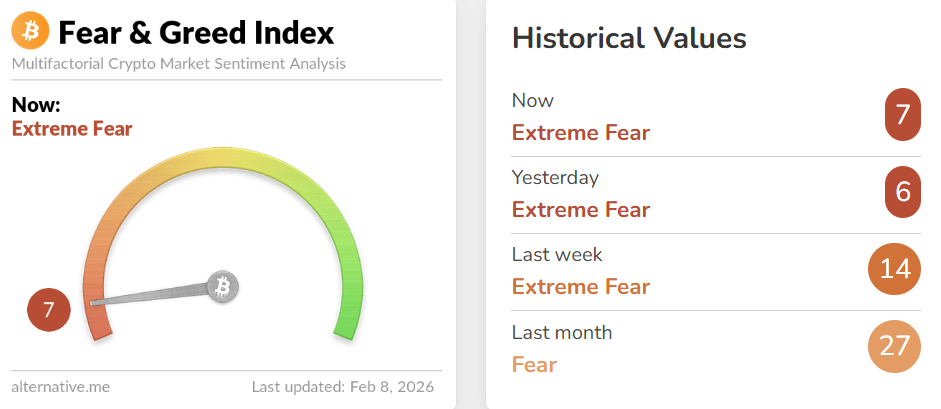
BTC-spot ETF outflows and BTC’s plunge to $60,000 sent the Bitcoin Fear & Greed Index deeper into the Extreme Fear zone. The Fear & Greed Index dropped from 20 to 6 on Saturday, February 7. Despite rising to 7 on Sunday, February 8, the Index remained deep in the Extreme Fear zone, reflecting oversold conditions. Typically, oversold conditions suggest a price recovery, supporting the bullish medium-term outlook.
However, market intelligence platform Santiment remarked on the BTC sell-off and warned about the near-term price outlook, stating:
“This combination of key stakeholders selling and retail buying is what historically creates bear cycles. Until there is a sign of clear capitulation from the crowd, smart money will continue to gladly sell off their bags and not have any urgency to buy back in until the crowd has decided to move on from crypto.”
Downside Risks: Central Banks, US Data, and ETF Flows
While fundamentals continue to support a constructive medium-term bias, downside risks include:
- The BoJ announces a higher neutral interest rate (potentially 1.5%-2%), signaling multiple rate hikes. BoJ rate hikes and Fed rate cuts would narrow rate differentials, potentially triggering a yen carry trade unwind as seen in mid-2024.
- US economic indicators fuel fears of a US recession and/or the Fed downplays rate cuts.
- BTC-spot ETFs report extended periods of outflows.
These scenarios would likely send BTC toward $60,000, exposing $50,000 and the August 2024 low of $49,351 (the yen carry trade unwind low).
In summary, the short-term outlook remains bearish as fundamentals align with technicals. However, the medium- to longer-term outlook is cautiously constructive, subject to favorable fundamentals evolving. These dynamics include expectations of Fed rate cuts and the progress of the Market Structure Bill.
Technical Analysis
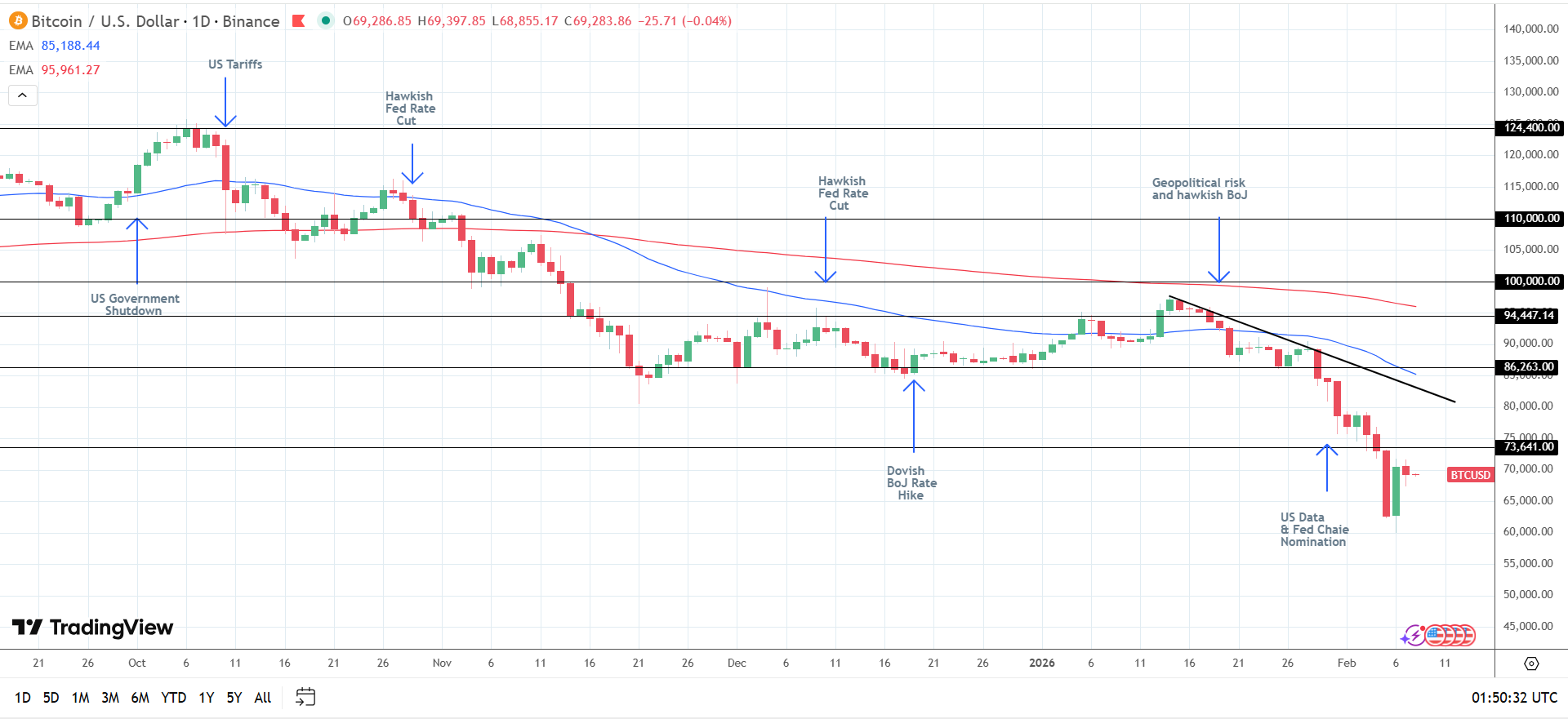
The weekly losses left BTC trading well below its 50-day and 200-day Exponential Moving Averages (EMAs), signaling bearish momentum. However, oversold conditions and developing fundamentals suggest a rebound from the current levels, offsetting the negative technicals.
A breakout above $75,000 would bring the 50-day EMA into play. A sustained move through the 50-day EMA would indicate a near-term bullish trend reversal, paving the way toward $95,000 and the 200-day EMA. A sustained move above the 200-day EMA would affirm a bullish trend reversal, opening the door to a test of the $100,000 psychological level.
Bearish Structure Validated: What Happens if BTC Reclaims $75,000?
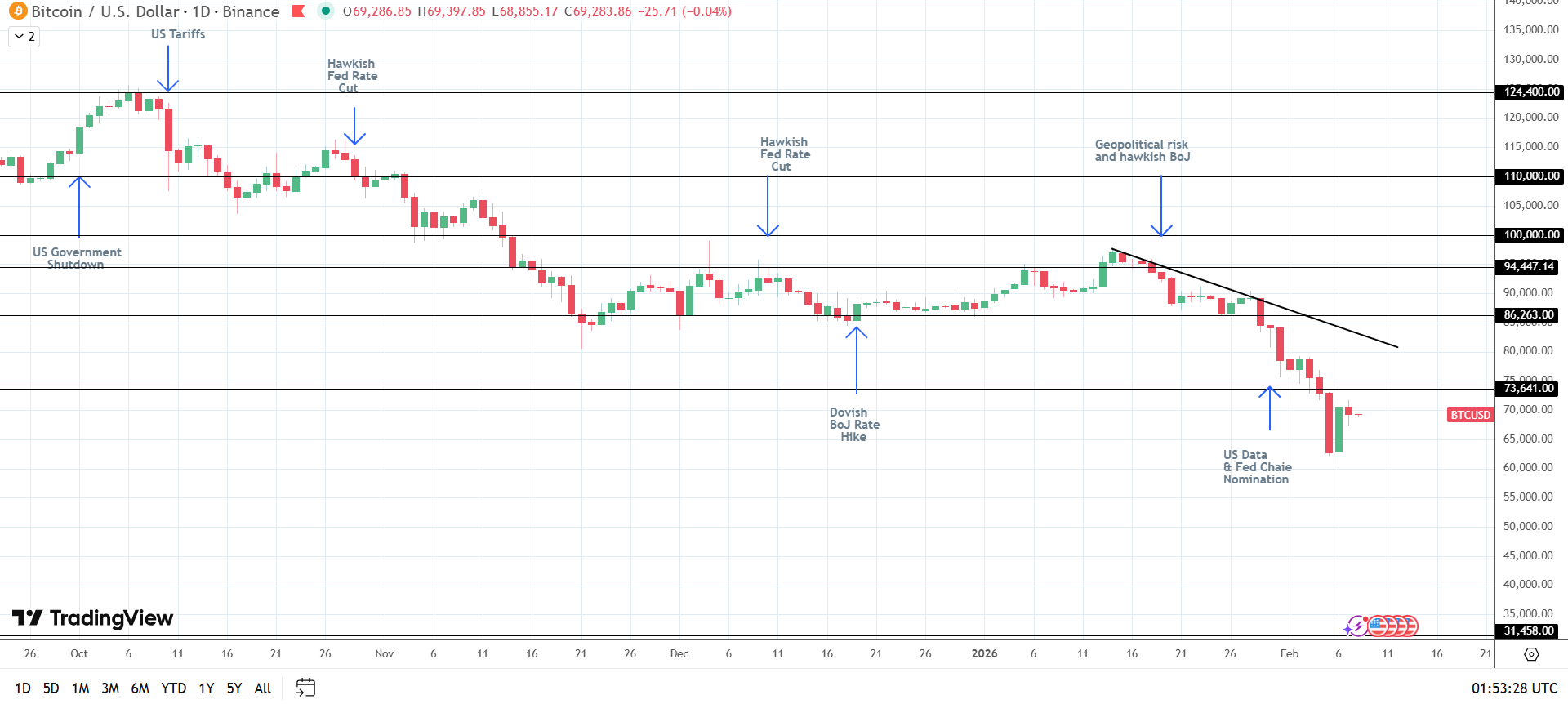
Reclaiming $75,000 would enable the bulls to target the upper trendline. A sustained move through the upper trend line would invalidate the bearish structure, affirming the bullish medium-term (4-8 weeks) price target of $100,000.
However, a sustained drop below the February 6 low of $60,000 would expose the August 24 low of $49,351 and validate the bearish structure.
Track BTC market trends with our real-time data and insights here.
Outlook: $60,000 Support Key to Medium-Term Bullish Outlook
US economic indicators, Fed rhetoric, the BoJ rate path, and US BTC-spot ETFs will influence demand for BTC.
The delayed US jobs report (February 11) will be the main event of the coming week. Softer labor market conditions and rising bets on an H1 2026 Fed rate cut would likely lift sentiment.
Considering the recent price action, the medium- and long-term outlook remains constructive, with a 6-12 month price target of $123,731 (ATH). The US Senate’s passing the Market Structure Bill would further support the bullish outlook.
Stay informed on BTC trends by monitoring macroeconomic developments, ETF flows, and technical indicators here.