
XRP took another hit on Saturday, February 7, as the battle between TradFi and DeFi for depositors sank hopes of the US Senate passing the Market Structure Bill in Q1.
Banking and crypto community representatives have met to thrash out an agreement on stablecoin yields, a key hurdle for crypto-friendly legislation. However, failure to find common ground remains a near-term headwind for XRP.
Despite the regulatory roadblocks, robust demand for XRP-spot ETFs continues to affirm the bullish medium-term price outlook.
Below, I will explore the key drivers behind recent price trends, the medium-term (4-8 weeks) outlook, and the technical levels traders should watch.

TradFi vs. DeFi: The Battle for the US Dollar Heats Up
Delays to much-needed crypto-friendly regulations contributed to XRP’s crash to a five-month low of $1.1227 on February 6. This week, representatives from the banking and crypto communities met to discuss stablecoin yields.
US banks argue that legislation allowing stablecoin yields would trigger a migration from bank deposits to stablecoins. Stablecoins would offer significantly higher yields to holders than bank interest on deposits.
Crucially, an exodus of deposits from US banks would expose lenders to a higher cost of wholesale funding, narrowing net interest margins (NIMs). Narrowing NIMs reduces bank profitability and, weaken TradFi’s monopoly on the US dollar.
Bitcoin Price Forecast
Every new Bitcoin analysis as it publishes, today's technical signal and key levels, live price — on one page.
See all Bitcoin forecastsCoinbase and the White House Underscore Banks’ Crypto Agenda
Coinbase (COIN) CEO Brian Armstrong recently remarked on the US banks’ attempts to block crypto legislation, stating:
“They’re trying to protect their own profit margins, taking money out of the, you know, pockets of hard-working average Americans and putting it into the coffers of these big banks that are hitting record profits. And so, our view is that there should be a level playing field where banks and crypto companies can lean into stablecoin legislation as an opportunity, and that includes paying rewards to Americans so that they can earn more money on their money.”
Notably, Armstrong also accused US banks of undermining President Trump’s pro-crypto agenda. Slowing the progress of the Market Structure Bill to the US Senate floor ahead of the midterms may be a strategy, given expectations that the Democrats will regain control of the House and the Senate.
However, a US Senate vote on the Market Structure Bill is set for late spring, giving TradFi and DeFi a chance to reach a consensus on stablecoin rewards.
President Trump remarked on the US banks attempting to block crypto, stating:
“Big banks are working overtime to block my pro-crypto agenda. [,,,]. They want to slow adoption. They want to stop crypto. It’s not going to happen! I will be signing the crypto bill to deliver real clarity and fairness. US national reserves buying Bitcoin will be on the table. We are making America the Crypto Capital of the World. Remember who did this for you!”
The next White House stablecoin session is slated for Tuesday, February 10. However, there will reportedly be no US bank CEOs in attendance, despite their opposition to stablecoin rewards.
XRP Exposed to Crypto-Related Legislative Headlines
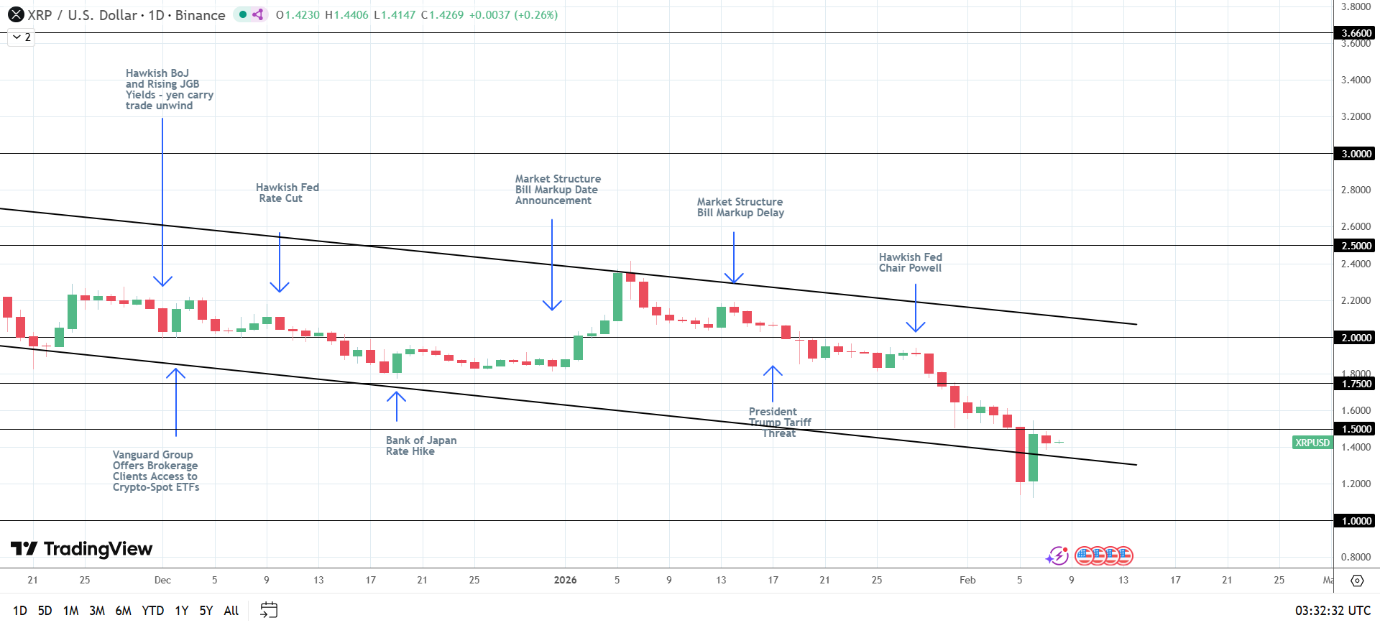
Crypto-related regulatory developments on Capitol Hill expose XRP to increased price volatility. The token enjoyed a bullish start to 2026, rallying from a December 31 low of $1.8103 to a January 6 high of $2.4151. XRP reacted to the US Senate Banking Committee’s announcement of its January 15 markup vote on draft text for the Market Structure Bill.
However, the delays to the Banking Committee’s markup vote have contributed to XRP’s plunge to a February 6 low of $1.1227. Notably, XRP has fallen 13.3% year-to-date and by 41% from the January 6 high, underscoring the token’s sensitivity to legislative developments.
Despite the ongoing delay to the Banking Committee’s markup vote, hopes of the US Senate eventually passing the Market Structure Bill support a bullish medium-term outlook. The passing of crypto-friendly legislation is likely to kickstart XRP’s next bull run, given previous price action.
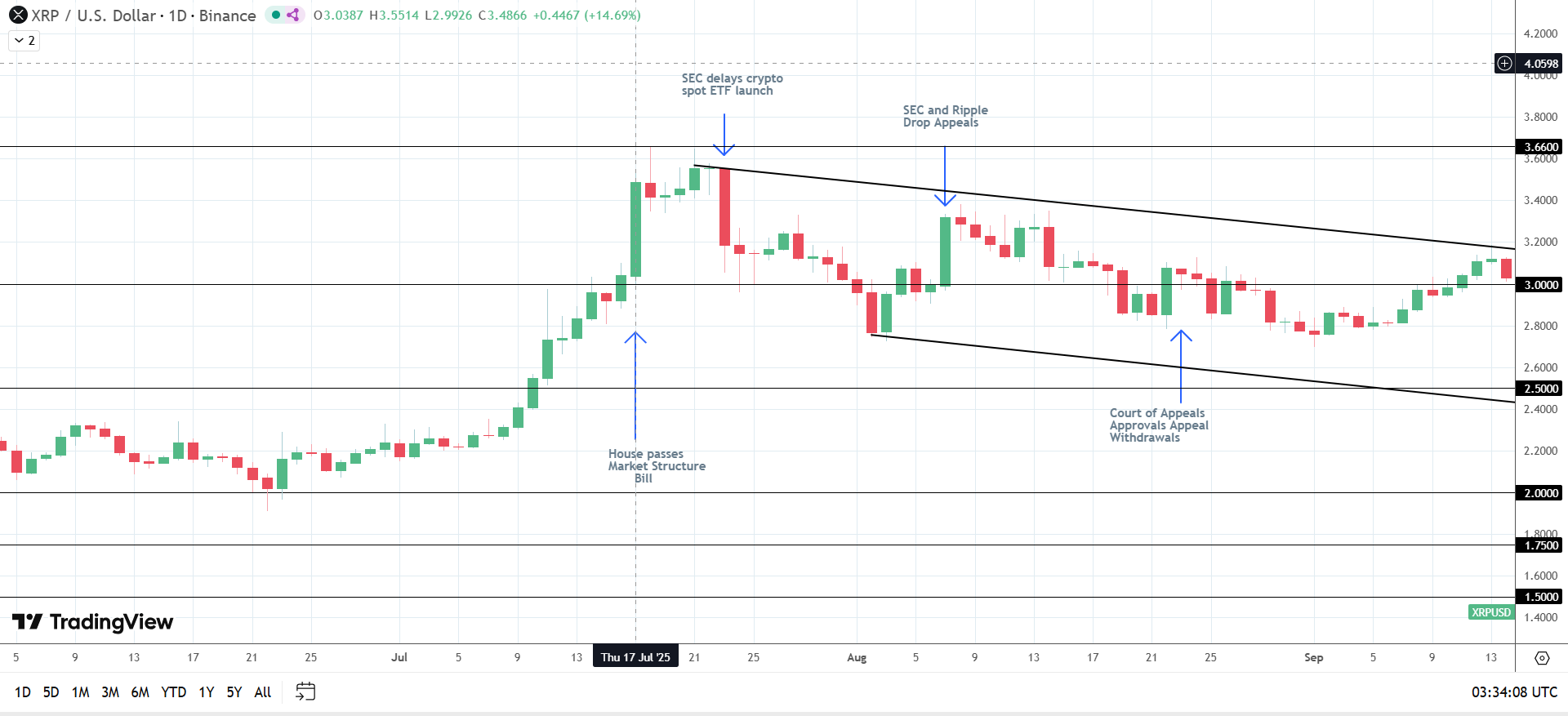
For context, XRP soared 14.69% on July 17 after the US House of Representatives passed the Market Structure Bill to the US Senate.
XRP Price Forecast: Short-, Medium-, and Long-Term Targets
This week’s reversal reaffirmed the negative short-term outlook (1-4 weeks), with a target price of $1.0.
However, strong demand for XRP-spot ETFs, hopes that the Senate will pass the Market Structure Bill, and increased XRP utility continue to support the bullish medium- to long-term price projections:
- Medium-term (4-8 weeks): $2.5.
- Longer-term (8-12 weeks): $3.0.
Key Downside Risks to the Bullish Medium-Term Outlook
Several events could challenge the constructive bias. These include:
- A hawkish Bank of Japan, with a higher neutral interest rate (potentially 1.5%-2.5%). Aggressive BoJ rate hikes could narrow US-Japan rate differentials in favor of the yen. Narrow rate differentials may trigger a yen carry trade unwind, as seen in mid-2024. A yen carry trade unwind would validate the bearish trend reversal.
- Soft US economic data and rising US recession risks.
- Delays and/or partisan opposition to the Market Structure Bill.
- Extended periods of XRP-spot ETF net outflows.
These factors would weigh on XRP demand, pushing XRP toward $1.0 and reaffirming the bearish short-term outlook.
Technical Analysis: Levels to Watch
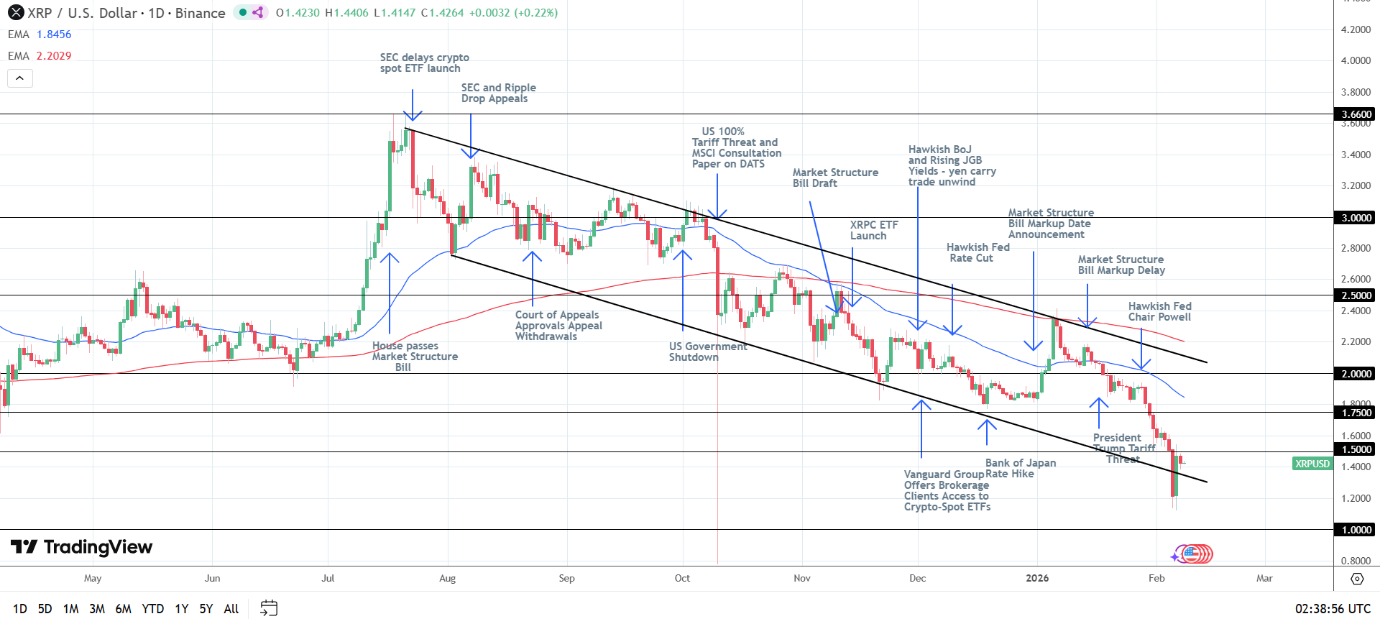
XRP fell 3.22% on Saturday, February 7, partially reversing the previous day’s 21.11% breakout to close at $1.4232. The token came under heavier selling pressure than the broader crypto market cap, which dropped 0.99%.
The 2026 reversal left XRP trading well below its 50-day and 200-day EMAs, indicating bearish momentum. However, several positive fundamentals continue to offset bearish technicals, indicating a bullish medium-term outlook.
Key technical levels to watch include:
- Support levels: $1.0 and then $0.7773.
- 50-day EMA resistance: $1.8456.
- 200-day EMA resistance: $2.2029.
- Resistance levels: $1.50, $2.0, $2.5, and $3.0.
On the daily chart, a breakout above $1.50 would enable the bulls to target the 50-day EMA and $2.0. A sustained move through the 50-day EMA and $2.0 would signal a near-term bullish trend reversal. A bullish trend reversal would bring $2.2 into play. A breakout above $2.2 would pave the way toward the 200-day EMA.
Importantly, a sustained move through the EMAs would reaffirm the bullish medium-term price targets.
Fundamental Events Driving Near-Term Price Action
Near-term price drivers include:
- XRP-spot ETF flows.
- US economic data and the Fed’s policy outlook.
- Crypto-related legislative developments.
- The Bank of Japan’s neutral rate and rate path.
- Increased geopolitical tensions.
Bearish Structure Remains Intact with $1.0 as Key Support
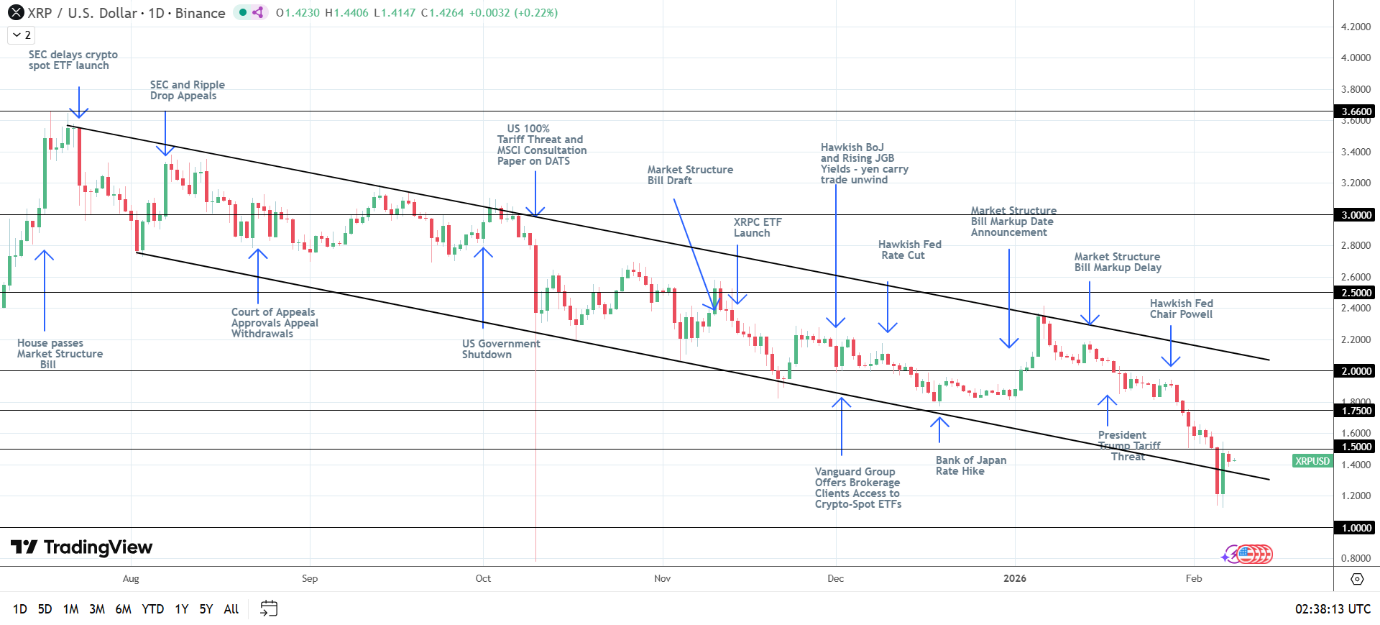
XRP’s pullback reinforced the existing bearish trend. A drop below the lower trendline would expose the February 6 low of $1.1227. If breached, $1.0 would be the next key support level.
Significantly, a drop below $1.0 would reinforce the bearish short-term outlook and further validate the bearish structure.
However, reclaiming $1.5 would bring $2.0 and the upper trendline into play. A sustained move through the upper trendline would invalidate the bearish structure and signal a bullish trend reversal, reinforcing the constructive medium-term bias.
- Short-term (1-4 weeks): $1.0.
- Medium-term (4-8 weeks): $2.5.
- Longer-term (8–12 weeks): target of $3.0.
XRP Outlook Hinged on Crypto Legislation, ETF Flows, and US Data
Looking ahead, crypto-related legislative developments remain key for XRP’s price outlook. The progress of the Market Structure Bill to the full Senate would likely trigger an XRP breakout.
However, geopolitical risks, US economic data, central bank chatter, and XRP-spot ETF flow trends will also influence near-term price moves.
A more dovish Fed rate path and a lower BoJ neutral rate (potentially 1%-1.25%) would lift sentiment. Sustained inflows into US XRP-spot ETFs and the progress of the Market Structure Bill would support the positive medium-term outlook.
In summary, these scenarios support a medium-term (4–8 weeks) move to $2.5. The US Senate’s passing the Market Structure Bill would reaffirm the longer-term (8–12 weeks) price target of $3.0.
Beyond 12 weeks, these factors are likely to drive XRP to its all-time high of $3.66 (Binance). A break above $3.66 would support a 6- to 12-month price target of $5.