



XRP plunges to its lowest level since the October flash crash on Thursday, February 5, as US economic data and AI jitters trigger a market rout.
US economic indicators signaled a sharp weakening in labor market conditions, fueling concerns about the US economy. Corporate earnings added to the selling momentum as Amazon.com (AMZN) announced its spending plans, spooking investors.
Delays to highly anticipated crypto legislation contributed to XRP’s retreat as hopes for the Market Structure Bill passing in Q1 faded.
Thursday’s sell-off reaffirmed a near-term bearish trend reversal. Nevertheless, the medium-term outlook remains cautiously bullish. Expectations that the Senate will eventually pass crypto-friendly legislation and increased utility remain crucial to XRP’s longer-term price trajectory.
Below, I will explore the key drivers behind recent price trends, the medium-term (4-8 weeks) outlook, and the technical levels traders should watch.
US Labor Market Data Impacts Sentiment
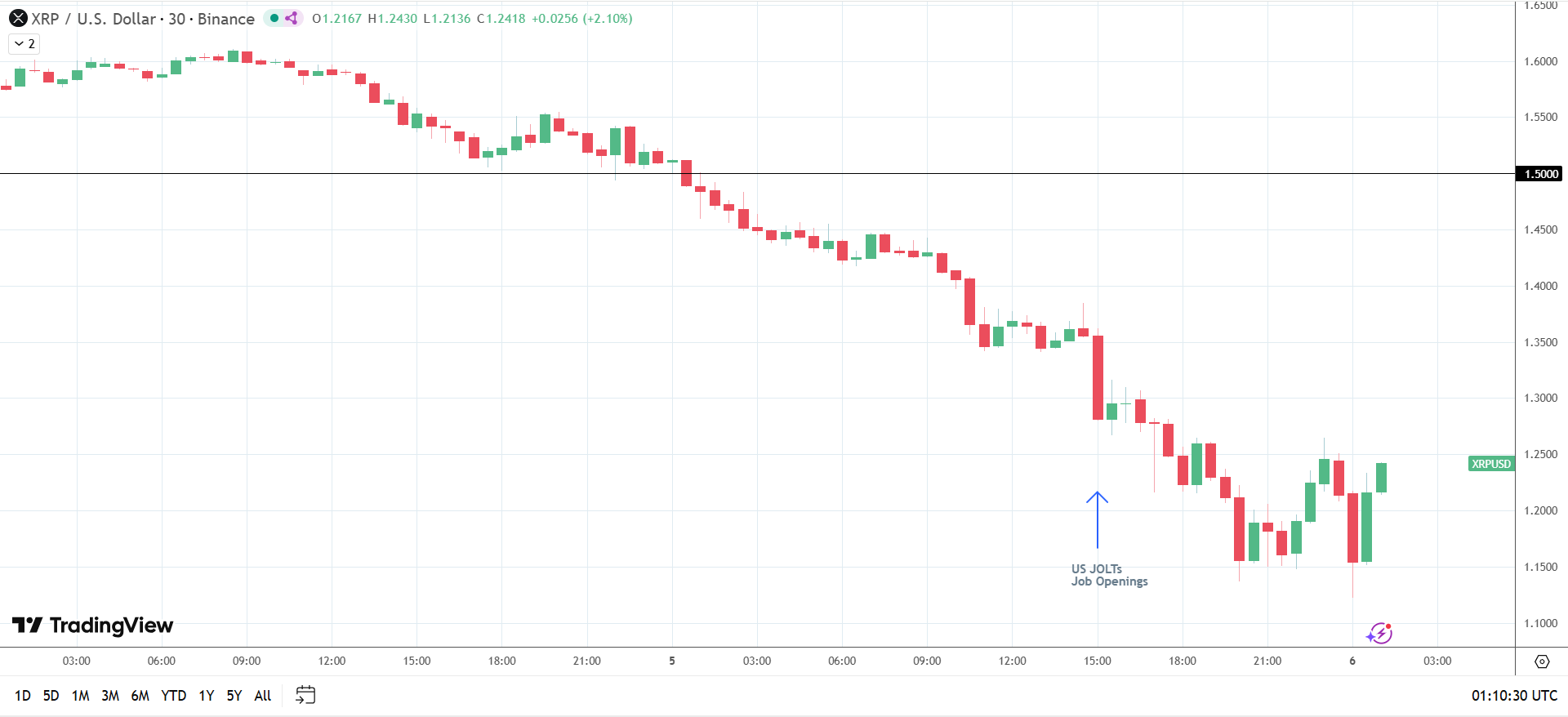
On February 5, US initial jobless claims and JOLTs job openings signaled a marked weakening in labor market conditions, weighing on risk appetite. Jobless claims increased from 209k (week ending January 24) to 231k (week ending January 31). More significantly, JOLTs job openings tumbled from 6.928 million in November to 6.524 million in December, while quit rates rose to 3.204 million (November: 3.193 million).
Rising jobless claims clashed with a slump in job openings, suggesting higher unemployment. Quit rates underscored waning confidence among US workers, another negative metric for the labor market and the US economy. Typically, rising unemployment impacts wage growth and consumer confidence, curbing consumer spending. A pullback in spending would weigh on the US economy, given that private consumption accounts for roughly 65% of GDP.
Notably, XRP slid from $1.3620 to a low of $1.1220 after the release of the labor market reports.
Amazon.com Spending Plans Spook Investors
While concerns about the US economy triggered the sell-off, Amazon.com’s spending plans added to the selling momentum. The company announced plans to spend $200 billion on CAPEX in 2026, topping a consensus of $146 billion.
AI-related spending has been a market focal point, given ongoing concerns about returns on investment. High spending offers no guarantee of returns, particularly as investors must wait years, not months, to see any benefits in a dynamic backdrop.
AI developments have added a layer of uncertainty about the longer-term, leaving markets to question the sizable CAPEX announcement. Notably, Amazon.com plunged 11.2% in after-hours trading in reaction to the news. Ahead of the announcement, AMZN closed the February 5 session down 4.42%.
Earlier this week, XRP price action underscored sensitivity to AI-related headlines, exposing the token to corporate America.
US Senate Eyes Q2 Market Structure Bill Vote
While US economic indicators and AI-related headlines influenced near-term trends, crypto-related legislative developments remain key to XRP’s medium- to long-term price outlook.
On February 5, Senator Cynthia Lummis stated that a Senate vote on the Market Structure Bill was now slated for spring 2026. The banking community’s push to block Stablecoin yields over concerns about losing deposits and the crypto community’s requirement for yields stalled the Market Structure Bill in January, weighing on XRP.
Stablecoin yields are likely to be significantly higher than US bank deposit rates. Banks have argued that stablecoin yields could result in an exodus of deposits from TradFi to DeFi. Depositors are key to US banks’ profitability. Typically, US banks pay depositors low interest but charge significantly higher lending interest rates, driving net interest margins and profits.
For context, the US Senate Banking Committee postponed its January 15 markup vote after Coinbase (COIN) withdrew its support for the Banking Committee’s draft text for the Market Structure Bill. Coinbase CEO Brian Armstrong cited several reasons for withdrawing its support, including concerns that the Banking Committee’s text would kill rewards on stablecoins and allow banks to ban their competition.
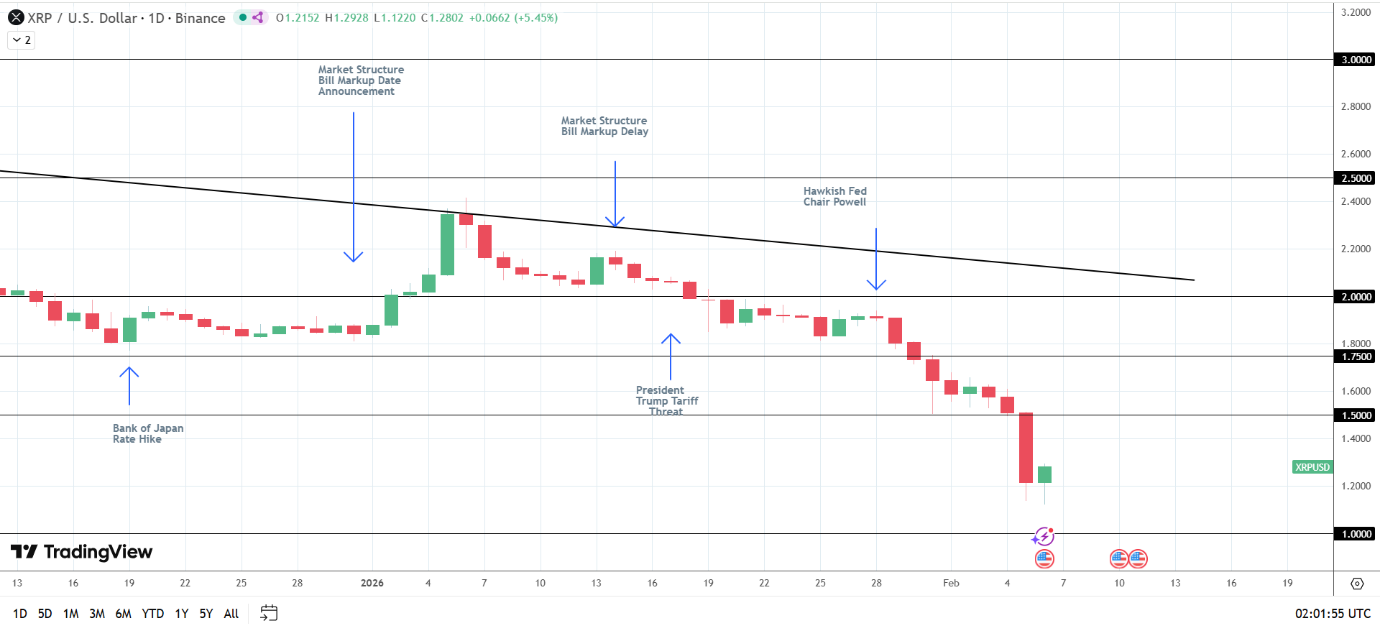
XRP rallied from a December 31 low of $1.8103 to a January 6 high of $2.4151 after the Banking Committee announced its markup date. However, delays to the Banking Committee’s markup have contributed to XRP’s plunge to sub-$1.15 levels.
Despite the delays, analysts expect the banking and crypto communities to reach an agreement on stablecoin yields, supporting the bullish medium-term outlook for XRP.
XRP Price Forecast: Short-, Medium-, and Long-Term Targets
The extended sell-off supported the negative short-term outlook (1-4 weeks), with a target price of $1.0.
However, resilient demand for XRP-spot ETFs, hopes for multiple Fed rate cuts, expectations that the Market Structure Bill will progress, and increased XRP utility continue to support the bullish medium- to long-term price projections:
- Medium-term (4-8 weeks): $2.5.
- Longer-term (8-12 weeks): $3.0.
Key Downside Risks to the Bullish Medium-Term Outlook
Several events could challenge the constructive bias. These include:
- A hawkish Bank of Japan, with a higher neutral interest rate (potentially 1.5%-2.5%). Multiple BoJ rate hikes could narrow US-Japan rate differentials and trigger a yen carry trade unwind, as seen in mid-2024. A yen carry trade unwind would validate the bearish trend reversal.
- Weak US economic data and rising US recession risks.
- Delays and/or partisan opposition to the Market Structure Bill.
- Extended periods of XRP-spot ETF net outflows.
These factors would weigh on XRP demand, pushing XRP toward $1.0 and affirming the bearish short-term outlook.
Technical Analysis: Levels to Watch
XRP tumbled 19.59% on Thursday, February 5, following the previous day’s 4.27% loss, closing at $1.2140. The token came under heavier selling pressure than the broader crypto market cap, which dropped 12.69%.
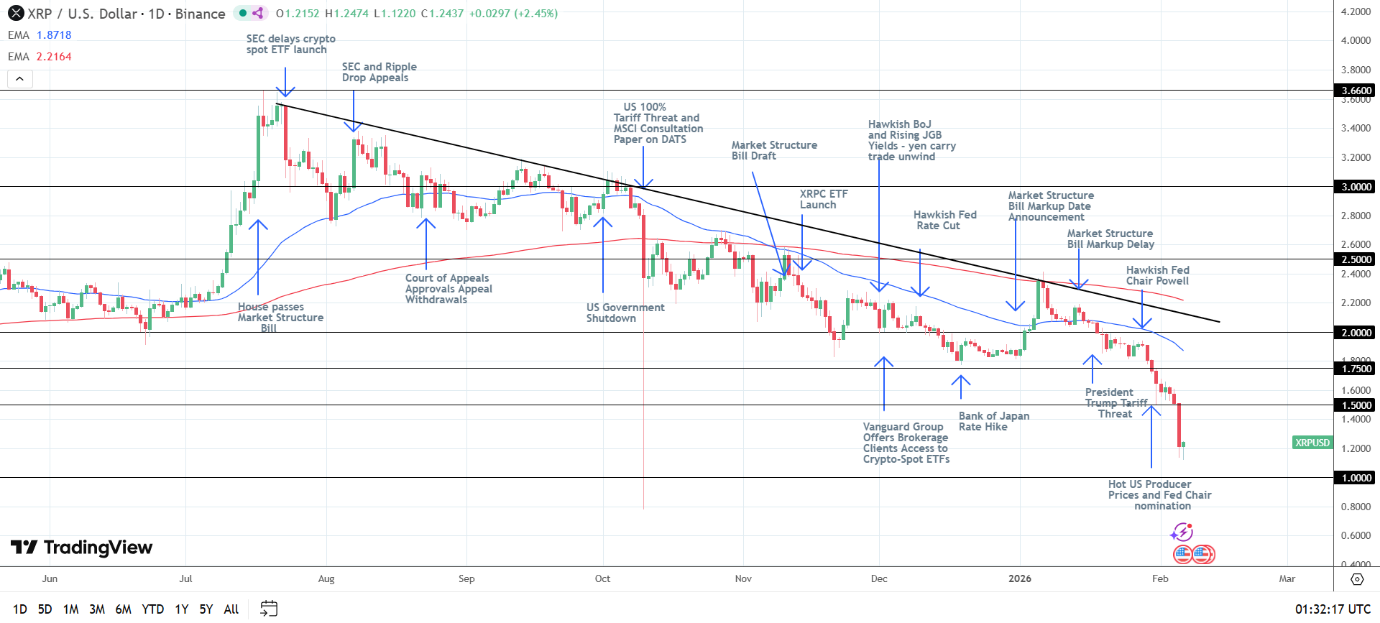
The extended sell-off left XRP trading well below its 50-day and 200-day EMAs, indicating bearish momentum. However, several favorable fundamentals continue to offset bearish technicals, supporting a bullish medium-term outlook.
Key technical levels to watch include:
- Support levels: $1.0 and then $0.7773.
- 50-day EMA resistance: $1.8718.
- 200-day EMA resistance: $2.2164.
- Resistance levels: $1.50, $2.0, $2.5, and $3.0.
On the daily chart, a breakout above $1.50 would bring the 50-day EMA and $2.0 into play. A sustained move through the 50-day EMA and $2.0 would signal a near-term bullish trend reversal. A bullish trend reversal would enable the bulls to target $2.2. A break above $2.2 would pave the way toward the 200-day EMA.
Significantly, a sustained move through the EMAs would reaffirm the bullish medium-term price targets.
Fundamental Events Driving Near-Term Price Action
Near-term price drivers include:
- XRP-spot ETF flows.
- US economic data and the Fed’s policy stance.
- Crypto-related legislative developments.
- The Bank of Japan’s neutral rate and rate path.
- Increased geopolitical risks.
Bearish Structure Remains Intact with $1.0 as Key Support
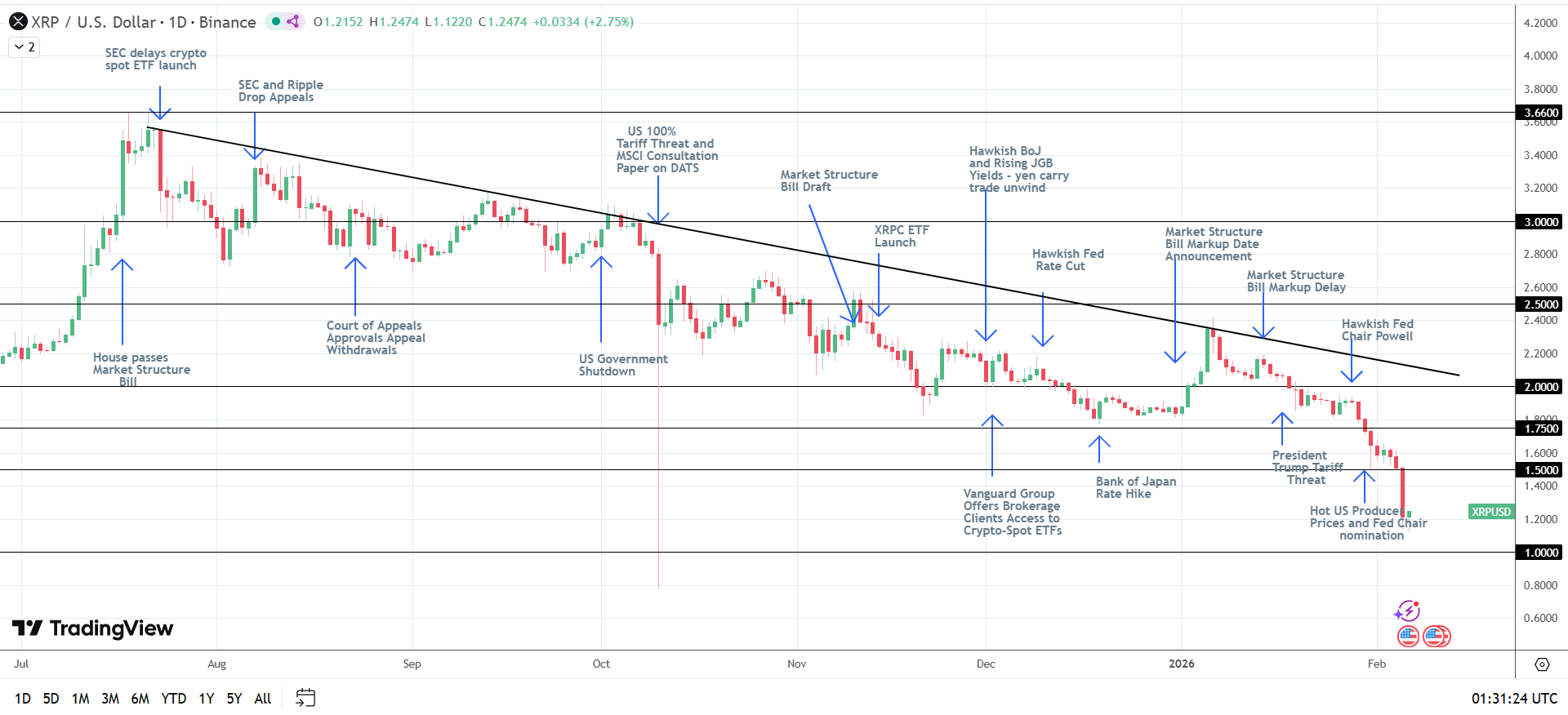
XRP’s February sell-off reflected increased bearish sentiment. However, XRP continues to trade above $1.0, a key support level. A drop below $1.2 would bring the psychological $1 level into view. If breached, the October 10 flash crash low of $0.7773 (Binance) would be the next key support level.
Significantly, a drop below $1.0 would reinforce the bearish short-term outlook and further validate the bearish structure.
Conversely, reclaiming $1.5 would pave the way toward $2.0 and the upper trendline. A sustained move through the upper trendline would indicate a bullish trend reversal, invalidating the bearish structure, and reinforcing the constructive medium-term bias.
- Short-term (1-4 weeks): $1.0.
- Medium-term (4-8 weeks): $2.5.
- Longer-term (8–12 weeks): target of $3.0.
XRP Outlook Hinged on Crypto Legislation, ETF Flows, and the Fed
Looking ahead, crypto-related legislative developments remain crucial for XRP’s price path. The progress of the Market Structure Bill to the full Senate would likely fuel buying interest in XRP.
However, geopolitical risks, US economic data, central bank chatter, and XRP-spot ETF flows will also influence near-term price trends.
A more dovish Fed rate path and a lower BoJ neutral rate (potentially 1%-1.25%) would boost sentiment. Strong demand for US XRP-spot ETFs and the progress of the Market Structure Bill would reinforce the positive medium-term outlook.
In summary, these events support a medium-term (4–8 weeks) move to $2.5. The US Senate’s passing the Market Structure Bill would reaffirm the longer-term (8–12 weeks) price target of $3.0.
Beyond 12 weeks, these factors are likely to drive XRP to its all-time high of $3.66 (Binance). A break above $3.66 would support a 6- to 12-month price target of $5.