



XRP resumes its downtrend on Tuesday, February 3. AI jitters, the Fed rate path, and crypto-related legislative developments continue to impact sentiment, sending the token toward key support levels.
Upbeat US economic indicators and Fed rhetoric have continued to dampen expectations of an H1 2026 Fed rate cut, weighing on sentiment.
However, delays to the progress of the Market Structure Bill remain a critical headwind for XRP.
Tuesday’s pullback reaffirmed a near-term bearish trend reversal. Nevertheless, the medium-term outlook remains cautiously bullish. Expectations that the Senate will eventually pass crypto-friendly legislation and increased utility remain key to XRP’s longer-term price trajectory.
Below, I will explore the key drivers behind recent price trends, the medium-term (4-8 weeks) outlook, and the technical levels traders should watch.
Fed Rate Cut Bets Fade, Sending XRP Lower
Last week, the Fed left interest rates at 3.75%, with Fed Chair Powell signaling a meeting-by-meeting policy stance. The Fed Chair cited elevated inflation and a robust labor market, downplaying the chances of a near-term rate cut. Since Powell’s comments, US producer prices indicated a sticky inflation outlook, with the manufacturing sector returning to expansion, supporting a more hawkish Fed policy stance.
According to the CME FedWatch Tool, the probability of a March Fed rate cut fell from 17.3% on January 27 to 8.4% on February 3. Meanwhile, the chances of a June cut dropped from 65.4% to 56.1%, weighed by Powell’s comments and the US data.
Bitcoin Price Forecast
Every new Bitcoin analysis as it publishes, today's technical signal and key levels, live price — on one page.
See all Bitcoin forecastsRegulatory Uncertainty Challenges Bullish Outlook
Falling bets on a Fed rate cut coincided with increased uncertainty about the Senate passing crypto-friendly legislation.
The White House crypto session on February 2 brought together representatives from the banking and crypto communities to discuss the US Senate Banking Committee’s draft text on stablecoin yields.
However, there was no definitive progress toward a common footing, suggesting a challenging road toward a Banking Committee markup vote.
In January, Coinbase (COIN) withdrew its support for the Banking Committee’s draft text for the Market Structure Bill. Coinbase CEO Brian Armstrong warned that the Banking Committee’s text would kill rewards on stablecoins and allow banks to ban their competition.
On the one side, the banking community is looking to protect profits. However, on the other side, the crypto community wants a seat at the table. The question remains whether the banking community would agree to stablecoin yields that dwarf interest on bank deposits, exposing US banks to an exodus of depositors.
For context, US banks rely on depositors as a source of cheap funding for lending to retail and corporate borrowers at higher interest rates. The difference between interest on deposits and lending rates is the net interest margin (NIM). NIMs are the bread and butter of bank profits, underscoring the importance of retaining depositors.
Crucially, banks would be forced to rely on alternative funding sources, such as wholesale funding, if depositors shift to the DeFi space. Higher funding rates would erode NIMs and bank profits. Bank of America CEO Brian Moynihan previously warned that more than $6 trillion in deposits could move from TradFi to DeFi if legislation permitted stablecoin yields.
XRP Exposed to Crypto-Related Regulatory Developments
XRP remains highly sensitive to regulatory developments, given the lengthy SEC vs. Ripple case, which concluded in August.
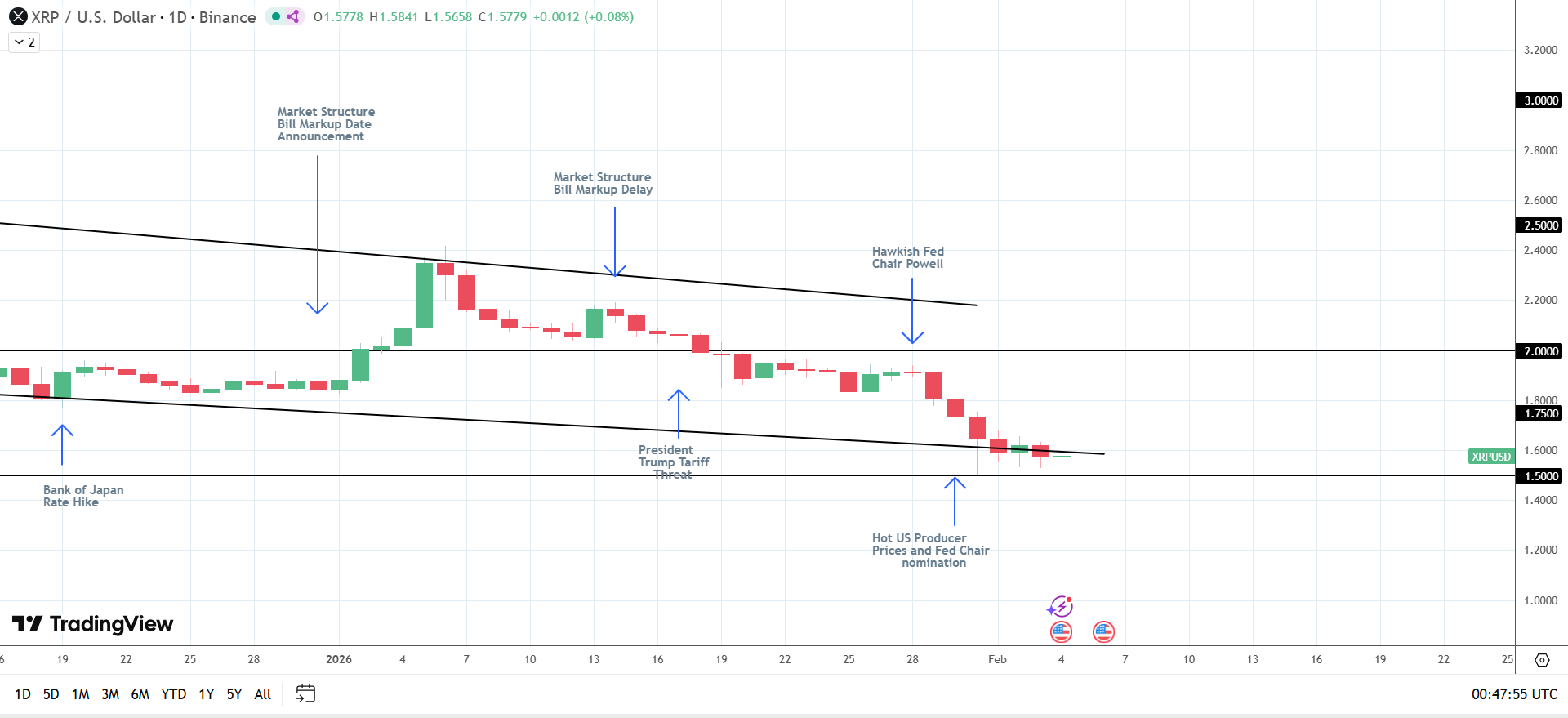
The token has plunged from a January 6 high of $2.4151 to a January 31 low of $1.5021, as traders reacted to the US Senate Agriculture Committee and the Banking Committee delaying markup votes.
Notably, the news of the Banking Committee postponing its markup vote overshadowed the Agriculture Committee advancing its draft text to the full Senate. XRP’s price trends underscored the importance of the Banking Committee’s draft text, a potentially more significant piece of legislation for the DeFi space.
However, despite the delays, analysts expect the Senate to pass the Market Structure Bill, albeit delayed, supporting a bullish medium- to long-term outlook for XRP.
Fed Rate Path and Crypto-Related Regulatory Developments Trigger XRP-Spot ETF Outflows
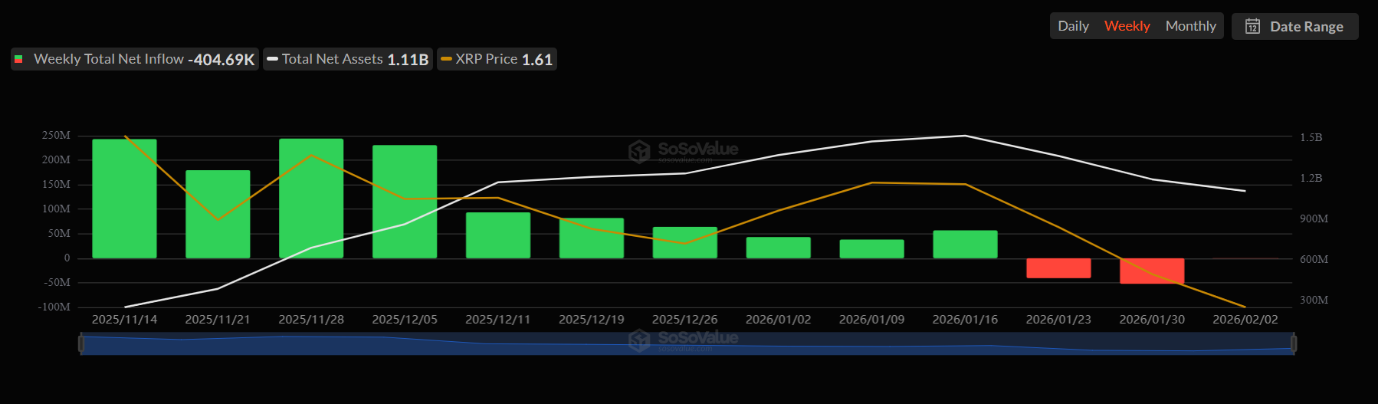
Crucially, fading expectations of an H1 2026 Fed rate cut and delays in much-needed crypto legislation cooled demand for XRP-spot ETFs.
The US XRP-spot ETF market reported $0.41 million in net outflows on February 2, following the previous week’s $52.26 million in total net outflows. Significantly, waning demand for spot ETFs tilts the supply-demand balance in favor of the bears, supporting the bearish short-term outlook.
Despite recent outflows, the US XRP-spot ETF market has seen $1.18 billion in net inflows since trading began in November. Robust inflows contrast with the US BTC-spot ETF market’s heavy outflows, supporting a constructive medium-term bias.
XRP Price Forecast: Short-, Medium-, and Long-Term Targets
January’s sell-off indicated a bearish trend reversal, signaling a negative short-term outlook (1-4 weeks), with a target price of $1.5.
However, strong demand for XRP-spot ETFs, lingering bets on multiple Fed rate cuts, hopes that the Market Structure Bill will progress, and increased XRP utility continue to support the bullish medium- to long-term price projections:
- Medium-term (4-8 weeks): $2.5.
- Longer-term (8-12 weeks): $3.0.
Key Downside Risks to the Bullish Medium-Term Outlook
Several factors could derail the constructive bias. These include:
- A hawkish Bank of Japan, with a higher neutral interest rate (potentially 1.5%-2.5%). Multiple BoJ rate hikes could narrow US-Japan rate differentials and trigger a yen carry trade unwind, as seen in mid-2024. A yen carry trade unwind would validate the bearish trend reversal.
- Strong US economic data and fading bets on an H1 2026 Fed rate cut.
- Delays and/or partisan opposition to the Market Structure Bill.
- Extended periods of XRP-spot ETF net outflows.
These events would weigh on XRP demand, sending XRP below $1.5 and affirming the bearish trend reversal.
Technical Analysis: Levels to Watch
XRP fell 2.62% on Tuesday, February 3, reversing the previous day’s 1.90% gain to close at $1.5767. The token tracked the broader crypto market cap, which dropped 3.22%.
The extended sell-off left XRP trading well below its 50-day and 200-day EMAs, signaling a bearish bias. However, several favorable fundamentals continue to counter bearish technicals, supporting a bullish medium-term outlook.
Key technical levels to watch include:
- Support levels: $1.50 and then $1.0.
- 50-day EMA resistance: $1.9279.
- 200-day EMA resistance: $2.2370.
- Resistance levels: $1.75, $2.0, $2.5, and $3.0.
On the daily chart, a breakout above $1.75 would enable the bulls to target the 50-day EMA and $2.0. A sustained move through the 50-day EMA and $2.0 would indicate a near-term bullish trend reversal. A bullish trend reversal would open the door to testing $2.2. A break above $2.2 would bring the 200-day EMA into play.
Importantly, a sustained move through the EMAs would reinforce the bullish medium-term price targets.
Fundamental Events Driving Near-Term Price Action
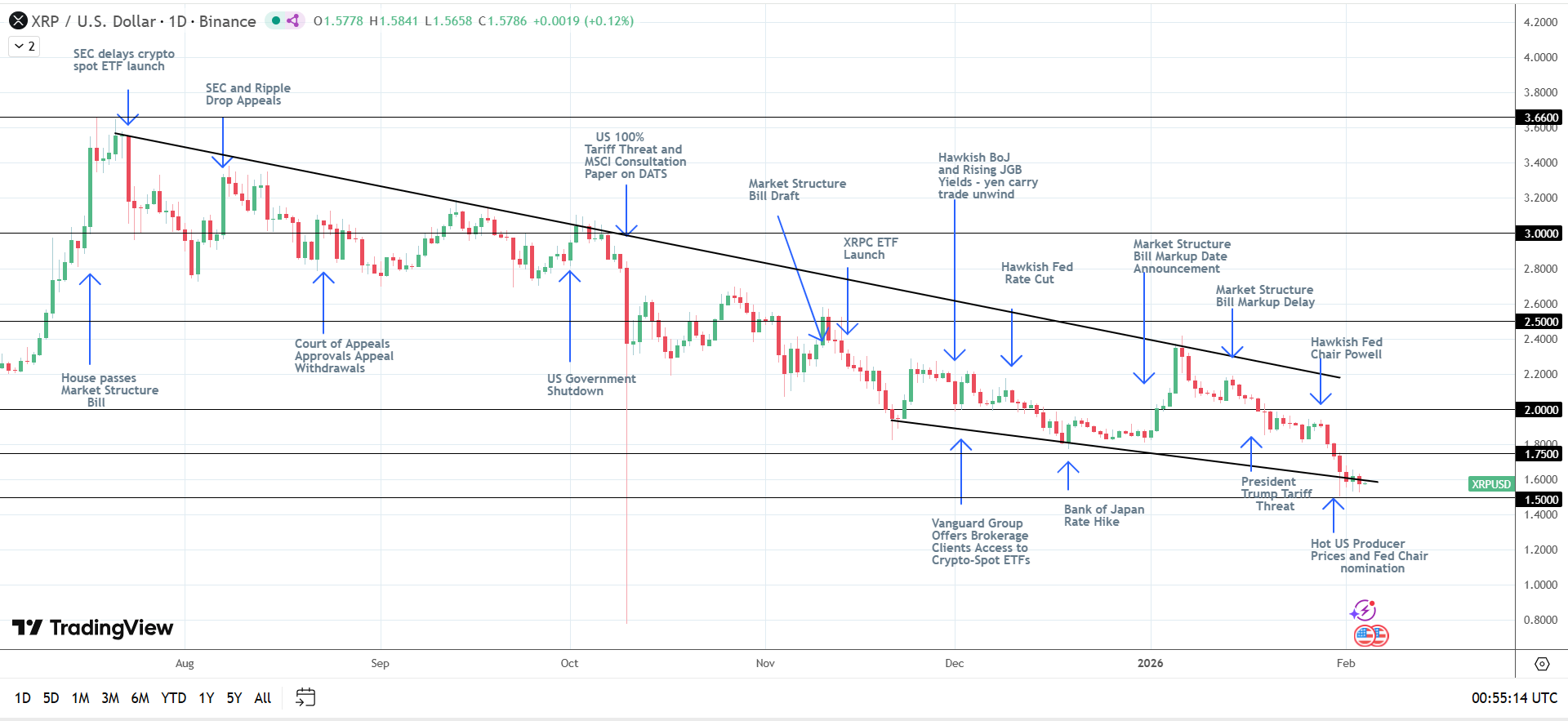
Near-term price drivers include:
- XRP-spot ETF flows.
- US economic indicators and the Fed’s policy stance.
- Crypto-related regulatory developments.
- The Bank of Japan’s neutral rate and rate path.
- Increased geopolitical risks.
Bearish Structure Remains Intact with $1.5 as Key Support
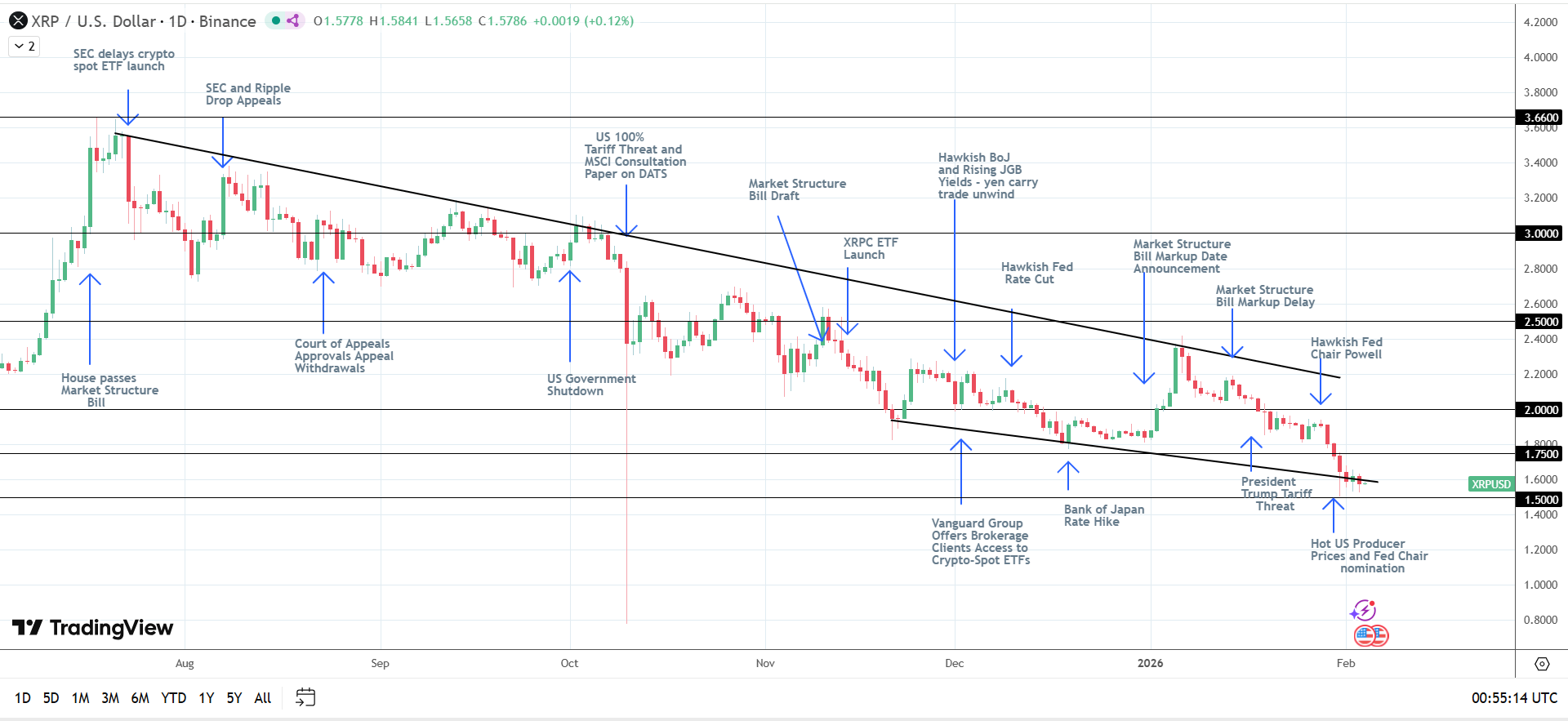
XRP’s January reversal signaled a bearish trend reversal and invalidated a bullish short-term outlook. However, XRP continues to trade above $1.5, a crucial support level. A break below $1.5 would bring the psychological $1 level into play. If breached, the October 10 flash crash low of $0.7773 (Binance) would be the next key support level.
Significantly, a drop below $1.5 would reaffirm the bearish short-term outlook and validate the bearish structure.
Conversely, reclaiming $2.0 would pave the way toward the upper trendline. A sustained move through the upper trendline would indicate a bullish trend reversal, invalidating the bearish structure, and affirming the constructive medium-term bias.
- Short-term (1-4 weeks): $1.5.
- Medium-term (4-8 weeks): $2.5.
- Longer-term (8–12 weeks): target of $3.0.
XRP Outlook Hinged on Crypto Legislation, the Fed, and ETF Flows
Looking ahead, crypto-related regulatory developments remain pivotal for XRP’s price path. Progress on the US Senate Banking Committee draft text for the Market Structure Bill would likely boost XRP demand.
However, geopolitical risks, US economic indicators, central bank rhetoric, and XRP-spot ETF flows will also influence near-term price trends.
A more dovish Fed policy stance and a lower BoJ neutral rate (potentially 1%-1.25%) would lift sentiment. Robust buying interest in US XRP-spot ETFs, and the progress of the Market Structure Bill would reaffirm the positive medium-term outlook.
In summary, these events support a medium-term (4–8 weeks) move to $2.5. The US Senate’s passing the Market Structure Bill would reinforce the longer-term (8–12 weeks) price target of $3.0.
Beyond 12 weeks, these events are likely to drive XRP to its all-time high of $3.66 (Binance). A breakout above $3.66 would support a 6- to 12-month price target of $5.