



XRP tracked the broader crypto market as risk aversion triggered heavy outflows from US BTC-spot and XRP-spot ETFs, overshadowing legislative developments on Capitol Hill.
US tech company earnings weighed on sentiment as large AI-linked spending plans spooked investors. Concerns about AI spending followed Fed Chair Powell’s hawkish press conference, leaving the Nasdaq 100 E-mini in the red on Thursday, January 29.
Meanwhile, the Market Structure Bill’s progress on Capitol Hill raised hopes that crypto-friendly regulations would increase crypto adoption.
Despite Thursday’s pullback, XRP’s medium-term price outlook remains bullish.
Below, I will explore the key drivers behind recent price trends, the medium-term (4-8 weeks) outlook, and the technical levels traders should watch.
XRP-Spot and BTC-Spot ETFs Record Heavy Outflows
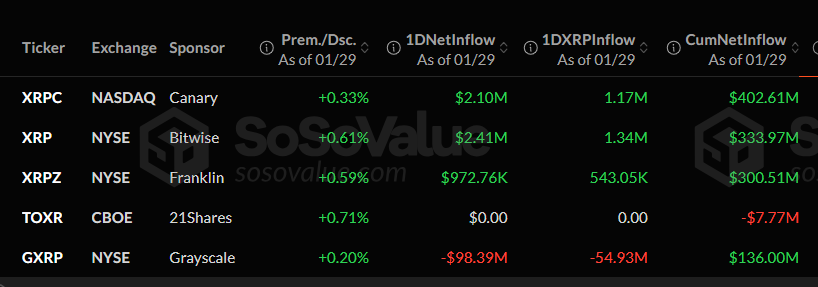
On January 29, the US XRP-spot ETF market saw $92.92 million in net outflows, its largest since the Canary XRP ETF (XRPC) launched in November. The Grayscale XRP ETF (GXRP) had net outflows of $98.39 million, snapping the XRP-spot ETF market’s six-day inflow streak.
Meanwhile, the Canary XRP ETF, the Bitwise XRP ETF, and the Franklin XRP ETF reported net inflows, limiting the damage. XRP-spot ETF flows continue to influence XRP’s supply-demand balance and price outlook. Since launch, the US XRP-spot ETF market has seen total net inflows of $1.17 billion, supporting the bullish outlook.
The US BTC-spot ETF market added to the negative sentiment, with net outflows of $500 million (pending iShares Bitcoin Trust numbers).
Fed Chair Powell’s non-committal stance on further rate cuts weighed on demand for crypto-spot ETFs, as expectations of an H1 2026 Fed rate cut cooled mid-week. Investor fears of AI spending among US firms and concerns over returns on investment contributed to the negative sentiment. The Nasdaq Composite Index fell 0.72% to close at 23,685, despite recovering from a session low of 23,233.
Bitcoin Price Forecast
Every new Bitcoin analysis as it publishes, today's technical signal and key levels, live price — on one page.
See all Bitcoin forecastsMarket Structure Bill Progresses on Capitol Hill
While risk sentiment triggered XRP-spot ETF outflows, crypto-related regulatory developments on Capitol Hill reaffirmed the bullish short- to medium-term outlook for XRP.
On January 29, the US Senate Agriculture Committee advanced its draft text of the Market Structure Bill, stating:
“Market structure legislation advances, marking a critical first step in the Senate.”
Ripple CEO Brad Garlinghouse commented on the Bill’s progress, stating:
“The last couple of weeks have been an absolute firestorm of action to get the Market Structure bill passed. While the Banking Committee clears its logjam (thank you Senator Tim Scott!), congrats are in order to the Agriculture Committee and Chairman John Boozman for advancing the Senate Agriculture Committee’s market structure bill out of committee today.”
Garlinghouse reiterated the importance of crypto legislation, adding:
“As I’ve said before, clarity is better than chaos. The legislative process can be messy and complex, but it is 100% necessary to have clarity for this and future generations of crypto entrepreneurs, builders, and users as this technology becomes increasingly ingrained into our global financial infrastructure.”
The focus will now be on the US Senate Banking Committee and its draft text of the bill. The Banking Committee postponed its markup and vote on its draft text after Coinbase withdrew its support on January 15. The Banking Committee has yet to announce a new markup date, as banking and crypto leaders attempt to find common ground on language regarding stablecoin yields.
Passage of the Banking Committee’s draft text will be critical for the Market Structure Bill to advance to the full Senate for a floor vote. Notably, the delay overshadowed the Agriculture Committee’s achievement, leaving XRP in the red.
XRP Price Forecast: Short-, Medium-, and Long-Term Targets
Despite Thursday’s XRP-spot ETF market outflows, total net inflows since launch support a positive short-term outlook (1-4 weeks), with a target price of $2. Furthermore, the progress of the Market Structure Bill, increased XRP utility, and bets on multiple Fed rate cuts reaffirm the bullish longer-term price projections:
- Medium-term (4-8 weeks): $2.5.
- Longer-term (8-12 weeks): $3.0.
Key Downside Risks to the Bullish XRP Outlook
Several scenarios could challenge the constructive bias. These include:
- The Bank of Japan signals multiple rate hikes to reach a higher neutral interest rate (potentially 1.5%-2.5%). A higher neutral rate would narrow US-Japan rate differentials more than expected. A sharply narrower rate differential could trigger an unwind of yen carry trades, as seen in mid-2024. A yen carry trade unwind would invalidate the bullish short-term outlook.
- Robust US economic data and cooling bets on an H1 2026 Fed rate cut.
- Delays and/or partisan opposition to the Market Structure Bill.
- Extended periods of XRP-spot ETFs outflows.
These scenarios would weigh on demand for XRP, pushing XRP below $1.70 and signaling a bearish trend reversal.
Technical Analysis: Levels to Watch
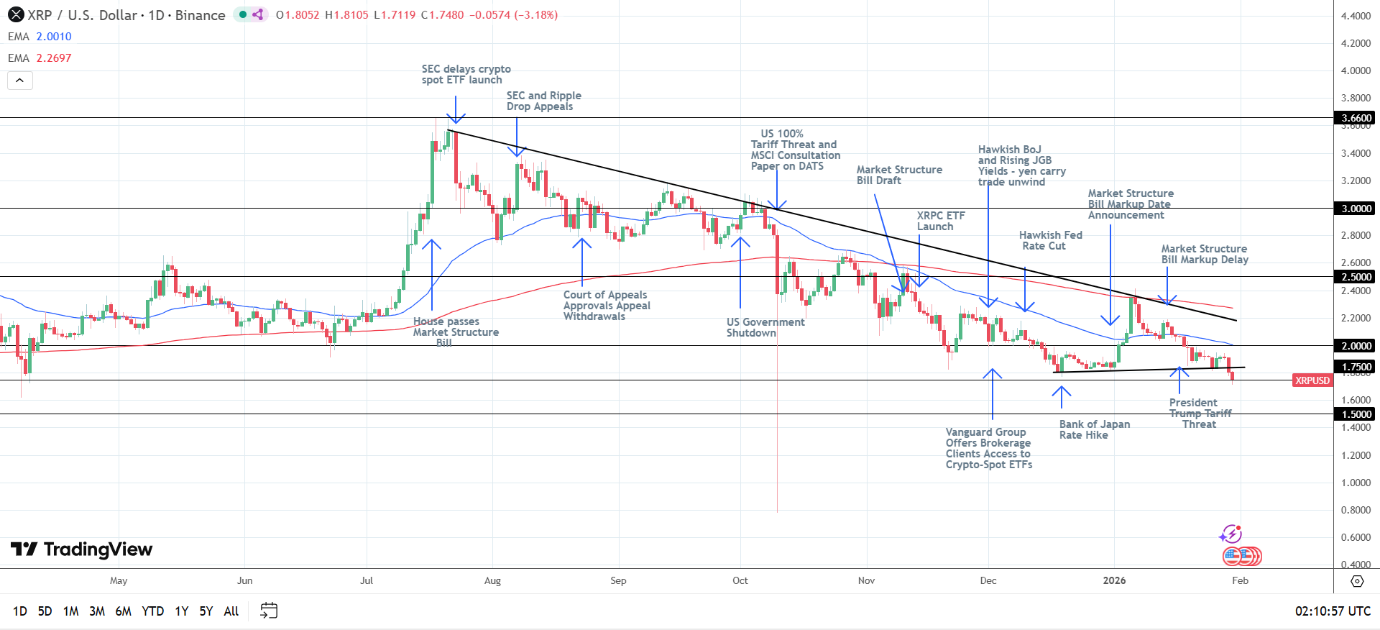
XRP slid 5.37% on Thursday, January 29, following the previous day’s 0.30% loss, closing at $1.8054. The token tracked the broader crypto market cap, which dropped 4.77%.
Thursday’s sell-off left XRP trading below its 50-day and 200-day EMAs, indicating a bearish bias. However, favorable fundamentals continue to counter bearish technicals, reaffirming the bullish outlook.
Key technical levels to watch include:
- Support levels: $1.70 and then $1.50.
- 50-day EMA resistance: $2.0010.
- 200-day EMA resistance: $2.2697.
- Resistance levels: $1.85, $2.0, $2.5, and $3.0.
On the daily chart, a breakout above $1.85 would bring $2.0 into play. A sustained move through $2.0 would enable the bulls to target the 50-day EMA. Importantly, a sustained break above the 50-day EMA would signal a near-term bullish trend reversal. A bullish trend reversal would open the door to testing $2.2. A breakout above $2.2 would pave the way toward $2.5 and the 200-day EMA.
A sustained move through the EMAs would reaffirm the bullish short- to medium-term price targets.
Fundamental Events Driving Near-Term Price Action
Near-term price drivers include:
- XRP-spot ETF flow trends.
- US economic data and the Fed rate path.
- US crypto-related legislative developments.
- The Bank of Japan’s neutral rate and policy stance.
- US President Trump’s tariff policies and geopolitical news.
Reclaiming $2 Critical with XRP’s Bullish Structure at Risk
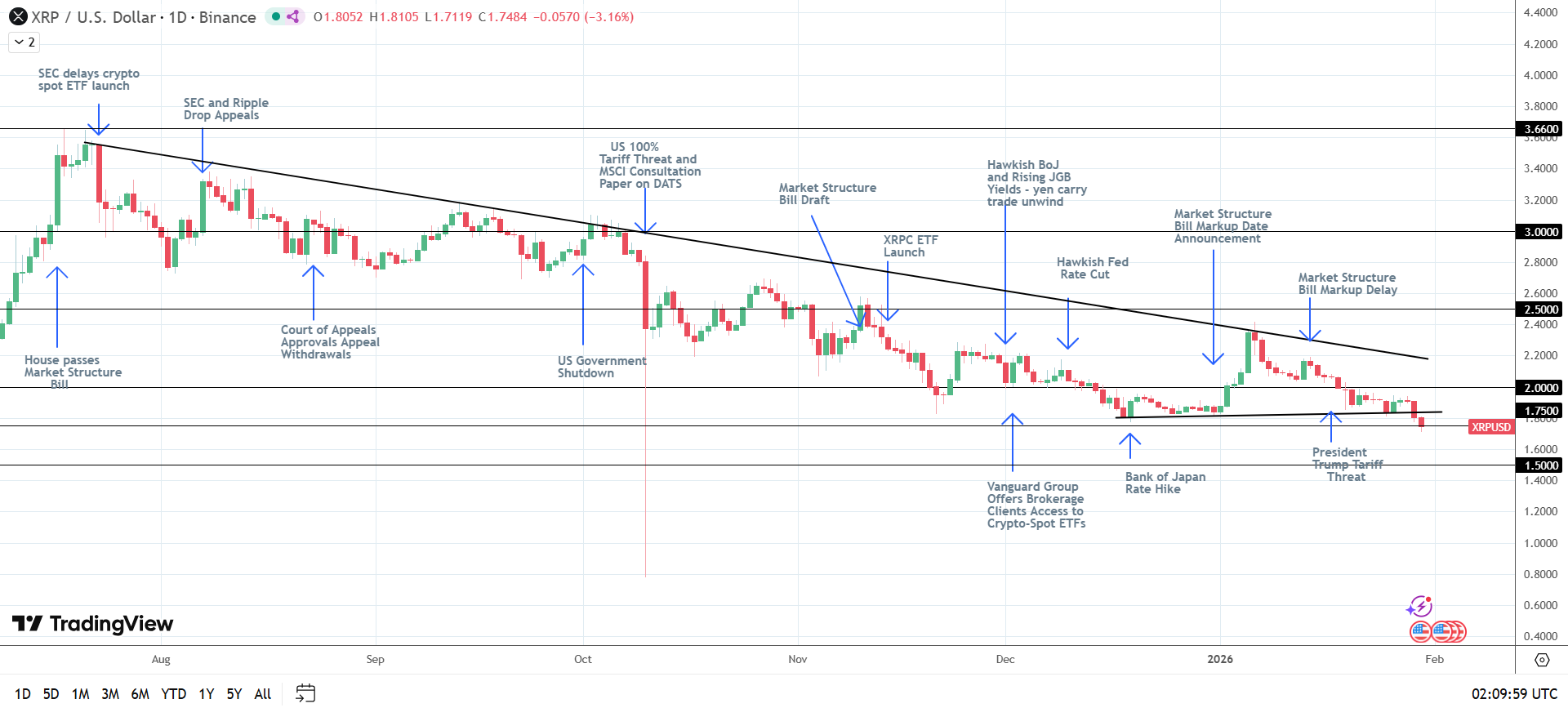
Breaking above $2 remains critical for the short- to medium-term outlook. The favorable fundamentals, as outlined above, continue to offset bearish technicals, suggesting a near-term rebound. However, XRP’s fall to a 2026 low of $1.7119 on Friday, January 30, and January losses of 5%, put the bullish structure and short- to medium-term price targets at risk.
A break above the lower trendline and a move through $1.85 would bring $2.0 into play. Breaking down resistance at $2 would pave the way toward the upper trendline. A sustained breakout above the upper trendline would affirm the bullish trend reversal and validate the bullish structure, supporting the price targets:
- Medium-term (4-8 weeks): $2.5.
- Longer-term (8–12 weeks): target of $3.0.
However, a sustained fall below the lower trendline to sub-$1.70 levels would invalidate the bullish structure, indicating a bearish trend reversal.
XRP Outlook Hinged on Crypto Legislation, ETFs, and Central Banks
Looking ahead, the Banking Committee’s markup vote will be crucial for XRP’s near-term price outlook. Progressing the draft text would boost hopes that the Senate will pass the Bill, fueling demand for XRP.
However, geopolitical developments and demand for XRP-spot ETFs will also dictate near-term price trends.
A more dovish Fed rate path and a lower BoJ neutral rate (potentially 1%-1.25%) would drive XRP demand. Strong inflows into US XRP-spot ETFs and the progress of the Market Structure Bill would affirm the constructive bias.
In summary, these factors support a medium-term (4–8 weeks) move to $2.5. The US Senate’s passing the Market Structure Bill would reaffirm the longer-term (8–12 weeks) price target of $3.0.
Beyond 12 weeks, these factors are likely to send XRP to its all-time high of $3.66 (Binance). A break above $3.66 would support a 6- to 12-month price target of $5.