The Beat That Wasn’t Enough
Netflix just dropped their Q4 earnings report, and honestly, the numbers look pretty solid at first glance. They beat expectations on both earnings and revenue – pulling in $12.05 billion versus the $11.97 billion analysts were expecting. Earnings per share came in at 56 cents, just edging out the 55 cent estimate. Revenue jumped 18% year-over-year, which is nothing to sneeze at.
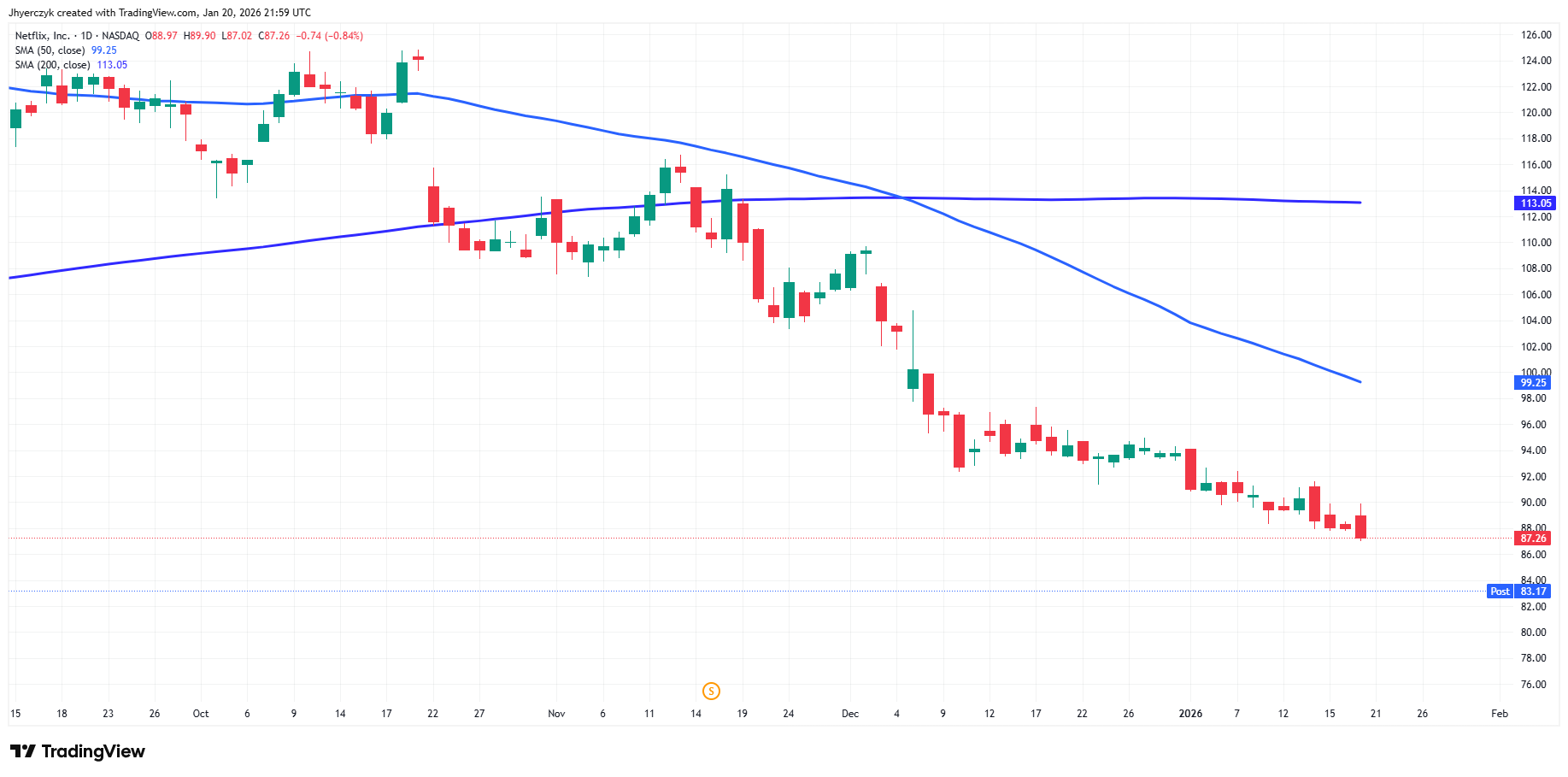
At 22:00 GMT, Netflix is trading $83.58, down $3.73 or -4.27%.

325 Million Subscribers and Counting
In my opinion, the major takeaway is: Netflix now has 325 million paid subscribers worldwide. That’s a massive milestone for the streaming giant. They crossed 300 million at the end of 2024, so they’re clearly still growing. Their ad-supported tier seems to be doing well too – ad revenue more than doubled in 2025 to over $1.5 billion, and they’re projecting it’ll roughly double again in 2026.
When “Good Enough” Isn’t Good Enough
Here’s why I think the stock dropped nearly 5% after hours. When a company beats estimates by such a thin margin (we’re talking pennies per share), investors sometimes see it as “not good enough,” especially for a high-flying tech stock like Netflix. The market had probably priced in stronger performance given all the buzz around Stranger Things’ final season and those NFL Christmas games.
The $82.7 Billion Elephant in the Room
But the real story here might be Netflix’s massive $82.7 billion bid for Warner Bros Discovery’s studio and entertainment assets. They’re going all-in to acquire HBO Max, Game of Thrones, Harry Potter, DC Comics – basically a treasure trove of content. They even amended their offer to all-cash at $27.75 per share and secured a whopping $67.2 billion in bridge loan commitments.
That’s a huge financial commitment, and investors might be getting nervous about the debt Netflix is taking on. Sure, it gives them incredible content and franchise power, but it’s also a risky play that could strain their balance sheet.
What’s Next for the Streaming Giant?
Looking ahead, Netflix expects 2026 revenue between $50.7-51.7 billion, which is decent but might not be the explosive growth some investors were hoping for. Combined with the broader tech sector bearishness from today, it’s not surprising the stock pulled back despite the beat.
Bottom line: Netflix is still growing and executing well, but investors seem worried about the Warner Bros acquisition costs and whether future growth justifies the current valuation. Sometimes good news just isn’t good enough for Wall Street.