


USD/JPY volatility has intensified in recent sessions as economic indicators, central bank rhetoric, and politics collide.
On Wednesday, February 4, service sector PMI numbers for Japan and the US will influence BoJ rate hike and Fed rate cut bets.
Markets currently expect a BoJ rate hike and a Fed rate cut by June 2026. Strong Japanese and weaker US services PMIs would support further monetary policy divergence. A narrowing rate differential favoring the yen would affirm the bearish short- to medium-term price outlook for USD/JPY.
Below, I’ll discuss the macro backdrop, near-term price catalysts, and technical levels traders should closely watch.
Japanese Services PMI Spotlights the BoJ
On February 4, Japanese services sector PMI data will fuel speculation about a BoJ rate hike. According to the preliminary survey, the S&P Global Japan Services PMI increased from 51.6 in December to 53.4 in January.
A higher PMI reading would signal a sharper pickup in economic momentum, given that services account for roughly 70% of Japan’s GDP. However, beyond the headline PMI, traders should consider any adjustments to the employment and prices sub-components, which are key focal points for the BoJ.
The preliminary survey showed that employment rose at the fastest pace since April 2019. Furthermore, service providers raised selling prices despite softer input cost inflation, signaling widening profit margins. Wider margins would enable service providers to increase employment and hike wages. Crucially, higher wages would increase households’ purchasing power, potentially fueling consumer spending and demand-driven inflation.
A higher inflation outlook would align with the BoJ’s quarterly inflation projections, suggesting a more hawkish BoJ rate path. Rising bets on an H1 2026 BoJ rate hike would strengthen the yen, sending USD/JPY lower.
For context, the BoJ revised its 2026 GDP and CPI projections upwards and signaled a near-term rate hike on January 23. The BoJ’s quarterly projections and forward guidance coincided with the preliminary services PMI data. USD/JPY tumbled 1.64% to close at 155.741 in response to the BoJ’s hawkish projections and the upbeat data.
USD/JPY Price Forecast
Every new USD/JPY analysis as it publishes, today's technical signal and key levels, live price — on one page.
See all USD/JPY forecasts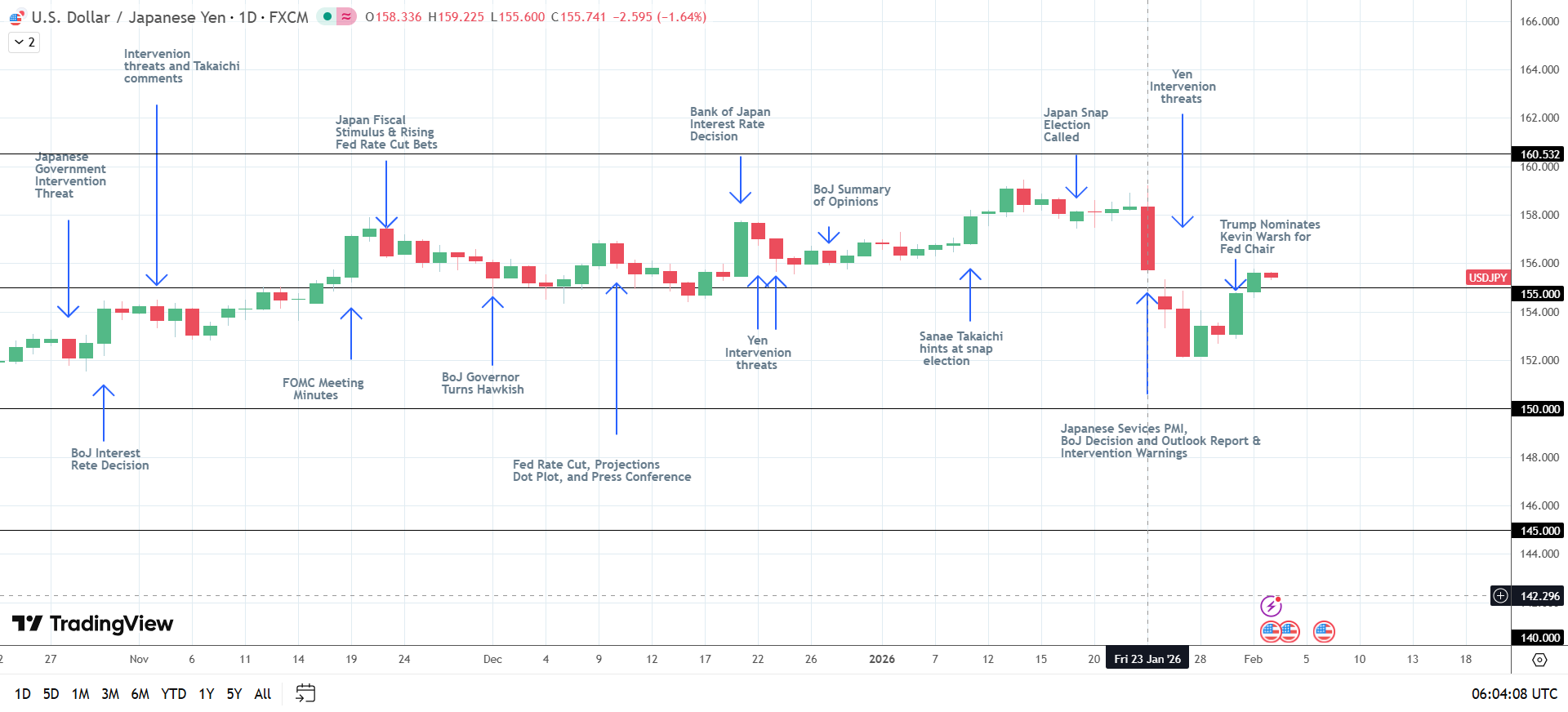
US ISM Services PMI and the Fed in Focus
While Japanese data will influence demand for the yen, US economic indicators will affect buying interest in the US dollar.
Economists expect the ISM Services PMI to fall from 54.4 in December to 53.5 in January. A lower PMI print would signal a loss of economic momentum, given that services contribute around 80% to US GDP. Beyond the headline PMI, the employment and prices sub-components will require consideration, given the Fed’s dual mandate.
Economists forecast the Employment PMI to remain at 52, while expecting the Prices PMI to slip from 64.3 to 64.0 in January.
Weaker prices and falling employment would fuel speculation about an H1 2026 Fed rate cut, weighing on the US dollar.
According to the CME FedWatch Tool, the chances of a March Fed rate cut dropped from 17.3% on January 27 to 8.4% on February 3, following stronger-than-expected US data. Meanwhile, the probability of a June cut fell from 65.4% to 56.1%. Waning bets on an H1 2026 Fed rate cut lifted USD/JPY from last week’s low of 152.092 to 155 levels, underscoring price sensitivity to incoming US data.
Importantly, an H1 2026 Fed cut would support expectations of multiple rate cuts in 2026. Multiple Fed rate cuts would coincide with the BoJ’s hawkish policy outlook, signaling a narrower US-Japan rate differential. Moreover, narrowing rate differentials, favoring the yen, would weigh on USD/JPY.
Crucially, a more dovish Fed rate path and a more hawkish BoJ policy stance would affirm the bearish short- to medium-term outlook for USD/JPY.
Technical Outlook: Key Levels to Watch
For USD/JPY price trends, traders should consider technical, incoming economic data, central bank chatter, and geopolitical developments.
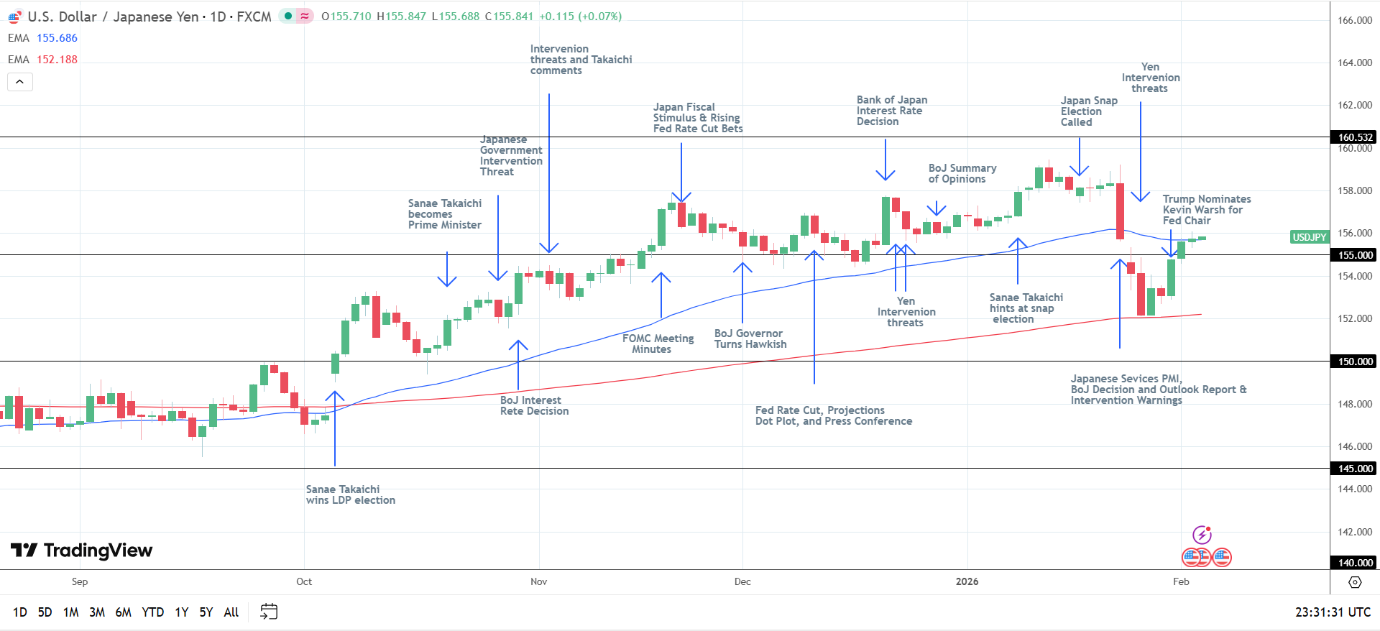
On the daily chart, USD/JPY trades above its 50-day and 200-day Exponential Moving Averages (EMAs). The EMA positions indicated a bullish bias. However, positive yen fundamentals continue to counter against technicals.
A drop below the 50-day EMA would expose the 200-day EMA. If breached, 150 would be the next key support level.
Significantly, a sustained fall through the EMAs would signal the bearish trend reversal and reinforce the negative short- to medium-term price outlook.
Positioning and Risk Outlook
In my view, the Services PMI forecasts, positive BoJ projections, a hawkish BoJ policy stance, and expectations of multiple Fed rate cuts support a negative price outlook.
However, upside risks to the bearish outlook include:
- Dovish BoJ chatter and a lower neutral interest rate (potentially 1% – 1.25%).
- US economic data tempers bets on an H1 2026 Fed cut.
These scenarios would send USD/JPY higher. However, threats of yen intervention are likely to cap the upside at around 160.
Read the full USD/JPY forecast, including chart setups and trade ideas.
Conclusion: Politics, the BoJ, and the Fed in the Spotlight
In summary, the USD/JPY trends will hinge on the BoJ’s policy stance, the Fed’s rate path, and geopolitical factors.
A higher BoJ neutral rate (1.5%-2.5%) would indicate a more hawkish BoJ rate path, strengthening the yen. Furthermore, dovish Fed rhetoric would also indicate narrowing rate differentials, reaffirming the bearish medium-term outlook for USD/JPY.
A sharply stronger yen and yen carry trade unwinds would likely send USD/JPY toward 140 over the longer 6-12 month time horizon.
For more in-depth analysis, review today’s USD/JPY trading setups in our latest reports and consult the economic calendar.