


XRP snaps a five-day losing streak as US economic indicators suggest a robust US economy, boosting sentiment.
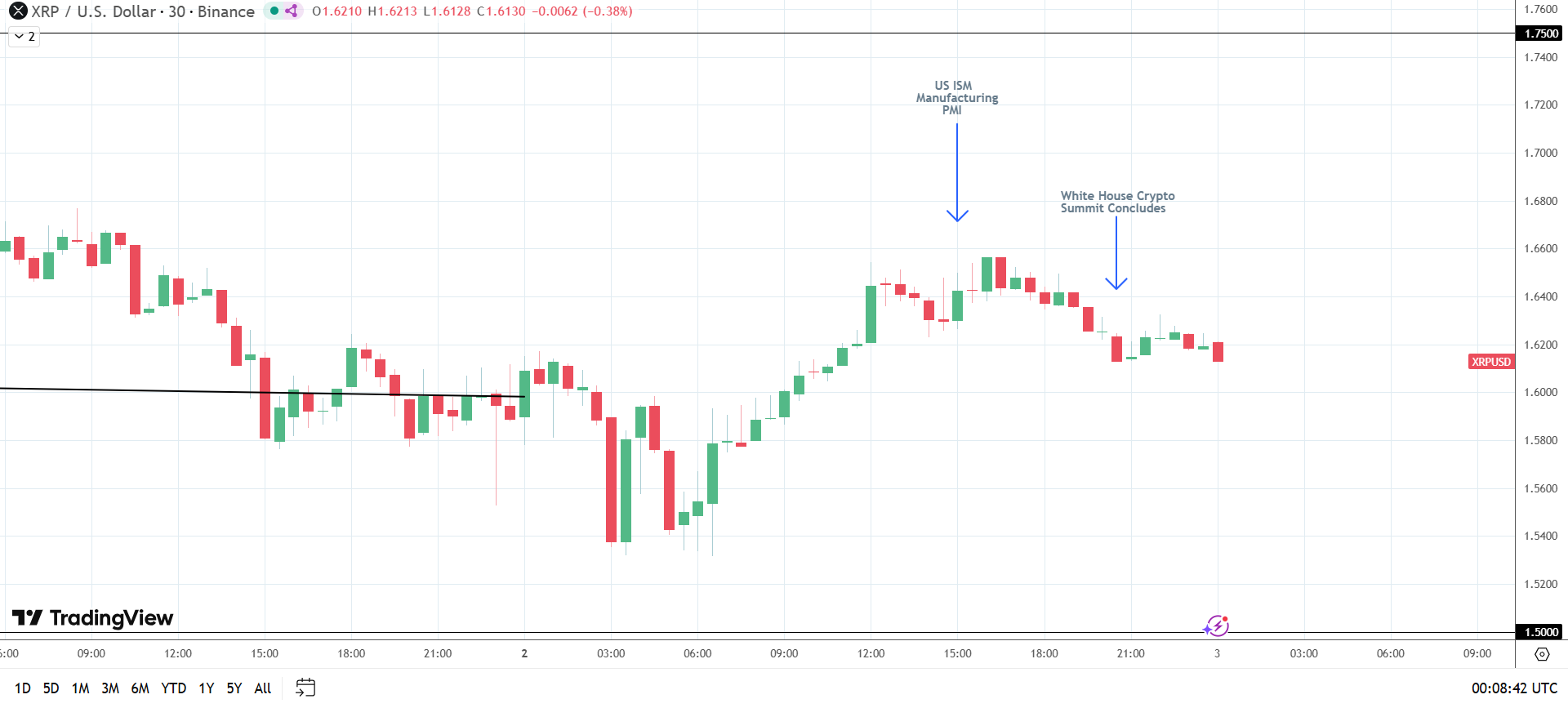
On Monday, February 2, the US ISM Manufacturing Index signaled a return to expansion across the sector, fueling demand for AI-linked stocks. Concerns about AI-linked spending and returns on investment had weighed on risk sentiment ahead of the Monday session.
Meanwhile, updates from the White House gathering of banking and crypto representatives underscored challenges to crypto-friendly legislation.
While the five-day losing streak indicated a near-term bearish trend reversal, the medium-term outlook remains bullish. Progress toward crypto-friendly legislation remains key to XRP’s price trajectory.
Below, I will explore the key drivers behind recent price trends, the medium-term (4-8 weeks) outlook, and the technical levels traders should watch.
White House Crypto Summit Highlights Challenges to Crypto Legislation
On February 2, representatives from the banking and crypto communities met with the US administration to find common ground on legislative rules for stablecoin yields.
Crypto in America host and journalist, Eleanor Terrett, shared updates from the session, stating:
“Everyone had a chance to speak, with roughly a 3:1 ratio of crypto to banking reps in the room. Crypto and AI Czar David Sacks was not in attendance. The meeting was led by Crypto Council Executive Director Patrick Witt.”
However, a statement from the banking community underscored challenges ahead in finding common ground on stablecoin yield-related legislation.
Terrett shared a press release from the coalition of bank trade groups, which said:
“As we shared in the meeting, we must ensure that any legislation supports the local lending to families and small businesses that drives economic growth and protects the safety and soundness of our financial system. Banks of all sizes will continue to work with lawmakers, the White House, and other stakeholders to help develop thoughtful, effective policy around digital assets.”
Senior reporter Brendan Pedersen remarked on the White House meeting and negotiations, stating:
“Folks in the room of the WH crypto-bank meeting have told me the two industries had very different approaches to initial negotiations. Crypto reps wanted to talk specific potential solutions on yield. Bank trade reps mostly avoided details, did not want to discuss discrete solutions.”
Pedersen added:
“I’m not suggesting banks advocates are doing a runaround here. This kind of early aloofness is standard issue policy negotiation strategy. Just interesting to see it contrast with the approach of an industry that is roughly speaking barely old enough to drive in the US.”
XRP Dips as Updates from the Banking Community Signal a Tough Road Ahead
XRP briefly climbed to $1.6325 before falling to $1.6079 as traders reacted to the updates from the White House and the banking coalition statement.
Failure to reach a compromise on stablecoin yields could derail hopes for comprehensive crypto regulations that foster innovation while protecting consumers.
For context, the US Senate Banking Committee postponed a markup vote on its draft text for the Market Structure Bill. Coinbase withdrew its support, stating that the draft text killed rewards on stablecoins, allowing US banks to ‘ban their competition.’
Coinbase’s stance on stablecoin yields and the banking community’s push to prevent rewards underscore the divide between TradFi and DeFi.
The presence of representatives from the American Bankers Association (ABA) hinted at a challenging first session, given the Association’s efforts to slow DeFi’s advancements on Main Street.
In 2023, Senator Roger Marshall acknowledged that he and Senator Elizabeth Warren drafted the Digital Asset Anti-Money Laundering Act, with help from the ABA. The Digital Asset Anti-Money Laundering Act proposed a banking-style anti-money laundering and countering the financing of terrorism (CFT) framework that could end DeFi’s competitiveness on Main Street.
Meanwhile, in 2025, the ABA requested that the Office of the Comptroller of the Currency (OCC) delay approvals for Ripple and Circle’s chartered banking licenses.
Crypto-related legislative developments remain key to XRP’s bullish medium- to long-term outlook. Analysts see the passing of the Market Structure Bill as crucial to increased XRP adoption and bullish price forecasts.
XRP Price Forecast: Short-, Medium-, and Long-Term Targets
Last week’s reversal signaled a bearish trend reversal, indicating a negative short-term outlook (1-4 weeks), with a target price of $1.5.
However, robust demand for XRP-spot ETFs, expectations of multiple Fed rate cuts, hopes that the Market Structure Bill will progress, and increased XRP utility continue to support the bullish medium- to long-term price projections:
- Medium-term (4-8 weeks): $2.5.
- Longer-term (8-12 weeks): $3.0.
Key Downside Risks to the Bullish Medium-Term Outlook
Several events could challenge the constructive bias. These include:
- A hawkish Bank of Japan, with a higher neutral interest rate (potentially 1.5%-2.5%). Multiple BoJ rate hikes could narrow US-Japan rate differentials, potentially triggering a yen carry trade unwind, as seen in mid-2024. A yen carry trade unwind would validate the bearish trend reversal.
- Upbeat US economic indicators and waning bets on an H1 2026 Fed rate cut.
- Delays and/or partisan opposition to the Market Structure Bill.
- Extended periods of XRP-spot ETF net outflows.
These scenarios would weigh on XRP demand, pushing XRP below $1.5 and reaffirming the bearish trend reversal.
Technical Analysis: Levels to Watch
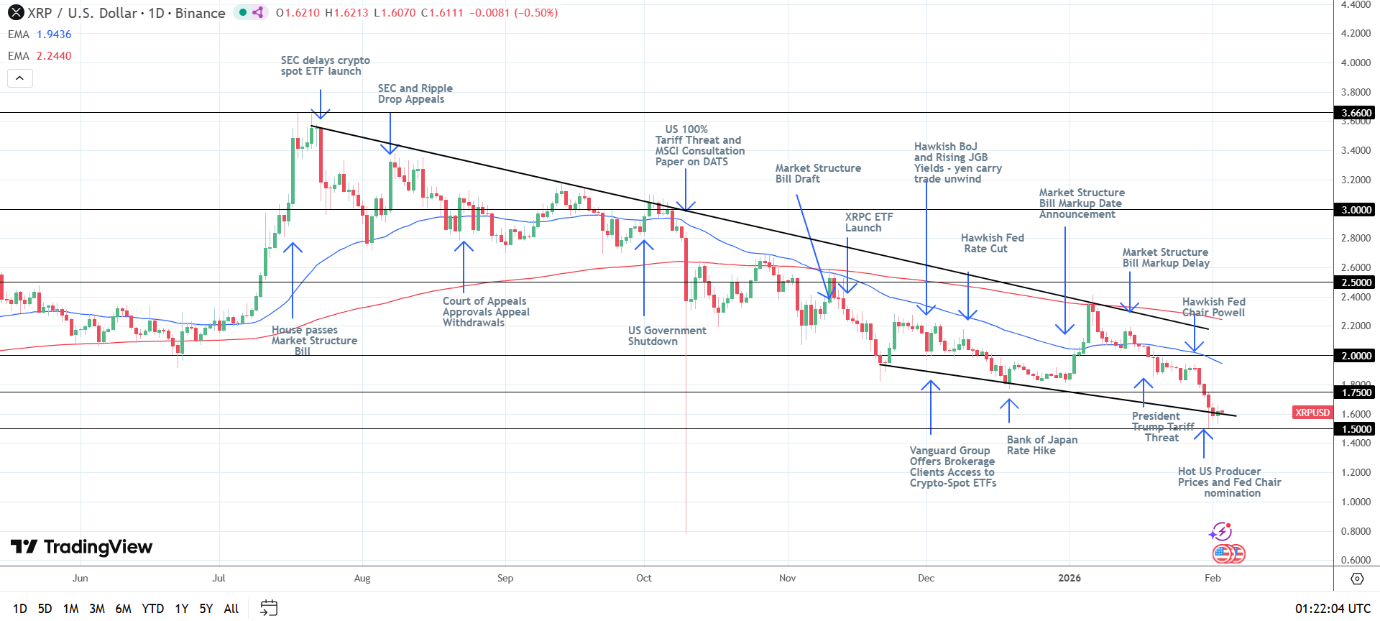
XRP gained 1.90% on Monday, February 2, partially reversing the previous day’s 3.47% loss, closing at $1.6192. The token underperformed the broader crypto market cap, which advanced 2.28%.
Last week’s sell-off left XRP trading well below its 50-day and 200-day EMAs, indicating a bearish bias. However, several positive fundamentals continue to counter bearish technicals, supporting a bullish medium-term outlook.
Key technical levels to watch include:
- Support levels: $1.50 and then $1.0.
- 50-day EMA resistance: $1.9436.
- 200-day EMA resistance: $2.2440.
- Resistance levels: $1.75, $2.0, $2.5, and $3.0.
On the daily chart, a break above $1.75 would bring the 50-day EMA and $2.0 into play. A sustained move through the 50-day EMA would signal a near-term bullish trend reversal, paving the way toward $2.2. A breakout above $2.2 would enable the bulls to target the 200-day EMA.
A sustained move through the EMAs would reaffirm the bullish medium-term price targets.
Fundamental Events Driving Near-Term Price Action
Near-term price drivers include:
- XRP-spot ETF flow trends.
- US economic data and the Fed’s monetary policy outlook.
- Crypto-related legislative developments.
- The Bank of Japan’s neutral rate and policy stance.
- Increased geopolitical risks.
Bearish Structure Intact with $1.5 as Key Support
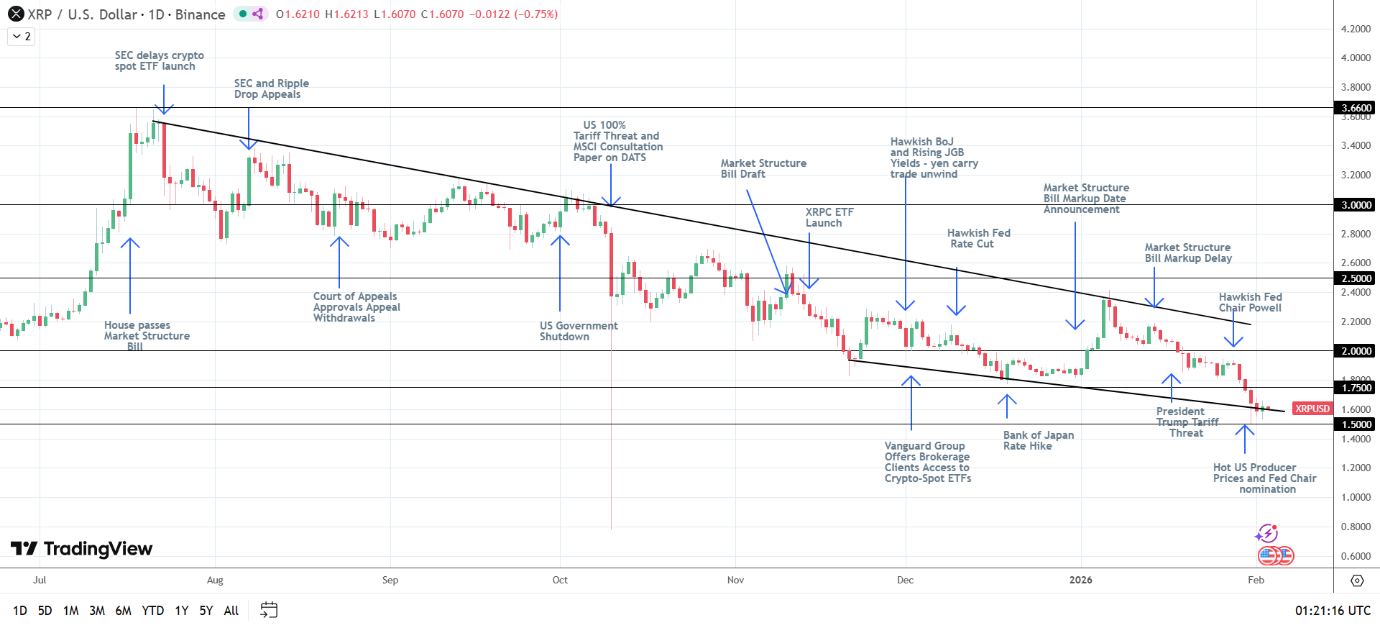
XRP’s drop below $1.75 indicated a bearish trend reversal and invalidated the bullish short-term outlook. However, XRP found crucial support at $1.5 and reclaimed $1.60. A drop below $1.5 would expose the psychological $1 level. If breached, the October 10 flash crash low of $0.7773 (Binance) would be the next key support level. Significantly, a break below $1.5 would reinforce the bearish short-term outlook and validate the bearish structure.
Conversely, breaking above $2.0 would bring the upper trendline into play. A sustained move through the upper trendline would signal a bullish trend reversal, invalidating the bearish structure, and affirming the constructive medium-term bias.
- Short-term (1-4 weeks): $1.5.
- Medium-term (4-8 weeks): $2.5.
- Longer-term (8–12 weeks): target of $3.0.
XRP Outlook Hinged on Crypto Legislation, US Data, and ETF Flows
Looking ahead, crypto-related legislative developments will be key for XRP’s price outlook. Progress toward a US Senate Banking Committee draft text for the Market Structure Bill would likely fuel XRP demand.
However, geopolitical risks, US economic data, central bank chatter, and XRP-spot ETF flow trends will also influence near-term price trends.
A more dovish Fed rate path and a lower BoJ neutral rate (potentially 1%-1.25%) would boost sentiment. Strong demand for US XRP-spot ETFs and the progress of the Market Structure Bill would reinforce the positive medium-term outlook.
In summary, these events support a medium-term (4–8 weeks) move to $2.5. The US Senate’s passing the Market Structure Bill would affirm the longer-term (8–12 weeks) price target of $3.0.
Beyond 12 weeks, these scenarios are likely to send XRP to its all-time high of $3.66 (Binance). A break above $3.66 would support a 6- to 12-month price target of $5.