
Mainland China’s CSI 300 and SSE Composite Index joined the broader market sell-off, as Chinese regulators tightened credit controls amid concerns over excess leverage and overheating.
Metals and mining sector stocks came under heavy selling pressure as gold and silver plunged late last week, extending their losses into this week.
Meanwhile, hopes for near-term fresh stimulus and monetary policy easing abated, as Chinese PMI data signaled robust momentum early in 2026.
Despite the pullback from January’s highs, the medium-term outlook remains bullish for Mainland and Hong Kong-listed stocks.
Below, I will explore the key drivers behind recent gains, the medium-term (3-6 months) market outlook, and the key technical levels traders should watch.

Major Chinese Exchanges Raise Margin Requirements
In January, China’s major stock exchanges raised their minimum margin requirements to address excess leverage, aimed at cooling an overheating market and tackling speculative trades.
Beijing, Shanghai, and Shenzhen increased their minimum margin requirements from 80% to 100%, effective January 19. The exchanges had lowered margin requirements to 80% in 2023 to support the markets.
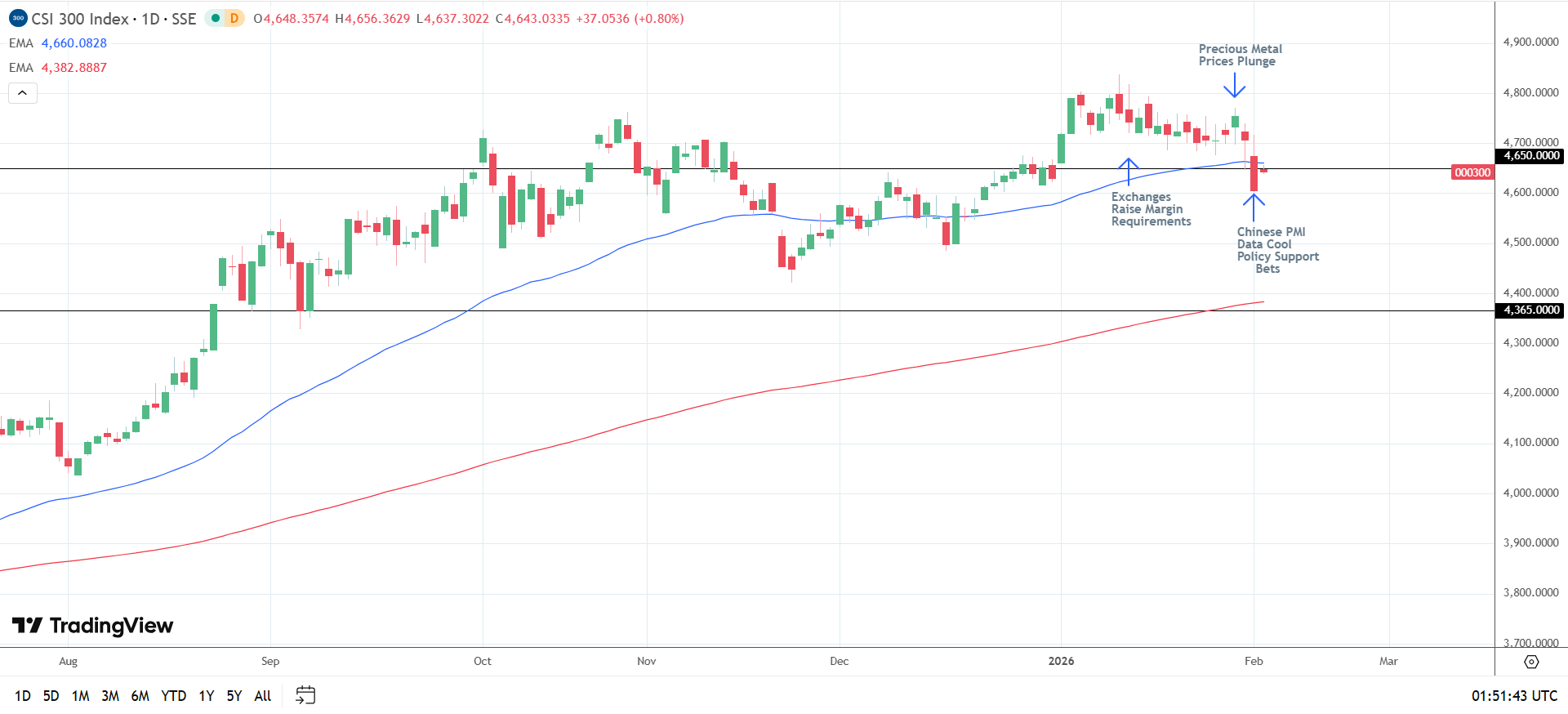
Notably, the CSI 300 dropped from its January 13 high of 4,837 to a January 27 low of 4,676 in response to the announcement.
Gold Price Forecast
Every new Gold analysis as it publishes, today's technical signal and key levels, live price — on one page.
See all Gold forecastsGold and Silver See Sharp Reversals, Weighing on Major Indices
On January 30, gold and silver saw heavy losses and extended their declines on February 2, adding to the market doom and gloom. Gold tumbled 9.16% on January 30 and by a further 4.6% on February 2. Meanwhile, silver tumbled 26.83% on January 30 and by 6.4% on February 2, sending Chinese commodity-linked stocks deep into negative territory.
Reports of counterparty Xu Maohua (“The Hat”) fleeing the country intensified the selling pressure on Chinese metal stocks. CN Wire reported:
“Chinese metal traders lost at least 1 billion yuan (144 million) after counterparty Xu Maohua (“The Hat”) fled the country, leaving trades unfinished, raising regulatory concerns over hidden financial risks. […] The incident has drawn scrutiny from China’s state-owned assets watchdog, which instructed major commodities SOEs to review operations and cut non-core revenue boosting activities. The Watchdog’s measures could reduce liquidity and increase pressure on small traders.”
The FTSE China A 600 Mining Index slid 7.8% on January 30 and by 9.25% on February 2.
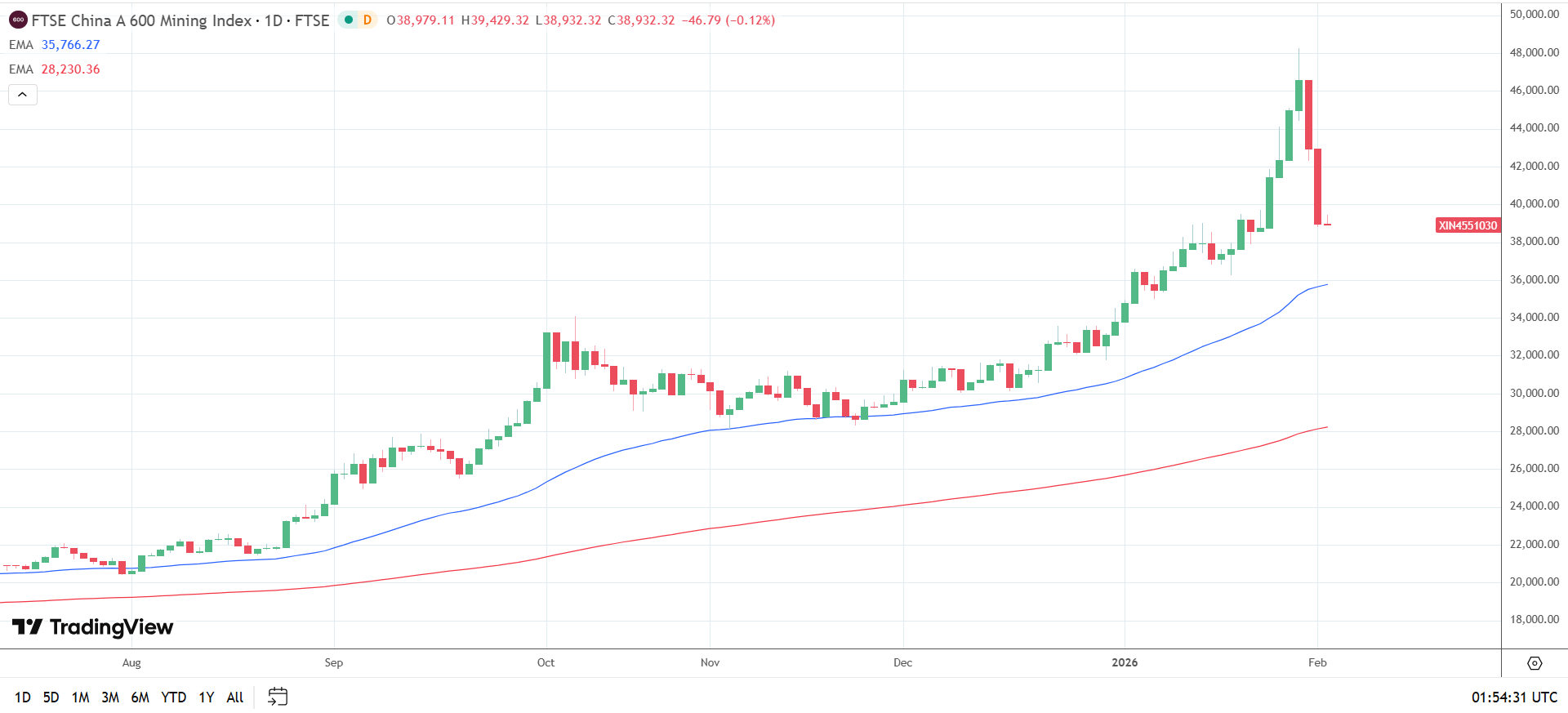
The mining sector sell-off contributed to the CSI 300’s fall to a February 2 low of 4,614, its lowest level since December 24.
Chinese Manufacturing PMI Cools Expectations of Near-Term Policy Support
Chinese economic indicators added to the negative market sentiment on February 2. The RatingDog China General Manufacturing PMI increased from 50.1 in December to 50.3 in January. Key highlights from the January survey included:
- Production increased at a quicker rate in January, as new orders increased.
- New export orders, particularly from Southeast Asia, signaled a pickup in client demand.
- Manufacturers responded by increasing staffing levels for the first time in three months.
- Significantly, the improving demand environment enables manufacturers to increase factory gate prices for the first time since late 2024. Goods producers also raised export prices.
Crucially, improving demand and rising employment may ease pressure on Beijing to roll out fresh stimulus and ease monetary policy. Typically, higher prices widen profit margins, enabling firms to raise wages. Tighter labor market conditions and rising wages may boost private consumption, bolstering the second part of China’s dual economy.
In January, Beijing announced fresh measures to boost domestic consumption targeting autos, home appliances, electronics, and smart durable goods. Beijing also aimed at households, pledging several measures, including:
- Extension of personal consumption loan interest subsidies to the end of 2026.
- Extension of tax and fee incentives for elderly care, childcare, and domestic services until the end of 2027.
- Increased fiscal spending in 2026.
- Expansion of interest subsidies to credit card installments (1% rate).
While there was a welcome upswing in demand and employment, manufacturers were less optimistic in January, underscoring the need for further policy support from Beijing.
RatingDog founder Yao Yu commented on the January PMI survey, stating:
“Looking ahead, if cost pressures persist while demand recovery is limited, profit margins will remain under pressure. Policy support for initiatives may consolidate the recovery momentum in 2026.”
Key Downside Risks to the Bullish Outlook
Despite the bullish sentiment, downside risks could derail the positive outlook. These include:
- An escalation in US-China trade tensions.
- Global tariffs targeting Chinese goods.
- Beijing delays monetary policy easing and the introduction of fresh fiscal stimulus.
- Waning external demand for Chinese goods.
- Slowing domestic demand.
- Chinese housing market deteriorates further.
These scenarios would likely send the Hang Seng Index below its 50-day EMA and the CSI 300 below its 200-day EMAs, indicating bearish trend reversals.
However, China’s advancements in AI, self-reliance on chip manufacturing, and improving manufacturing sector activity support a constructive short- to medium-term bias for Mainland China indices.
Furthermore, economists expect that Beijing can boost domestic consumption by introducing new subsidies and lowering borrowing rates, while bolstering the housing market.
CSI 300 Technical Outlook: Resistance Levels in Focus
Chart technicals and market fundamentals remained diverged in early trading on Tuesday, February 3. Viewing the daily chart, the CSI 300 trades below its 50-day EMA, but holds above its 200-day EMA. The EMA positions signal a bearish near-term but bullish longer-term bias.
A breakout above the 4,650 resistance level and the 50-day EMA would signal a near-term bullish trend reversal. A bullish trend reversal would bring the January 13 high of 4,837 into play. A sustained move through 4,837 would enable the bulls to target 5,000. Breaking above the 50-day EMA will be crucial for the bullish outlook.
Hang Seng Index: Bullish Outlook Intact
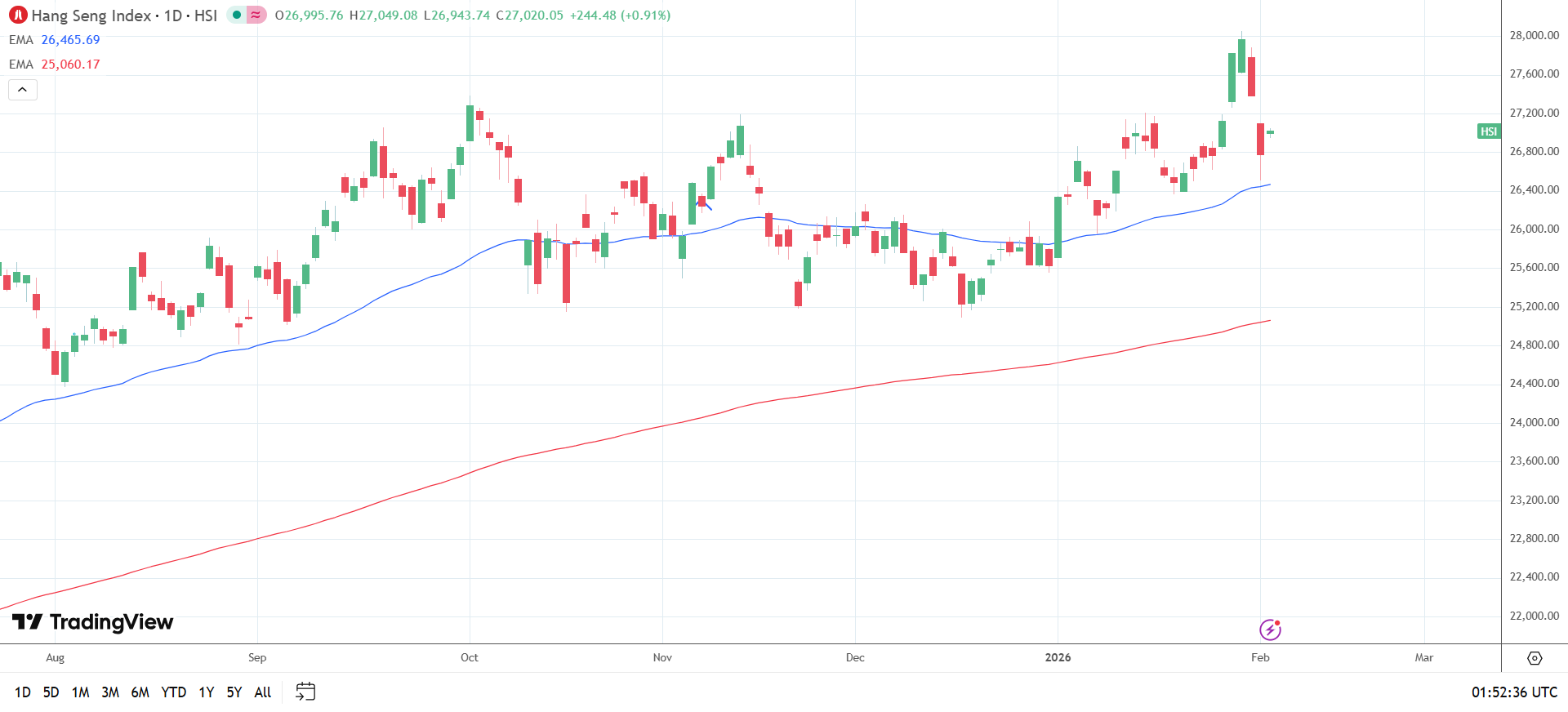
The Hang Seng Index’s outlook contrasts with the CSI 300, as the Index trades above its 50-day and 200-day EMAs. These EMAs signal bullish momentum, aligning with favorable fundamentals.
A break above January’s high of 27,207 would bring the October 2025 high of 27,382 into play. A move through 27,382 would pave the way toward 28,000. Breaking down resistance at 28,000 would open the door to testing 30,000 for the first time since 2021.
Conclusion:
To summarize, the short- and medium-term outlook remains constructive. Beijing’s recent policy measures, expectations of further support, albeit delayed, China’s AI-linked advancements, and a pickup in manufacturing sector activity are likely to drive demand for Mainland China and Hong Kong-listed stocks.
However, global trade headlines, housing market developments, and price trends are likely crucial for domestic consumption. Effective policy measures targeting domestic consumption would likely send the CSI 300 to its 2021 all-time high of 5,931.
Discover strategies to navigate this week’s market trends here.