
US stock futures advanced early in the Asian market session on Tuesday, February 3, consolidating the previous day’s gains. Concerns about AI-related spending and returns on investment eased as the dust settled from Microsoft’s (MSFT) earnings results. Upbeat US economic data from February 2 signaled a pickup in manufacturing sector activity in January, lifting sentiment.
Hopes of the US government’s partial shutdown ending on February 3 and a US-India trade deal contributed to the uptick in sentiment.
Notably, USD/JPY held onto the 155 level after Monday’s gains, adding to the positive sentiment. The Nikkei 225 surged 2.94% in morning trading, joining US equity futures in positive territory.
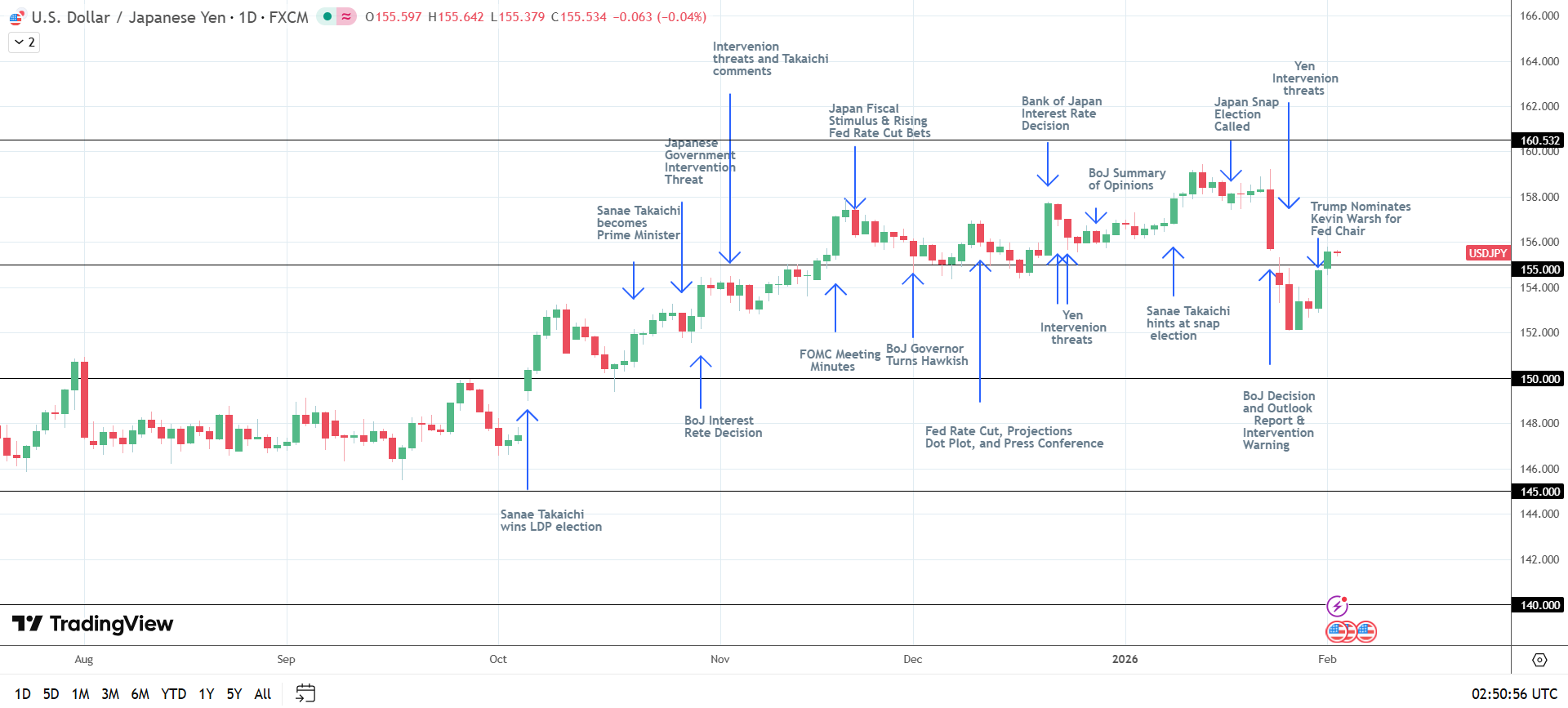
Monday’s rally and the morning gains reflected optimism over multiple Fed rate cuts in 2026 and sentiment toward the US economic outlook, supporting a cautiously bullish outlook for the US index futures.
Below, I’ll outline the key market drivers, the medium-term outlook, and the technical levels traders should watch.

US and India Reach a Trade Agreement
Easing trade tensions boosted demand for risk assets on February 3. US President Trump announced a US-India trade deal, stating:
“We agreed to a Trade Deal between the United States and India, whereby the United States will charge a reduced Reciprocal Tariff, lowering it from 25% to 18%. They will likewise move forward to reduce their Tariffs and Non Tariff Barriers against the United States, to ZERO. The Prime Minister also committed to “BUY AMERICAN,” at a much higher level, in addition to over $500 BILLION DOLLARS of U.S. Energy, Technology, Agricultural, Coal, and many other products.”
As part of the deal, Prime Minister Modi agreed to stop buying Russian oil and buy more from the US, and potentially Venezuela.
Dow Jones Price Forecast
Every new Dow Jones analysis as it publishes, today's technical signal and key levels, live price — on one page.
See all Dow Jones forecastsUS Labor Market, the Fed, and Earnings in Focus
US futures trended higher during the Asian session on February 3. The Dow Jones E-mini gained 24 points, while the Nasdaq 100 E-mini and the S&P 500 E-mini advanced 83 points and 10 points, respectively.
Later on Tuesday, JOLTs job openings will spotlight the US labor market. Economists expect job openings to drop from 7.146 million in November to 7.1 million in December.
A drop in job openings would support expectations of multiple Fed rate cuts in 2026, fueling demand for US stock futures. Lower borrowing rates could boost earnings and stock valuations. The labor market data will likely have more influence, given the announced delay to Friday’s US jobs report.
Beyond the data, traders should closely monitor Fed speakers. Insights into the labor market, inflation, and the timing of rate cuts would also influence sentiment.
Meanwhile, corporate earnings results will remain key for the near-term market trends. PepsiCo (PEP), Advanced Micro Devices (AMD), and PayPal (PYPL) are among the marquee names to release earnings results.
Strong earnings and lower job openings would support a cautiously bullish short-term and positive medium-term outlook for US stock futures. However, an anticipated House of Representatives vote on a funding bill to reopen the government is also likely to affect risk appetite.
Overnight, President Trump raised hopes of the House passing the funding deal, stating:
“I am working hard with Speaker Johnson to get the current funding deal, which passed in the Senate last week, through the House and to my desk, where I will sign it into Law, IMMEDIATELY! We need to get the Government open, and I hope all Republicans and Democrats will join me in supporting this Bill, and send it to my desk WITHOUT DELAY.”
Key Technical Levels for Dow Jones, Nasdaq 100, and S&P 500
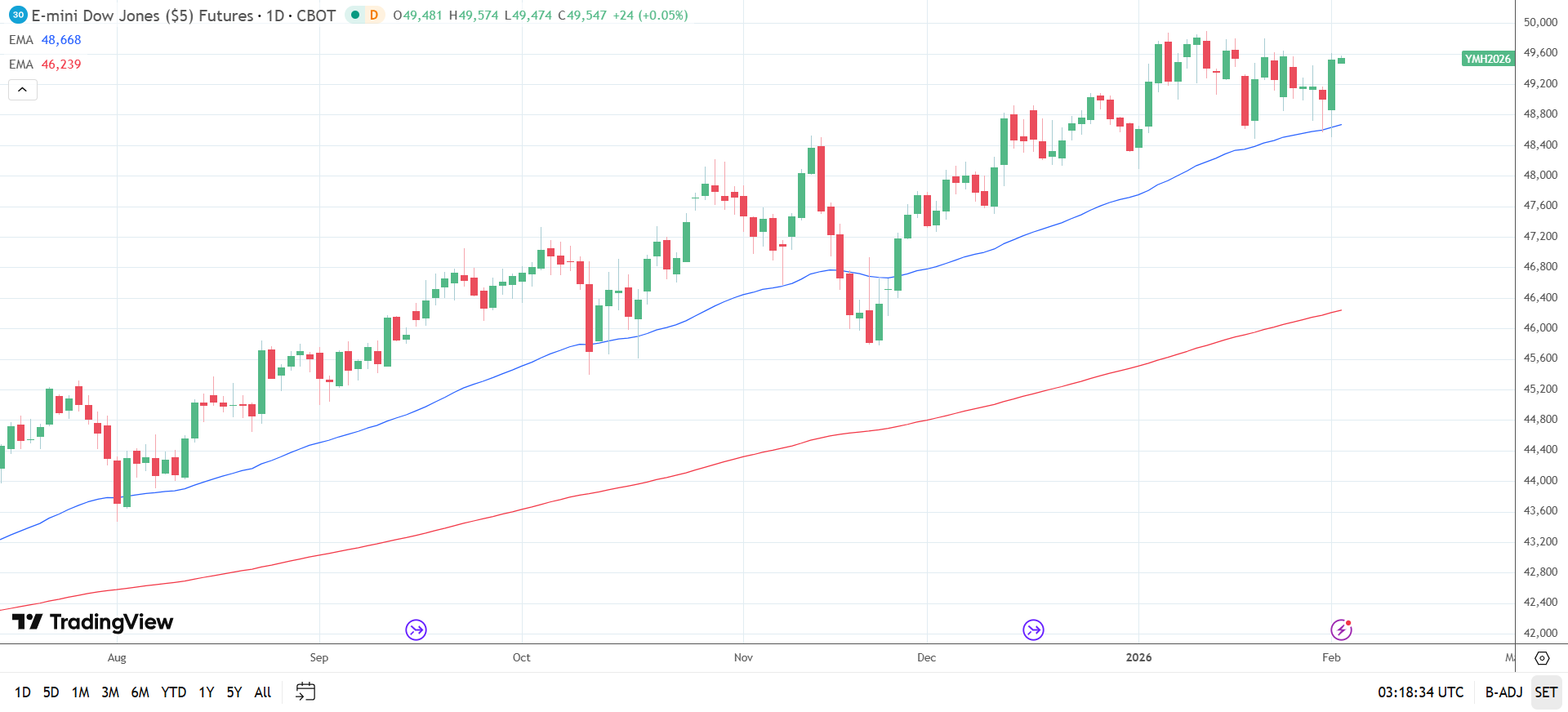
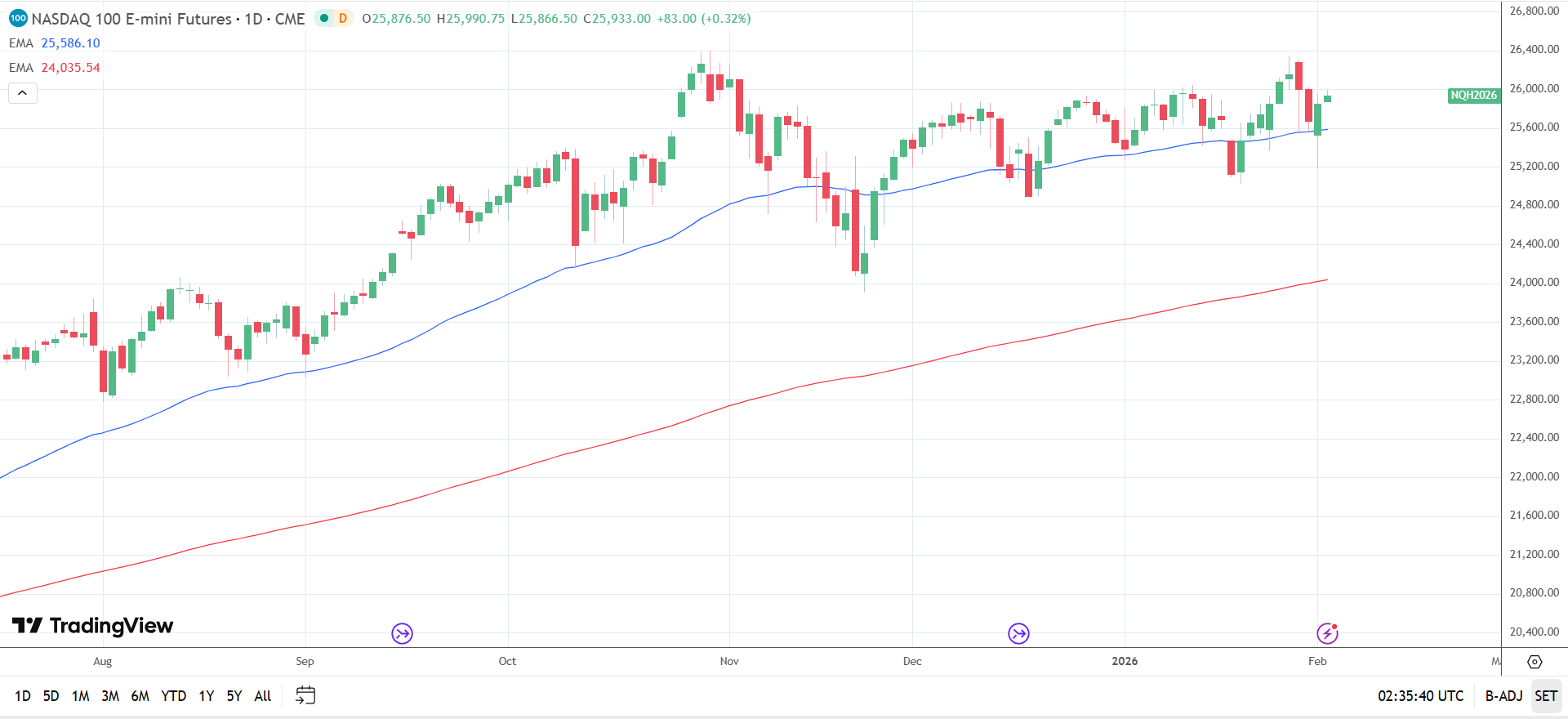
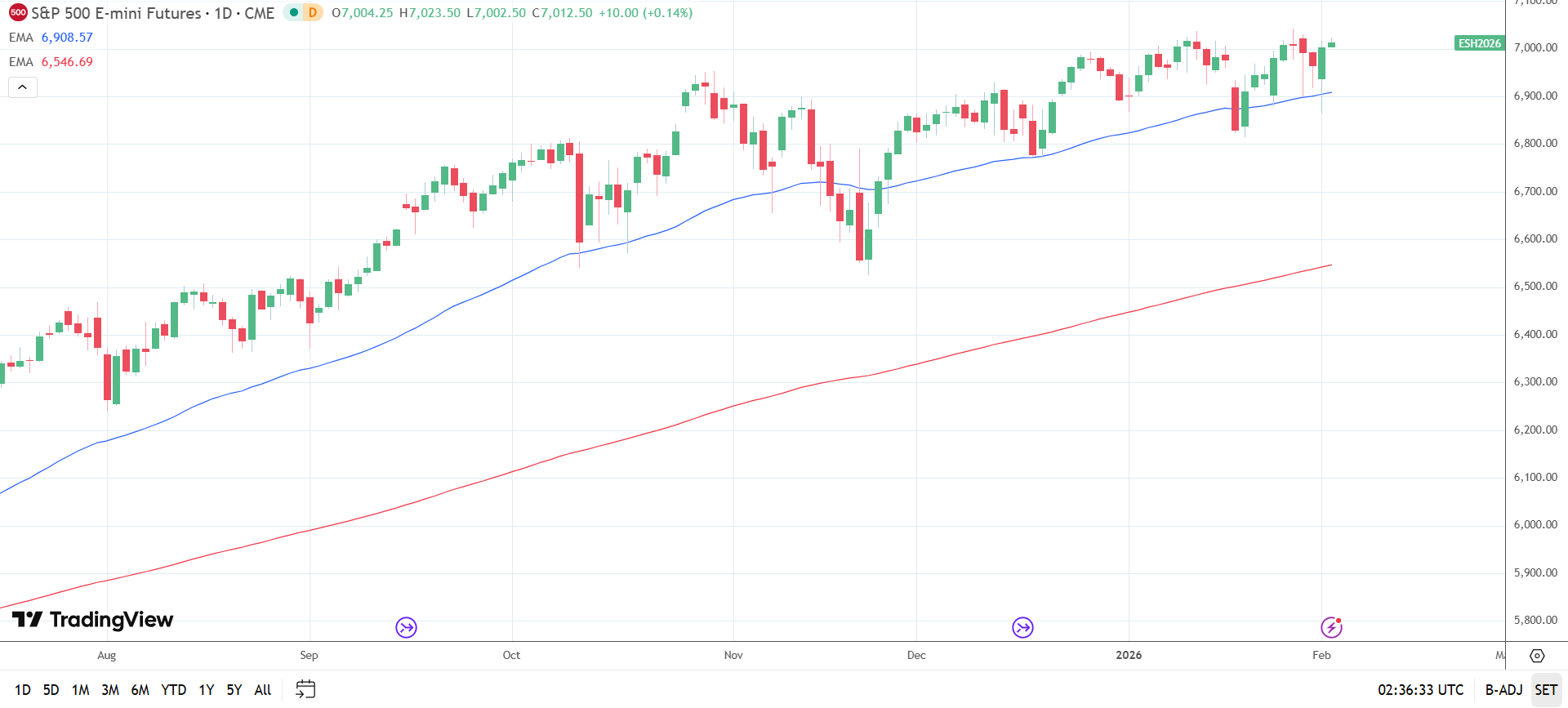
Monday’s recovery and morning gains left the Dow Jones E-mini, the Nasdaq 100 E-mini, and the S&P 500 E-mini trading above their 50-day and 200-day EMAs. The EMA positions signaled bullish momentum, aligning with positive fundamentals.
Near-term trends will hinge on geopolitical risks, earnings, US economic data, central bank chatter, and the US House vote. Key levels to monitor include:
Dow Jones
- Resistance: the January 13 record high of 49,901 and then 50,000.
- Support: 49,000 and then the 50-day EMA (48,668).
Nasdaq 100
- Resistance: 26,000 and then the October 30 record high of 26,399.
- Support: the 50-day EMA (25,585), 25,000, and then 24,500.
S&P 500
- Resistance: the January 13 high of 7,036, followed by 7,500.
- Support: the 50-day EMA (6,909) and then 6,500.
Outlook: Strong US Economy, Rate Cut Bets, and Earnings Reinforce Bullish Outlook
In my opinion, the short-term price outlook remains cautiously bullish. Bets on an H1 2026 Fed rate cut, and upbeat sentiment toward Q4 earnings support the bullish medium-term outlook. These positive fundamentals align with technicals for US index futures.
However, several factors would challenge the bullish medium-term outlook, including:
- Increased geopolitical risks.
- The Bank of Japan indicates a higher-than-expected neutral interest rate (potentially 1.5%-2.5%). A narrower-than-expected US-Japan rate differential may trigger a yen carry trade unwind. Such a scenario would invalidate the short-term outlook.
- Fed rhetoric and US economic data dampen bets on multiple Fed rate cuts in 2026.
- Corporate earnings and outlooks disappoint.
Conclusion: Constructive Bias Intact
In summary, the strong US economy, a dovish Fed rate path, robust earnings, and a cautiously hawkish BoJ reaffirm the short- and medium-term outlooks for US stock futures.
However, traders should monitor BoJ chatter, warnings of yen intervention, and USD/JPY trends. Hawkish BoJ cues, a dovish Fed policy stance, and more intervention threats could send USD/JPY toward 150, potentially triggering a yen carry trade unwind.
Despite risks of a yen carry trade unwind, new all-time highs for US stock futures are likely if US economic data fuel bets on a June Fed rate cut. Fed rate cuts are likely to have a more lasting, longer-term effect on company earnings and equity valuations than narrowing US-Japan rate differentials on sentiment.
Follow our live coverage and consult the economic calendar for real-time market updates.