
Mainland China and Hong Kong equity markets get a boost as China improves trade relations with key partners.
China went into diplomatic overdrive in recent weeks. Early signs of improved dialogue with the US, the UK, and Canada eased concerns over weakening external demand in 2026.
Meanwhile, Beijing’s monetary policy and fiscal stimulus moves supported demand for Mainland China stocks as the IMF and Goldman Sachs project a strong economic year ahead.
Improved trade relations and Beijing’s focus on monetary policy and fiscal stimulus support the bullish medium-term outlook for Mainland China indices.
Below, I will explore the key drivers behind recent gains, the medium-term (3-6 months) market outlook, and the key technical levels traders should watch.

China Eyes Improved Trade Terms to Maintain Economic Momentum
Treasury Secretary Scott Bessent commented on his meeting with Chinese officials at the World Economic Forum, stating:
“During my meeting this week with Vice Premier He Lifeng of China, we held a positive discussion regarding the implementation of the economic agreement between President Trump and President Xi. Look forward to meeting with the Vice Premier again soon.”
US-China relations have improved since President Trump and Chinese President Xi Jinping’s meeting in October. The trade war truce extension supported a more optimistic economic outlook for China.
Meanwhile, China aims to forge stronger ties with the UK. An upcoming meeting with UK Prime Minister Keir Starmer is expected to include representatives from Chinese firms BYD, China Mobile, Sinopharm, and several Chinese banks.
The meeting with the UK Prime Minister follows last week’s announcement of Canada’s new strategic partnership with China.
Hong Kong Hang Seng Price Forecast
Every new Hong Kong Hang Seng analysis as it publishes, today's technical signal and key levels, live price — on one page.
See all Hong Kong Hang Seng forecastsBeijing Eyes Measures to Bolster Consumer and Producer Prices
This week, the National Development and Reform Commission (NDRC) announced plans to target price recovery. According to CN Wire:
“China will implement a more proactive fiscal policy and a moderately loose monetary policy, prioritizing price recovery as a core objective, National Development and Reform Commission Vice Chairman Wang Changlin said on Tuesday.”
The NDRC Vice Chairman reportedly stated that the government plans to create a positive interaction between economic growth and consumer and producer prices.
While China’s economy expanded 5% in 2025, deflationary pressures lingered despite an uptick in consumer prices at the year’s end. Price wars have squeezed corporate margins, forcing firms to cut wages and/or reduce staffing levels to manage costs. Addressing deflation could boost wages and increase employment, fueling domestic consumption.
For context, retail sales increased by just 0.9% year-on-year in December, down from 1.3% in November. A continued slowdown in retail sales growth since May’s 6.4% surge underscored the impact of falling corporate profits on consumer sentiment and spending.
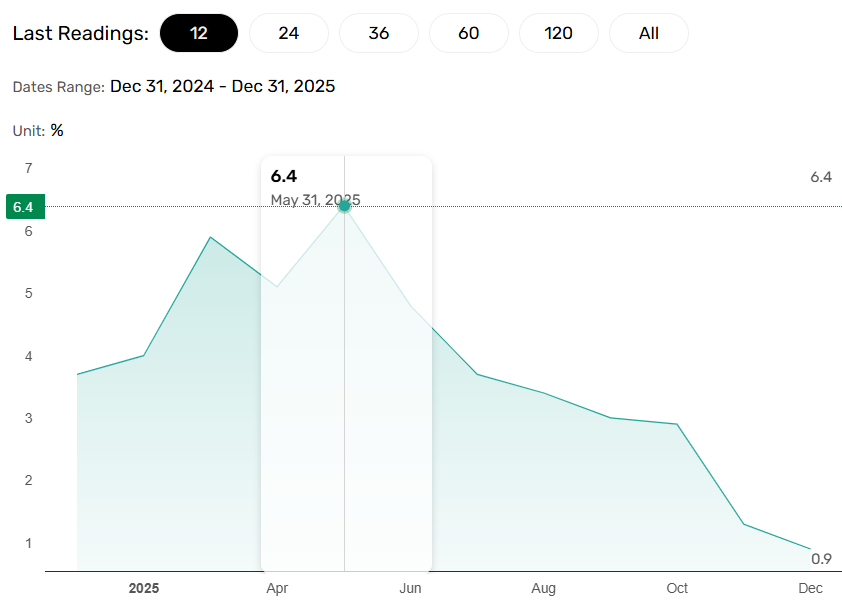
China’s dual economy didn’t fire on all cylinders in 2025. Waning domestic demand left the Chinese economy reliant on exports to drive economic momentum. Export trends underpinned the importance of improved trade terms with key partners. Nevertheless, Beijing’s focus on domestic consumption could be key in the year ahead should global economic momentum slow.
Beijing Announces Measures to Boost Consumption
The NDRC’s announcement coincided with Beijing’s fresh measures to drive domestic demand. This week, Beijing announced several measures, including:
- Extension of personal consumption loan interest subsidies to the end of 2026.
- 1.5% annual interest subsidy to SME private firm loans in 2026.
- Extension of tax and fee incentives for elderly care, childcare, and domestic services until the end of 2027.
- Increased fiscal spending in 2026.
- Expansion of interest subsidies to credit card installments (1% rate).
IMF Raises China’s 2026 Growth Projection
Beijing’s monetary and fiscal policy support will be crucial to the bullish short- to medium-term outlook for Mainland indices. This week, the International Monetary Fund (IMF) increased its 2026 growth projection to 4.5%, up from its October forecast of 4.2%. The IMF attributed the improved outlook to lower US tariffs and expectations of further policy support from Beijing.
Goldman Sachs projected 4.8% growth for 2026, citing China’s exporters diversifying to non-US markets. However, Goldman Sachs Research downplayed the prospect of domestic consumption and services contributing. Chief China Economist Hui Shan commented:
“Although Chinese exporters have successfully diversified into non-US markets, supporting our positive outlook for Chinese exports, building a consumption- and services-driven economy will take years, if not decades.”
Hui Shan’s view further underscores the importance of improved trade relations and robust external demand for economic growth.
Key Downside Risks to the Bullish Outlook
Despite the optimistic outlook, downside risks could derail the positive projections. These include:
- A breach of the US-China trade war truce.
- Global tariffs on Chinese shipments.
- Beijing postpones monetary policy easing and fresh fiscal stimulus.
- Slowing external demand for Chinese goods.
- Weaker domestic consumption.
- Chinese housing market crisis intensifies.
These scenarios could send the Hang Seng Index and CSI 300 below their 50-day EMAs, signaling near-term bearish trend reversals.
Despite these risk factors, China’s advancements in the AI space, increased self-reliance on chip manufacturing, and improving global relations reaffirm the constructive short- to medium-term bias for Mainland China indices.
Economists and traders are optimistic that Beijing can fuel domestic demand through lower borrowing rates and subsidies, while stabilizing the housing market.
CSI 300 Technical Outlook: Resistance Levels in Focus
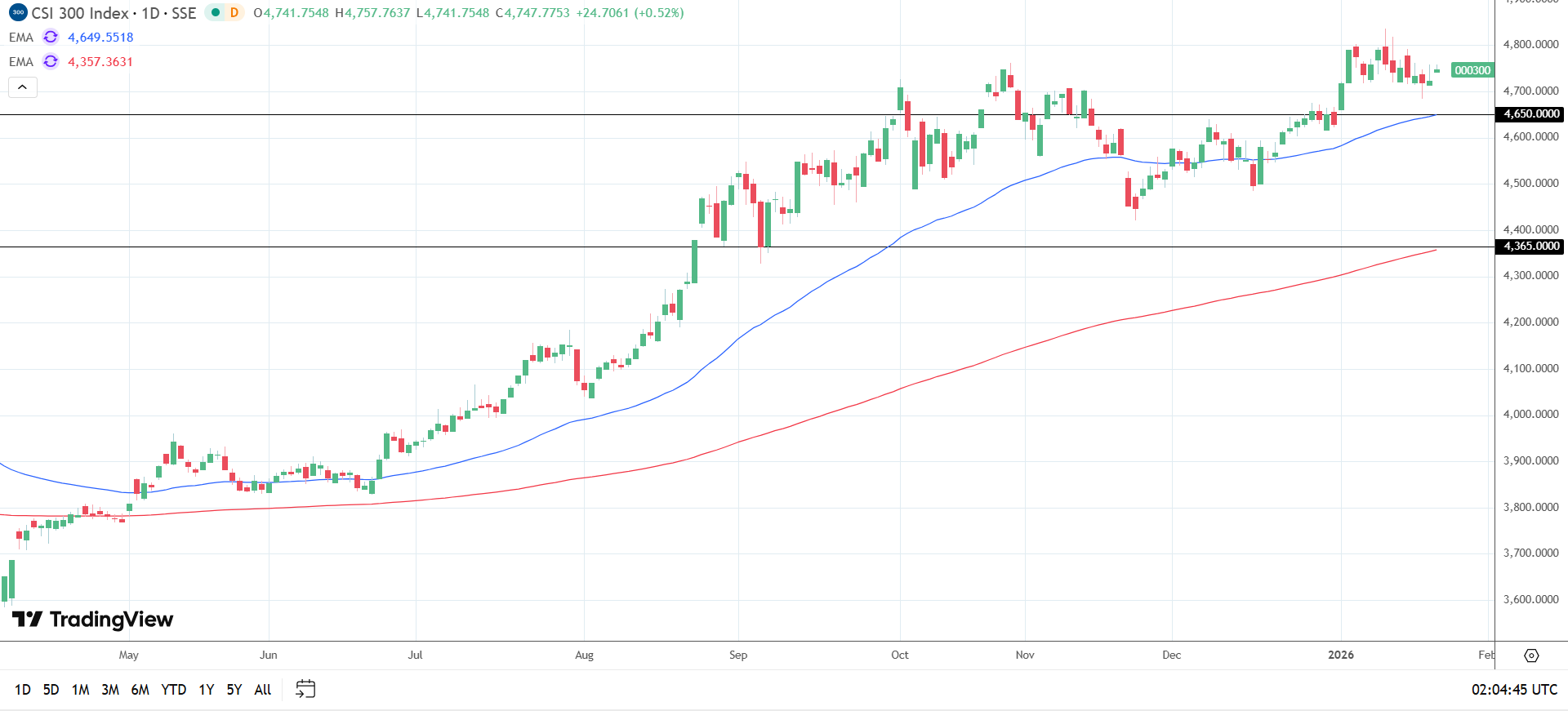
Technicals and fundamentals remained aligned in early trading on Thursday, January 22. Viewing the daily chart, the CSI 300 trades above its 50-day and 200-day EMAs, indicating bullish momentum.
A breakout above the January 13 high of 4,817 would bring 5,000 into play. A sustained move through 5,000 would pave the way toward the 2021 all-time high of 5,931. Avoiding a sustained drop below the 50-day EMA is key for the bullish outlook.
Hang Seng Index: Bullish Outlook Intact
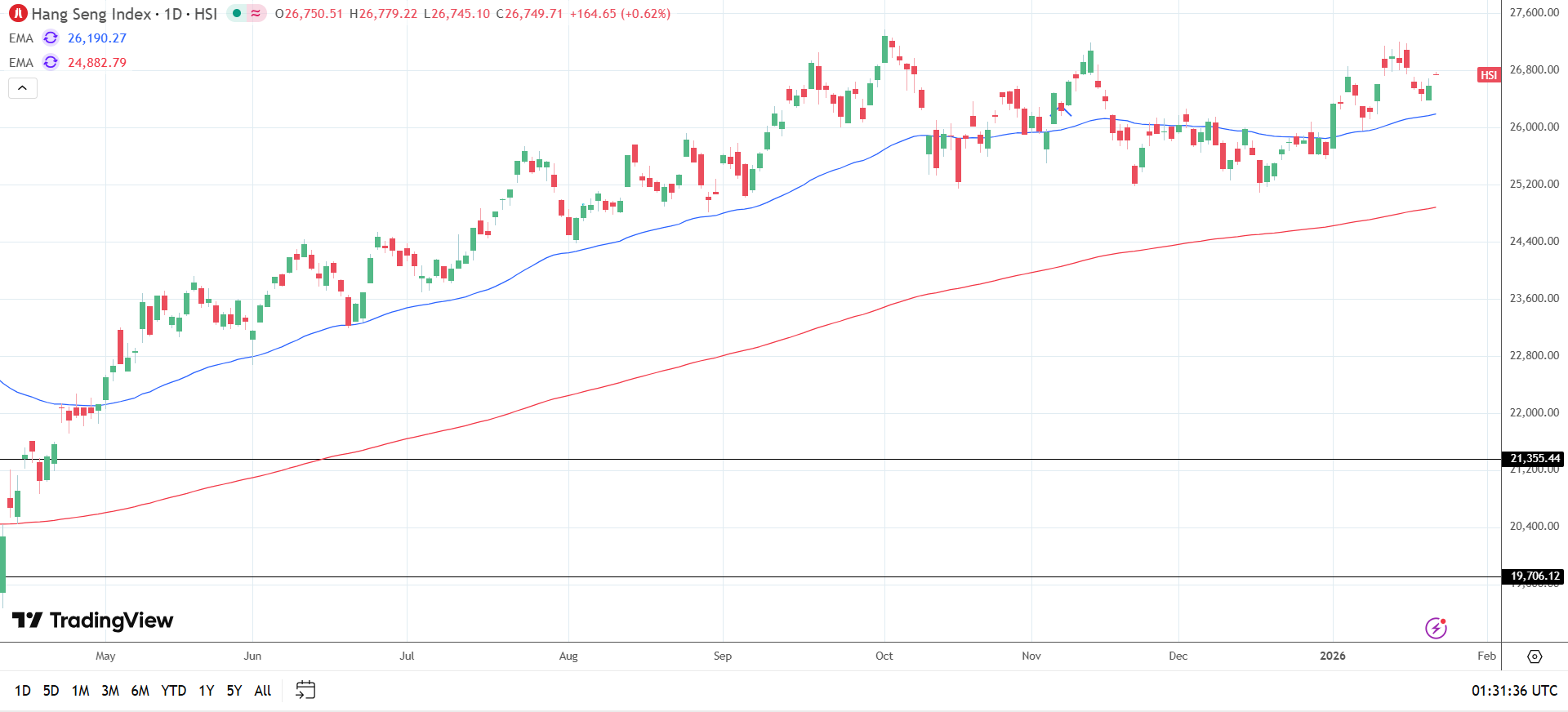
The Hang Seng Index’s projection mirrors the CSI 300, with the index trading above its 50-day and 200-day EMAs. These EMAs signal bullish momentum, aligning with positive fundamentals.
A breakout above the January 15 high of 27,207 would enable the bulls to target the October 2025 high of 27,382. A move through 27,382 would bring 28,000 into play. A break above 28,000 would pave the way toward 30,000 for the first time since 2021.
Conclusion:
In summary, the short- and medium-term outlook remains bullish. Beijing’s recent policy measures, expectations of more policy support, China’s progress in the AI space, and robust external demand are likely to increase appetite for Mainland China and Hong Kong-listed stocks.
However, real estate developments, global trade relations, and price trends are likely key for consumers and private consumption. Meaningful policy measures lifting domestic demand would likely send the CSI 300 to its 2021 all-time high of 5,931.
Discover strategies to navigate this week’s market trends here.