
USD/JPY rebounded as Japanese economic data and the upcoming national election sank the yen.
Japan goes to the polls on Sunday, February 8, with Prime Minister Sanae Takaichi enjoying impressive approval ratings. Expectations of a landslide win fueled concerns about Prime Minister Takaichi pursuing her fiscal policy plans unchallenged, weighing on the yen.
Meanwhile, a sharp drop in Japanese household spending tempered bets on a near-term Bank of Japan rate hike, adding to the yen’s pullback.
USD/JPY rallied 1.57% to close the week at 157.18, underscoring sentiment toward the BoJ policy stance and the prospects of a landslide win on February 8. Despite last week’s pullback, the medium-term outlook is cautiously bearish, as monetary policy divergence continues to favor the yen.
Below, I examine the upcoming economic calendar, the medium-term catalysts (4-8 weeks), and the technical levels traders should watch.

Japan Election to Kickstart a Pivotal Week for USD/JPY
Japan’s national election will be the main event of the week ahead. A landslide victory that gives the Liberal Democratic Party (LDP) a simple majority (233 seats) in the Lower House and the LDP-Japan Innovation Party (JIP) coalition a supermajority (310 seats or more) will be key for near-term USD/JPY trends.
An LDP simple majority and an LDP-JIP supermajority would allow the coalition to override vetoes from the Upper House. Prime Minister Takaichi’s strengthened position would allow for unchallenged fiscal spending legislation. Amid concerns about Japan’s more than 240% debt-to-GDP ratio, a free rein on legislation would likely push the debt-to-GDP ratio higher.
Notably, 10-year Japanese Government Bond (JGB) yields soared from an October 3 level of 1.659% to a January 20 high of 2.382%. The sharp increase in risk premium for holding 10-year JGBs underscored worries about debt-to-GDP.
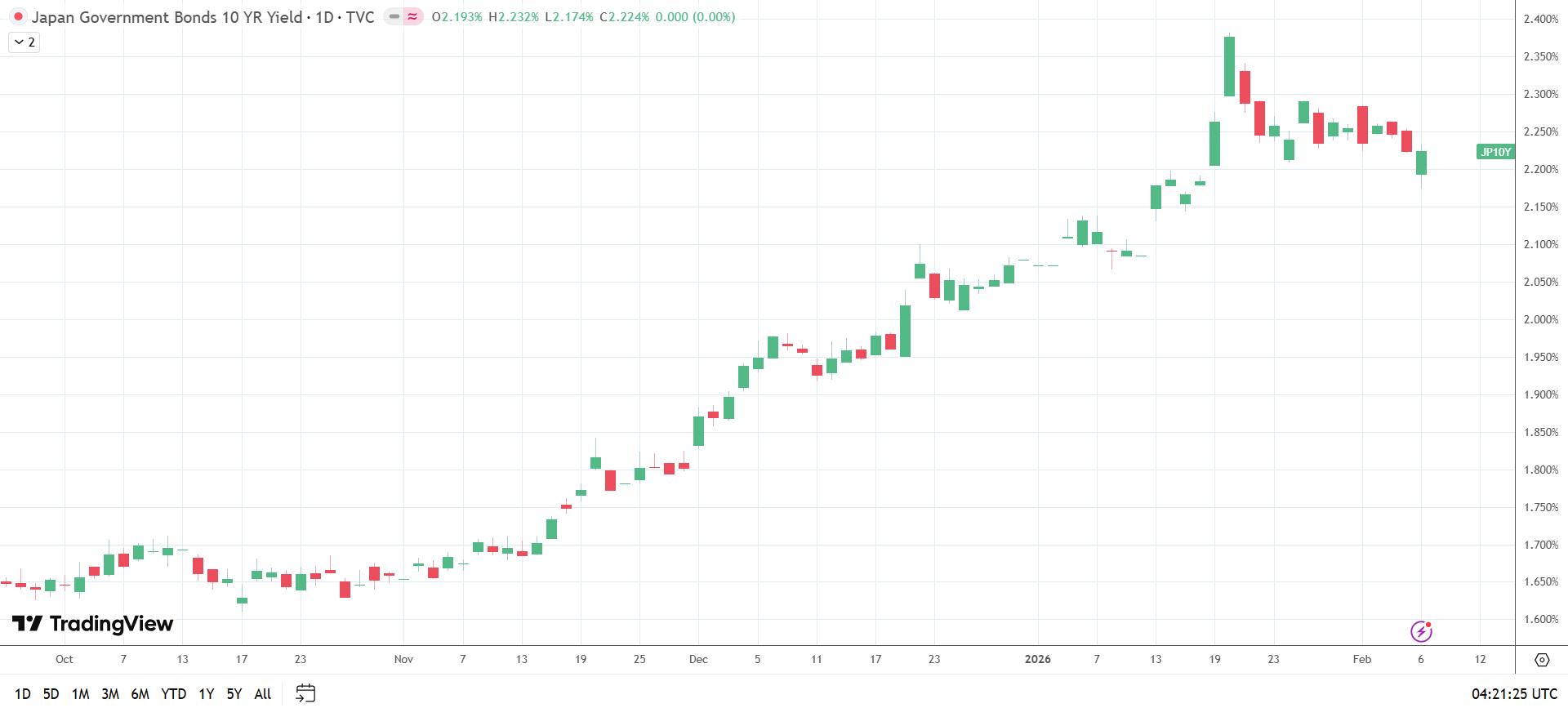
Soaring 10-year JGB yields triggered the yen sell-off and USD/JPY climb from 147.056 to a January 14 high of 159.454.
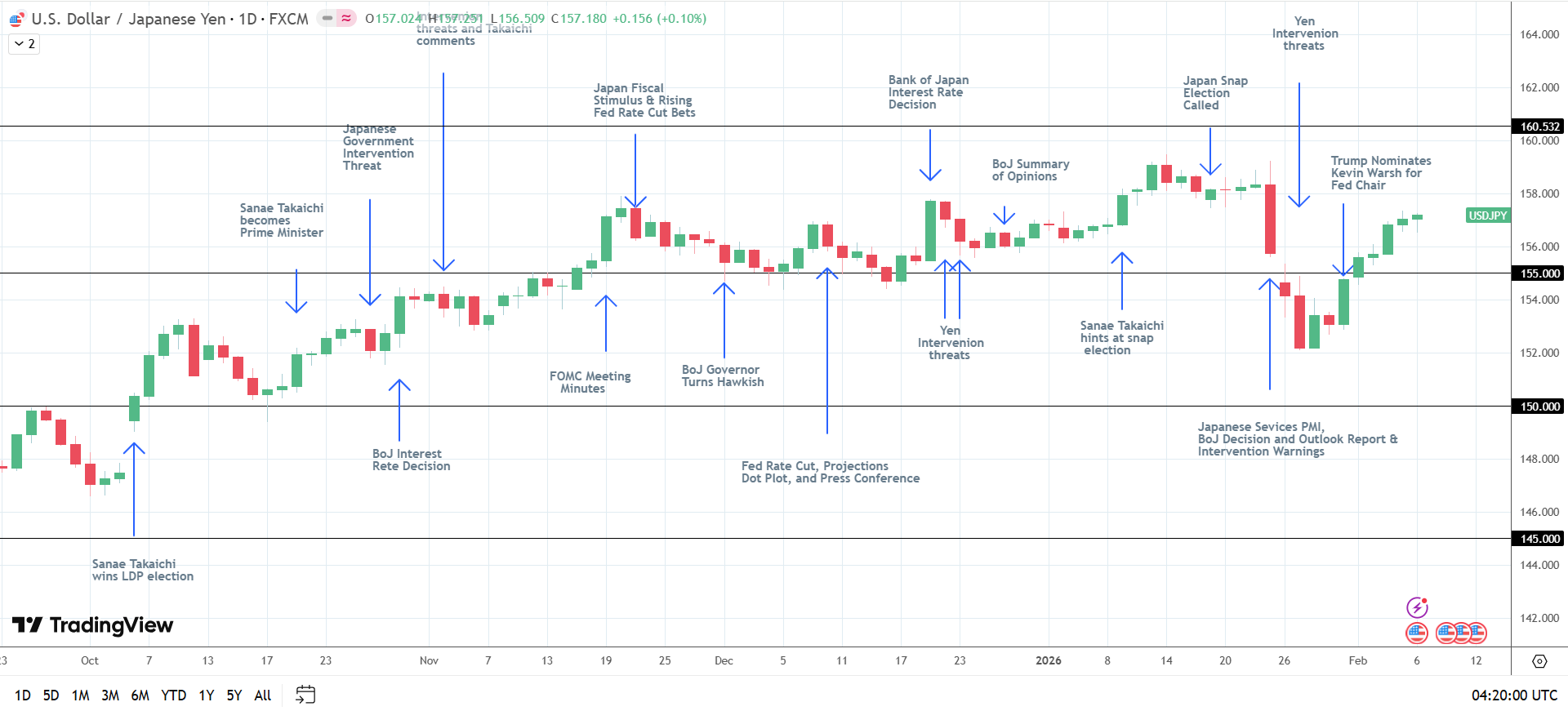
The prospect of an LDP-JIP supermajority in the Lower House supports the bullish short-term outlook for USD/JPY. However, yen intervention threats are likely to continue capping the upside below 160 as seen in January.
Meanwhile, a supermajority would remove the need for Prime Minister Takaichi to make concessions with smaller coalition parties. Over the longer term, this is likely to give the LDP greater control over legislation and ensure prudent fiscal spending, supporting a bearish medium-term outlook for USD/JPY.
USD/JPY Price Forecast
Every new USD/JPY analysis as it publishes, today's technical signal and key levels, live price — on one page.
See all USD/JPY forecastsKey Japanese Economic Indicators to Look Out For
While the election result will be key to near-term price trends, Japanese economic data will influence the BoJ’s policy stance. On Monday, February 9, wage growth will fuel speculation about a BoJ rate hike. Economists expect average cash earnings to rise 3% year-on-year in December, following a 0.5% increase in November.
A sharp upswing in wage growth would align with the BoJ’s outlook on wages and growing support for rate hikes.
For context, higher wages could boost households’ purchasing power, offsetting the effects of rising import prices. Increased purchasing power, coupled with improving consumer sentiment, would indicate a pickup in spending. Higher spending would fuel demand-driven inflation and bolster the economy, given that private consumption accounts for around 55% of GDP.
Crucially, these scenarios would align with the BoJ’s hawkish quarterly projections, which sent USD/JPY down 1.64% on January 23.
However, leading inflation indicators will also be key given Tokyo’s softer consumer prices in January. Economists expect producer prices to rise 2.3% year-on-year in January, down from 2.4% in December. Holding above the BoJ’s 2% target may revive bets on an H1 2026 rate hike, boosting demand for the yen. A stronger yen would send USD/JPY lower, supporting the bearish medium-term price outlook.
Follow real-time updates to stay ahead of USD/JPY market developments.
US Economic Calendar: Retail Sales, the Jobs Report, and the Fed in Focus
While Japan’s election and Japanese economic data will affect the yen, US economic indicators and Fed rhetoric will influence buying interest in the US dollar.
On Tuesday, February 10, retail sales data will reflect consumer sentiment and economic momentum. Economists forecast retail sales will rise 0.5% month-on-month in December, down from 0.6% in November.
While resilient consumer spending may ease immediate fears of a US recession, the jobs report will be key on Wednesday, February 11.
Economists expect unemployment to remain at 4.4% in January, and wage growth to slow from 3.8% YoY in December to 3.6% YoY in January. Softer wage growth would indicate a drop in consumer spending, dampening demand-driven inflation. A cooler inflation outlook would suggest a more dovish Fed rate path, reaffirming the bearish medium-term price outlook for USD/JPY.
Beyond the data, traders should closely monitor Fed chatter for clues on the timing of a rate cut.
According to the CME FedWatch Tool, the chances of a March 2026 Fed rate cut increased from 13.4% on January 30 to 23.2% on February 6. Additionally, the probability of a June cut rose from 67.3% to 75%. Shifts in the chances of March and June cuts will be key for US dollar trends.
Market View: Medium-Term Yen Strength
In my opinion, USD/JPY would likely fall toward 150 on market bets on multiple Fed rate cuts and a hawkish BoJ policy stance. Narrowing US-Japan rate differentials would affirm the bearish medium-term (4-8 weeks) outlook. A drop below 150 would reaffirm the longer-term (8-16 weeks) 145-140 range.
Counter-Trend Risks: What Could Send USD/JPY Toward 160?
Upside risks include:
- LDP-JIP wins a landslide election and announces aggressive fiscal spending plans.
- Upbeat US economic data and Fed rhetoric cool bets on an H1 2026 rate cut.
- Weaker Japanese economic data temper BoJ rate hike expectations.
Despite the upside risks, yen intervention threats are likely to cap upside around 160. Given the upside risks, a breakout above 158 would pave the way toward January’s high of 159.453. A move toward 159.453 would invalidate the medium-term bearish structure.
Financial Analysis
Technical Outlook: Bearish Momentum Building
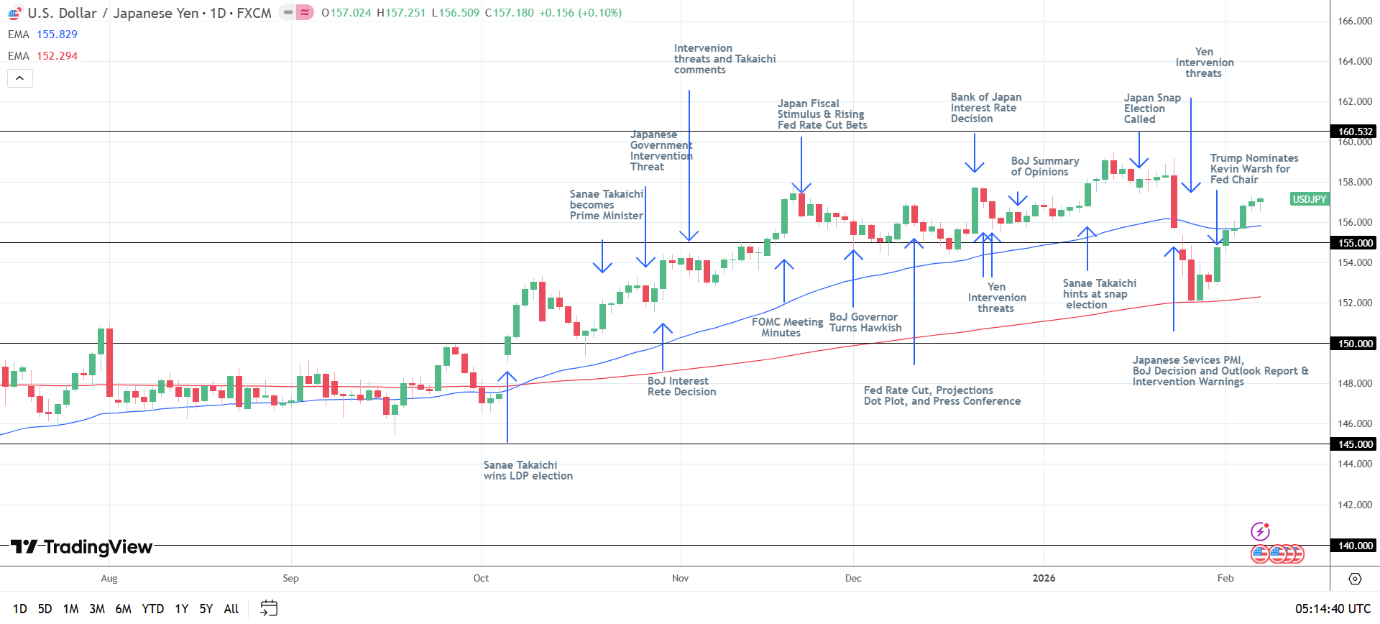
On the daily chart, USD/JPY traded above its 50-day and 200-day Exponential Moving Averages (EMAs). The EMA positions signaled a bullish bias. However, favorable yen fundamentals continue to counter technicals, supporting the negative outlook for USD/JPY.
A drop below the 50-day EMA would expose 155. If breached, the 200-day EMA would be the next key technical support level. Crucially, a sustained fall through the EMAs would indicate a bearish trend reversal, bringing the 150 support level into play. A break below 150 would enable the bears to target the 145-140 range, aligning with the longer-term price projection.
Key Takeaways
The USD/JPY pair has gained 1.57% in February, reversing the previous month’s 1.34% loss. However, a hawkish BoJ policy stance would indicate a narrower rate differential, reinforcing the bearish medium- to long-term outlook for USD/JPY.
Key levels will include 150 and 140 on the downside, and 158 and 160 on the upside.
Consult our economic calendar for historical and upcoming data.