
USD/JPY reclaims 157 as Japanese election polls show the Liberal Democratic Party (LDP) and Japan Innovation Party (JIP) heading for a landslide win on Sunday, February 8.
On February 8, a landslide victory would strengthen Prime Minister Sanae Takaichi’s position, enabling her to roll out her stimulus spending plans uncontested. Concerns over Prime Minister Takaichi’s spending plans and Japan’s 240% debt-to-GDP ratio have been a root cause for the yen’s weakness since October.
Meanwhile, Japanese economic data fueled speculation about an H1 2026 Bank of Japan rate hike.
Despite USD/JPY briefly reclaiming 157, the medium-term outlook remains bearish. Monetary policy divergence and prudent fiscal spending plans are likely to boost demand for the yen.
Below, I’ll discuss the macro backdrop, near-term price catalysts, and technical levels traders should closely watch.

Japan Election Takes Center Stage
As the Japanese election approaches, the polls suggest Prime Minister Takaichi’s Liberal Democratic Party could win a simple majority (233 seats) in the Lower House. Crucially, some polls indicate the LDP-JIP coalition could take 310 seats in the Lower House, a supermajority. A supermajority would allow an LDP-JIP coalition to override vetoes from the Upper House and pass fiscal spending legislation.
Given market concerns about Prime Minister Takaichi’s fiscal spending plans, a landslide victory would be a bullish short-term trigger for USD/JPY. However, an LDP simple majority would also mean that Prime Minister Takaichi is less dependent on JIP for Lower House legislation. JIP would lose its position to push its own fiscal policies, potentially a positive for the yen over the medium- to longer-term.
For context, USD/JPY rallied from an October 3 low of 147.056 to a January 14 high of 159.454 in response to Takaichi becoming the leader of LDP.
USD/JPY Price Forecast
Every new USD/JPY analysis as it publishes, today's technical signal and key levels, live price — on one page.
See all USD/JPY forecasts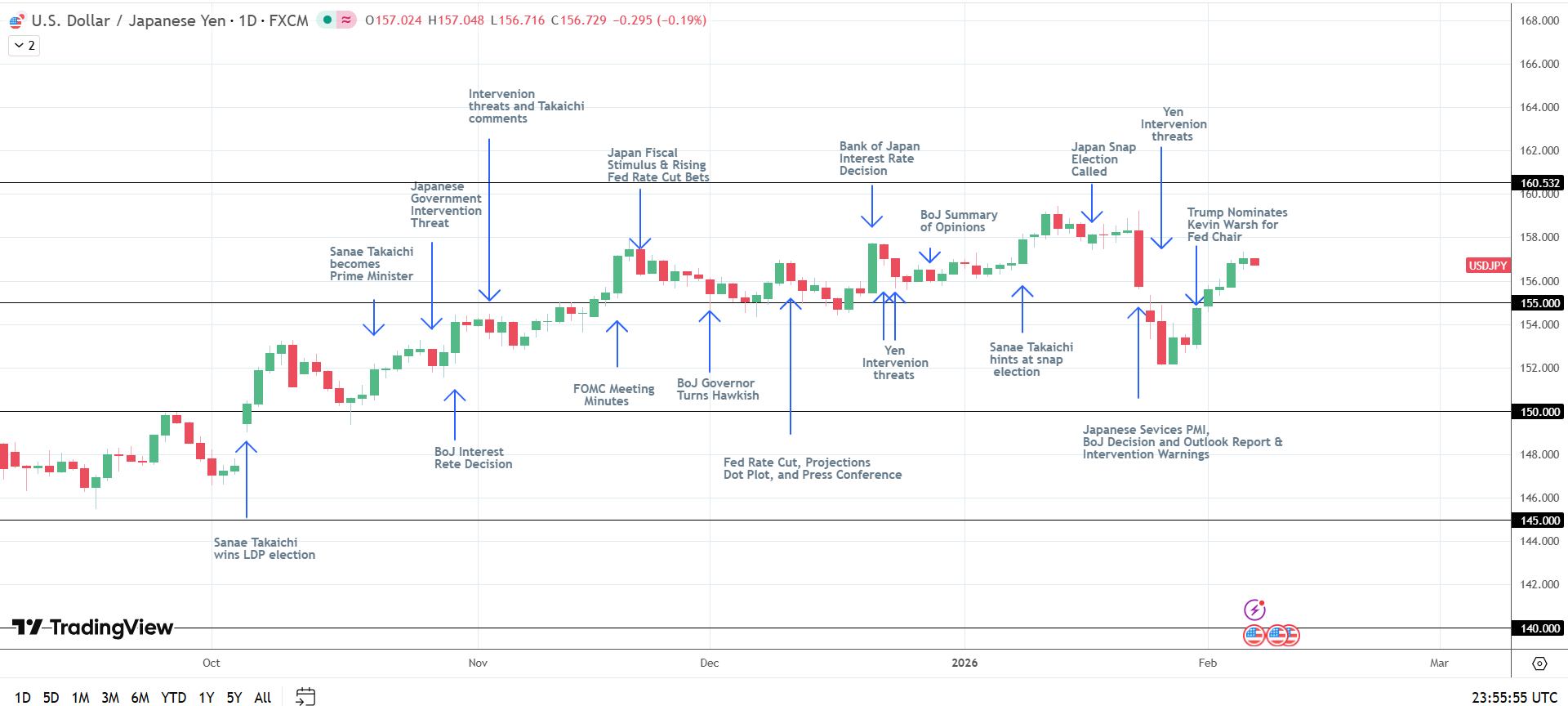
Japanese Household Spending Slumps
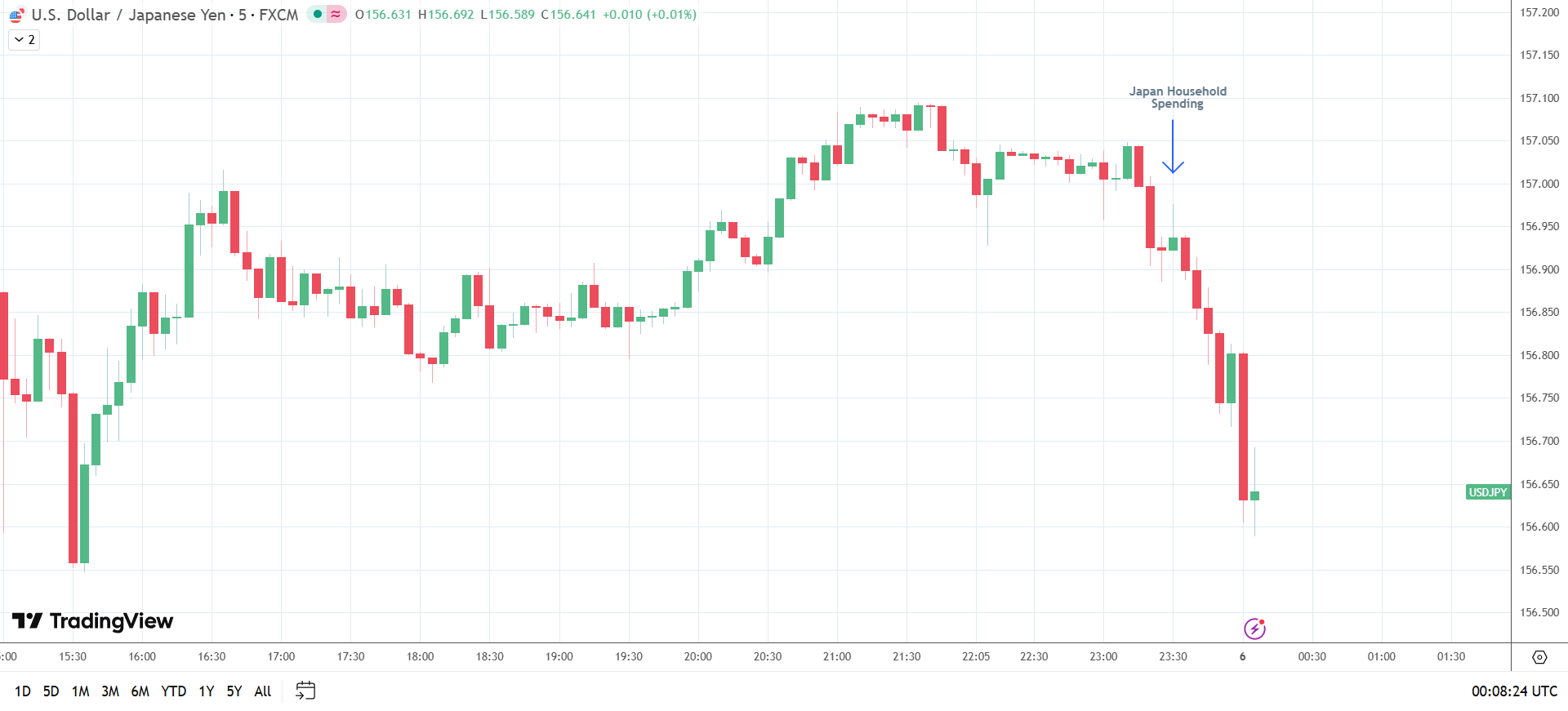
While Sunday’s election remains the key driver for the yen, Japanese economic data continues to fuel speculation about an H1 2026 BoJ rate hike. On Friday, February 6, Japanese household spending tumbled 2.6% year-on-year in December, after rising 2.9% in November.
The pullback in spending may cool bets on an H1 2026 BoJ rate hike. Weaker spending dampens demand-driven inflation. Furthermore, a slump in spending would affect the economy, given that private consumption accounts for around 55%-60% of Japan’s GDP. These factors would support a more dovish BoJ policy stance.
However, the latest slump in household spending could reflect the effect of a weaker yen on import prices. The BoJ has signaled a need to address yen weakness to combat rising import prices. Higher import prices erode households’ purchasing power while lifting consumer prices.
Notably, the weaker-than-expected household spending report weakened the USD/JPY pair in early trading. A more hawkish BoJ policy stance would support the bearish medium-term outlook for USD/JPY.
US Consumer Sentiment Spotlights the Fed
While Japanese data and the upcoming election influence yen demand, US economic data will affect buying interest in the US dollar.
Later on Friday, US consumer sentiment numbers will take center stage, given the delay to the US jobs report. Economists forecast the Michigan Consumer Sentiment Index to fall from 56.4 in January to 55.0 in February. Waning consumer sentiment could signal a pullback in consumer spending and a softer inflation outlook. Cooling inflation would support a more dovish Fed rate path, weighing on US dollar demand.
A more dovish Fed policy stance and a more hawkish BoJ rate path would indicate a narrowing in US-Japan rate differentials. Narrowing rate differentials in favor of the yen would be bearish for USD/JPY.
According to the CME FedWatch Tool, the chances of a March Fed rate cut increased from 13.4% on January 29 to 24.3% on February 4. Meanwhile, the probability of a June cut jumped from 61.8% to 82.3%.
Technical Outlook: Key Levels to Watch
For USD/JPY price trends, traders should assess technical indicators, incoming economic data, central bank chatter, and political developments.
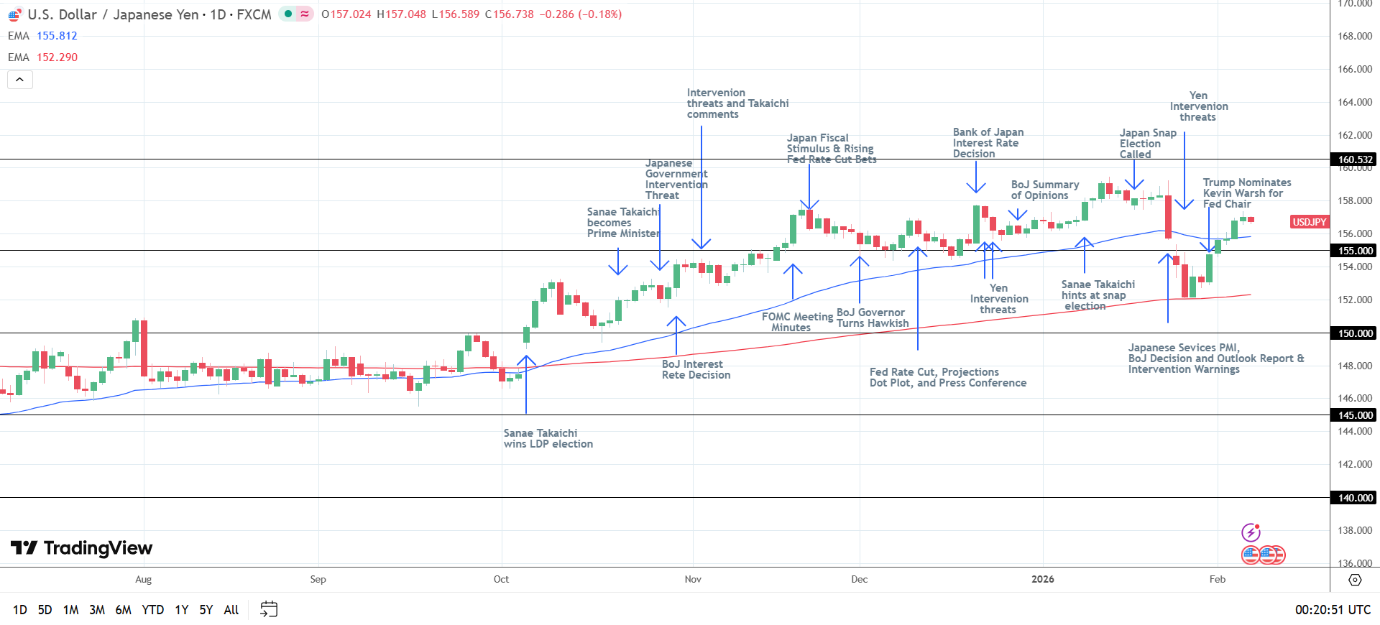
On the daily chart, USD/JPY remains above its 50-day and 200-day Exponential Moving Averages (EMAs). The EMA positions signal a bullish bias. However, positive yen fundamentals continue to offset technicals.
A break below the 50-day EMA would bring the 200-day EMA into play. If breached, 150 would be the next key support level.
Importantly, a sustained fall through the EMAs would indicate a bearish trend reversal and reaffirm the negative medium-term price outlook.
Positioning and Risk Outlook
In my view, a hawkish BoJ policy stance and expectations of multiple Fed rate cuts support a negative price outlook. However, upside risks to the bearish outlook include:
- Dovish BoJ rhetoric and a lower neutral interest rate (potentially 1% – 1.25%).
- US economic data cools expectations of an H1 2026 Fed rate cut.
These events would send USD/JPY higher. However, yen intervention warnings are likely to cap the upside at around 158.
Read the full USD/JPY forecast, including chart setups and trade ideas.
Conclusion: Politics, the BoJ, and the Fed in the Spotlight
In summary, USD/JPY trends will hinge on Sunday’s election results, the BoJ’s policy stance, the Fed’s rate path, and geopolitical factors.
A landslide LDP-JIP win and a higher BoJ neutral rate (1.5%-2.5%), indicating a more hawkish BoJ rate path, would likely strengthen the yen over the medium-term. Furthermore, dovish Fed chatter would also signal narrowing rate differentials, reaffirming the bearish medium-term outlook for USD/JPY.
Looking beyond the medium-term (1-3 months), a sharply stronger yen and yen carry trade unwinds would likely send USD/JPY toward 140 over the longer 6-12 month time horizon.
For more in-depth analysis, review today’s USD/JPY trading setups in our latest reports and consult the economic calendar.