
Cooling Japanese inflation indicators sent USD/JPY higher on Friday, December 26, countering Japanese government efforts to strengthen the yen through intervention warnings.
Headline inflation dropped to the Bank of Japan’s 2% target, supporting a lower neutral interest rate and fewer rate hikes to achieve policy normalization. The softer inflation numbers come after Japan’s Finance Minister Satsuki Katayama warned of yen interventions earlier this week. A more dovish BoJ on cooling inflation will increase the threat of a yen intervention, capping USD/JPY gains.
Cooling Japanese inflation and fading bets on a March Fed rate cut challenged the bearish medium- to longer-term outlook for USD/JPY. Nevertheless, monetary policy divergence continues to favor the yen, given the prospect of an incoming Fed Chair favoring lower rates.
Below, I’ll discuss the macro backdrop, the near-term price catalysts, and technical levels traders should closely watch.

Tokyo Inflation Dips, Yen Weakens
Tokyo’s annual inflation rate fell from 2.7% in November to 2.0% in December, while the so-called core-core inflation rate eased to 2.6% (November: 2.8%). Despite headline inflation dropping to the BoJ’s 2% target, the more influential core-core inflation rate remained above the target, supporting further rate hikes.
However, the lower inflation rate suggested fewer rate hikes to achieve price stability, aligning with last week’s dovish rate hike. USD/JPY reacted to the inflation numbers, rising from 155.751 to a post-data high of 156.271.
USD/JPY Price Forecast
Every new USD/JPY analysis as it publishes, today's technical signal and key levels, live price — on one page.
See all USD/JPY forecasts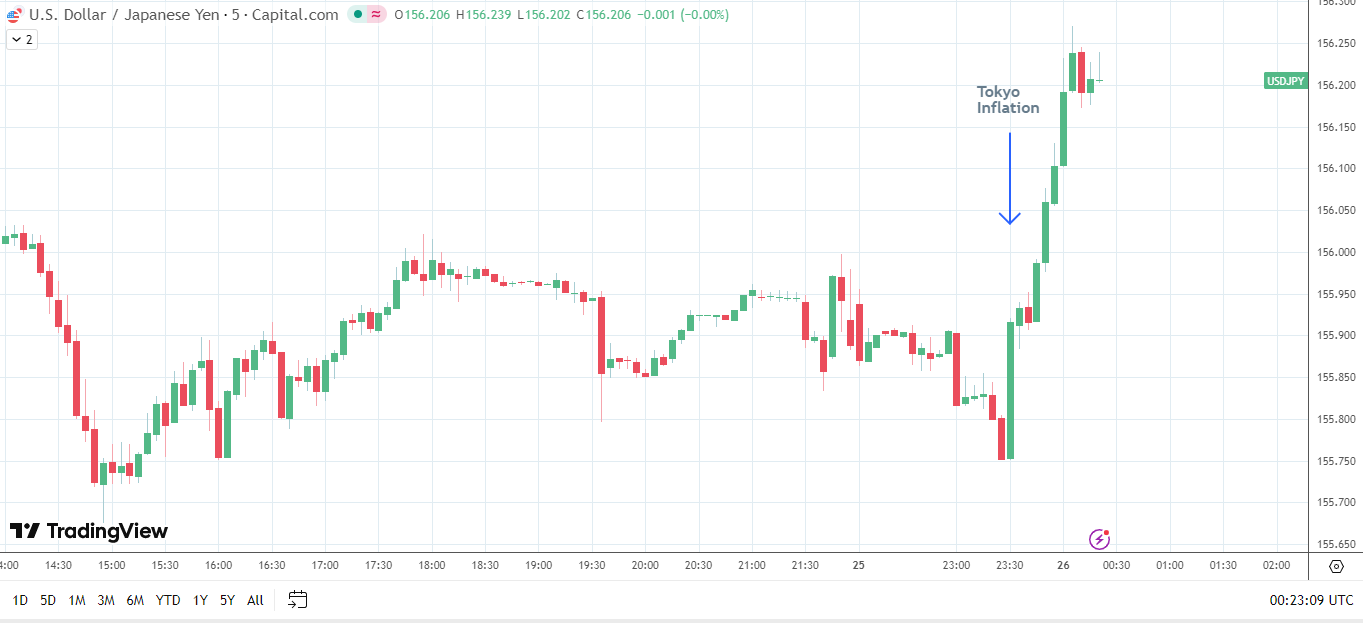
Retail Sales and Labor Market Data Keep BoJ Hawks in Play
December’s inflation data was the key USD/JPY driver in early trading on Friday. Meanwhile, consumer spending cooled in November, supporting a softer national inflation outlook. Retail sales increased 1% year-on-year in November, down from 1.7% in October.
Crucially, a pullback in spending will also dampen economic momentum, given that private consumption contributes roughly 55% to Japan’s GDP.
While inflation and retail sales data weakened demand for the yen, labor market data limited the pullback. Japan’s unemployment rate remained steady at 2.6% in November, supporting higher wages. An upswing in wages could boost consumer spending and fuel demand-driven inflation.
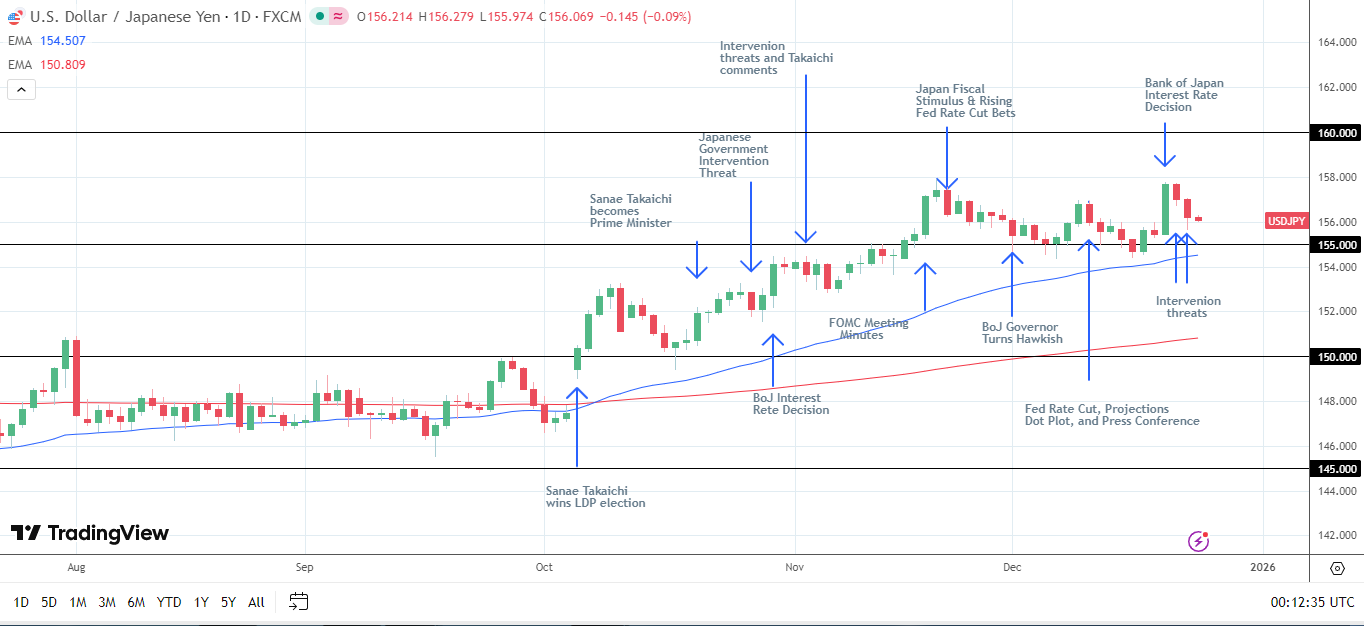
However, policymakers would need to see higher wages translate into consumption to raise rates further. While a more dovish BoJ rate path would weaken the yen and send USD/JPY higher, government yen intervention threats would continue to push the pair lower, supporting the cautiously bearish short- to medium-term USD/JPY price outlook.
For the short-term, USD/JPY trends will hinge on the Japanese government’s pain threshold for yen weakness, currently at 158, given the recent communication. With USD/JPY sitting around the 156 level, the pair would likely return to 157 before another pullback to 155 levels, given recent price trends. On this basis, the short-term outlook remains cautiously bearish.
Fed Speakers in Focus
While USD/JPY advanced on softer retail sales and inflation data, Fed chatter will influence US dollar demand later on Friday.
This week’s US GDP and deflator price data tempered bets on a March Fed rate cut, strengthening the US dollar. However, a cooling labor market and November’s CPI report continue to support further Fed rate cuts, signaling a bearish short- to medium-term USD/JPY price outlook.
Dovish Fed rhetoric would revive expectations of a March rate cut, weighing on the US dollar.
According to the CME FedWatch Tool, the probability of a March Fed rate cut fell from 58.3% on December 19 to 47.0% on December 26. The sharp drop reflected the influence of the Q3 US GDP report on sentiment.
Technical Outlook: USD/JPY on a Downward Trajectory
With markets monitoring technical indicators and fundamentals, they will provide crucial insights into potential USD/JPY price trends.
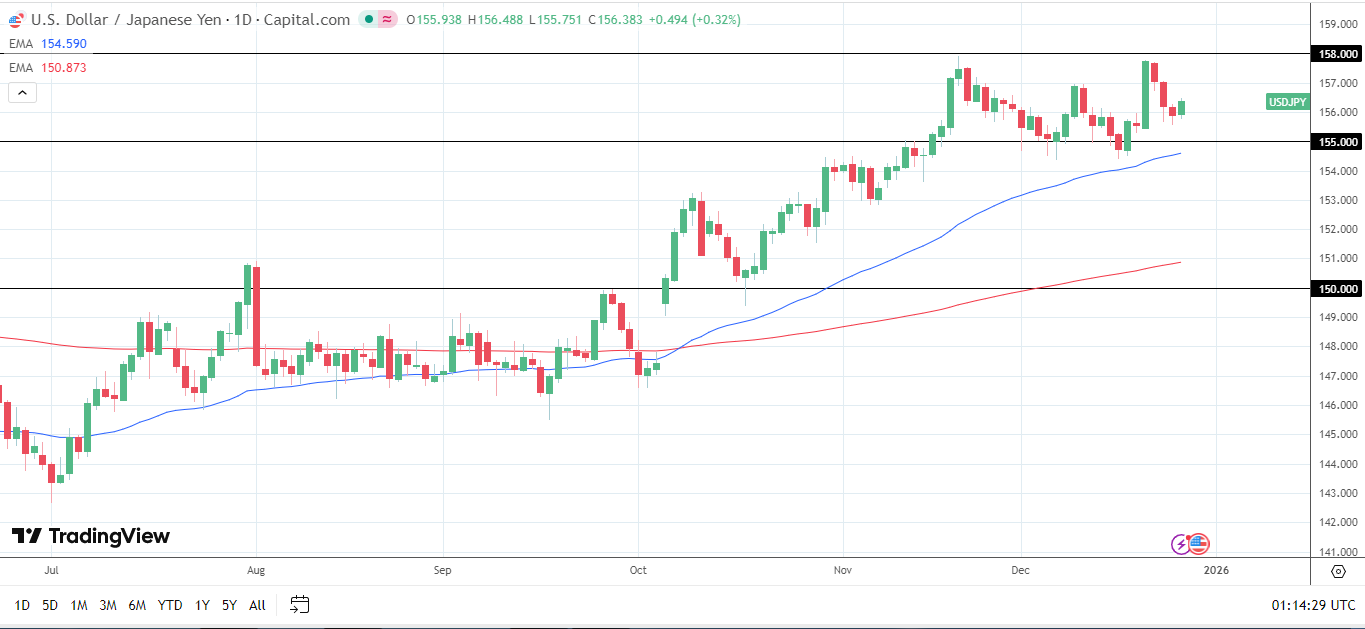
Looking at the daily chart, USD/JPY traded above its 50-day and 200-day Exponential Moving Averages (EMAs), indicating a bullish bias. While technicals remained bullish, fundamentals are increasingly outweighing the technical structure, suggesting a bearish outlook.
A break below the 155 support level would expose the 50-day EMA. If breached, the 200-day EMA would be the next key technical support level. Importantly, a sustained drop below the EMAs would signal a bearish near-term trend reversal, bringing sub-150 into play.
Position and Upside Risk
In my view, intervention threats will continue to cap USD/JPY upside at 158. Meanwhile, JGB yields would likely bolster yen demand, indicating a negative price outlook. However, the BoJ’s neutral interest rate will be pivotal, given recent concerns about sticky US inflation.
A higher neutral interest rate level, neither accommodative nor restrictive, would indicate a more hawkish BoJ rate path and a narrower US-Japan rate differential. A narrower rate differential would make yen carry trades into US assets less profitable, reversing yen carry trades, sending USD/JPY toward 140 over the longer term.
However, upside risks to the bearish outlook include:
- Dovish BoJ chatter and a 1% neutral interest rate.
- Strong US data.
- Hawkish Fed rhetoric.
These scenarios would weaken the yen and boost demand for the US dollar, sending USD/JPY higher. However, yen intervention warnings are likely to cap the upside at around the 158 level, based on the latest communication.
Read the full USD/JPY forecast, including chart setups and trade ideas.
Conclusion: Focus on the BoJ Neutral Rate
In summary, USD/JPY trends reflect the Japanese government’s focus on forex markets and changing sentiment toward narrowing rate differentials. Market focus will remain on BoJ Governor Ueda and the Fed’s outlook on monetary policy and the BoJ’s view on the neutral interest rate.
A 1.5% to 2.5% neutral rate would indicate more aggressive BoJ rate hikes, supporting the bearish short- to medium-term outlook for USD/JPY. Furthermore, dovish Fed rhetoric will likely send USD/JPY toward 140 in the 6-12 month time horizon.
For more in-depth analysis, review today’s USD/JPY trading setups in our latest reports and consult the economic calendar.