
Mainland China’s CSI 300 and SSE Composite Index continue to hover below their multi-year highs, despite rising geopolitical tensions.
This week, President Trump spooked markets. Trump threatened a 100% tariff on imports from Canada if Prime Minister Mark Carney signed a free-trade deal with China. The US President viewed a Canada-China trade deal as a potential avenue for Chinese manufacturers to circumvent US tariffs.
However, the market impact was limited given that Prime Minister Carney assured markets there would be no free trade agreement.
While geopolitical risks tested demand for risk assets, the short- to medium-term outlook remains bullish for Mainland and Hong Kong-listed stocks.
Below, I will explore the key drivers behind recent gains, the medium-term (3-6 months) market outlook, and the key technical levels traders should watch.

Geopolitical Spat Leaves Mainland China Below Multi-Year Highs
On Friday, January 23, US President Trump threatened a second trade war with a key trading partner in a matter of days, weighing on sentiment. The US President reacted to news of Canada and China rekindling trade relations, stating:
“If Governor Carney thinks he is going to make Canada a “Drop Off Port” for China to send goods and products into the United States, he is sorely mistaken. China will eat Canada alive, completely devour it, including the destruction of their businesses, social fabric, and general way of life. If Canada makes a deal with China, it will immediately be hit with a 100% tariff on all Canadian goods and products coming into the U.S.A.”
However, Prime Minister Carney cooled market fears of a full-blown US-Canada trade war, dismissing reports of a free trade deal with China. The Canadian Prime Minister elaborated that such a free trade deal would contravene the trade agreement between the US, Mexico, and Canada (USMCA).
Hong Kong Hang Seng Price Forecast
Every new Hong Kong Hang Seng analysis as it publishes, today's technical signal and key levels, live price — on one page.
See all Hong Kong Hang Seng forecastsCanadian and Chinese Economies Exposed to US Tariff Risks
Mexico is the largest exporter of goods to the US. However, Canada ranked second in 2025, underscoring the potential impact of a 100% tariff on the Canadian economy. However, the 100% tariff threat would also affect China’s efforts to access the US market through third countries. Given China’s continued economic reliance on trade, a free trade deal with Canada, without the threat of US tariffs, could have been a boon for Chinese goods producers.
Nevertheless, Beijing’s efforts to forge new trade relations and expand existing agreements remain key for 2026. On January 1, Mexico introduced a 50% tariff on Chinese goods, targeting a wide range of sectors, including autos, clothing, and furniture. Mexico has remained a key market for China’s auto sector and a potential backdoor into the US via the USMCA. Trump’s tariff threat against Canada suggests that the US may have pressured Mexico into targeting Chinese goods.
These developments align with the US administration’s moves to pressure economies to reduce reliance on Chinese goods. In July 2025, the US imposed a 40% levy on transshipments from Vietnam and a 19% duty on Indonesian goods, targeting China.
Beijing Increases Focus on Domestic Consumption
President Trump’s continued focus on China underpinned the need for Beijing to continue expanding the other component of its dual economy, domestic consumption.
Beijing’s pledges to roll out fiscal stimulus and cut interest rates have been crucial for Mainland China equity market trends. Policy measures aimed at boosting domestic demand would ease reliance on external demand and balance China’s dual economy. A more balanced dual economy would enable Beijing to weather trade wars and overseas economic storms.
On Monday, January 26, Beijing reportedly announced fresh measures to boost domestic consumption. The CN Wire reported:
“China’s Commerce Ministry: To optimize trade-in programs, boosting consumption of autos, home appliances, electronics, and smart durable goods.”
Monday’s pledge followed last week’s announcement of several pledges and fresh measures targeting households, including:
- Extension of personal consumption loan interest subsidies to the end of 2026.
- Extension of tax and fee incentives for elderly care, childcare, and domestic services until the end of 2027.
- Increased fiscal spending in 2026.
- Expansion of interest subsidies to credit card installments (1% rate).
Outlook for Private Consumption Brightens
Notably, these measures have raised consumer and market optimism about the economic outlook. East Asia Econ commented on China’s allocation of financial savings trends, stating:
“China – the end of the flight to safety. Like the actual monthly deposit data, Friday’s PBC Q425 depositor survey shows a slowing of the flood of household savings into the safety of bank deposits. The structural deflation pressure caused by the collapse of real estate activity and the chaos of the Covid lockdowns is beginning to ease.”
Importantly, these trends could signal a pickup in household spending, contributing to GDP growth.
Key Downside Risks to the Bullish Outlook
Despite current market optimism, downside risks could challenge the positive outlook. These include:
- An escalation in US-China trade tensions.
- Global tariffs targeting Chinese goods.
- Beijing delays monetary policy easing and the rollout of fresh fiscal stimulus.
- Weakening external demand for Chinese goods.
- Slowing domestic consumption.
- Chinese housing market deteriorates further.
These factors would likely send the Hang Seng Index and CSI 300 below their 50-day EMAs, indicating near-term bearish trend reversals.
However, China’s progress in AI, self-reliance on chip manufacturing, and improving trade terms with key partners reinforce a constructive short- to medium-term bias for Mainland China indices.
Economists and analysts expect that Beijing can boost domestic consumption by lowering borrowing rates and introducing new subsidies, while bolstering the housing market.
CSI 300 Technical Outlook: Resistance Levels in Focus
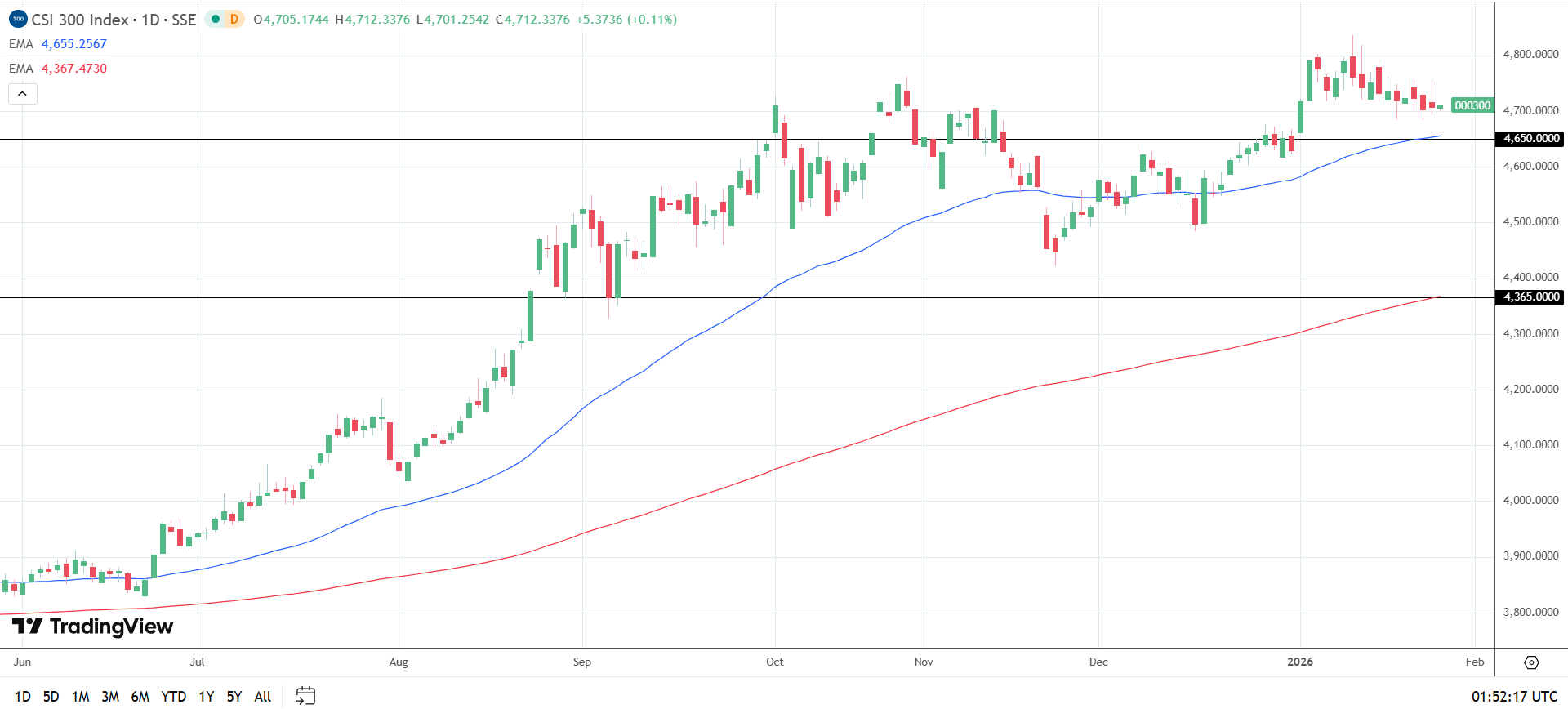
Chart technicals and market fundamentals aligned in early trading on Tuesday, January 27. Viewing the daily chart, the CSI 300 trades above its 50-day and 200-day EMAs, signaling bullish momentum.
A break above the January 13 high of 4,817 would pave the way toward 5,000. A sustained move through 5,000 would enable the bulls to target the 2021 all-time high of 5,931. Holding above the 50-day EMA will be crucial for the bullish outlook.
Hang Seng Index: Bullish Outlook Intact
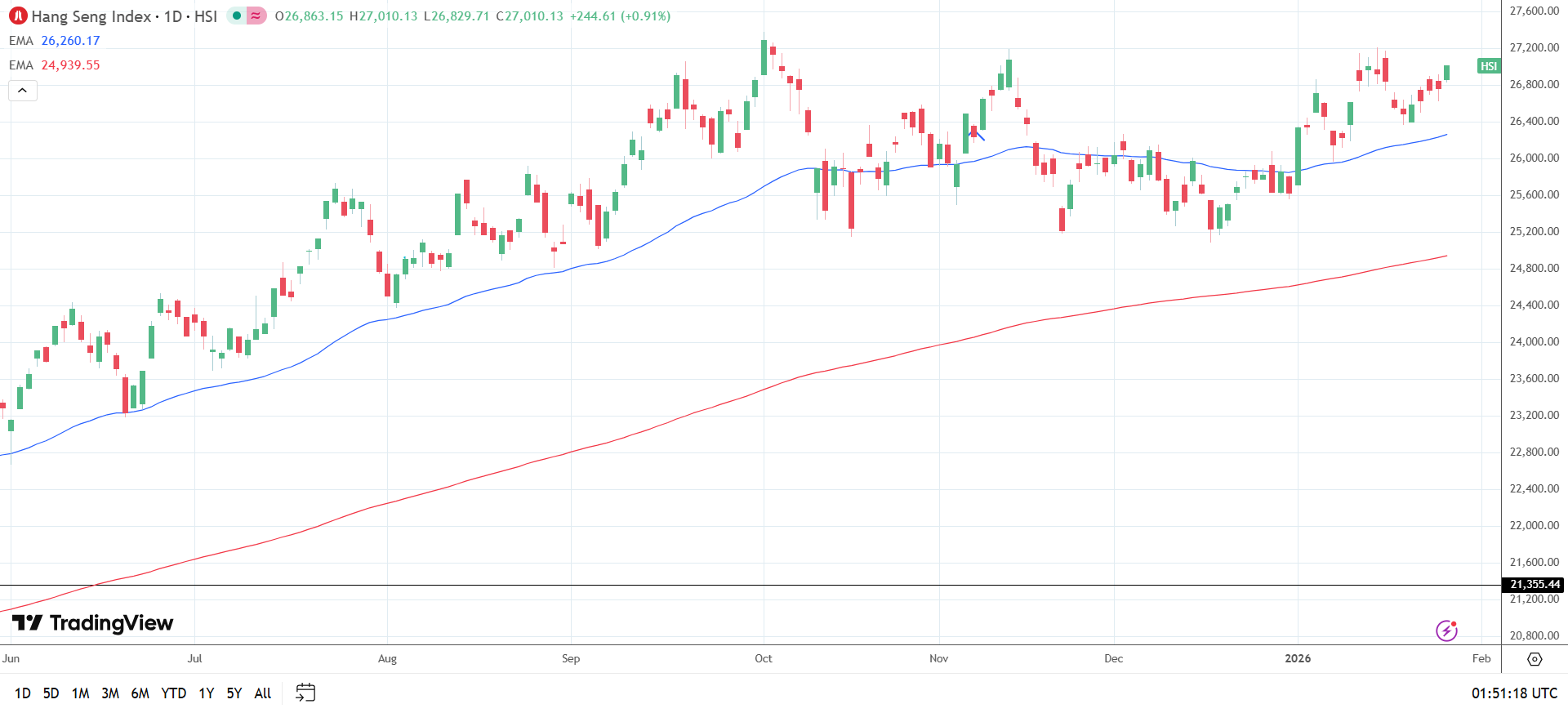
The Hang Seng Index’s outlook aligns with the CSI 300, with the index holding above its 50-day and 200-day EMAs. These EMAs indicate bullish momentum, aligning with favorable fundamentals.
A move through January’s high of 27,207 would bring the October 2025 high of 27,382 into play. A break above 27,382 would open the door to testing 28,000. Breaking down resistance at 28,000 would support a move toward 30,000 for the first time since 2021.
Conclusion:
To summarize, the short- and medium-term outlook remains constructive. Beijing’s recent policy measures, expectations of further support, China’s AI-linked advancements, and strong external demand are likely to boost buying interest in Mainland China and Hong Kong-listed stocks.
However, global trade relations, housing market developments, and price trends are likely crucial for private consumption. Effective policy measures increasing domestic consumption would likely drive the CSI 300 to its 2021 all-time high of 5,931.
Discover strategies to navigate this week’s market trends here.