XRP falls for a fourth consecutive day as US banks fight to maintain dominance over depositors.
The Market Structure Bill remained a talking point on Saturday, January 17, as uncertainty grew over crypto players’ ability to push through crypto-friendly legislation. Yields were the focal point for banks and crypto exchanges, a key factor behind Coinbase (COIN) pulling its support for the Banking Committee’s draft text.
Meanwhile, robust demand for US XRP-spot ETFs propped XRP above the crucial $2.0 psychological support level.
The near-term outlook remains cautiously bullish, with a constructive medium-term bias, despite delays to the Market Structure Bill.
Below, I will explore the key drivers behind recent price trends, the medium-term (4-8 weeks) outlook, and the key technical levels traders should watch.
US Banks Block Stablecoin Yield Provisions to Protect Deposit Dominance
This week, Coinbase withdrew its support for the US Senate Banking Committee’s draft text of the Market Structure Bill. Coinbase CEO Brian Armstrong outlined several issues with the draft text, including legislation for stablecoin yields. The Coinbase CEO stated:
“Draft amendments that would kill rewards on stablecoins, allowing banks to ban their competition.”
Stablecoins and stablecoin yields could potentially erode the US banks’ control over capital and materially impact their bottom line.
How Net Interest Margins Keep Banks Profitable
For context, US banks pay negligible interest to depositors. Banks then lend depositors’ money to corporations at a higher interest rate. The difference between lending and depositor interest rates is referred to as the net interest margin (NIM). Net interest margins are a crucial component of bank earnings. The higher the NIM, the greater the potential for earnings, subject to credit conditions and demand.
Why Yield-Bearing Stablecoins Threaten Traditional Banking
The evolution of a regulated stablecoin market, which offers significantly higher yields than interest on fiat currency deposits with banks, would shift deposits from TradFi to DeFi. US banks would lose their monopoly and could face a slow death at the hands of the crypto industry.
Bank of America CEO Brian Moynihan has warned that more than $6 trillion in deposits could migrate from the US banking system to stablecoins if legislation allows yields on stablecoins.
Falling deposits would mean banks either have to lend less or access wholesale funding, which costs more than interest on deposits, Narrowing NIMs and falling demand for credit would impact bank profits. Notably, there was no mention of increasing interest earned on deposits to compete with stablecoin yields, which would limit the damage.
Scaramucci Criticizes Banks Blocking Stablecoin Yields
Anthony Scaramucci commented on the legislative developments on Capitol Hill and the banking sector monopoly, stating:
“The whole system is broken: The Banks do not want the competition from the stablecoin issuers, so they’re blocking the yield. In the meantime, the Chinese are issuing yield, so what do you think the emerging countries will choose as a rail system, the one with or without yield?”
Public Opinion Favors Stablecoin Rewards
Should the American voter as decide the stablecoin rewards?
Ripple Chief Legal Officer Stuart Alderoty shared a Stablecoins Reward survey conducted by the National Cryptocurrency Association. According to the January survey:
- 48% of Americans believe consumers should earn rewards on stablecoins.
- 12% think the government should block earning rewards on stablecoins.
- Meanwhile, 41% of Americans were undecided.
The survey also revealed:
- 71% of crypto holders think it is important for the United States to lead globally in stablecoin innovation.
- 46% of Americans believe banks oppose stablecoins because they are concerned about competition in financial services.
The National Cryptocurrency Association concluded:
“Stablecoin rewards are emerging as a clear consumer preference – and Americans do not want the government to step in and ban them.”
Regulatory Delays Continue to Cap XRP Demand
While stablecoin yields don’t directly affect XRP, delays to much-needed crypto-friendly legislation affect demand for the token. Crypto regulation, which provides clear rules of the road and protects consumers, would likely boost demand for XRP, given its real-world utility. Increased demand through XRP-spot ETFs and utility would tilt the supply-demand balance firmly in XRP’s favor.
XRP-Spot ETF Inflows Signal Strong Institutional Confidence
Since launching in November, the US XRP-spot ETF market has seen $1.28 billion in net inflows, outperforming the US BTC-spot and US SOL-spot ETF markets.
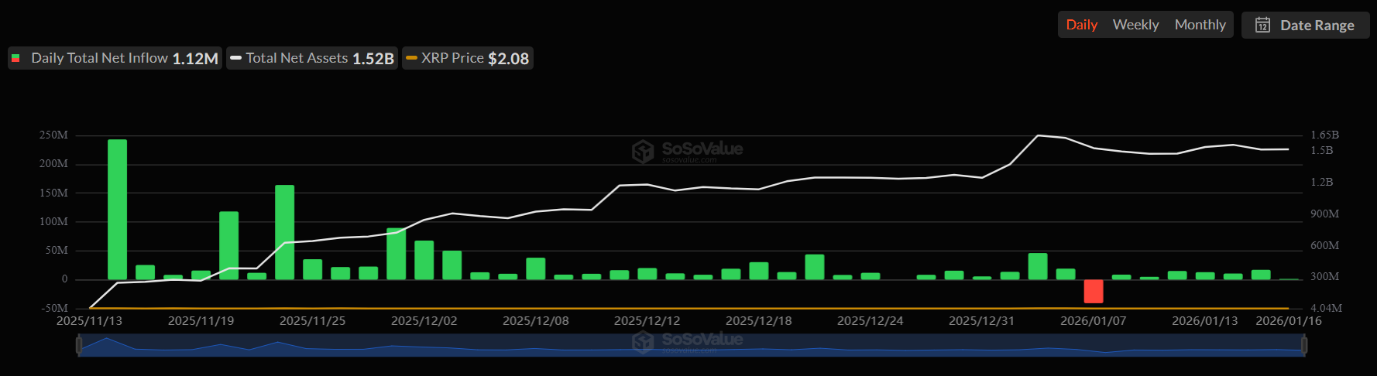
For context, US SOL-spot ETF issuers have reported just $863.8 million in net inflows despite launching in October. Meanwhile, the US BTC-spot ETF market has seen $1.5 billion in net outflows since the launch of the Canary XRP ETF (XRPC) on November 14.
The strong demand for XRP-spot ETFs reflects market sentiment toward real-world XRP utility. Beyond utility, investors are also mindful of the potential impact of crypto-friendly legislation on XRP’s price trajectory.
XRP Price Reacts Sharply to Legislative Headlines
XRP rallied 33% from December 31 to January 6 as investors reacted to the US Senate Banking Committee’s announcement of its January 15 markup vote. However, the token has fallen 6.2% since the postponement of the markup vote. XRP’s price action underscores the anticipated impact of crypto legislation on demand for the token.
Crucially, the progress of the Market Structure Bill, robust demand for XRP-spot ETFs, and increased utility remain pivotal to the bullish medium-term price projection.
XRP Price Forecast: Short-, Medium-, and Long-Term Targets
Progress toward crypto regulation, XRP-spot ETF inflows, and increased XRP utility reaffirm a cautiously positive short-term outlook (1-4 weeks), with a $2.5 price target.
Moreover, hopes that the Senate will eventually pass crypto-friendly legislation reinforced the bullish longer-term price targets:
- Medium-term (4-8 weeks): $3.0.
- Longer-term (8-12 weeks): $3.66.
Key Downside Risks to the Bullish XRP Outlook
Several scenarios could derail the positive outlook. These include:
- The Bank of Japan declares a hawkish neutral interest rate (potentially 1.5%-2.5%), indicating multiple BoJ rate hikes. Importantly, a higher neutral rate could trigger a yen carry trade unwind, reversing the short-term outlook.
- US economic data and the Fed are reducing bets on an H1 2026 rate cut.
- US lawmakers oppose the Market Structure Bill, delaying crypto regulation.
- XRP-spot ETFs report outflows.
These scenarios would likely weigh on sentiment, sending XRP below $2, which would indicate a bearish trend reversal.
Technical Analysis: Levels to Watch
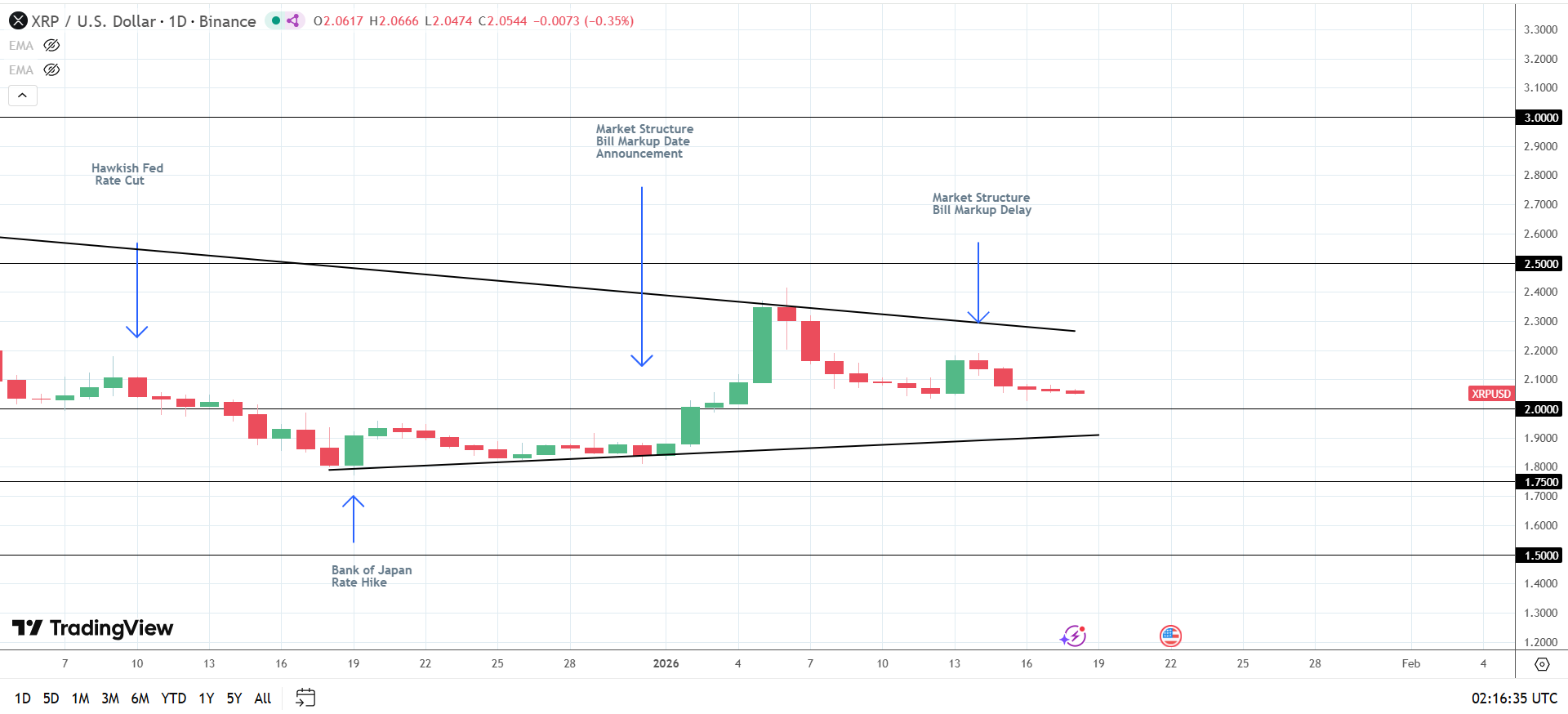
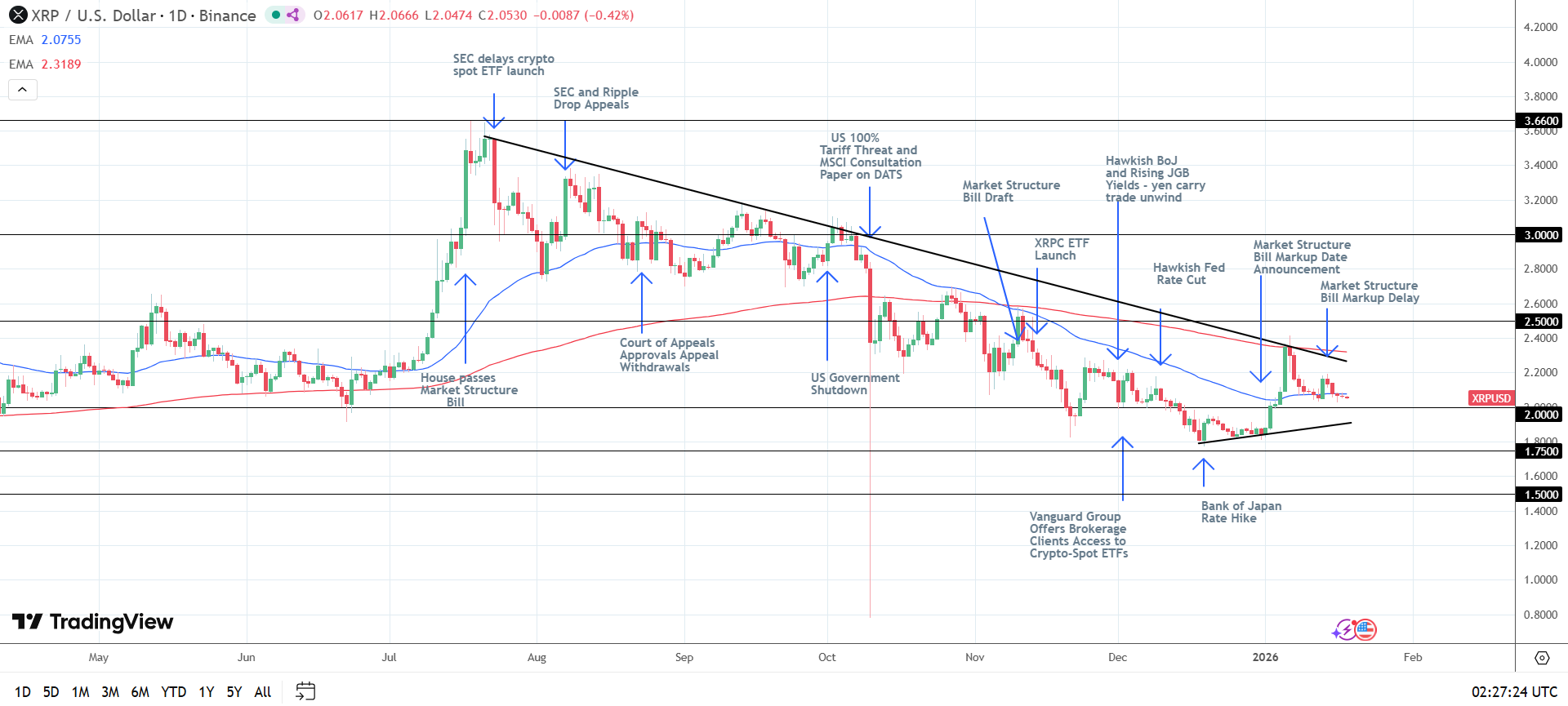
XRP fell 0.27% on Saturday, January 17, following the previous day’s 0.54% loss, closing at $2.0617. The token tracked the broader crypto market cap, which dropped 0.19%.
A four-day losing streak left XRP below its 50-day and 200-day EMAs, indicating a bearish bias. However, the bullish fundamentals continue to counter technicals, limiting the downside.
Key technical levels to watch include:
- Support levels: $2.0, $1.75, and then $1.50.
- 50-day EMA resistance: $2.0755.
- 200-day EMA resistance: $2.3189.
- Resistance levels: $2.5, $3.0, and $3.66.
Viewing the daily chart, a break above the 50-day EMA would indicate a near-term bullish trend reversal, paving the way toward $2.2. A sustained move through $2.2 would bring the 200-day EMA into play.
Importantly, a breakout above the EMAs would affirm the bullish medium- and longer-term price targets.
Fundamental Drivers That Could Move XRP Near Term
Near-term price drivers include:
- XRP-spot ETF flow trends.
- US economic indicators and the Fed’s policy stance.
- US crypto-related legislative developments on Capitol Hill.
Holding Above $2 Is Crucial for XRP’s Bullish Structure
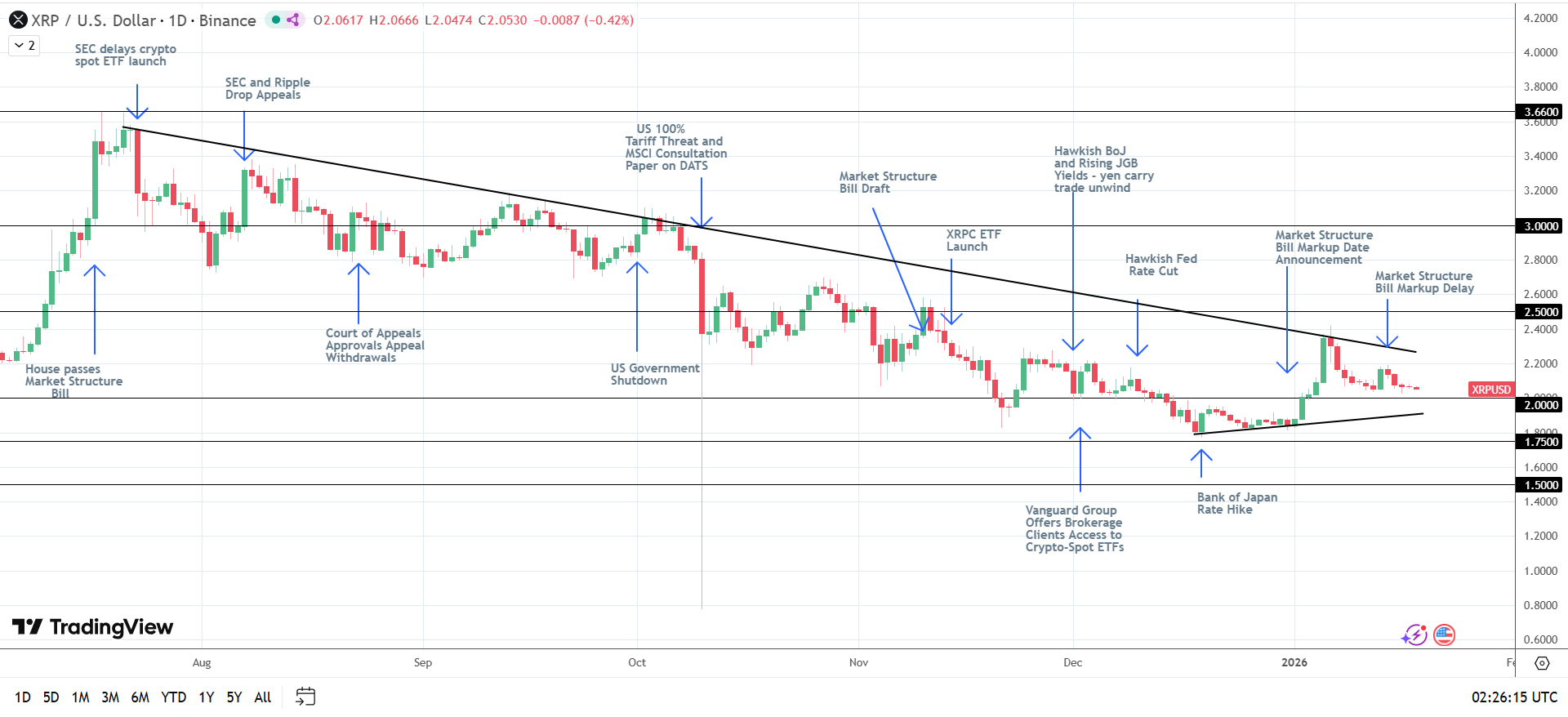
Remaining above the $2 psychological support level remains pivotal for the short- to medium-term outlook. Positive fundamentals continue to offset bearish technicals, suggesting a recovery. The rebound from December’s $1.7712 low and the early gains of 11.46% in 2026 reaffirmed the bullish structure and short- to medium-term price projections.
A breakout above $2.2 would bring the upper trendline into play. A sustained move through the upper trendline would confirm the bullish trend reversal and validate the bullish structure, supporting the price targets:
- Medium-term (4-8 weeks): $3.0.
- Longer-term (8–12 weeks): target of $3.66.
However, a break below $2.0 would expose the lower trendline. A sustained fall through the lower trendline would invalidate the bullish structure, indicating a bearish trend reversal.
XRP Outlook Hinges on Capitol Hill and Central Banks
Looking ahead, crypto-related legislative developments on Capitol Hill remain key to XRP’s price outlook. Traders should closely monitor announcements from the Banking Committee and Agriculture Committee. This week, the Agriculture Committee delayed its markup vote to January 27.
Meanwhile, central bank rhetoric and XRP-spot ETF flows will also dictate the near-term price outlook.
Renewed hopes for a March Fed rate cut, and a dovish BoJ neutral rate (potentially 1%-1.25%) would boost sentiment. Robust demand for XRP-spot ETFs and positive crypto-related news from Capitol Hill would reaffirm the constructive bias.
In summary, these factors support a medium-term (4–8 weeks) move to $3.0. Meanwhile, a March Fed rate cut and the Senate passing the Market Structure Bill would reaffirm the longer-term (8–12 weeks) price target of $3.66.
Looking beyond 12 weeks, these factors are likely to send XRP to its all-time high of $3.66 (Binance). A break above $3.66 would affirm a 6- to 12-month price target of $5.