XRP plunged below crucial support as US inflation numbers, President Trump’s nominee for Fed Chair, and fears of a US government shutdown triggered a sell-off.
US producer prices came in hotter than expected for December on Friday, January 30, challenging hopes for an H1 2026 Fed rate cut. Uncertainty about the Fed’s rate path intensified after President Trump announced his nominee for the Fed’s top spot, sending XRP and the broader crypto market sharply lower on the day.
Meanwhile, concerns about another US government shutdown contributed to the losses. A shutdown could delay the progress of the Market Structure Bill, weighing on XRP demand.
Two days of heavy selling left XRP below $1.75, affirming a bearish trend reversal. Nevertheless, the medium-term outlook is cautiously bullish.
Below, I will explore the key drivers behind recent price trends, the medium-term (4-8 weeks) outlook, and the technical levels traders should watch.

US Producer Prices and Trump’s Fed Chair Nominee Fuel Monetary Policy Uncertainty
On January 30, US producer prices signaled a sticky inflation outlook, cooling bets on an H1 2026 Fed rate cut. Producer prices rose 3% year-on-year in December, mirroring November’s increase. Meanwhile, core producer prices increased 3.3% YoY, up from 3.1% in November.
Typically, producers adjust prices based on demand, passing cost savings or higher costs on to consumers, influencing the consumer price index. December’s upswing in core producer prices justified Fed Chair Powell’s concerns about elevated inflation and his need for meeting-by-meeting data-based interest rate decisions.
December’s hotter-than-expected data coincided with President Trump nominating Kevin Warsh to become Fed Chair. While markets expect Warsh to deliver on Trump’s push for lower rates, the consensus was that Warsh is more hawkish than other potential picks.
Ultimately, producer prices are likely to leave the Fed in a policy holding pattern until June at the earliest. Nevertheless, Fed Chair Powell’s successor will likely lower rates despite an elevated inflation backdrop, bullish for risk assets such as XRP.
However, XRP’s potential status as a US asset reserve may be in doubt if Warsh becomes Fed Chair. While seeing Bitcoin as a store of value, Warsh has previously been less than enthusiastic about cryptocurrencies, describing cryptos as worthless. For context, the Fed would be among the stakeholders required to approve a strategic reserve asset, suggesting a yes to BTC, but a no to XRP. Congress and the US Treasury also need to greenlight a strategic reserve asset.
Notably, Bitcoin (BTC) fell just 0.54% on January 30, while Ethereum (ETH) slid 4.08%, joining XRP with heavy losses.
Bitcoin Price Forecast
Every new Bitcoin analysis as it publishes, today's technical signal and key levels, live price — on one page.
See all Bitcoin forecasts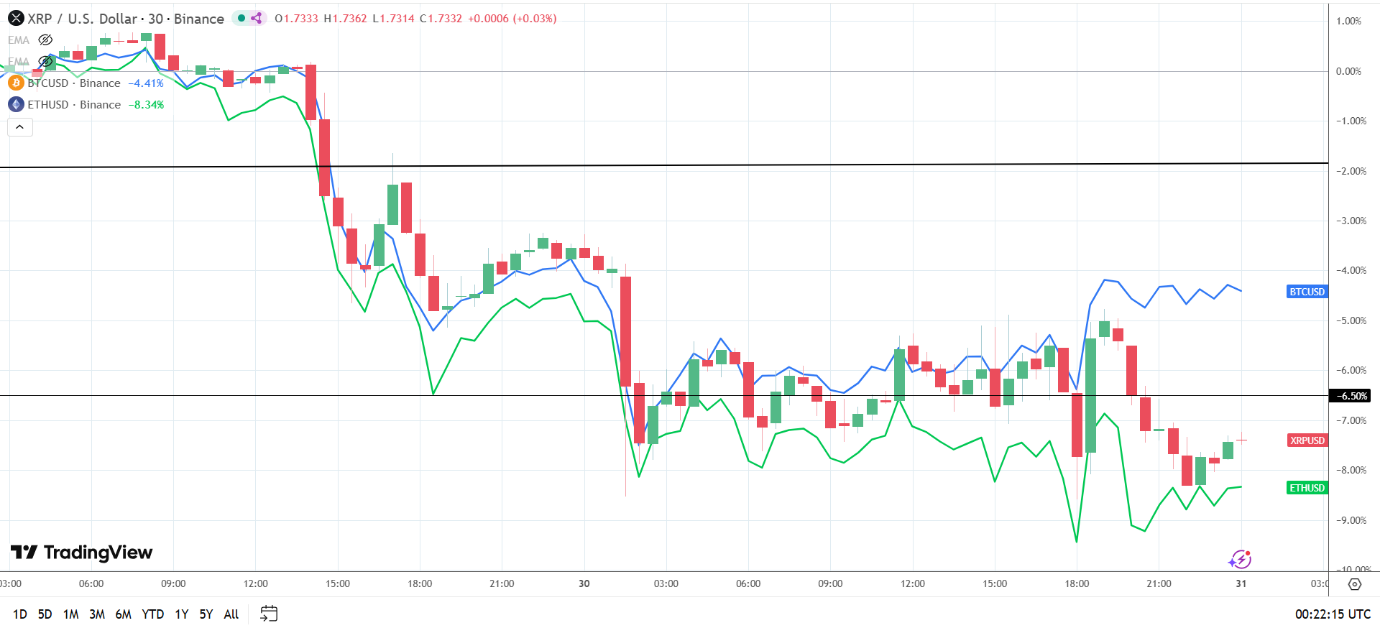
XRP Price Forecast: Short-, Medium-, and Long-Term Targets
Friday’s sell-off left XRP below crucial support levels, signaling a bearish trend reversal and derailing the positive short-term outlook (1-4 weeks). This week’s reversal indicates a cautiously bearish short-term outlook, with a target price of $1.5.
However, expectations of multiple Fed rate cuts, the progress of the Market Structure Bill, and increased XRP utility continue to support the bullish longer-term price projections:
- Medium-term (4-8 weeks): $2.5.
- Longer-term (8-12 weeks): $3.0.
Key Downside Risks to the Bullish XRP Outlook
Several factors could challenge the constructive bias. These include:
- A hawkish Bank of Japan, with a higher neutral interest rate (potentially 1.5%-2.5%). Sharply narrower US-Japan rate differentials could trigger a yen carry trade unwind, as seen in mid-2024. A yen carry trade unwind would reinforce the bearish trend reversal.
- Strong US economic data and fading bets on an H1 2026 Fed rate cut.
- Delays and/or partisan opposition to the Market Structure Bill.
- Extended periods of XRP-spot ETF net outflows.
These factors would weigh on demand for XRP, pushing XRP toward $1.5 and reaffirming the bearish trend reversal.
Technical Analysis: Levels to Watch
XRP slid 4.03% on Friday, January 30, following the previous day’s 5.37% plunge to close at $1.7326. The token came under heavier selling pressure than the broader crypto market cap, which fell 1.2%.
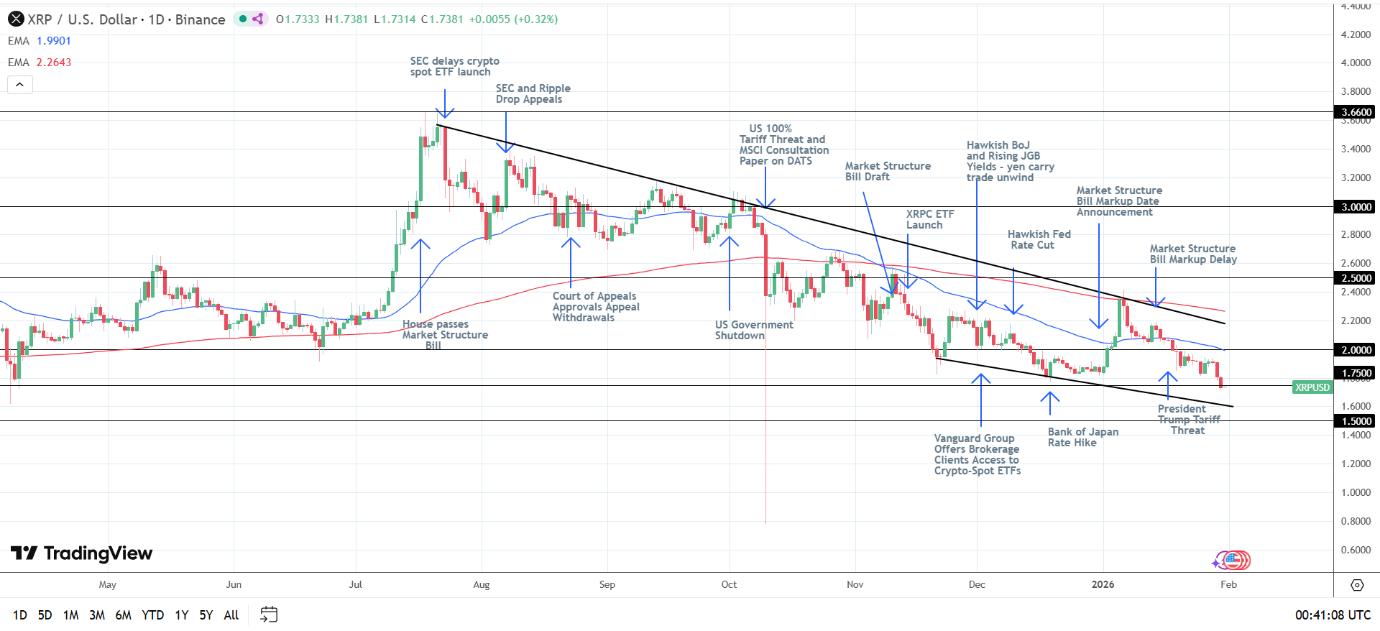
Friday’s sell-off left XRP trading below its 50-day and 200-day EMAs, signaling bearish momentum. However, several positive fundamentals continue to offset bearish technicals, affirming the bullish medium-term outlook.
Key technical levels to watch include:
- Support levels: $1.70 and then $1.50.
- 50-day EMA resistance: $1.9901.
- 200-day EMA resistance: $2.2643.
- Resistance levels: $1.85, $2.0, $2.5, and $3.0.
On the daily chart, a break above $1.85 would pave the way toward $2.0. A sustained move through $2.0 would bring the 50-day EMA into play. Significantly, a sustained break above the 50-day EMA would indicate a near-term bullish trend reversal. A bullish trend reversal would enable the bulls to target $2.2. A breakout above $2.2 would open the door to testing $2.5 and the 200-day EMA.
A sustained move through the EMAs would reaffirm the cautiously bullish medium-term price targets.
Fundamental Events Driving Near-Term Price Action
Near-term price drivers include:
- XRP-spot ETF flows.
- US economic indicators and the Fed’s policy stance.
- US government shutdown-related news and crypto-related regulatory developments.
- The Bank of Japan’s neutral rate and rate path.
- Rising geopolitical risks.
Bearish Structure Exposes $1.5
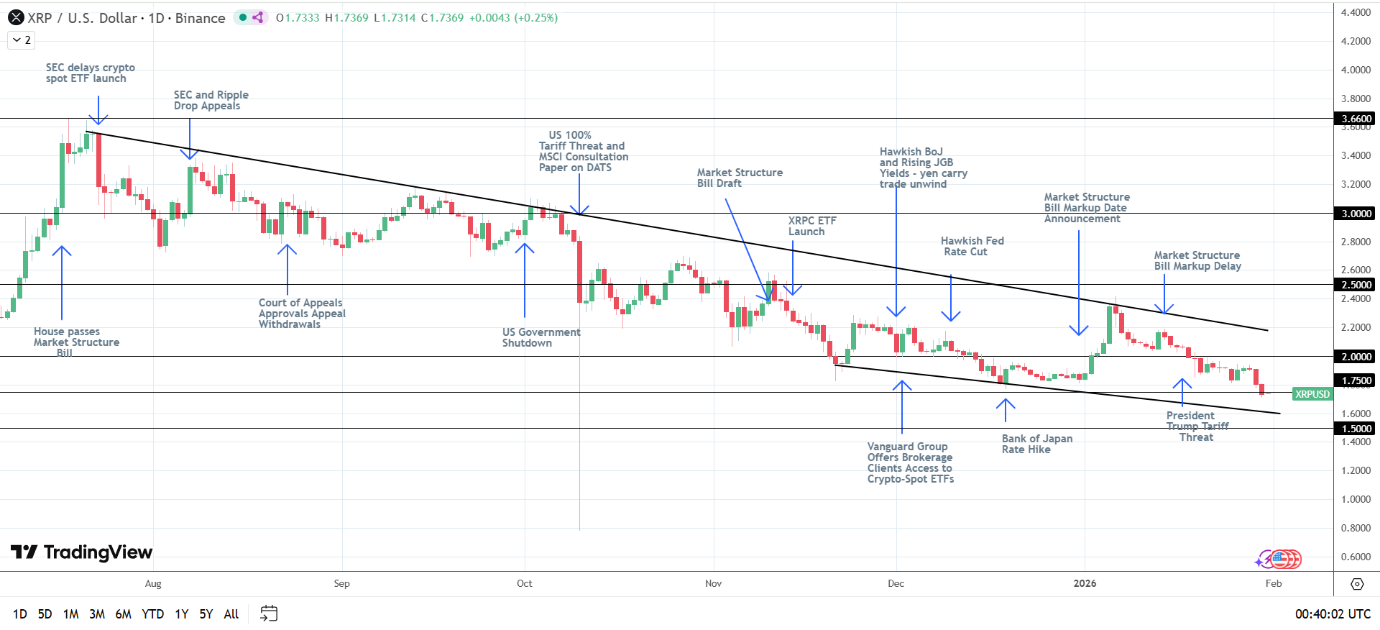
Friday’s drop below $1.75 indicated a bearish trend reversal and invalidated the bullish short-term outlook. A break below $1.7 would bring the lower trendline into play. If breached, $1.5 would be the next key support level. Crucially, a break below the lower trendline would reaffirm the bearish short-term outlook and validate the bearish structure.
Meanwhile, reclaiming $2.0 would bring the upper trendline into play. A sustained move through the upper trendline would signal a bullish trend reversal, invalidating the bearish structure, and affirming the constructive medium-term bias.
- Short-term (1-4 weeks): $1.5.
- Medium-term (4-8 weeks): $2.5.
- Longer-term (8–12 weeks): target of $3.0.
XRP Outlook Hinged on Crypto Regulations, ETFs, and Central Banks
Looking ahead, the progress of the Market Structure Bill will be pivotal for XRP’s near-term price outlook. The focus will be on the US Senate Banking Committee’s draft text and markup vote, which was postponed earlier this month. Progressing the draft text would raise hopes that the Senate will pass the Bill, boosting XRP demand.
However, geopolitical headlines, central bank rhetoric, and demand for XRP-spot ETFs will also influence near-term price trends.
A more dovish Fed policy stance and a lower BoJ neutral rate (potentially 1%-1.25%) would lift sentiment. Robust inflows into US XRP-spot ETFs and the progress of the Market Structure Bill would reinforce the positive medium-term outlook.
In summary, these factors support a medium-term (4–8 weeks) move to $2.5. The US Senate’s passing the Market Structure Bill would reaffirm the longer-term (8–12 weeks) price target of $3.0.
Beyond 12 weeks, these events are likely to drive XRP to its all-time high of $3.66 (Binance). A break above $3.66 would support a 6- to 12-month price target of $5.