



What if I told you that the single most potent idea in technical analysis isn’t some complicated indicator or hidden formula—it’s just knowing where the price is apt to halt? That’s the whole point about support and resistance. And still, for something like this, it’s astonishing how many traders either complicate it too much or skip it altogether. I have seen full-time traders lose money on trades that appeared 100% legit on a spreadsheet only to find out they completely overlooked a major level staring them right in the face. Whether you’re just learning how to read a chart, or you’ve been analyzing candles for years, this article is meant to help you refine your perspective about price action—and more importantly, your reaction to it.
The Fundamentals: What is Support and Resistance?
Here’s the simplest mental model I could come up with: visualize a ball bouncing in a room. The floor is support—it’s the price level at which buyers get aggressive enough to halt the decline. The ceiling is resistance—the point at which sellers overwhelm buyer’s interest and cap the rally. That’s it. That’s the idea in a nutshell. Everything else is just adding skin on a bone. But here’s the twist—these levels aren’t just lines on a chart. They’re a reflection of market psychology. They show us where real money made real decisions. Where institutions put in bids, where retail traders panicked, where algorithms triggered. And that’s why they tend to matter again when price comes back to visit them.
Key insight: support and resistance levels work due to their representation of collective decision-making. They’re the fingerprints of market psychology.
Why Support and Resistance Matter
I understand it—”support and resistance” sounds like 101 stuff. But let me take you on a journey and explain why even seasoned traders explore these levels over and over again:
Decision points
Every support or resistance zone is, in a sense, a fork in the road. Price comes to the level, and you’re sitting there, waiting to see: does it bounce, or does it break? That binary outcome is what gives you an indication to enter a trade. No key level, no significant decision point.
Entry and exit signals
These levels are natural junctures to think about buying or selling. Bounce off support? Possible long entry. Rejection at resistance? Maybe it’s time to take a profit. The levels don’t guarantee anything—but they tell you where you should put your energy.
Risk management
Here’s where we go to the practicalities of life. You’re long, and support is at $150; you know exactly where your thesis falls apart—somewhere below $150. That gives you a natural place for a stop-loss, as opposed to coming up with some arbitrary percentage.
Trend validation
Resistance breaks and holds as new support? That’s not just a pattern; that’s the market telling you that the price character has changed. This idea, also known as trend reversal is one of the most reliable signals in technical analysis.
The Three Types of Support and Resistance
Not all levels are created equal.
Here’s how I think about them:
1. Static Levels
These are your classic horizontal lines—drawn from prior swing highs, swing lows, and areas where price has repeatedly reversed. If you pulled up a chart of SPY right now and connected the obvious tops and bottoms, you’d have static support and resistance.
Pro tip: Don’t hunt for perfection. Look for the zones that jump out at you. If you have to squint, it’s probably not a meaningful level.
2. Dynamic Levels
These are levels that move with price—trendlines, moving averages, channels. Unlike static levels, dynamic support or resistance shifts over time, which makes them especially useful in trending markets. A rising 50-day moving average on a daily chart? That’s dynamic support in an uptrend. A declining trendline connecting lower highs? Dynamic resistance in a downtrend.
3. Psychological Levels
Traders are human (well, mostly), and humans love round numbers. Think $100, $50, $25—these are price levels where buy and sell orders tend to cluster. If AAPL is trading at $198 and rallying, you can bet there’s a wall of sell orders sitting at $200. Psychological levels won’t always hold, but they’re worth having on your radar—especially on large-cap names and major index levels.
How to Identify Key Levels (Without Overthinking It)
Now, I know what you’re thinking: “How do I actually find these levels?” Here’s my framework: Think zones, not lines. Support and resistance are areas, not exact prices. A zone might be $148–$150, not just $149.32. More touches = more significance.
If price has bounced off a level four times, it’s clearly important to the market. Role reversal is real: when support breaks, it often becomes resistance—and vice versa. This is one of the most useful concepts in all of chart reading.
It’s important to note that higher timeframes carry more weight, as a support level on a weekly chart is far more significant than one on a 5-minute chart. When in doubt, zoom out. Past levels aren’t guarantees: just because $150 held last time doesn’t mean it will again.
Bottom line: Keep it simple. Identify the obvious levels, mark the zones, and then watch price’s reaction—that’s where the real information is.
For instance, take a look at this NVDA chart—notice how the horizontal levels marked by arrows align with repeated reaction points across multiple years. The green arrows show support bounces, and the red arrows show resistance rejections:
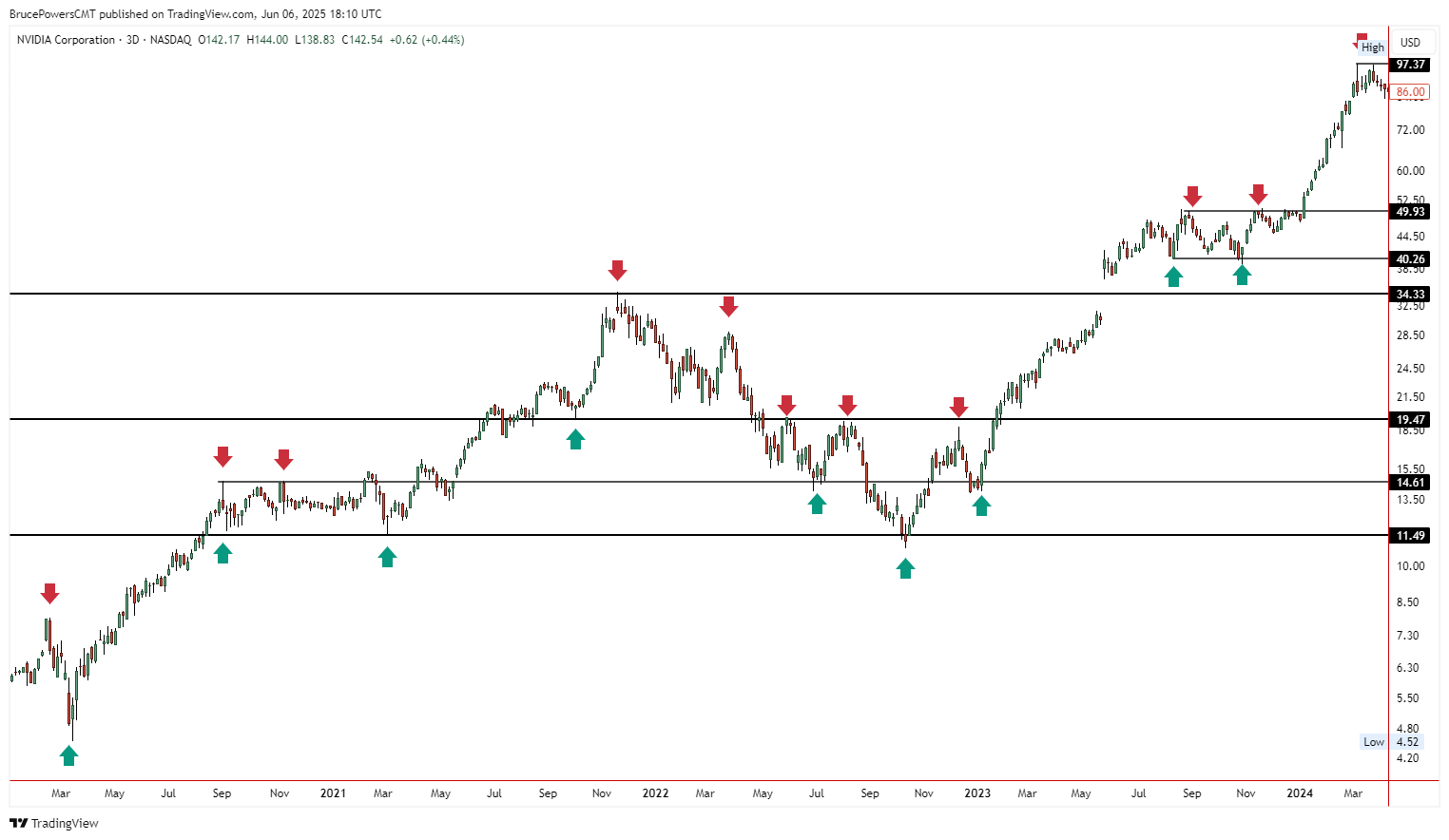
NVDA 3-day chart: Static support and resistance levels with role reversal visible at key price zones.
Drawing Trendlines That Actually Work
Trendlines are one of the greatest weapons in the chart reader’s arsenal—and one of the most subjective. Two different analysts can easily draw different trendlines on the same stock chart, and both can be correct, to an extent. That said, there are some guidelines that help:
- It takes two points to draw a trendline, but three or more make it much more reliable.
- Connect swing lows in uptrends and swing highs in downtrends.
- Steep trendlines are fragile. The sharper the angle, the more unsustainable the trend probably is (think of them as “rendered vulnerable by their own steepness”) The steadier the slope, the more durable the trend likely is.
- More touches = stronger trendline. Each opportunity to test the line only adds relevance.
- Be prepared to redraw. Trendlines get broken. This isn’t failure; it’s a re-opening of the chart and a willingness to see new information.
The rule of thumb is: treat every trendline as a potential failure until the price does (or doesn’t) confirm it. What you’re really watching for is the reaction at the line—not the line itself.
The following chart draws out a great example on the AAPL long-term chart. Notice how lines are redrawn and re-established throughout the play? It’s normal. It’s expected. A good thing.
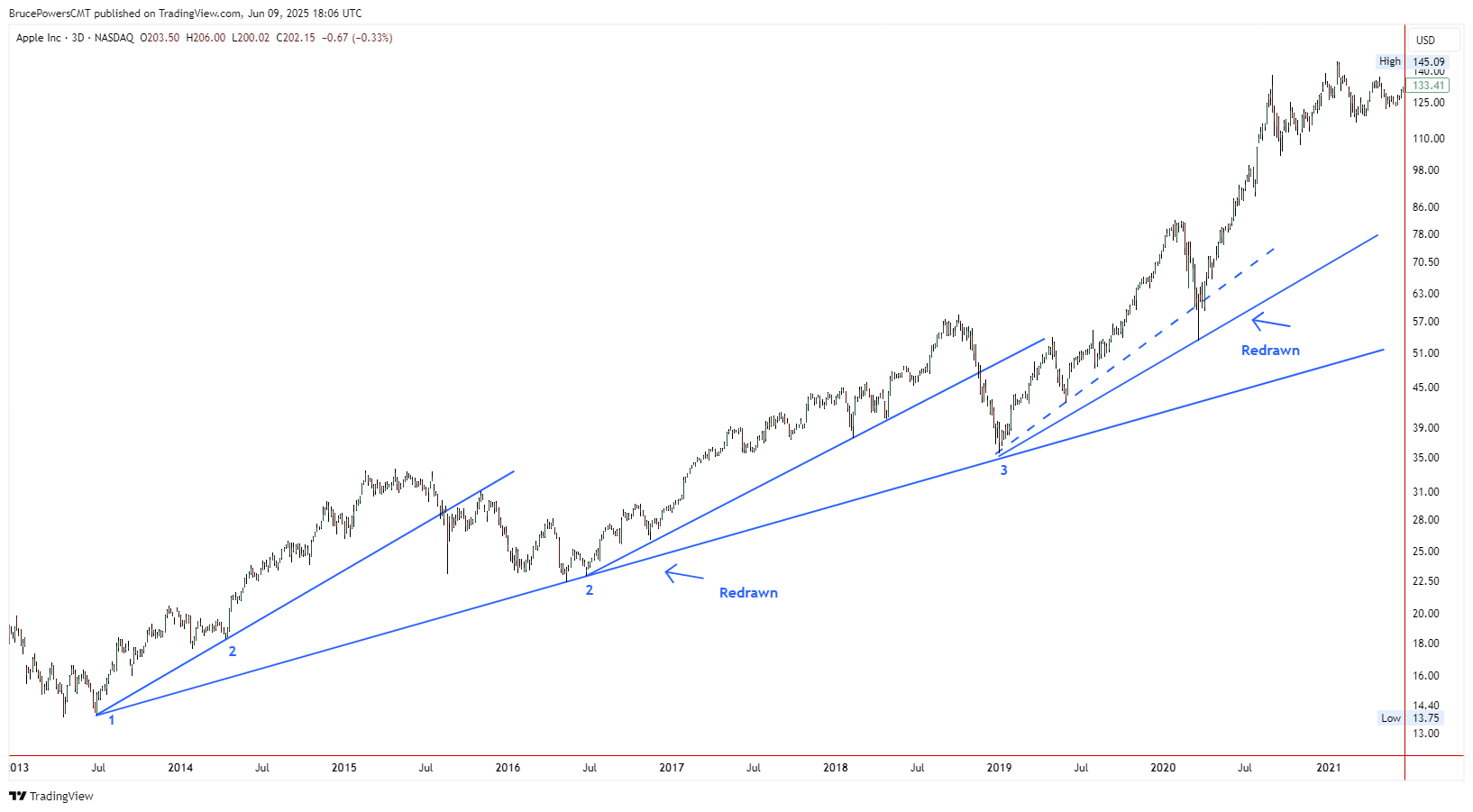
AAPL 3-day chart: Uptrend trendlines connecting swing lows, with redrawn lines as the trend shifted over time.
Putting It All Together: Trading These Levels
Okay, so here’s where the rubber meets the road. You’ve singled out your levels, drawn your trendlines, etc.—now what?
First, a shift in mindset: treat all levels as potential failures until they’ve been confirmed.
A breakout (up or down) requires confirmation of strength or weakness. It’s the behavior of price at or near the level that gives real clues. Ask yourself these questions as the price approaches a key level:
- What’s going on with volatility? Is it expanding? Contracting?
- How’s the momentum changing? Slowing down into the level; accelerating through it?
- Is price following through? Or are price patterns failing?
- Is volume confirming the movement?
Moving Averages as Dynamic Support and Resistance
I’m all for keeping things simple, and moving averages (MAs) are as simple as they come for spotting dynamic support and resistance. Here’s the quick-and-dirty: a rising MA acts as a moving floor under price in an uptrend; a declining MA acts as a moving ceiling above price in a downtrend. Pullbacks to a rising MA can be opportunities to buy. Rallies into a falling MA can be opportunities to short.
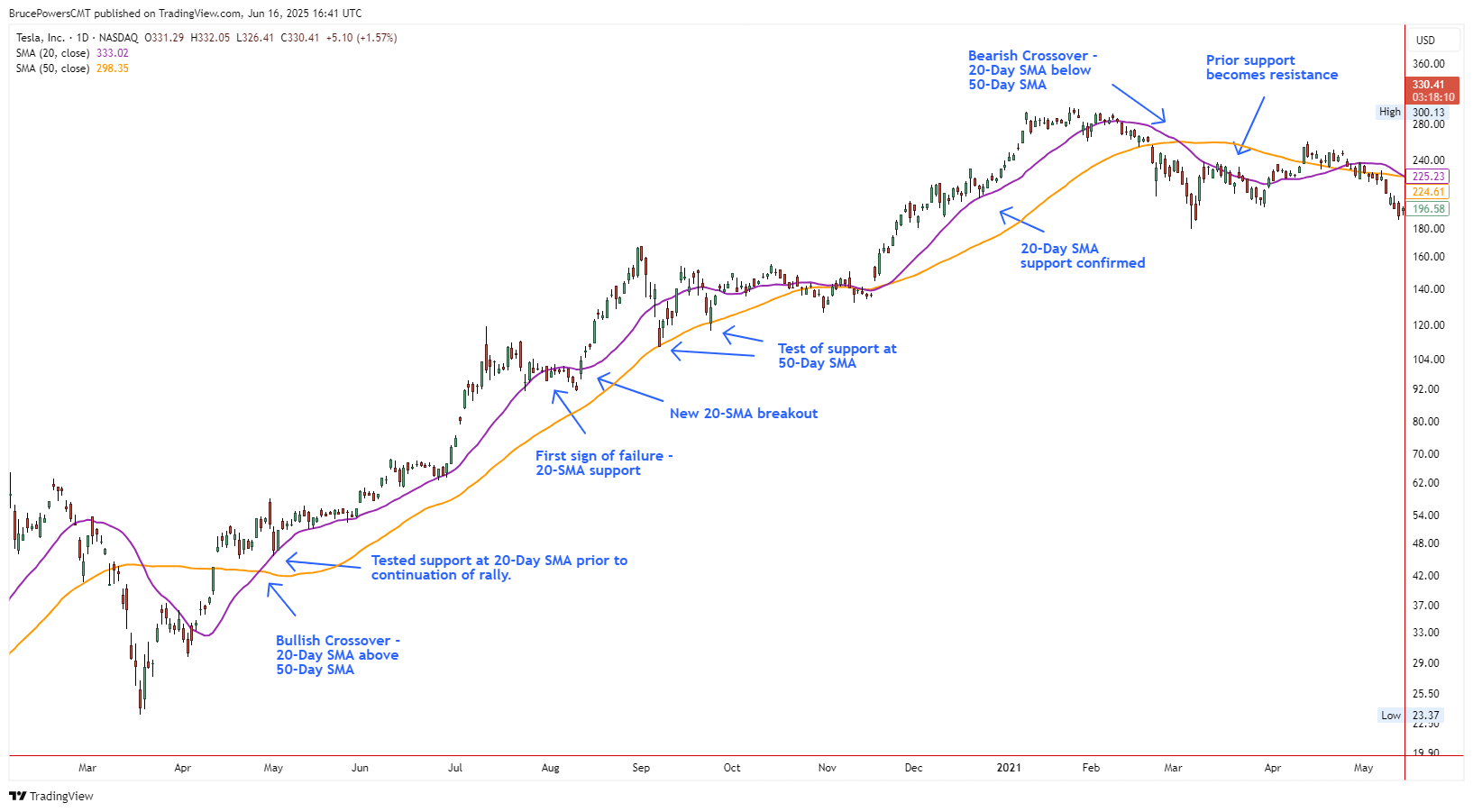
Dynamic support and resistance using moving averages across different timeframes.
One of the drawbacks is that moving averages are lagging indicators. They trail price action—they’re not meant to forecast it. They’re most effective when the market is trending and less effective while the market is ranging.
Two Fundamental Strategies: Reversals and Breakouts
Let’s break this down into the two fundamental trading strategies using support and resistance:
Strategy 1: Trading Reversals
Bullish Reversal: Identify a key support area. Observe how price responds as it nears the support area. If there’s evidence of a low being formed—decreasing momentum, bullish candle patterns, and volume decreasing as price pulls back—wait for a bullish reversal signal. You can drop down to a lower time frame (four-hour, one-hour, or fifteen-minute) for a quicker trigger.
Your initial stop goes beneath the recent lows.
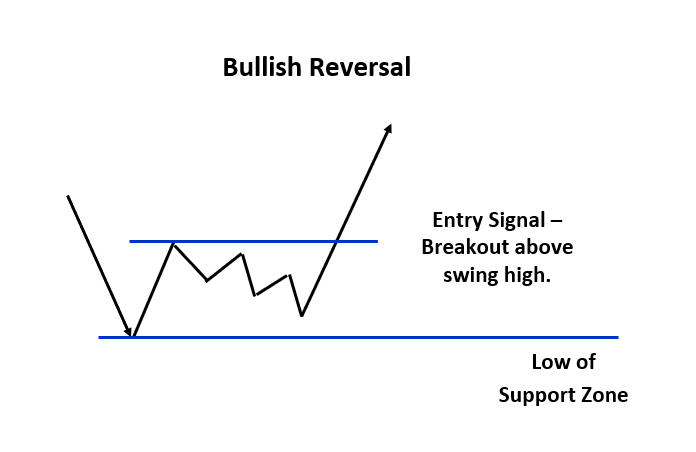
Bullish reversal setup: Price finds support; builds a base; reverses higher.
Bearish Reversal: Same idea, but in reverse. Identify resistance, observe how price reacts, and wait for a bearish signal.
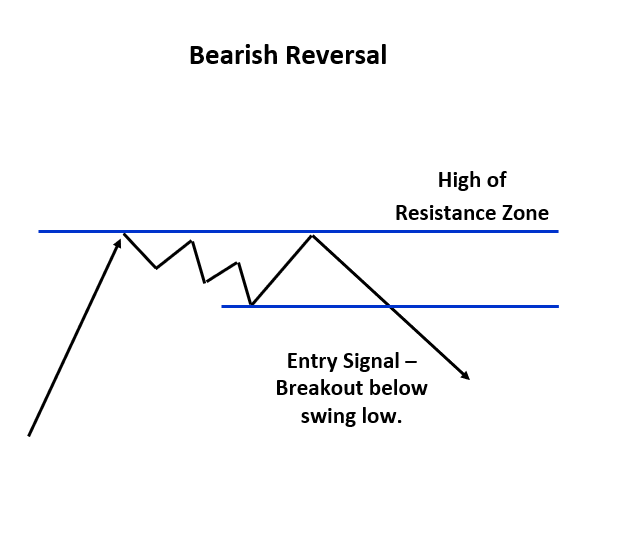
Bearish reversal setup: Price stalls at resistance; reverses lower.
Strategy 2: Trading Breakouts
Breakouts are exciting and precisely where most traders get burned by false breakouts.
Fact is: there are two ways to enter and four scenarios to be prepared for.
Two Types of Entry:
- Enter on the initial breakout (aggressive).
- Wait for the first good pullback after the breakout (conservative; sometimes better R/R).
Four Scenarios After a Bullish Breakout:
- Scenario 1: Uptrend acceleration; shallow pullback; trend continuation.
- Scenario 2: Breakout and pullback to breakout area; support tests the previous breakout area as new support; price reverses.
- Scenario 3: Breakout and pullback retraced to 100% downside of the breakout; dips just beneath breakout area—damn uncomfortable, but it’ll negate the setup.
- Scenario 4: Breakout failure; price rejects off the breakout and key support; exit signal.
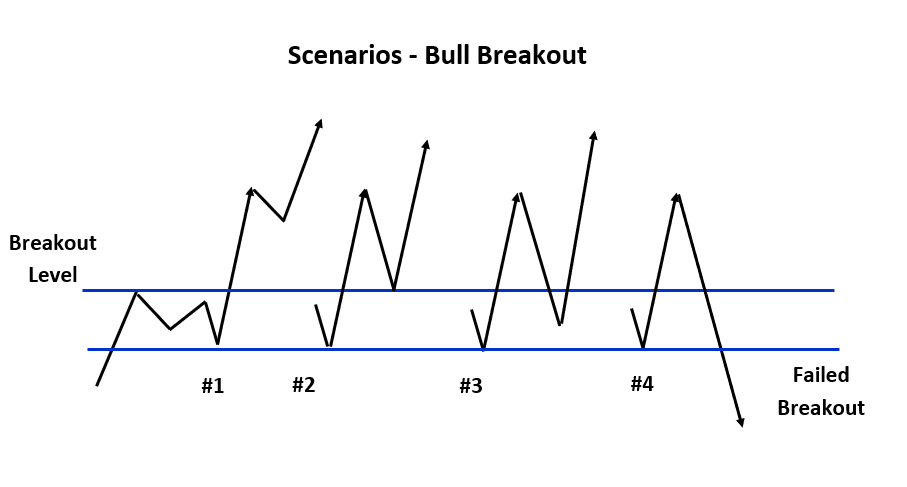
Post-breakout scenarios: From clean uptrend continuation to complete downward failure.
The best part about the scenarios is that false breakouts are a part of trading—and you should expect them. Protect yourself from them by using volume, momentum indicators, and moving averages to confirm the breakout.
Real-World Examples: AAPL and EUR/USD
Let’s run through two tangible setups:
Example 1: Apple Inc. (AAPL) — Breakout After a 46-Week Base
On the daily time frame, AAPL spent about 46 weeks building a sideways-range base, classic for consolidation.
Your initial entry fired on the upside breakout of the new high.
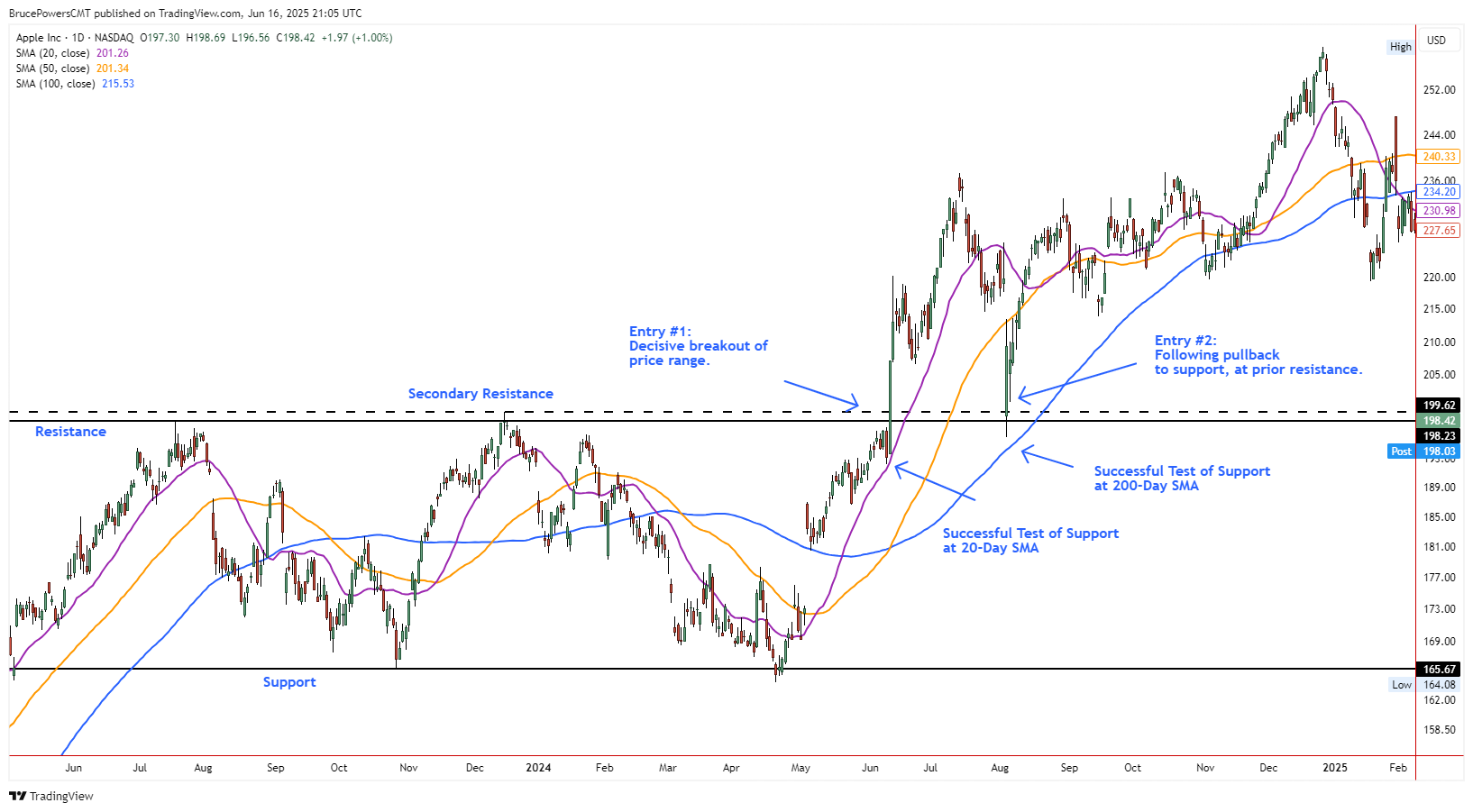
AAPL daily chart: Initial upside breakout of the 46-week sideways-basing pattern.
After the high at $220.20, Apple pulled back to create the second high, reversing to locate support at $206.59. Dust off the two-hour time frame, and the 50-period moving average confirms the price action.
Thereafter, the following secondary entries triggered:
- Aggressive entry: Rally above the minor swing high—first sign of the pullback ending.
- Trendline breakout: Price broke above the declining trendline marking resistance of the retracement.
- New high: Rally above the prior swing high—trend continuation confirmed.
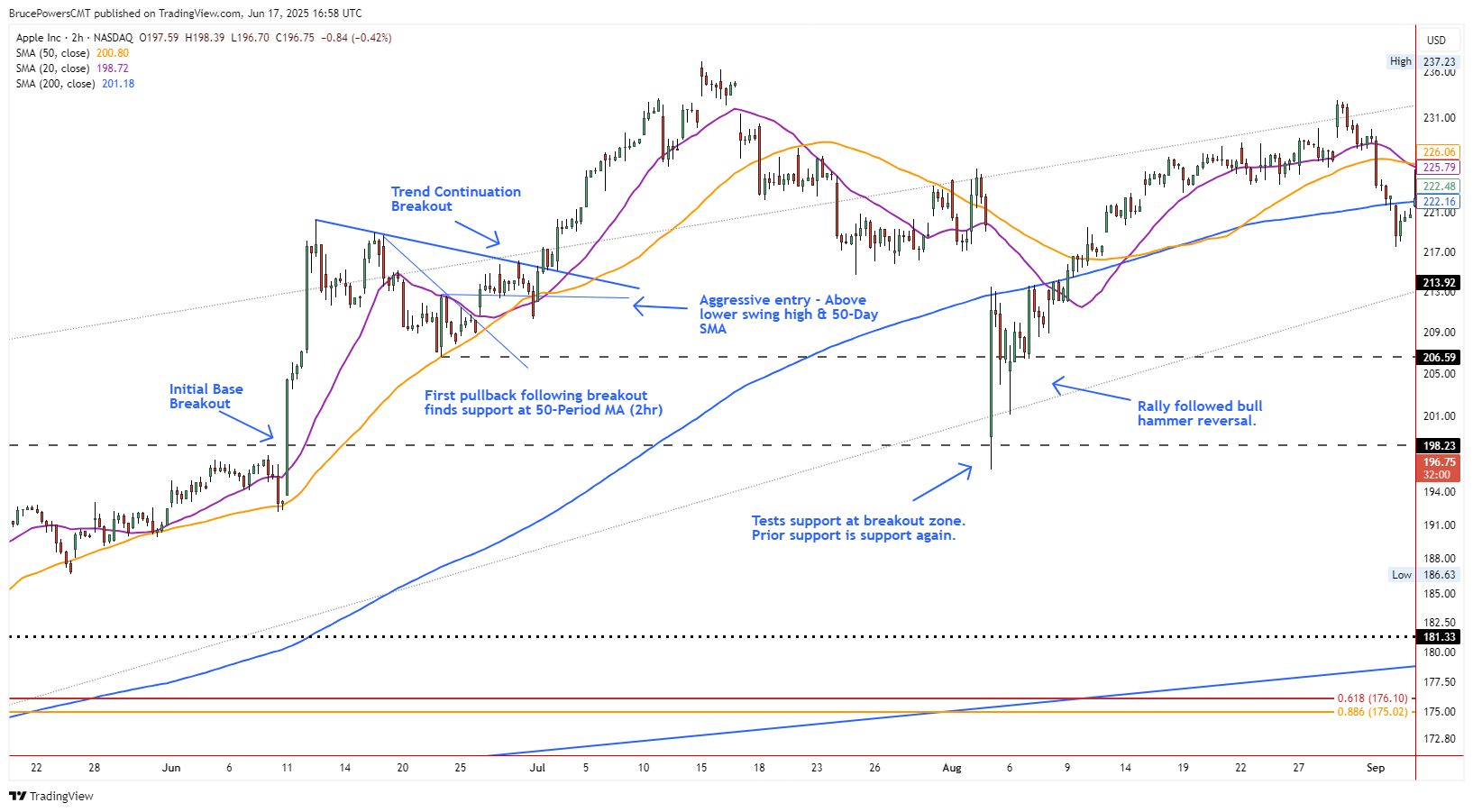
AAPL two-hour chart: Secondary entry triggers after the initial pullback—50-period moving average confirms the pullback support.
Notice how the secondary entries after the first pullback often give you a better R/R than the initial breakout. The pullback aid gives you a clear stop level.
Example 2: EUR/USD — Breakout After a Multi-Month Consolidation
EUR/USD spent the final months of 2024 and the start of 2025 in a range, building a clear resistance ceiling at $1.0528. On March 4th of 2025, a decisive upside breakout triggered.
The first real pullback found support at the confluence of levels—the 200-day moving average and prior horizontal support $1.0733. That’s the type of stacking evidence that creates a high-impact trade setup.
The triggers included an aggressive reversal signal above the minor swing high of $1.0850. That trigger was followed by a continuation signal at the new trend high of $1.0955.
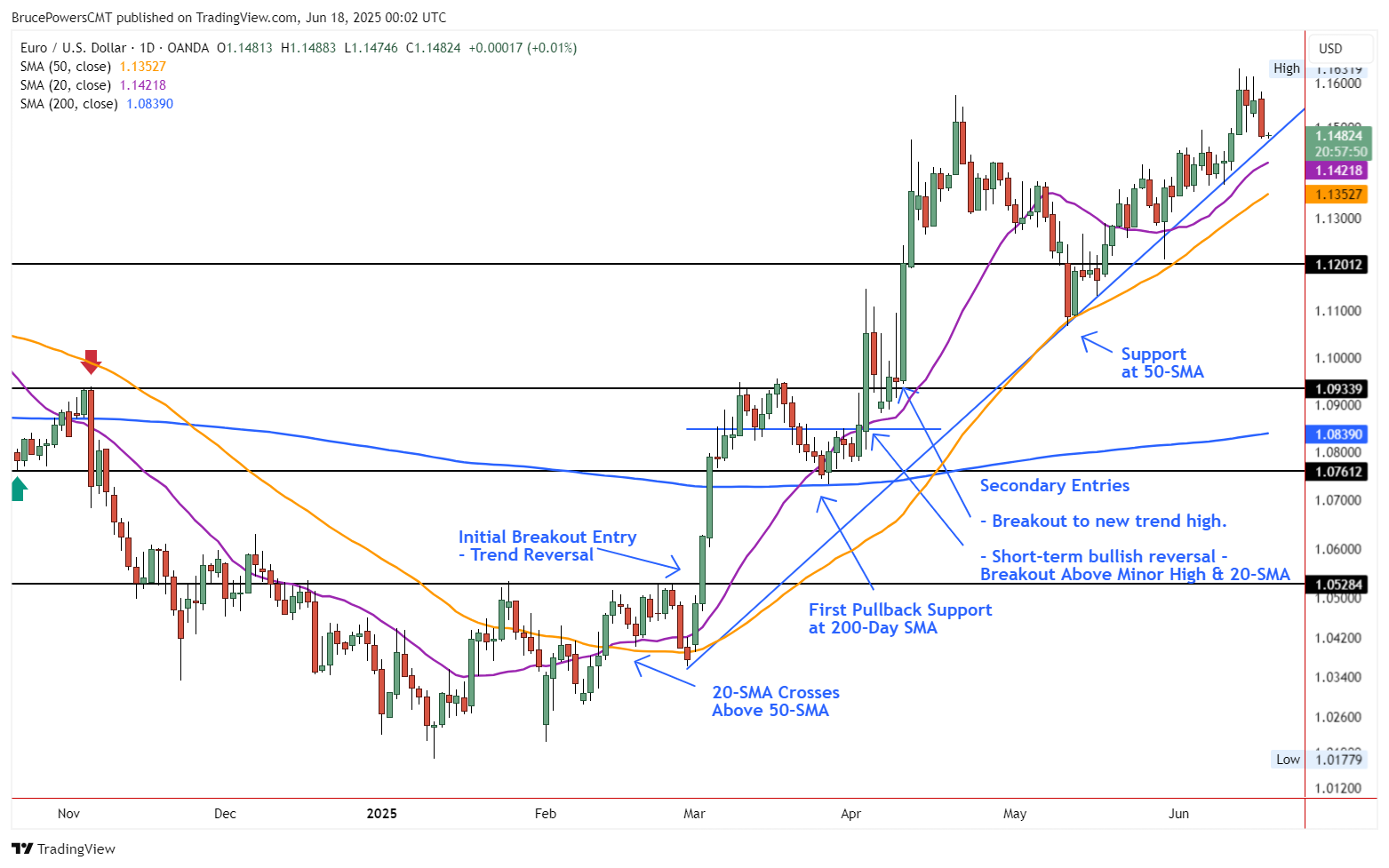
EUR/USD: Upside breakout from multi-month consolidation, with the first pullback finding support at the 200-day MA and prior support.
Confluence of Support Levels
When multiple types of support share the same space—static, dynamic, and a key shifting average—watch out. This is often called a confluence of support levels. Confluence is one of the most powerful concepts in technical analysis. When varying kinds of support—horizontal price levels, trendlines displaced over time, and moving averages—all converge at the same price level, the result is a greater impediment to price movement. Traders get excited to watch these areas because the cumulative effect of multiple types of support can produce outsized price reactions, like a hard bounce or hard continuation.
Final Thoughts: Keep It Clean, Keep It Disciplined
Support and resistance are possibly the most important concepts in all of technical analysis—but not for the reasons you think. Many traders are attracted to support and resistance because they are the crux of price movement. Simple supply and demand. However, the importance of support and resistance extends beyond simply identifying potential reversal zones.
They’re everywhere. Each single chart, each timeframe, in each market. No matter what market you trade—equities, futures, forex, or cryptocurrencies, in no matter what timeframe you are looking at—5m, daily, or monthly—you will always identify areas of supply and demand that are seemingly like magnet zones where prices stall and/or reverse.
Just like a dancer will dance around within the imaginary boundaries of a stage, price action will tend to respect these areas and bounce back and forth between them or break through them when conditions warrant.
Here’s what I want you to remember:
- They are areas, not exact prices. They require a buffer.
- Pay attention to how market reacts around the level—that’s the signal.
- Use static and dynamic levels in combination with moving averages for confluence.
- Always have a game plan for risk management—those pivotal levels tell you where your plan failed.
- Expect false breakouts. They’re not glitches—they’re a part of the game.
What do you think is the best way to acquire these skills? The answer is practice. Open up a demo account. Start laying down levels and watching how the market reacts. Over time, you’ll get a sense of which levels actually matter—and that sense is worth more than any indicator.