Digging into the deep tool kit of technical analysis, you can find some exotic items for you to use. Just because they are exotic doesn’t mean that they can’t be incorporated into your process. It may even give you that edge because no one else uses them and you are getting a perspective that few see. That’s how I feel about Renko Charts.
Most participants only focus on time. They use the traditional chart types like bar charts and even candlestick charts have become integrated into the norm. Traders and investors often look at 1-minute, 5-minute, or daily candles as if time itself were the only factor of market value or trends. Indeed, standard charting prioritizes time over price. However, by varying your chart type, you can access the instrument from a different perspective. Renko charts in particular operate on an event driven basis. By prioritizing price movement and volatility bands, they provide a different view of market reality, effectively compressing periods of stagnation and expanding periods of high volatility.
By removing time, Renko allows you to see the structural will of the market.
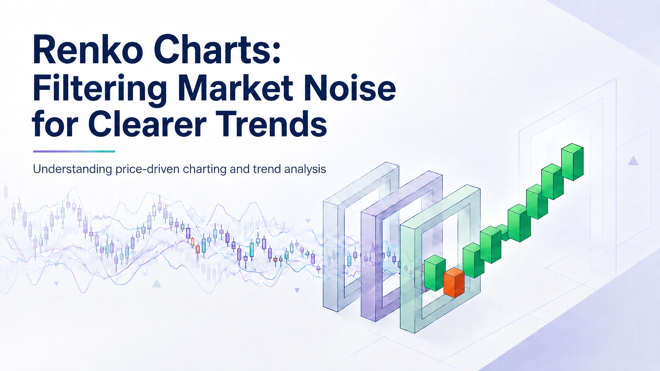
Renko Charts, similar to Candlestick charts, have a Japanese origin. Renko charts go back to the Edo period (1603-1868) in the rice markets. Traders needed a way to track changes in the crop value without getting distracted by the noise of what was happening in the literal markets. Renko comes from renga, the Japanese word for “brick”. Think of Renko as an undulating wall of price, built one block at a time in either green or red.
In the modern platforms, Renko charts function through an event driven horizontal axis. The chart only moves to the right when a price completion event occurs. These bricks are plotted at a 45-degree angle from the previous one, and you’ll never see them placed side-by-side.
The 3 main features of Renko are:
Not all Renko bricks are built the same. The calculation methodology is determined by your strategic outlook.
| Sizing Method | Strategic Utility | Primary Drawback |
|---|---|---|
| Fixed Value | Provides consistency for scalping and fixed risk/reward setups | Fails to adapt to high frequency shifts. Can become noisy during events |
| Average True Range (ATR) | Dynamically self-adjusts the brick size based on market volatility | High “repainting” risk. This means that the chart can change shape upon refreshing of the chart |
| Percentage Based | Maintains proportional scaling, ideal for long-term macro analysis of instruments | Difficult to use for precise, intraday pips-based strategies. |
The standard ATR setup could be a bit annoying and unstable because it recalculates the entire history based on the current window. However institutions often use ATR Persistence. This is a rolling calculation methodology that ensures the Renko brick structure remains static and does not “repaint” or change its historical shape every time you refresh your data feed.
The construction of the bricks can vary as well. Some of the construction methods include:
Indeed, Renko tells you the What but you still need the indicators to confirm the When. This synergy here works very well because Renko acts as a pre-filter for the indicators themselves.
From a Trend Following point of view traders generally use the brick moves to assist in the change of trend. Because of the 2x movement requirement to change brick color, seeing 2 consecutive bricks of a new color confirms that the new momentum has sufficient velocity to likely continue. It helps traders filter out fake out breakouts.
Moreover, peaks and troughs become objective horizontal levels on a Renko chart. These bricks show you where the market’s demand or supply failed to come through, providing clear targets for breakout entries or stop loss placement.
Also, traders include technical analysis indicators with their Renko charts. This combo offers visual clarity, adding a much needed layer of objective validation to its simplified price action. This synergy helps you confirm whether the trend has actual momentum to back it up or if the market is drifting to and fro on low volume.
Think of using moving averages (MAs) as filtering the filter. A MA on Renko is exceptionally smooth. It would act as support or resistance, helping to determine the ultimate trend direction of the instrument.
RSI when paired with the Renko measures velocity divergence. If price is printing new bullish bricks but the RSI peaks are trending lower, the energy of the move is dissipating, signaling some level of reversal.
Traders watch for walking the bands. High conviction moves will hug the outer bands. If you see bricks begin to alternate colours while the bands squeeze, you’ve entered a range. This would require some patience as you await a new trend direction to formulate.
Renko charts filter the noise in these modern markets. Analysts can ignore the flicker and focus on price moves. But with all types of techniques, it is more useful when combined with other tools. But you would use Renko to find the overarching trend of the market, combining with candlesticks as a secondary monitor to identify exit points and monitor intra-brick volatility.
Cedric Thompson, CMT, CFA, is an investment strategist with experience in asset management, corporate strategy, and multi-asset investing.