
While many retail traders are focused on where price is—whether above or below a moving average, above or below a trend line—professional traders tend to pay just as much attention to volatility as price. The volatility of an instrument is simply a measure of how fast and how much price moves around. This is something we can read in real time with Bollinger Bands, one of the most valuable and one of the most misused indicators in existence.
John Bollinger developed his namesake indicator in the 1980’s. The indicator is not a buy/sell system, nor will it paint green buy arrows and red sell arrows all over your charts. What Bollinger Bands can do, however, is help you read whether the market is overbought or oversold; whether it’s calm or volatile; whether it’s mean reverting or trending. In essence, Bollinger Bands can help traders understand whether price is swinging too far to one side of the pendulum or another.
In our seventh article in the series, we will take a detailed look at Bollinger Bands, their use and application, and how traders can avoid misusing this valuable tool. Let’s first start with an understanding of volatility.

Understanding Volatility
The dirty little secret that most retail traders will never tell you is that they completely ignore volatility. They may watch the price action of their favorite instruments, they may watch for certain patterns or trends, but the actual measurement of volatility is completely ignored. This is akin to driving a car and only looking at the speedometer but never at the engine temperature light.
Volatility, simply put, is a measurement of how much and how fast price fluctuates. Low volatility often leads to a compression of price that eventually leads to a breakout. Spikes in volatility can often lead to the beginning of a new trend. Learning to track and understand different forms of volatility can help traders stay ahead of the curve when it comes to catching the beginning of a major move.
There are three forms of volatility that traders need to understand:
1. Historical (Realized) Volatility: This is what Bollinger Bands measure directly, via standard deviation. Historically, 68% of all closing prices have been within 1 standard deviation of the 20-period moving average. 95% of closing prices have historically been within 2 standard deviations. The farther away from the mean price closes, the likelier it is to return to the mean at some point.
2. Implied Volatility (IV): This is the options market’s best guess at future realized volatility. When IV is in the bottom 10–20%, breakouts often aren’t far behind. If you trade options in conjunction with technical analysis, this is very important to note.
3. Intraday/Short-Term Realized Volatility: This can be measured on a bar-by-bar basis with the Average True Range (ATR), but for the purposes of Bollinger Bands, we can use BandWidth.
In short, all forms of volatility cluster and mean-revert. As low-volatility periods continue, price action will continue to get tighter and tighter until a breakout occurs. Then, as high-volatility periods continue, price action will continue to get more and more volatile until it once again mean-reverts. The cycle of realized volatility looks like this:
Compression → Expansion → Exhaustion → Compression
Commit this to memory, because this is the never-ending story of financial markets.
What Are Bollinger Bands, Anyway?
Bollinger Bands are simply a volatility-based envelope that surrounds a simple moving average. There are 3 components to Bollinger Bands:
Upper Band: a moving average (normally 20-period) plus 2 standard deviations (20 periods).
Middle Band: a simple moving average, normally 20-period (SMA)—the market’s short-term “fair value.”
Lower Band: a moving average minus 2 standard deviations ( normally 20 periods).
Bollinger Bands provide a relative definition of high and low that adjusts for price volatility. They answer the question: “Are prices high or low compared to historical volatility?”
Bollinger Bands consist of a moving average and two standard deviations plotted above and below it. Standard deviation is a measure of volatility, therefore Bollinger Bands adjust themselves to the market conditions. When the markets become more volatile, the bands widen, leaving more room between the moving average. During less volatile periods, the bands contract, keeping prices closer to the moving average.
The positioning of the bands is telling. The tops of the bands are determined by the addition of the standard deviation to the moving average. The bottoms of the bands are determined by subtracting the standard deviation from the moving average. Along with calculating and plotting the bands, you can also calculate and plot the moving average of the bands to determine the volatility of the instrument.
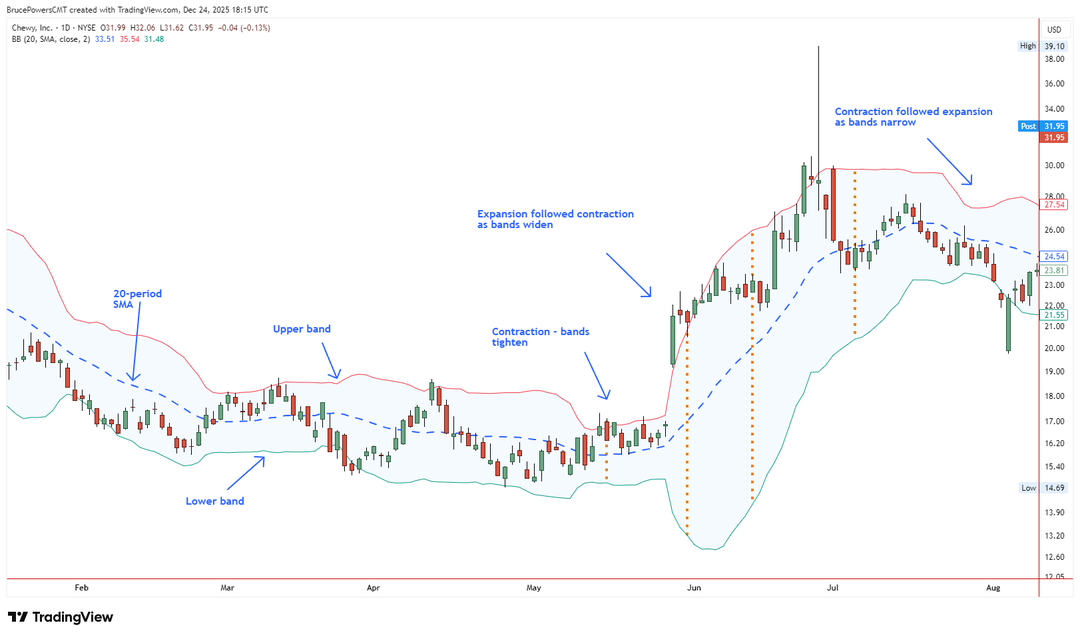
Daily Chart — Chewy, Inc. (CHWY)
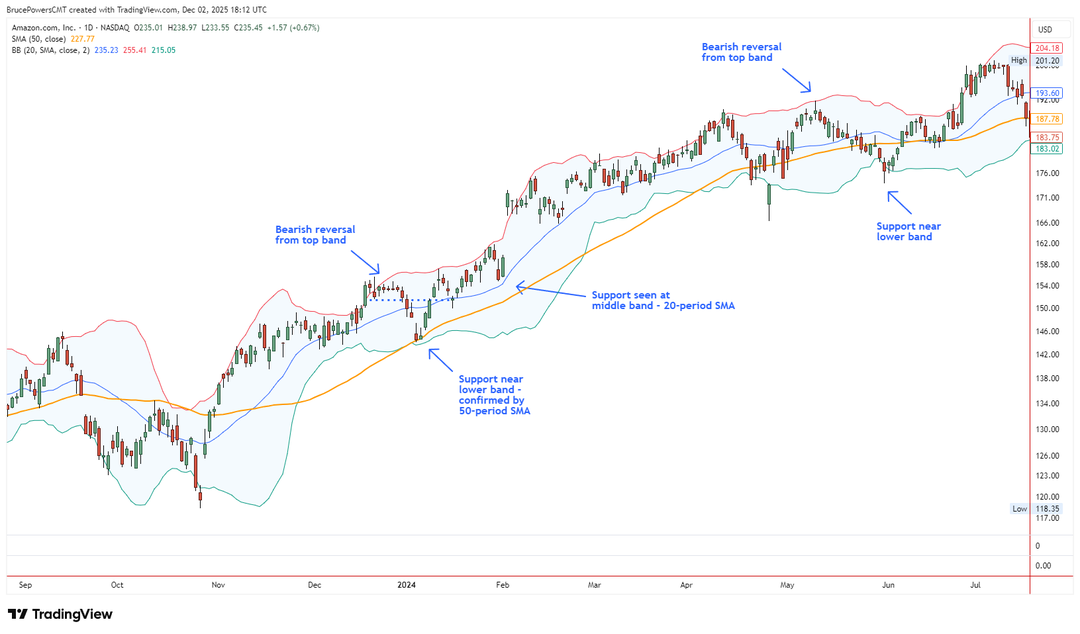
Daily Chart — Amazon.com Inc. (AMZN)
The fourth regime is characterized as “Choppy/Mean-Reverting” or “The Grind.” In this type of environment, the Bollinger Bands are fairly wide and are moving in a parallel fashion. Price is moving back and forth between the upper and lower bands, with no clear direction. There is volatility present, just not in any one direction. Trend followers hate this regime, but mean reversion traders love it. And most importantly, this is where the majority of traders end up giving back all their profits.
The bottom line is this: once you learn to properly read the bands and identify the regime, it will be clear whether you should be buying pullbacks, riding trends, fading extremes, or doing absolutely nothing. The last option, doing nothing, is often the most overlooked and underutilized strategy in a trader’s arsenal.
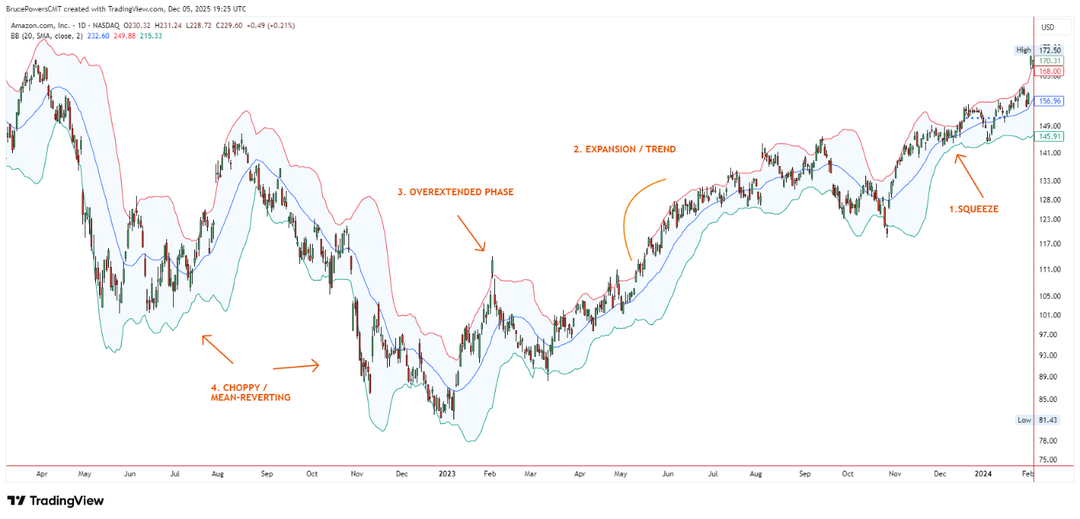
Daily Chart — Amazon, Inc. (AMZN) — All four volatility regimes visible across a multi-month period.
Understanding the Four Regimes: Core Bollinger Band Strategies
Now that we have discussed the four different regimes that exist when using the Bollinger Bands, let’s take a look at four of the strategies that professional traders use with Bollinger Bands. Each one of these strategies corresponds to one of the four regimes. If you use the wrong strategy in the wrong regime, you will be leaving a lot of money on the table. But if you match the strategies with the right regime, you will be surprised at just how well you can do.
Before we begin, I want to emphasize that simply tagging the upper or lower Bollinger Band should never be used as a signal. Context is crucial in this game.
Strategy A: The Bollinger Band Squeeze — High-Probability Setup
The squeeze is one of the most popular and reliable patterns in technical analysis. It is relatively easy to trade, especially when you are looking at the right regimes to use it in. A Bollinger Band squeeze occurs when band width drops to the lowest 10% of its six-month range. This means that volatility is at a six-month extreme low and that a large move is likely imminent. To trade a squeeze, the following rules apply:
• Band width should be the lowest it has been in at least six months.
• One way to filter for stronger Squeezes is to use bands inside the Keltner Channel (the original TTM Squeeze filter).
• Wait for the first close outside the band in the breakout direction + expanding band width. This is where patience comes into play.
• Enter on the breakout bar or the first pullback to the middle band (20-period moving average).
• Use a stop below the breakout candle low (if you are going long) or above the high (if you are going short).
• Initial price target = measured move = BandWidth at the point of the Squeeze.
• Use the middle band to trail your stop.
Again, understand that a Squeeze does not indicate direction. It simply tells you that volatility is at an extreme low and is due to expand.
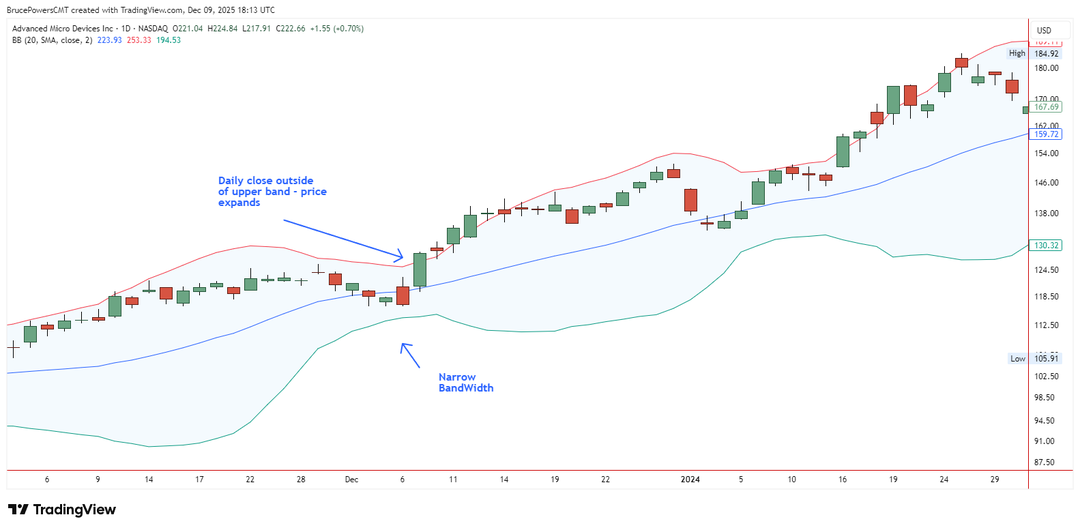
Daily Chart — Advanced Micro Devices, Inc. (AMD) — A textbook Squeeze setup.
Strategy B: Trend Following with “The Bollinger Walk”
After the squeeze is where you get the really large price moves. This is where, after the breakout, price “walks the band.” It simply rides the upper Bollinger Band (in an uptrend) or lower band (in a downtrend) and the bands continue to expand. This is where the patient trend followers make their money. Most traders struggle with this because they get in too late or get out too early. Here are a few simple fixes to this:
1. Only trade a walk when the ADX > 25. This ensures that it is a legitimate trend.
2. Use the 50-period moving average or the middle band as support and stay in the trade as long as price remains above it.
3. Use a trailing stop below the lower band, minus a buffer, for uptrends (opposite for downtrends).
4. If you want a tighter stop, you can use the 20-period center line.
This is a great way to take a modest breakout and turn it into a monster winner. The key is to just let the trend take over and not pull the rip cord too quickly.
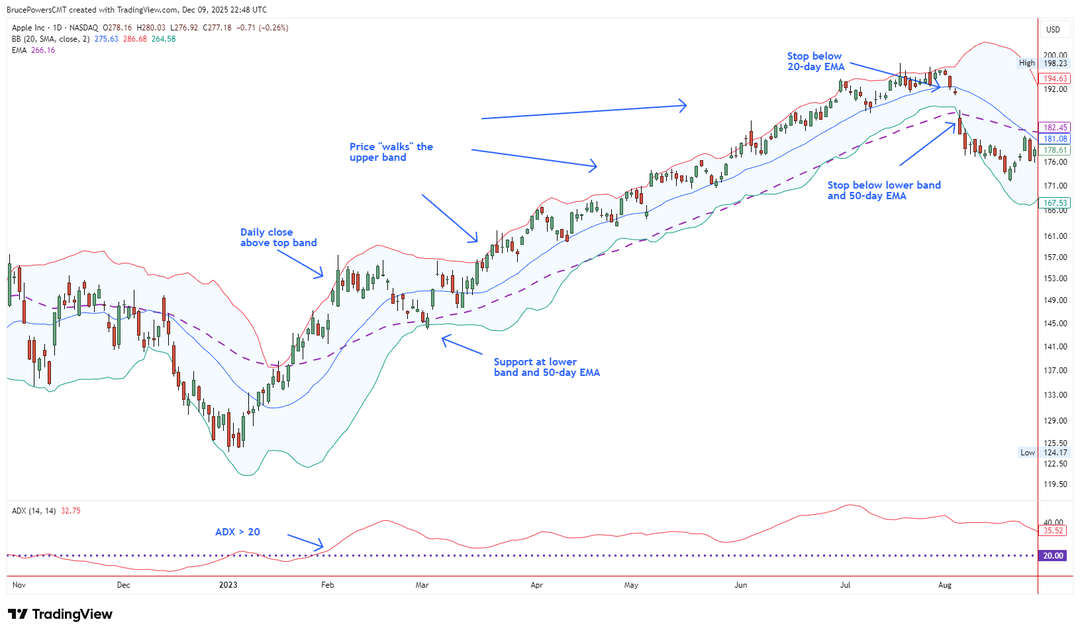
Daily Chart — Apple, Inc. (AAPL) — Clean Bollinger Walk with price riding the upper band.
Strategy C: Mean-Reversion Plays — Fading Band Tags in Ranges
In choppy, non-trending markets (parallel bands, low ADX), price regularly tags the outer bands and snaps back. This is the domain of the mean-reversion trader. Fade the extremes when:
• %B > 1.0 or< 0 (price is fully outside the band).
• BandWidth is elevated but flat or narrowing, not expanding.
• RSI (14) shows clear divergence, or is above 75 / below 25.
Enter on reversals toward the middle band. Target the opposite band or the center line. Keep stops just outside the tagged band. The result? Tight risk, higher reward-to-risk potential.
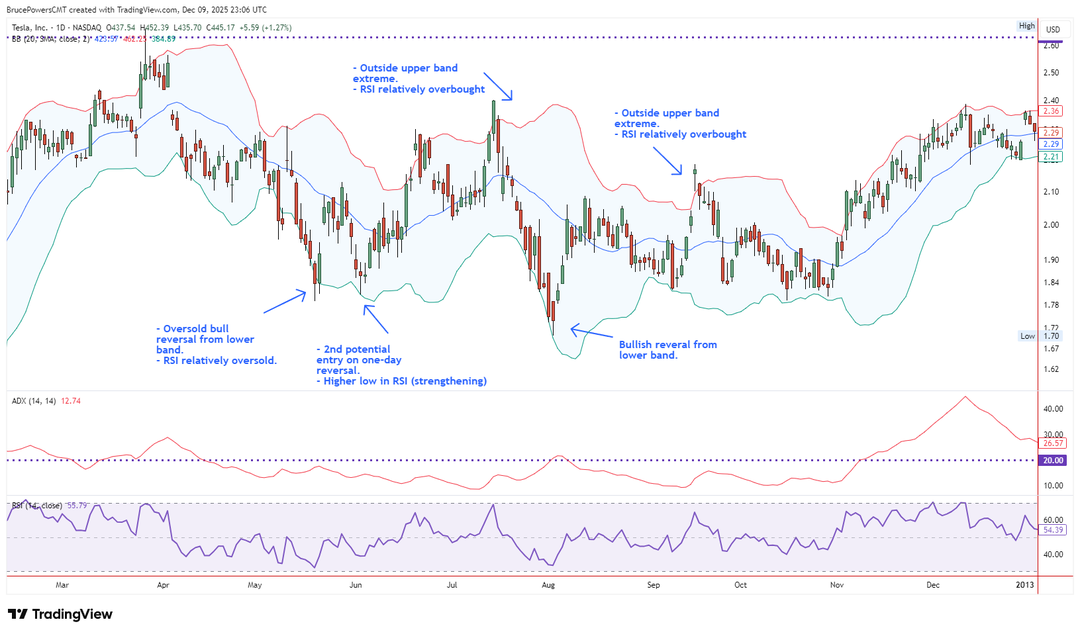
Daily Chart — Tesla, Inc. (TSLA) — Mean-reversion setups in a range-bound environment.
Strategy D: W-Bottoms and M-Tops — John Bollinger’s Signature Patterns
These are Bollinger’s own favorite patterns, and for good reason:
Bullish W-Bottom: Price tags or touches the lower band twice. The second low is higher and forms while BandWidth is narrowing or the lower band itself is rising—a strong mean-reversion buy signal.
Bearish M-Top: Mirror image at the upper band. Two touches, second touch weaker, bands narrowing from above. Confirm with divergence or a declining volume trend on the second touch.
These patterns work beautifully when the broader context supports them.
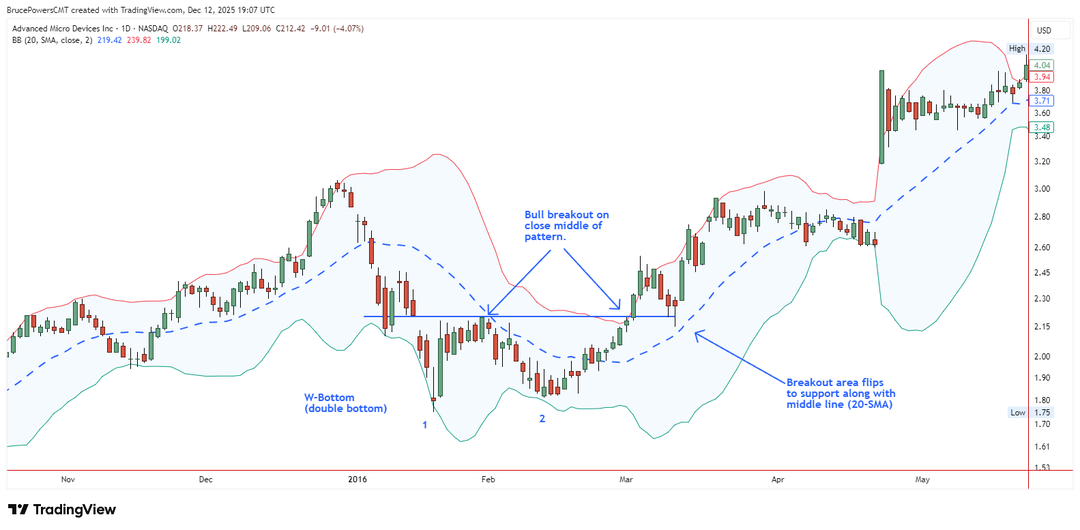
Daily Chart — Advanced Micro Devices, Inc. (AMD) — W-Bottom formation with higher second low.
Bottom line: These four strategies can be applied across stocks, forex, and crypto—as long as the volatility regime matches. Master one for each regime and Bollinger Bands become a genuine edge in your toolkit.
Best Practices and the Five Mistakes That Cost Real Money
The fastest way to lose money with Bollinger Bands is to use them incorrectly. Here are the five most common—and most expensive—mistakes I see traders make:
1. Buying the lower band or shorting the upper band in isolation. Most of the time, this is noise, not a signal. Without regime context, a band tag means almost nothing.
2. Using default (20, 2) settings religiously. On weekly charts or low-volatility forex pairs, a 50-period lookback with 2.1 standard deviations may work better. Test your market. The defaults are a starting point, not gospel.
3. Trading every squeeze. About half of squeezes fail or produce tiny moves. Two filters that dramatically improve quality: (a) bands must be inside Keltner Channels, and (b) wait for the first strong expansion bar on above-average volume.
4. Placing stops too tight during expansion. Volatility just exploded—your stop needs room to breathe, or you’ll be shaken out on the first perfectly normal pullback.
5. Ignoring the larger trend. A squeeze inside a massive higher-timeframe downtrend is usually a bear-trap continuation. An initial upside breakout may trap buyers before the dominant downtrend resumes. Always check the bigger picture.
One golden rule beats everything else: context is king. A band tag in a strong bull market is support. The exact same tag in a bear market is resistance. Don’t fight the larger trend.
Managing Risk & Understanding the Mindset of Volatility Trading
Volatility is a two-sided beast—it provides opportunity and it provides risk. Here’s how to stay on the right side of the trade:
Position Sizing
In a squeeze, you may choose to take 1.5 to 2× normal size—risk is condensed, your risk per share is lower. In expansion, take normal or smaller size.
Stop Placement
Never place a stop at the band level. In expansion, place it just below the lower band (or above the upper band) by 0.5 to 1.0 ATR. In mean-reversion trades, just outside the band you tagged. Your stop should give the trade some breathing room.
The Most Important Question of All
Before every trade, ask yourself this question: “What Volatility Regime are we currently in?”
If you are in a squeeze—sit back and wait for the trigger. Expansion—allow the trade to breathe, and avoid the temptation to take profits too early. Overextended—lighten up or consider reversing the trade. Choppy—take small size, scalp the trade, and accept that the reward is smaller here.
Conclusion — and What’s Coming Next
Bollinger Bands are not a holy grail. They are a lens of volatility—a way to define the current market condition so that you can apply the right strategy at the right time. By classifying the market into 4 phases—Squeeze, Expansion, Overextension, and Mean Reversion—you are no longer trading blind. You have a statistical model that works for all asset classes, including equities, commodities, forex, and cryptocurrency.
Quick recap of the model:
Low Volatility (Squeeze): Consolidation in progress. Expecting breakout. Wait for direction to be confirmed.
High Volatility (Expansion): Price is riding the bands. Play the trend, and let your profits run.
Mean Reversion (Range-Bound): Price bouncing between the bands. Play both sides and fade the extremes.
By combining the regime with other confirming indicators such as ADX, RSI, volume, etc., you will have a regime-based trading methodology that adapts to the ever-changing market.
So here’s a question to leave you with: The next time you look at a chart, do you know what Volatility Regime you are looking at? If you do, you are already better than 90% of the traders out there. See you in the next article!