
Simple and Exponential Moving Averages
A Guide to Cutting Through the Noise, Finding Trends, and Catching Momentum
Have you ever stared at a price chart and felt like you were looking at static on a broken TV?
You’re not alone. Raw price action on any liquid market, stocks, forex, crypto, futures, can look like pure chaos. Every tick, every candle, every intraday spike screams for attention, and most of it is just noise. The question every trader eventually asks is: how do I see the signal underneath all of this?
That’s where moving averages come in. They’re arguably the most widely used tool in all of technical analysis, and for good reason. A well-chosen moving average strips away the chaos and reveals the underlying trend, the one thing that, over time, actually pays traders who position themselves correctly on the right side of it.
In this article, we’re going to break down exactly how simple and exponential moving averages work, why they matter, and, most importantly, how to actually use them in real trading setups. No fluff. No over-optimization rabbit holes. Just the stuff that works.

So What Exactly Is a Moving Average?
At its core, a moving average (MA) is just a line on your chart that shows the average price of a security over a chosen number of periods—say 20, 50, or 200 bars. Each new bar, the oldest price drops off and the newest one gets added, so the average “moves” with price.
Why does that matter? Because it filters out the short-term noise and highlights the direction of the market. Instead of reacting to every minor fluctuation, you can glance at a moving average and quickly assess: is this market trending up, trending down, or going nowhere?
Now, there are two types of moving averages that you need to know:
The Simple Moving Average (SMA)
The SMA is the straightforward one. It takes the closing prices over your chosen period, adds them up, and divides by the number of periods. A 50-day SMA? That’s just the average of the last 50 daily closes. Every price point gets equal weight. Clean, simple, and predictable.
If you’re a math geek, here’s the actual math behind it:
SMA = (P₁ + P₂ + … + Pₙ) / n
The Exponential Moving Average (EMA)
The EMA is the SMA’s faster cousin. It applies more weight to recent prices, so it reacts quicker to new information. That responsiveness is a double-edged sword—you’ll catch emerging trends earlier, but you’ll also get more whipsaws in choppy, range-bound markets.
Its formula is a little bit fancier:
EMAₜ = (Priceₜ × k) + (EMAₜ₋₁ × (1 − k)), where k = 2 / (n + 1)
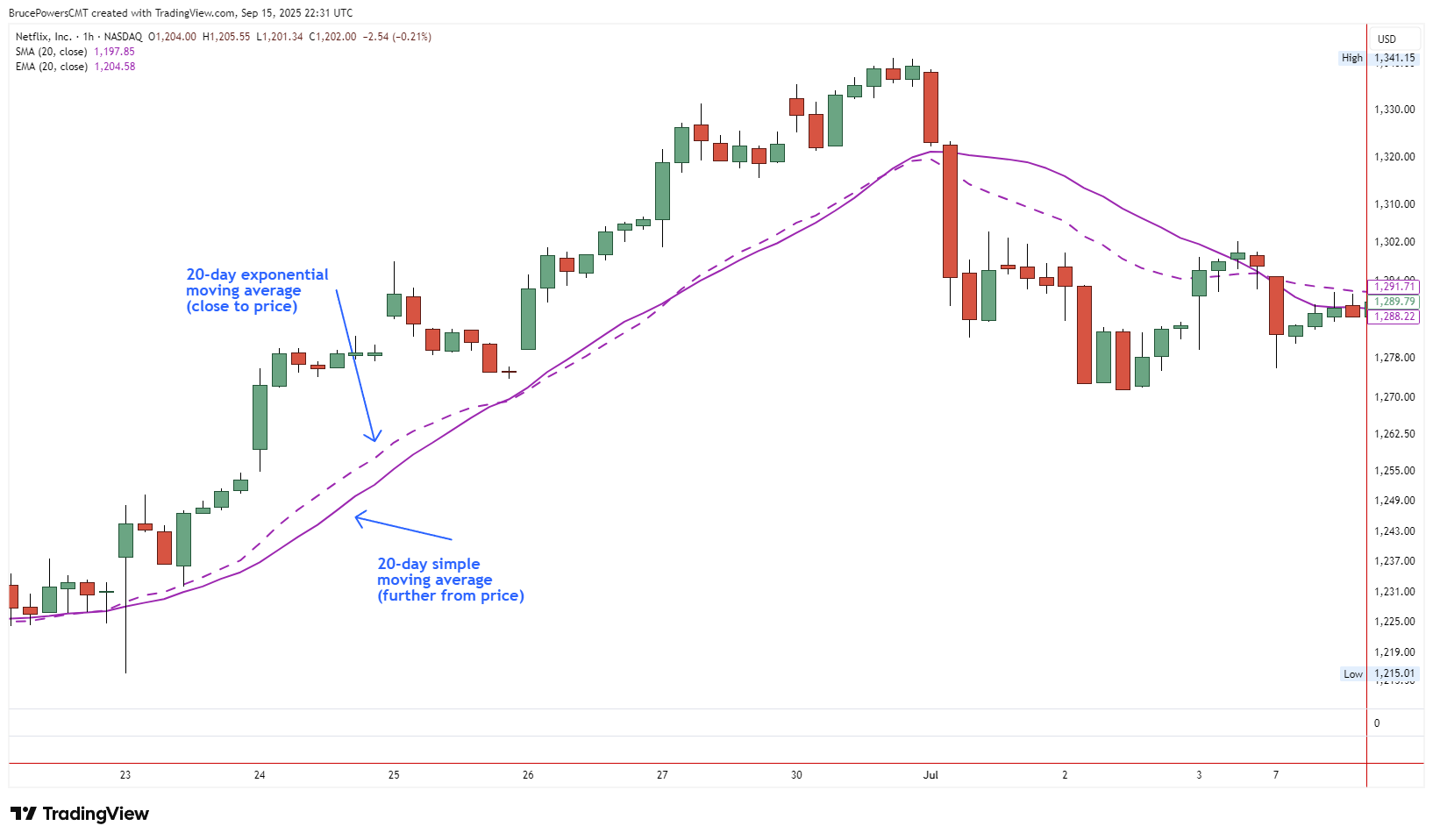
Simple vs. Exponential 20-Day Moving Averages — notice how the EMA hugs price more tightly.
So Which Moving Average Should You Use?
Simple Moving Averages vs. Exponential Moving Averages
Think of it this way. You’re driving on a winding, pothole-filled road. The SMA is like a broad, sturdy bridge—it smooths out the bumps beautifully, but it turns slowly. You might not feel that sharp curve until you’re already past it.
The EMA is like a sports car. You’ll feel every bump, every turn, but you’ll also be more agile and responsive. You can hug those turns tightly and speed through the straightaways. The EMA is like a road that follows every curve in the road. You feel every bump, but you feel every bump. Which is better? Well, neither really. They’re just different, and you have to choose what works for you and how sensitive you want your trading to be.
Identifying Trends with Moving Averages
Moving averages don’t predict anything. They just tell you what’s going on. And that information can be very valuable when understood properly. Here’s the basic idea:
If the moving average is going up and the price is above it, we’re in an uptrend. There’s enough buying pressure to keep pushing that average up. This is when you should be looking for long setups.
If the moving average is going down and the price is below it, we’re in a downtrend. There’s enough selling pressure to keep pushing that average down. This might be a good time to look at short setups or hunker down and be defensive.
If the moving average is flat and the price is dancing around it, we’re in a sideways market. This is usually a bad place to be if you’re a trend-follower. If you can, just get out.
Moving Averages as Support and Resistance
One of the most useful things about moving averages is that they provide a kind of dynamic support and resistance. They’re like a floor or a ceiling that moves as the price moves. In an uptrend, a moving average will often provide a level where the price falls and then bounces. In a downtrend, a moving average will often provide a level where the price rises and then fails. Many people like to watch the 50-day and 200-day SMAs for this. If you’re above a rising 50-day SMA, that’s bullish. If you’re below a falling 50-day SMA, that’s bearish. Some people like to watch the 20-day SMA and play it the same way.
For example: let’s say you’ve got a stock that’s steadily above a rising 50-day SMA. Every time it dips down to the moving average, it finds support and bounces. That’s what you like to see in an uptrend! Now let’s say you’ve got a stock that’s below a falling 50-day SMA. It keeps coming up to the moving average and bouncing off. That’s what you like to see in a downtrend! It’s useful to know which side of the moving average you’re on.
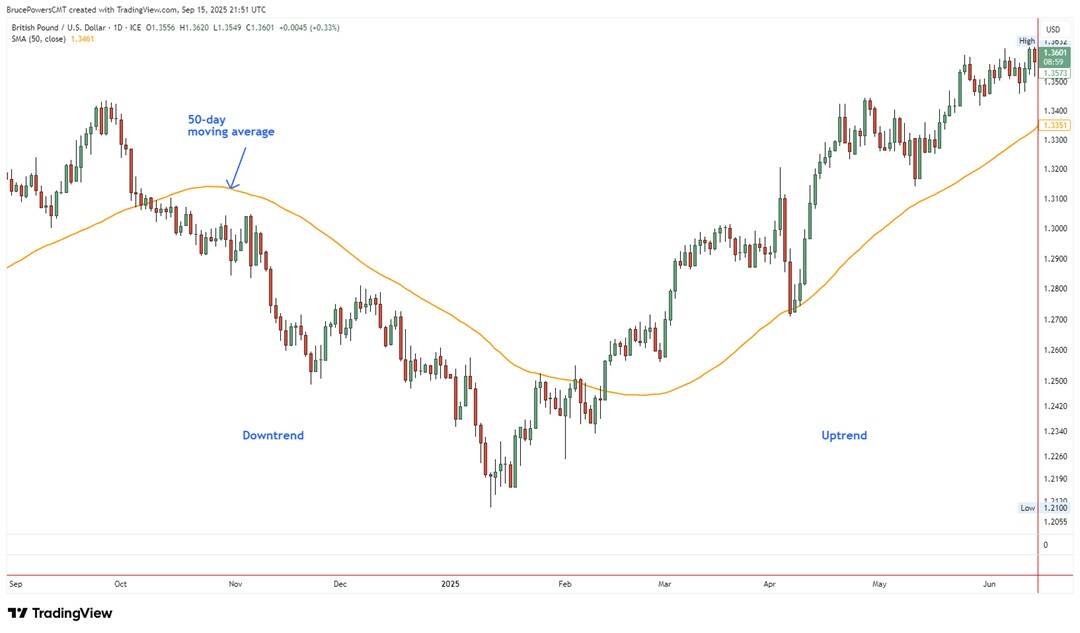
Price respecting the 50-day SMA as support in an uptrend and resistance in a downtrend.
Lag as a Feature
Moving averages are often criticized for being “lagging indicators”. And you know what? They are! But that’s not always a bad thing. In fact, it’s often a good thing. The reason is that the “lag” filters out a lot of the noise. It filters out all the fakeouts and spikes and intraday nonsense that can nail a nervous trader. By the time the moving average has actually turned around, you know you’ve got something real. You’re not just whipsawing back and forth on every twitch and rumor.
Of course, you can always shorten the length of your moving average if you want to be more responsive. If you want to filter out even more noise, you can lengthen the average. The point is just to be aware of it, and to choose the right tool for the job.
Multiple Time Frame Analysis: The Magic
A SMA on one time frame is fine and dandy, but it becomes far more valuable when you also start considering a second time frame. If there’s a 50 period SMA signal on the daily chart but there’s also a 200 period SMA signal on the weekly chart, that’s when things start getting interesting.
For example, if the weekly 200 period SMA is higher and price is above it, and the daily 50 period SMA is also higher and price is above it, that’s a higher probability signal. Because the longer-term trend is bullish and the medium term trend is also bullish, they’re both in agreement.
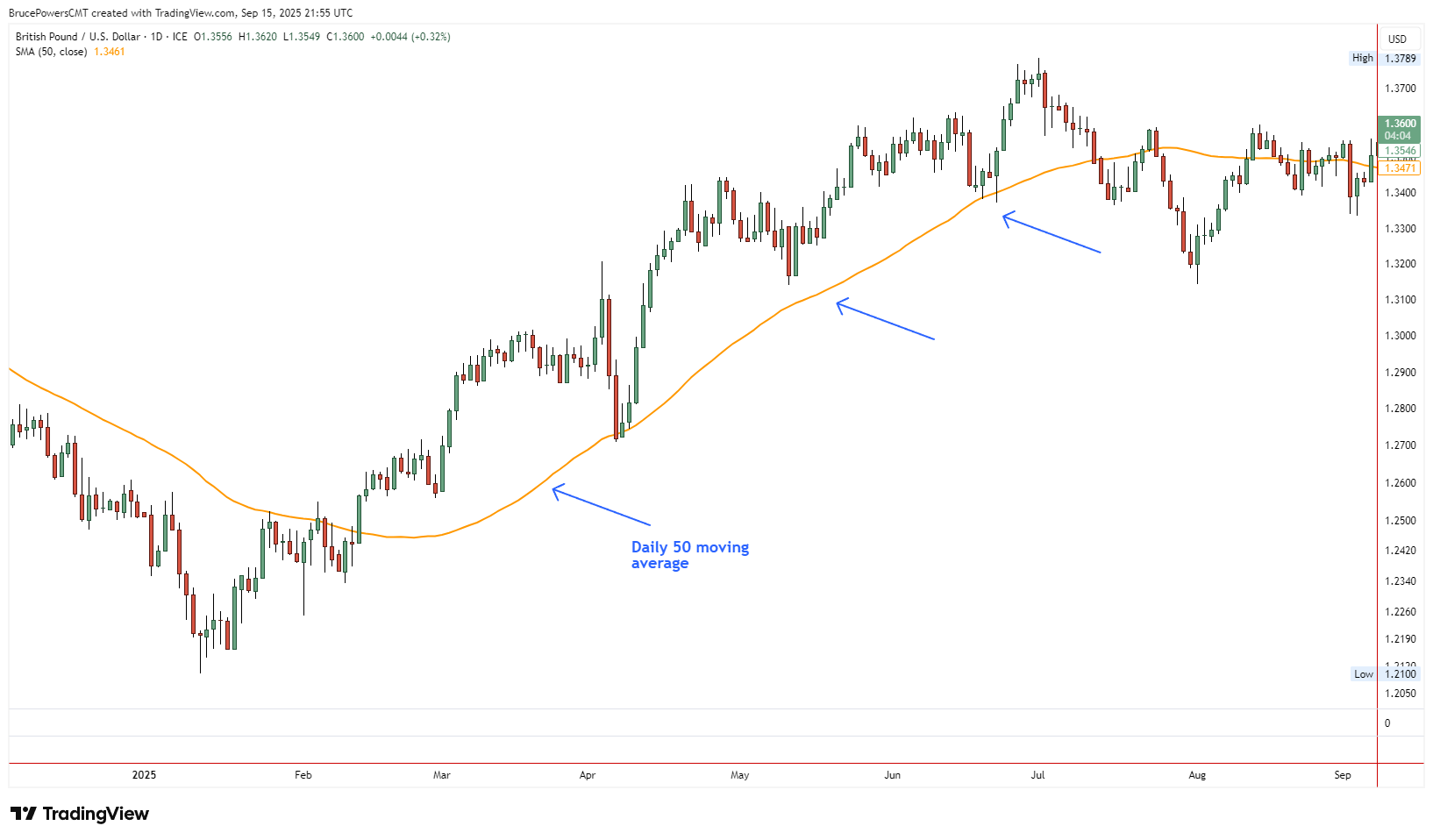
Daily GBP/USD — 50-day and 200-day SMAs defining trend structure.
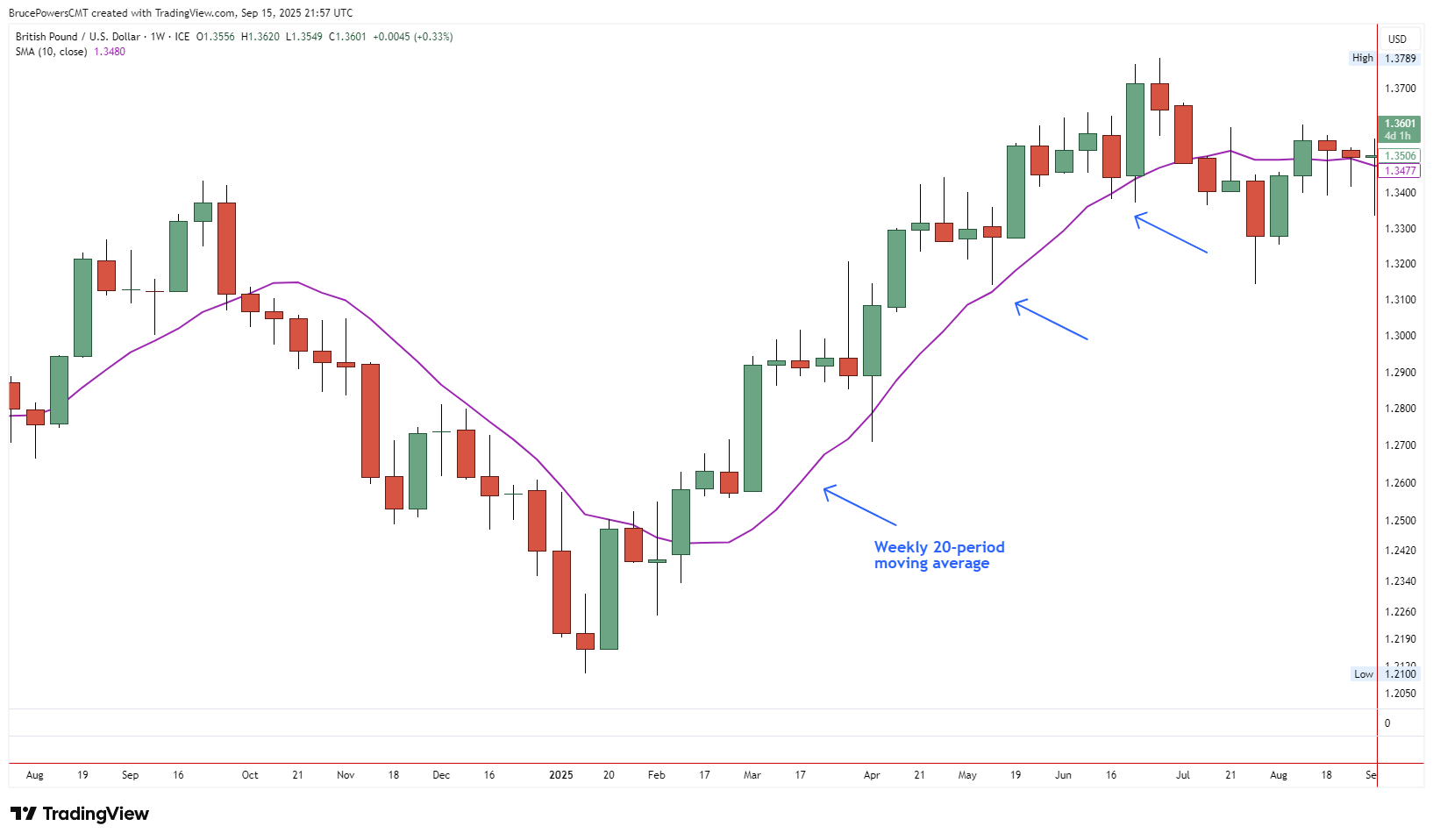
Weekly GBP/USD — the same moving averages on a higher time frame confirm the daily chart.
Interesting how the 50 period SMA and 200 period SMA tend to line up on the same support and resistance levels, just on a different resolution?
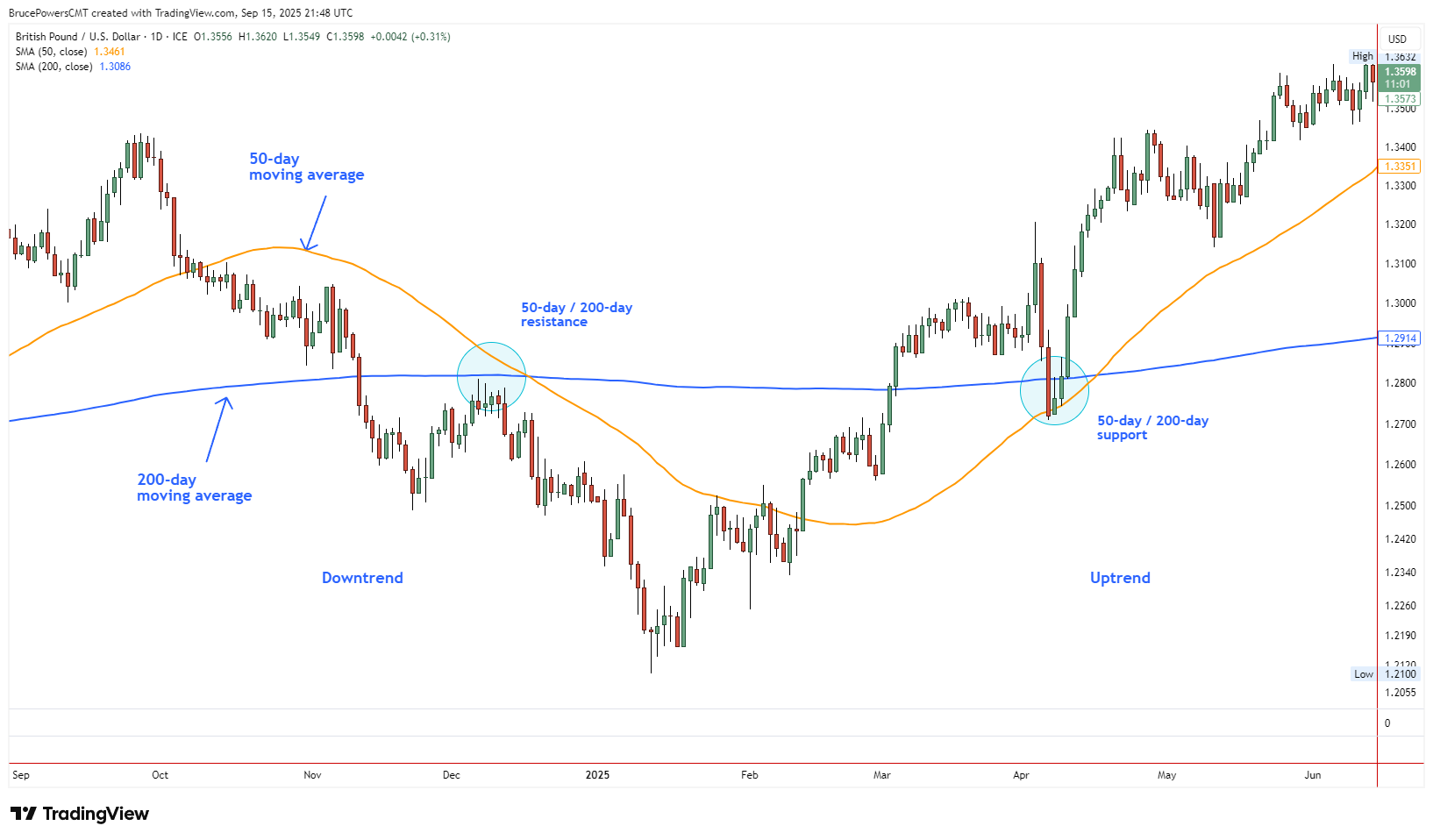
50-period and 200-period SMA: Support and resistance levels on different scales.
When price breaks or bounces off support and resistance levels on multiple time frames, you can bet that this is going to be a big level.
Practical Applications: 4 Main Uses
The SMA is a very versatile indicator, it can be used in all markets and on all time frames, stocks, ETF’s, forex, futures and cryptocurrencies. Here are the main four ways of using moving averages in trading:
1. Dynamic Support and Resistance
We already spoke about how the moving averages can be used as support and resistance levels. They’re called dynamic support and resistance because the moving averages are changing all the time as new price data is coming in.
In an uptrend, the 20 period SMA or the 50 period SMA is acting as a buy the dip type level. In a downtrend, the moving averages are acting as sell the rally type levels, levels where the price will rally to and then fail.
For example, you can see that in a strong uptrend, the 20 day SMA in Caterpillar (CAT) stock is acting as a buy the dip level. Every time the price touches the moving average, buyers are stepping in and the price is going back up. Later on, after a deeper correction, the price touches the 50 day SMA and bounces from there, which tells us that the trend is still intact, just on a deeper level.
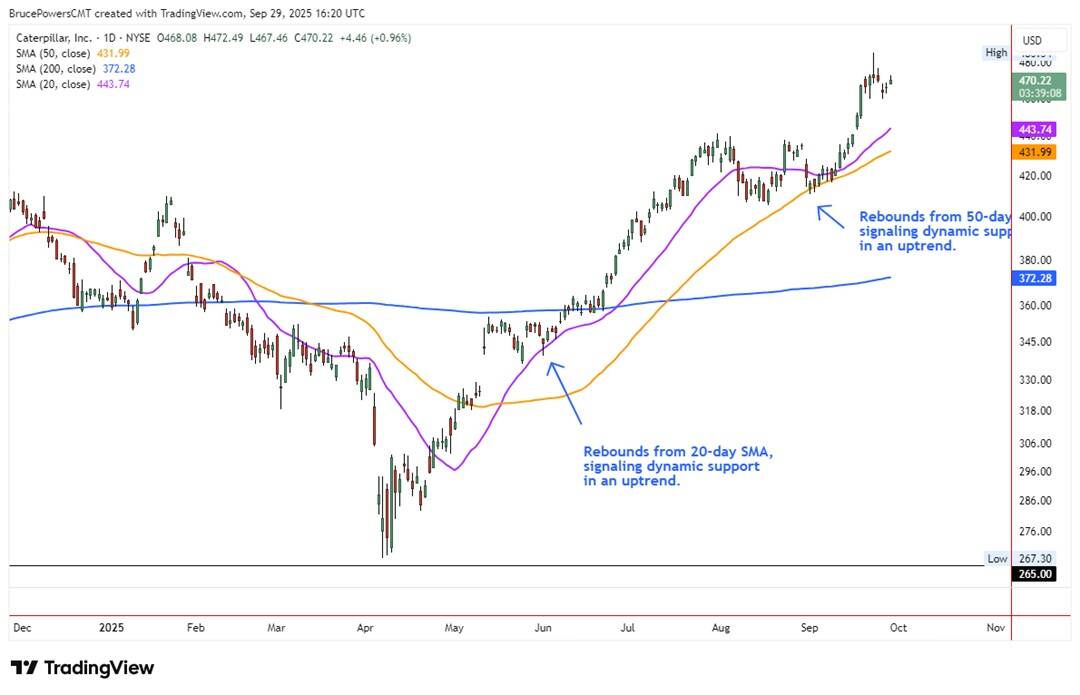
Daily Chart — Caterpillar (CAT): 20-day and 50-day SMA acting as dynamic support.
2. Moving Average Crossovers
This is probably the most common way of using moving averages, when the fast moving average crosses over the slow moving average. The idea is simple, if the fast moving average crosses above the slow moving average, it’s a bullish signal. If the fast moving average crosses below the slow moving average, it’s a bearish signal.
The most common example of this is the Golden Cross where the 50 day SMA crosses above the 200 day SMA. It’s considered a long term bullish signal. The opposite, the Death Cross where the 50 day SMA crosses below the 200 day SMA is considered a long term bearish signal.
For shorter term traders, a common moving average crossover strategy is the 20 period and the 50 period Exponential Moving Average (EMA). When using a crossover system, always consider the big picture.
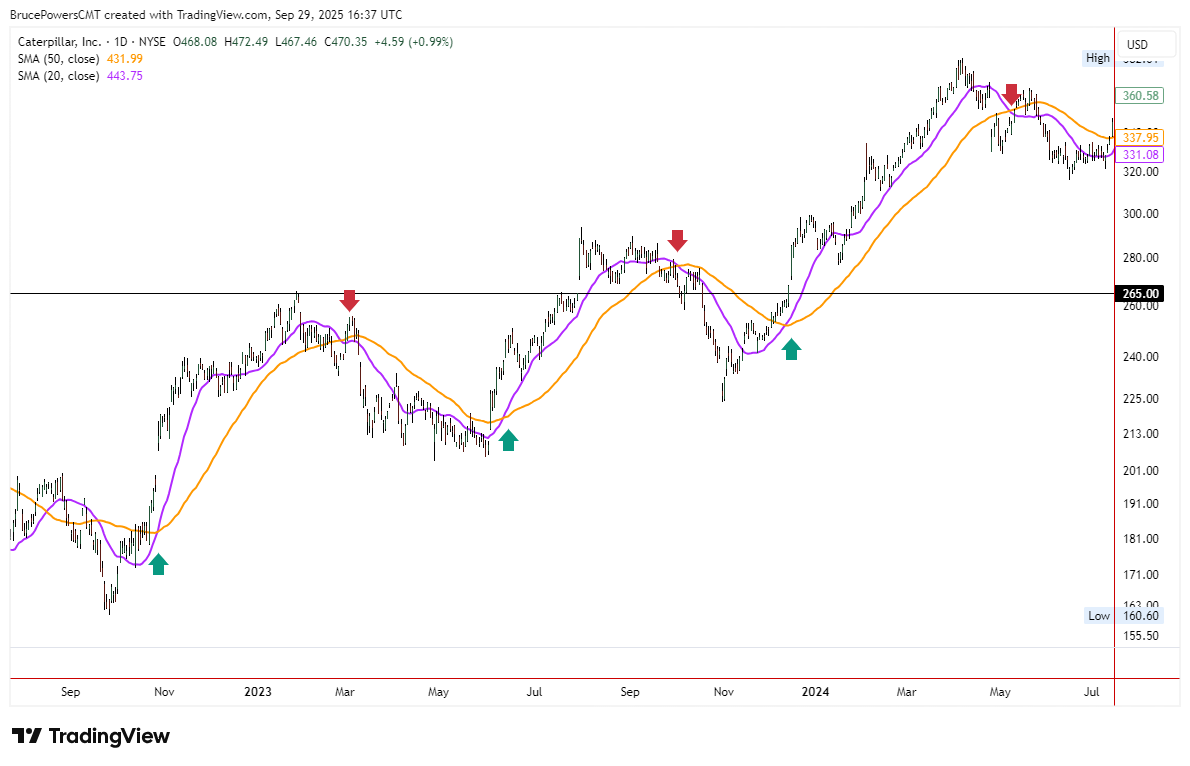
Daily Chart — Caterpillar (CAT): 20/50 SMA crossover signals indicated with arrows.
3. Confirming the Trend
A moving average also helps you decide whether price action signals the continuation of a trend. Three factors are involved in confirming the trend:
Price must be above the moving average for an uptrend, and below for a downtrend. The moving average should have an upward slope (for an uptrend) or a downward slope (for a downtrend). A short-term moving average should be above a longer-term moving average for an uptrend, and below for a downtrend.
On a 2-hour chart of Arista Networks (ANET), price may slice through the 20-period moving average, which fails to hold as support during sharp rallies. However, the price pulls back to, and bounces off, the 50-period and 200-period moving averages, which remain in a rising trajectory. The uptrend is intact, even though the shortest-term moving average proves to be too sensitive to define support in this case.
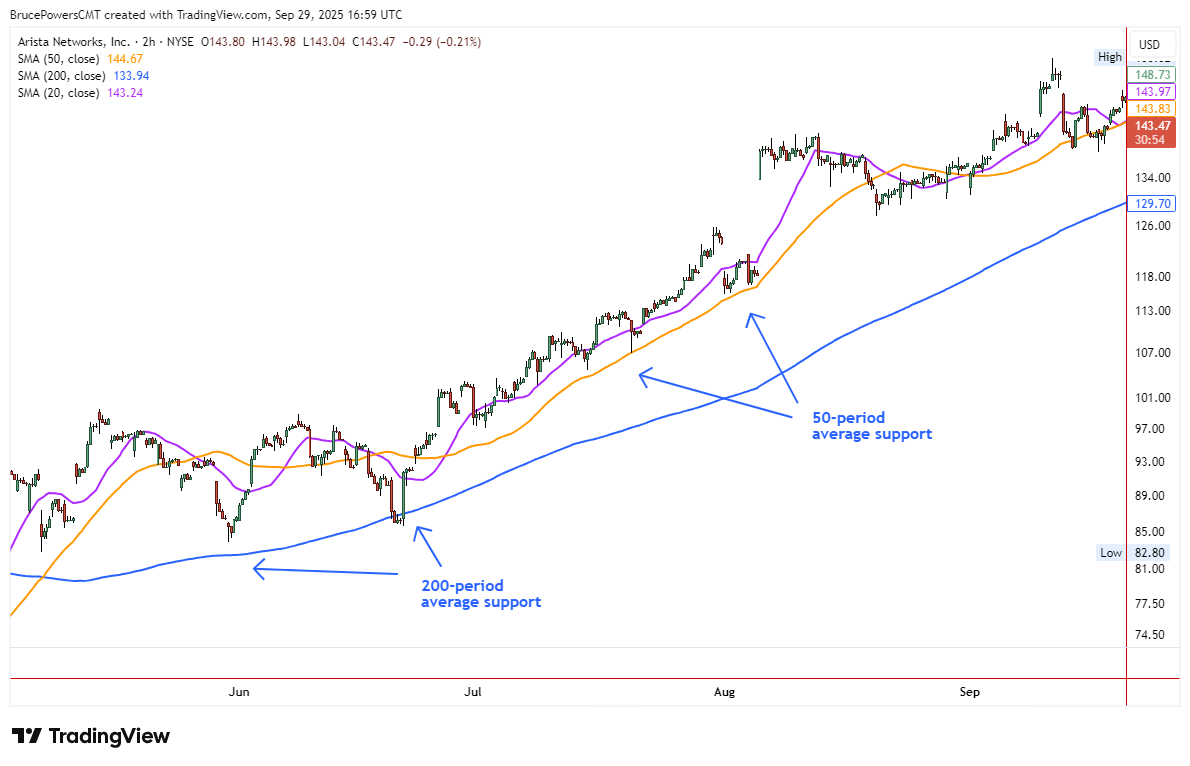
2-Hour Chart — Arista Networks (ANET): 50 and 200-period moving averages confirm the uptrend.
4. Identifying Breakouts
Moving averages can also help you identify breakouts, particularly when used in conjunction with chart patterns and volume. A move above a key moving average after a period of sideways movement can signal that buyers are in control and that an uptrend is underway. A move below a key moving average can signal that the bears are in control and that a deeper pullback or trend reversal is underway.
For instance, in the following chart SOLUSD is trading below a flattish 20-period EMA on the 2-hour chart for several days while price compresses into a narrowing range. A powerful bullish candle violates the 20 EMA decisively, and remains above the EMA on pullbacks. That’s a breakout, and the 20 EMA now serves as dynamic support in the new uptrend.
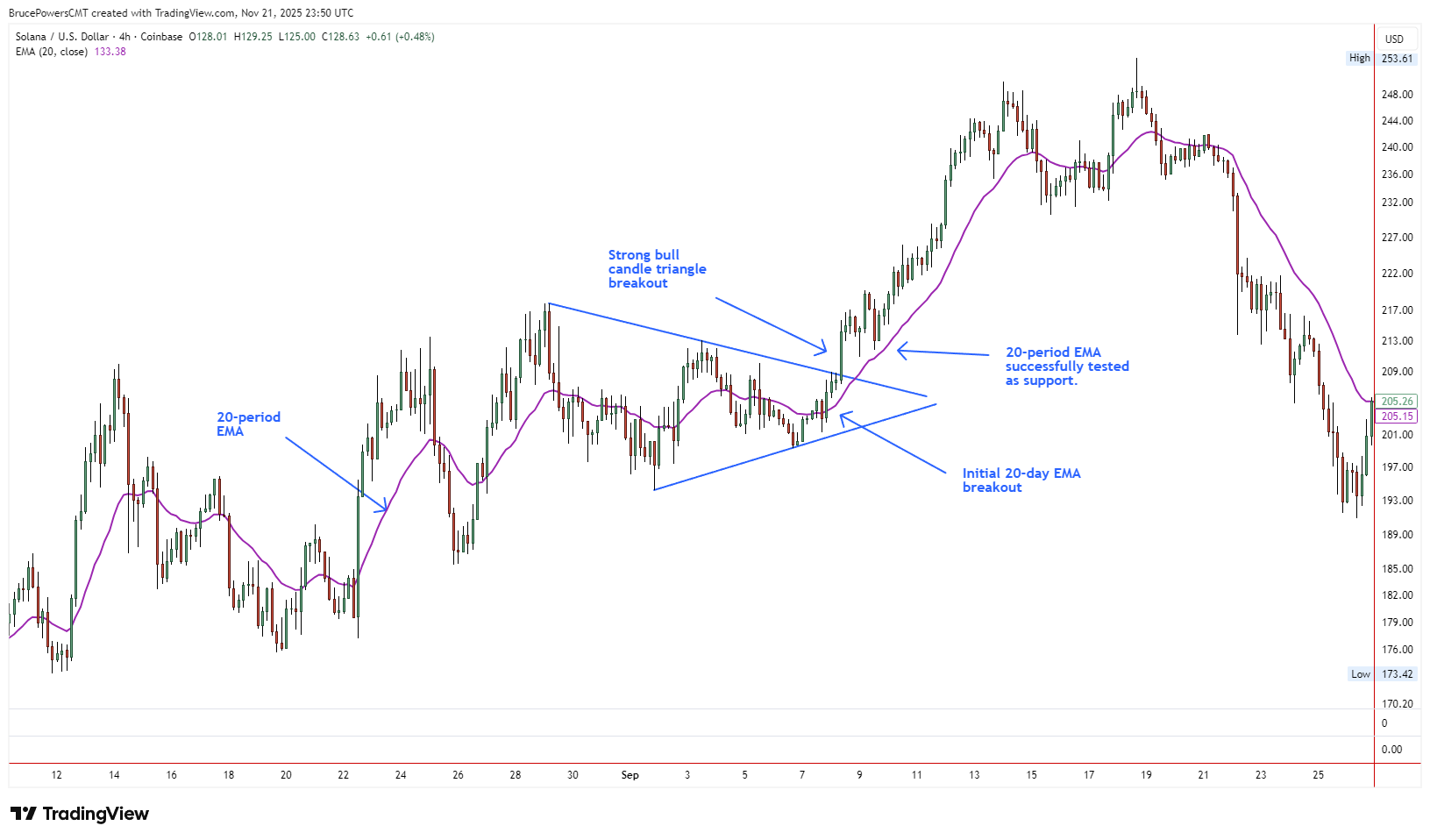
2-Hour Chart — SOLUSD: Price violates the 20-period EMA and breaks out into a new uptrend.
New Trader Tip: If you’re new to trading, experiment with moving averages in a demo account. Observe how price interacts with moving averages on various time frames and instruments before risking money.
Two Trading Strategies to Try Now
Now that you understand the basics of moving averages, here are two trading strategies you can use today.
Strategy #1: The 8/20 Moving Average Crossover
In this strategy, a shorter-term 8-period moving average crosses above a longer-term 20-period moving average, signaling short-term momentum.
The strategy: Establish a trend bias using a higher time frame, or using a long-term moving average. Then look for crossovers of the 8-period and 20-period moving averages on your trading time frame.
Long setup: When the 8-period moving average crosses above the 20-period moving average, consider a long position if price is above a higher time frame moving average (daily 50 or 200) and if the overall trend is bullish. Enter the position on confirmation: when price breaks above the high of the crossover candle, or when price touches the moving averages and holds.
Short: The 8-period SMA must cross under the 20-period SMA. The price should already be under a higher time frame moving average, and the overall trend should be to the downside. The entry is a confirmation of the moving average crossover. This is a break of the low of the crossover candle or a failed test of that low. The stop will be placed just above the most recent swing high or low or just above the cluster of the moving averages. This stop can be trailed by moving averages, swing highs and lows or multiples of the ATR as the trade progresses in your favor.
Example: The iShares Russell 2000 ETF (IWM) on November 3, 2025 broke under a long-term up trend line and closed under the 20-period SMA. This was a clue that the bears were in control. A few days later, the 8-period SMA crossed under the 20-period SMA for the first time since August 2025. This was the first indication that the momentum in the market had shifted to the downside. The short entry was made under the low of the day at 241.64. The stop was placed just above the high of the day and just above the moving averages.
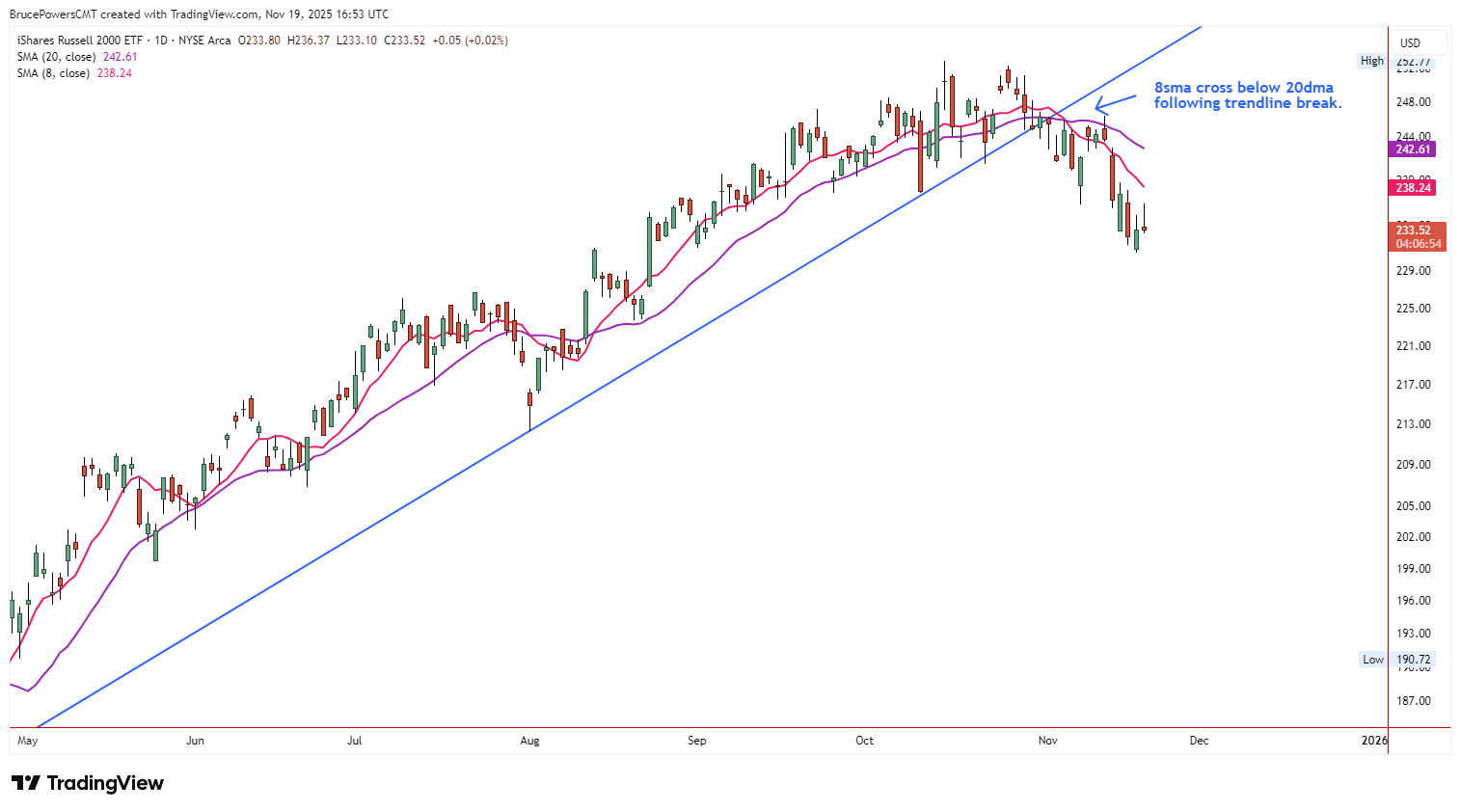
Daily Chart — IWM: The 8/20 moving average cross that put the momentum in favor of the bears.
Strategy #2: Pullback to the 20-Day Moving Average
This is a trend continuation strategy. The goal is to enter trends on the first or second pull back to the 20-day moving average after a stock has broken out above or below the moving average. This is one of the best strategies for new traders.
What you are looking for is a stock that has broken out above the 20-day moving average after a period of consolidation or a pull back. The first or second pull back to the moving average should result in the price holding at or very near the moving average. The same is true for a breakdown. Once the stock has broken under the 20-day moving average, the first or second rally back to the moving average should stall at or very near the moving average.
Long: A stock has broken out above the 20-day moving average after a period of consolidation or a pull back. The price has then pulled back to the area of the 20-day moving average. You want to see the price hold in this area. This can be in the form of a bull candle or a higher low. Volume can also be used to confirm the strength of the pull back. Once you see the price has held and is turning back higher, you can enter long. The stop will be placed under the low of the pull back or just under the 20-day moving average.
Short: A stock has broken under the 20-day moving average after a consolidation or a rally. The price then rallies back to the area of the 20-day moving average. The price should stall at or near the moving average. This can be in the form of a bear candle or a lower high. Once you see the price has stalled and is turning back lower, you can enter short. The stop will be placed above the high of the pull back or just above the 20-day moving average. The targets will be determined by the prior highs and lows in the market as well as measured moves. The stop can be trailed by moving averages, swing highs and lows or multiples of the ATR.
Example: On March 17, 2025 the stock Advanced Micro Devices (AMD) closed back above its 20-day moving average after spending time under it. This was a sign to the bulls that the stock may be returning to their control. The price then pulled back and briefly traded under the 20-day moving average. Later in April, AMD closed back above the 20-day moving average. The stock then had a one day pull back that held just above the moving average. A break above 97.55 would complete the reversal pattern. The risk was the 20-day moving average.
There are a few things to watch out for when using moving averages this way. The first is failed breakouts. Sometimes price will pop above the moving average but fail to hold its gains. It closes below the MA and heads lower. You can filter some of these out by demanding strong follow through and confirmation from volume. You can also keep your stop close, just below the moving average. With practice, you’ll get a feel for which breakouts are likely to succeed and which aren’t.
On May 30, AMD again found support near the 20-day SMA, and a five-day high breakout above 115.54 resumed the uptrend.
Risk: Failed breakouts. Price reclaims the 20-day SMA briefly but then rolls back below and continues lower. Manage this by requiring strong follow-through, looking for confirming volume, and keeping stops tight.
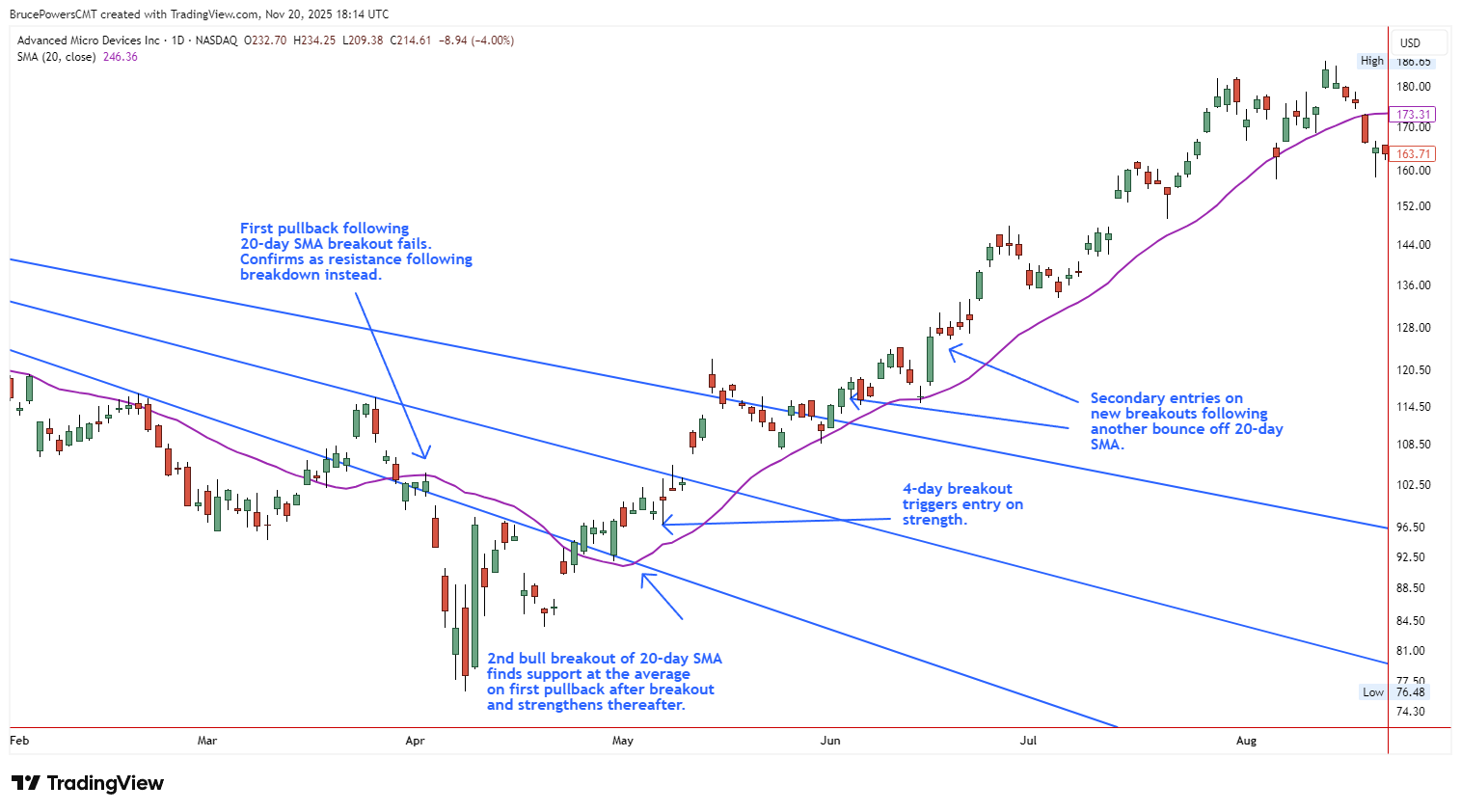
Daily Chart — AMD: Pullback entries to the 20-day SMA in a developing uptrend.
Pitfalls to Watch For (And How to Stay Out of Trouble)
Moving averages are powerful, but they’re not magic. Here are the traps I see traders fall into most often:
Lag blindness. A 200-day SMA is great for defining the long-term trend, but it will absolutely miss fast reversals. Know the trade-off of the period you’re using.
Over-optimization. Don’t spend hours curve-fitting the “perfect” MA length for one particular stock. Stick with the standards, 20, 50, 200, across all your instruments. Keep it simple. The edge isn’t in the magic number; it’s in consistent application and disciplined risk management.
Over-reliance. Moving averages are one tool in a larger toolkit. If you’re ignoring price action, volume, and market structure because a moving average “says” to buy, you’re going to have a bad time. Context is everything.
News blindness. Major economic releases, earnings surprises, and geopolitical events can send price rocketing through moving averages like they’re not even there. Always check the economic calendar and know when high-impact events are scheduled.
What works: Use a 20-day EMA (or wait for a second confirming candle) to counter lag. Stick to the 20, 50, 200 framework. Pair MAs with price action and volume. Require agreement across at least two timeframes before taking a trade. That last one alone will filter out a huge number of false signals.
The Bottom Line
Moving averages aren’t sexy. They’re not the newest AI-powered indicator or the hot quant strategy everyone’s talking about on social media. They’re a straightforward, well-understood tool that has stood the test of time across every market, every asset class, and every timeframe.
Here’s what I’d recommend if you’re putting this into practice: Start with a small set of core averages, 20, 50, and 200, across your preferred markets. Test the 8/20 SMA crossover and the 20-day SMA pullback strategy on a demo account. Add confirming tools like price action and volume before committing real capital. And give it time—consistent observation and practice with moving averages will improve both your chart reading and your overall trading decisions.
The traders who do well with MAs aren’t the ones who found the “perfect” setting. They’re the ones who learned to read the context, respect the trend, manage their risk, and stay disciplined when the market gets noisy.