The Iran war is likely to feature prominently in the meeting of the ECB Governing Council this week. However, the ECB will feel it is flying comparatively blind presently as updated ECB staff projections are likely to have only partially reflected effects of the Iran war at this stage.
The cut-off date for ECB projections being normally three weeks before a given meeting ought to reduce the reflection of the war on updated staff projections due this week. The ECB is likely to reference that the projections are subject to greater unknowns given the recency of the energy crisis and associated economic uncertainty.
No Policy Action Likely at This Week’s Rate-setting Gathering
No policy action is likely at the meeting from 18-19 March although the ECB is seen referencing how central the role of the Iran war is to near-term decision making. The surge in oil prices brings back unwanted memories of the 2022 energy price shock after Russia’s invasion of Ukraine. Because ECB policy makers were late in their responses then during the ensuing cost-of-living crisis, they are likely to be on greater alert today to not react late again and let the inflation genie back out of the bottle.
A recent Bloomberg survey I participated on concluded only 7% of respondents expect a rate hike by December of this year and less than a third expect any tightening by the end of next year. That puts the majority of panelled economists at odds with the capital markets, which now price around two 25bp rate hikes by year-end 2026. Whereas there may have been an element of a “wait-and-see” mode from many policy makers until recently, Brent crude now having returned above $100 a barrel (Figure 1) may have changed any lingering mentality of complacency.
Figure 1. Oil prices trading around $100 a barrel
Brent spot price, free on board, $ per barrel
EUR/USD Price Forecast
Every new EUR/USD analysis as it publishes, today's technical signal and key levels, live price — on one page.
See all EUR/USD forecasts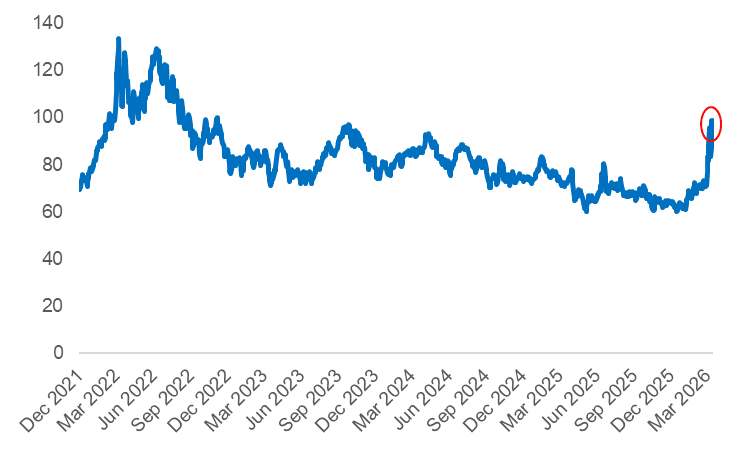
Inflation Risks Leaning to the Upside
At the same time, the war is only several weeks old at this stage and policy makers are rightfully keen to avoid any knee-jerk policy responses to present heightened uncertainty – especially given how such conflicts have in the past de-escalated as abruptly as they first escalated. Nevertheless, this latest war does appear different from the past short conflicts between the US, Israel and Iran, with the partial closure of the Strait of Hormuz – through which previously around 20% of global oil supply and significant volumes of liquefied natural gas had passed – marking the trump card threatening a much lengthier conflict than the four to five weeks hoped for by the US President or even the up to six weeks recently postulated by the US Department of War.
If the hot war were to ease as hoped inside the forthcoming weeks, the economic effects for the euro area would stay comparatively modest and no policy response from the central bank may be needed. Conversely, any prolonged war would risk fundamentally shifting the outlook for inflation.
Inflation risks lean at this stage in a direction of an overshoot of the euro area’s 2% price-stability target rather than an undershoot. Just when too-high inflation had appeared defeated with the pace of price rises settling around 2%, inflation could easily once more temporarily exceed 3%, or even surpass 4% if Brent crude prices stay above $100 a barrel for any period. Before the war, inflation risks for the region had become roughly balanced.
Policy Makers Are Probably Concerned About the Region’s Recovery
Policy makers are probably concerned about the euro area recovery. Recent experiences during the cost-of-living crisis speak to how exposed the euro area economy remains to energy and supply-side crises as a meaningful net energy importer. Any prolonged energy shock would place further upside pressures on financing rates and stress financial conditions. Under an adverse scenario, real growth this year for the euro area could slow by several tenths of 1% if instability within the broader Middle East were to stay heightened.
Finally – renewed inflation and recovery risk – if prolonged – may test the early succession plans for ECB President Christine Lagarde. Any hopes of an exit of Lagarde before the 2027 French elections would need to rest on an easing of geopolitical uncertainty and a more accommodating economic ecosystem.
Dennis Y. Shen is a macroeconomist and recently named top 73 economist globally. He is a lecturer in finance at the International School of Management (Germany) and serves as a Member of the Supervisory Board of Visioneers gGmbH. He is a regular contributor for the London School of Economics.