The Federal Reserve is seen taking no action at its meeting concluding today, although the majority of the Federal Open Market Committee (FOMC) is probably going to continue pencilling at least one rate cut before year-end. Another round of dissent(s) at this meeting is probable, with such dissenter(s) again voting for a prompt 25bp rate cut.
The Iran war has changed the circumstance – with the associated stagflationary threat having the potential of testing the resilience of the American economy of the recent years. The markets scaled back Fed rate-cut bets as WTI crude neared $100 a barrel – providing some impetus to those Fed policy makers who have backed reflecting a two-sided description for future policy decisions within today’s policy statement. If such language were to be reflected, that could serve as a form of a slight insurance policy against near-term easing after the forthcoming change of Fed Chair and foreseen dovish shift.
At Least One Rate Cut in 2026 Continues to Appear Probable
But at least one rate cut this year continues to appear probable – even if such a cut may not necessarily appear justified. A recent poll of Bloomberg-panelled economists I participated on observed economists pushing back their expectations for the Federal Reserve’s next interest rate cut to June of this year from March, but still predict two quarter-point reductions by year-end.
The expectation of many economists of further easing recognises the vocal preferences for lowered rates of the incoming Fed Chairman Kevin Warsh, the repeated demand of President Donald Trump for a low-interest rate policy and the inertia for easing facing a majority of the FOMC who predicted at minimum one cut for this year previously. Legal cases against the outgoing Fed Chairman Jerome Powell as well as against Governor Lisa Cook underscore furthermore a current pressure campaign against FOMC participants having more hawkish opinions.
For Warsh to hold off the inevitable pressure from Trump after the former ascends to his new role, a rate cut before the November elections may appear like the price of doing business. Any such cut so close to the elections may inevitably amplify questions around Fed independence – especially if too-high inflation were to remain anything but resolved.
Those justifying any rate cut this year may again point to select signs of weaknesses within the US labour market – after a poor non-farm payrolls and slight rise of the unemployment rate last month. Such weaknesses are likely to be furthered by the consequences for household purchasing power from the higher energy costs. The same dovish policy makers might dismiss the inflationary effects of the Iran war as “transitory” – repeating the same mistake made by the central bank during recent commodity-price and supply shocks. The appreciation of the dollar may help their case by slightly lowering import pricing.
US Dollar Index Price Forecast
Every new US Dollar Index analysis as it publishes, today's technical signal and key levels, live price — on one page.
See all US Dollar Index forecastsRisks for Inflation Skewed to the Upside Presently
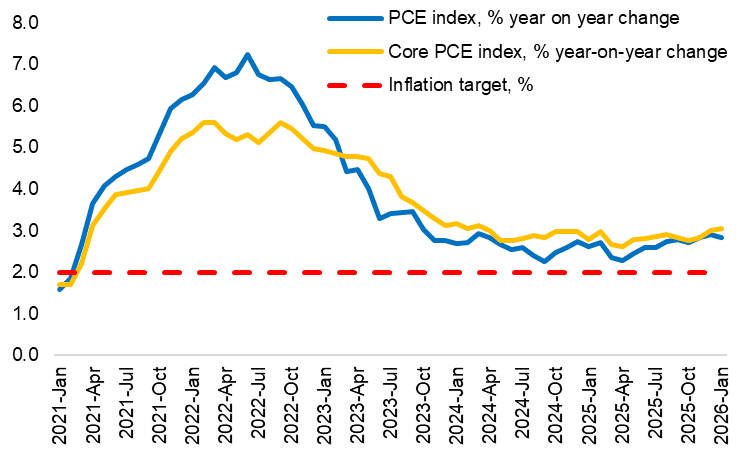
Once renewed rate reductions become a live possibility by at the earliest the June FOMC meeting (contingent on when Warsh is confirmed by the Senate), divisions inside the Fed are probable to widen further. Risks for inflation are skewed to the upside presently – as the higher energy and food prices, the pass-through of recently announced trade levies, a robust economy and fiscal stimulus raise prices. This will keep many FOMC participants hesitant to cut, as those officials call attention to the five years of above-target price rises at this stage (Figure 1) and already-existing questions around the central bank’s commitment to its inflation mandate.
Meanwhile, inflation doves will argue rather that further disinflation is on course thanks to decelerating price rises of housing and the fact that tariff effects for inflation may be fading, whereas trade and immigration policies continue to adversely affect the health of the US labour market.
Figure 1. US inflation has been above target for the past five years
US personal consumption expenditures (PCE) price index, % year-on-year change
Dennis Y. Shen is a macroeconomist and recently named top 73 economist globally. He is a lecturer in finance at the International School of Management (Germany) and serves as a Member of the Supervisory Board of Visioneers gGmbH. He is a regular contributor for the London School of Economics.