
Market Overview
WTI crude – it’s been bouncing around the $92 to $95 mark – with prices recently testing the $100 ceiling, and it’s all due to the ongoing mayhem in the Middle East keeping that precious geopolitical risk premium firmly in place in the energy markets.
There’s still tons of uncertainty floating around the Strait of Hormuz – which, incidentally, handles around 15 to 20% of the worlds oil, and that’s only serving to tighten up supply expectations even further. So, despite the rather sizeable 6.56 million barrel US inventory build, the market remains on high alert.
We’ve seen some relief from emergency reserve releases, but it’s not been enough to calm things down, and efforts to keep shipping lanes stable have only offered limited respite all in all. Natural Gas is pretty much following suit on the energy volatility front.
In the short term, you can bet those prices are going to stay pretty high, with supply headlines swinging the intraday mood into sharp relief.

Natural Gas Technical Analysis: Breakdown Below $2.996 Support Exposes $2.861 as Bearish Pressure Builds
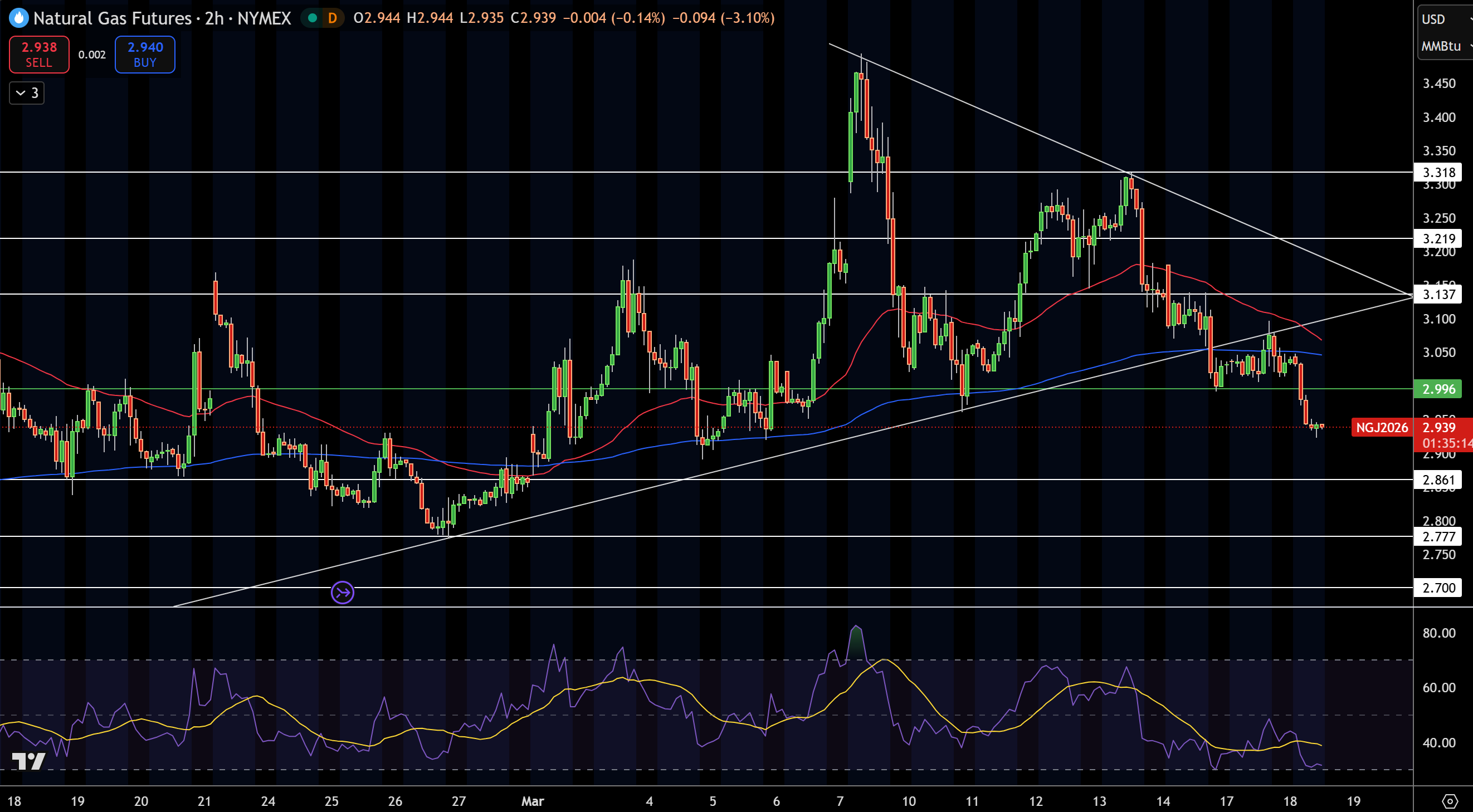
Natural Gas futures are trading at around $2.94 on the 2-hour chart and have just gone and broken below that key $2.996 support level and slipped under the 50- & 200-period moving averages. We’ve also got the ascending trendline that guided the recovery from the low at $2.75 and that’s been broken – which isn’t a good sign in terms of the overall structure.
Its now starting to look a lot like a descending triangle – with lower highs capped by trendline resistance around $3.13.
The RSI is lingering in the low 40s, which is a pretty clear indication that things are bearish. Not yet though – its not in oversold territory. So if we can keep trading below $2.94, then the way is open for a further drop down to $2.861 & $2.777 – while a recovery above $3.05 would stabilise the bias a bit.
Natural Gas Price Forecast
Every new Natural Gas analysis as it publishes, today's technical signal and key levels, live price — on one page.
See all Natural Gas forecastsWTI Crude Oil Analysis: $93.00 Support Holds as $103 Fibonacci Target Looms
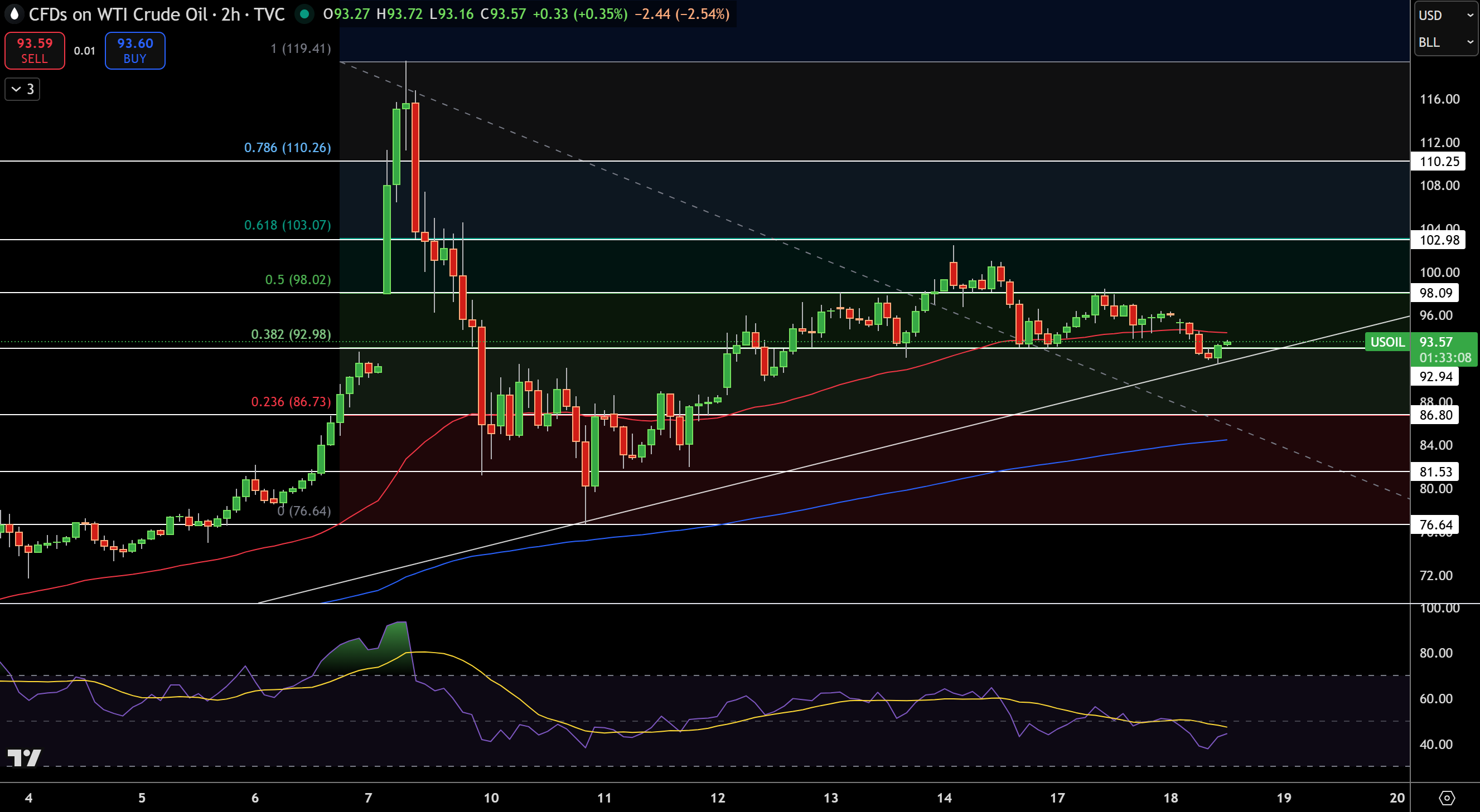
Looking at the technical side of the oil market , WTI crude oil is trading at around $93.57 – not showing much movement. To be honest, it’s kind of consolidating above that all-important $92.98 to $93.04 support mark, which also just happens to line up with the 0.382 Fibonacci retracement. The price is being squeezed in between a rising trendline and that descending channel resistance – and that’s looking like a pretty clear setup for a big move in either direction.
Now, if we take a look at the moving averages, the 50-period one is basically flattening out at around $94, while the 200-period one is still trending upwards from about $84. That’s all still looking pretty bullish to us in the medium term. And if we take a peek at the RSI, it’s around 45 which is basically neutral at this point, but still suggests we do have some upside left in the tank.
If WTI crude oil manages to stay above $98.02 for a bit then it starts to open up the possibility of it getting all the way up to $103.07 – which just happens to be that 0.618 Fibonacci level. But if it breaks below $92.94 then the opposite happens and it gets exposed to that $86.73 and things start looking pretty bearish.
Brent Crude Oil Analysis: $99.96 Support Anchors Bullish Structure as $106.56 Breakout Beckons
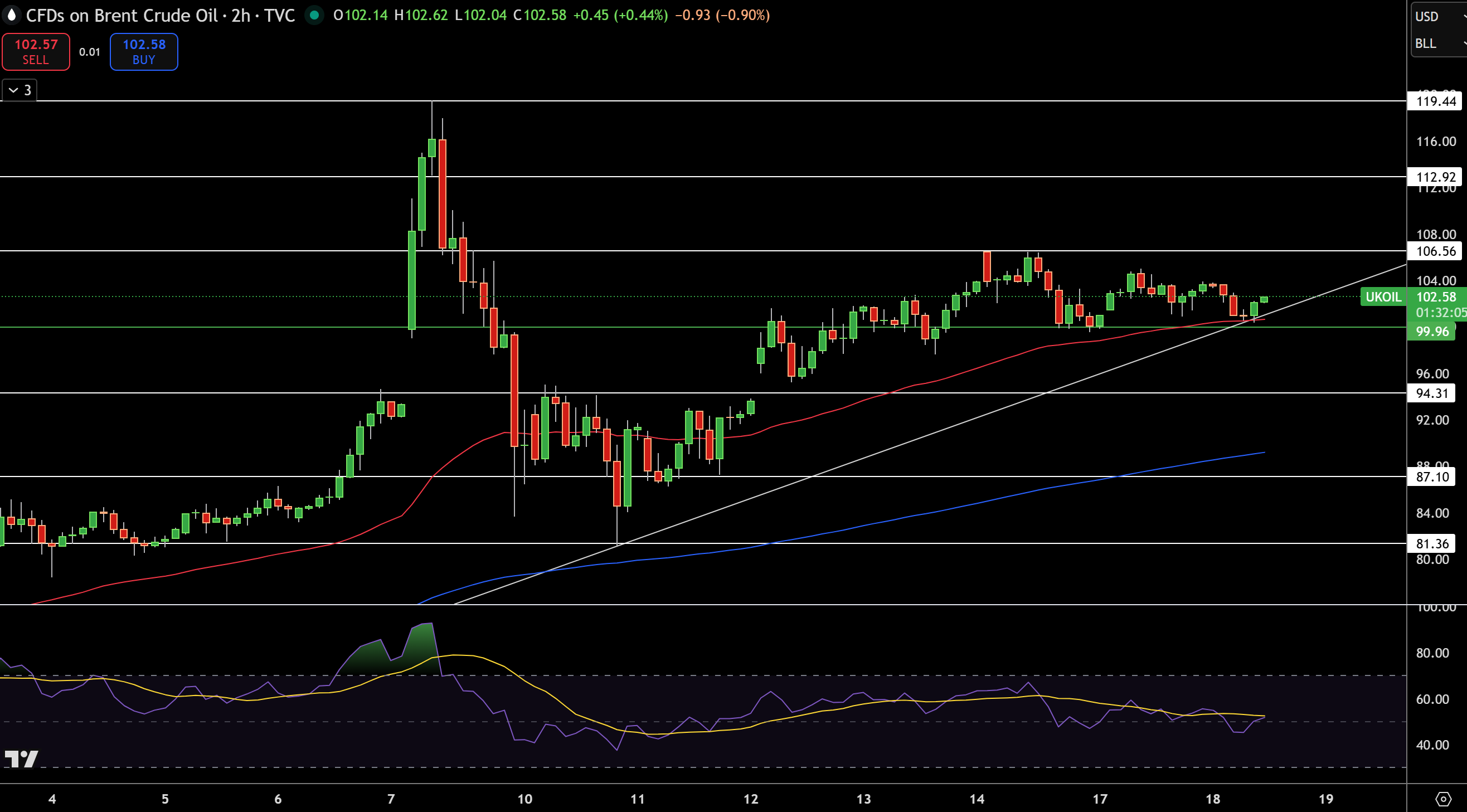
Brent crude is trading at around $102.58 on the 2-hour chart and is happily holding above that very important $99.96 level. This is also where it intersects with a nice rising trendline that formed on the way up from the recent low. Higher lows are building into the price structure and that’s reinforcing the idea that things are still looking pretty bullish – even with some recent consolidation below the $104 mark.
We’ve also got the 50-period moving average lurking around $100 & steadily acting as a dynamic support level , meanwhile the 200-period MA at around $87 continues to point upwards – which is just another way of saying the trend is still strong. The RSI is moseying along in the mid-40s, which suggests that the momentum is pretty neutral – but there is room for things to move higher.
The breakout level is now $106.56 – if we can clear that, then $112.92 is on the horizon but failure to do so risks a pullback down to $94.31