
Bitcoin (BTC) has gone up by 15% in the past 30 days, and today’s price action could be paving the way for an even stronger rally toward the $85,000 area.
Total short liquidations spiked to $220 million in the past 24 hours, with BTC positions accounting for over half of that amount, as the token just broke through a long-dated resistance once again.
Bullish momentum seems to persist despite some geopolitical and macroeconomic headwinds. Oil is still trading above $100, but market participants appear to be expecting that negotiations between the United States and Iran will result in the end of the blockade.
Moreover, Chairman Jerome Powell delivered his last speech as head of the U.S. Federal Reserve this week, following the central bank’s monthly FOMC meeting. No changes were made to the federal funds rate, as expected, while Kevin Warsh is expected to take over the reins of the Fed this month.
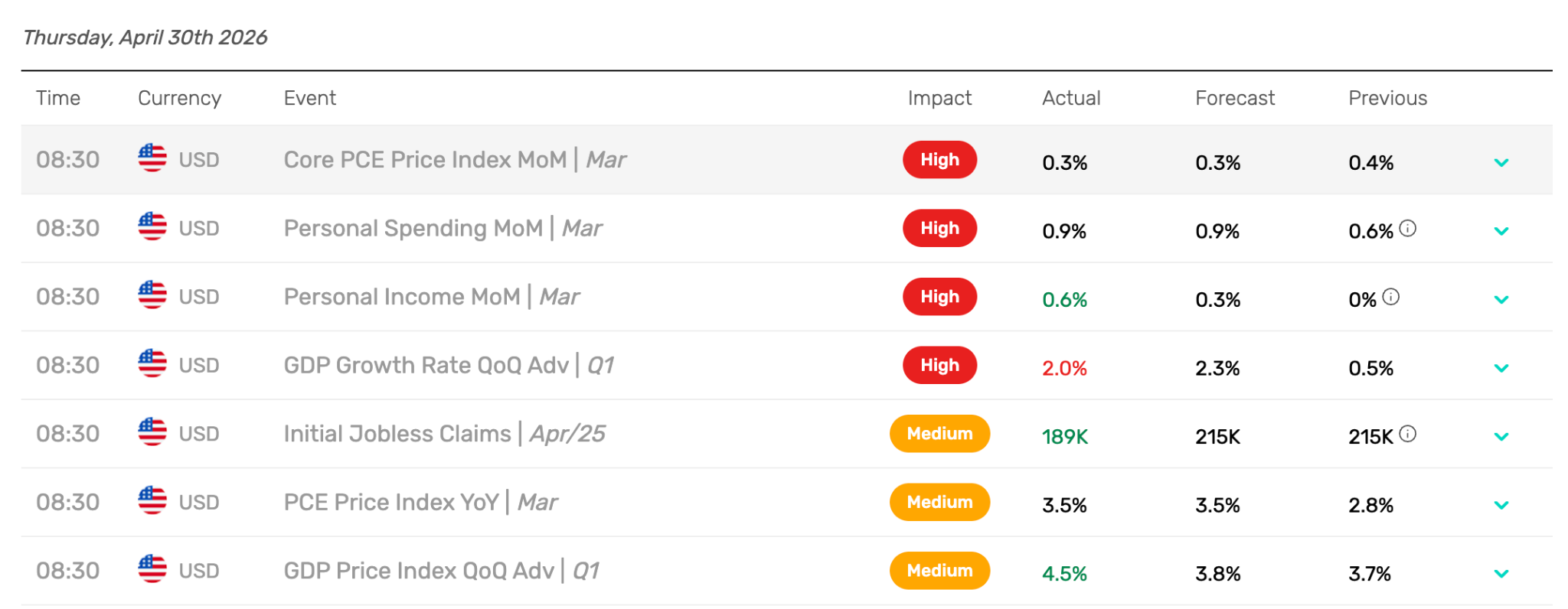
Warsh is a bit of a wild card for the market, and that explains why prices have been in consolidation mode ahead of the beginning of his tenure. This week, inflation spiked to 3.5% in the U.S. amid higher energy costs.
Analysts no longer expect a rate cut this year as the Fed needs to get inflation under control before that happens. However, Warsh is considered more dovish than his predecessor.
If the odds of a rate cut this year increase at some point, that would be favorable for Bitcoin (BTC) and other risky assets.

BTC ETFs Break 3-Day Streak of Negative Inflows
Meanwhile, BTC exchange-traded funds (ETFs) broke a 3-day streak of negative net inflows yesterday, as investors poured nearly $24 million into these vehicles. From April 14 to April 24, ETFs brought in over $2.1 billion in inflows, underscoring some strong buying interest that we have not seen in months.
Sentiment in the crypto market soured a bit after the latest pullback. The Crypto Fear and Greed Index dropped from a recent peak of 62 – the highest this gauge has been since October 2025 – to 45 at the time of writing.
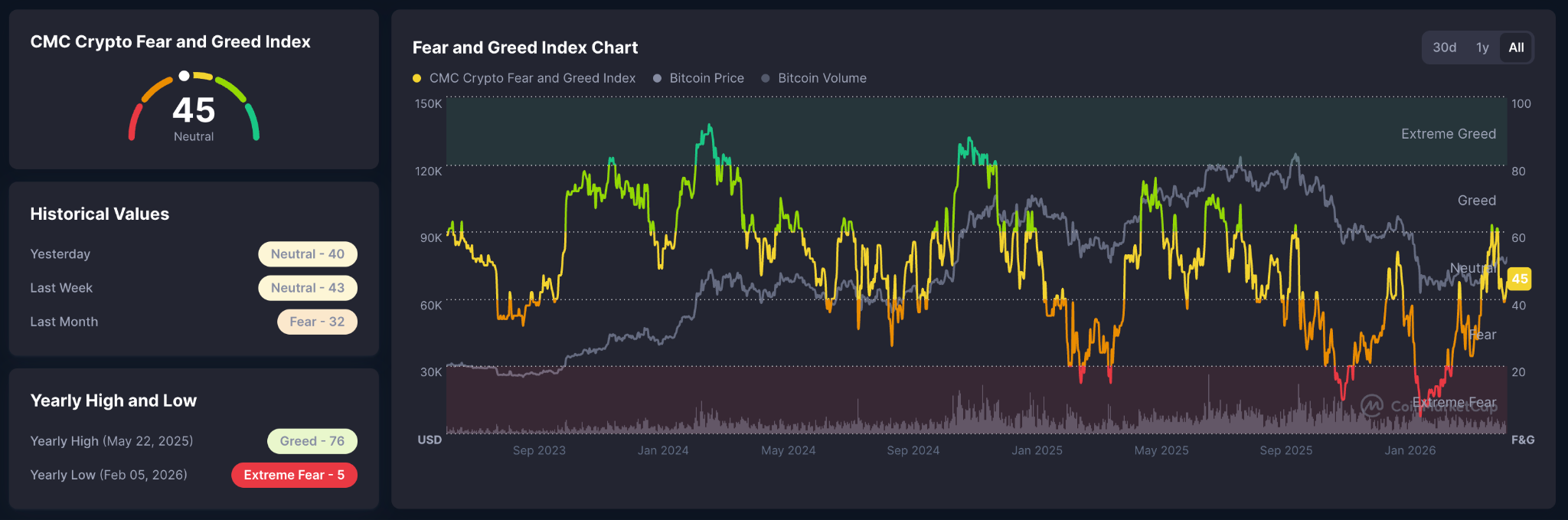
This is perfectly normal. It means that the market is still cautious about this rally. No investor is buying that this is the beginning of a full-blown recovery yet. They might, if the price rises above some key thresholds.
This makes Bitcoin’s latest moves very interesting to keep an eye on, as spotting a change in the prevailing trend early on can result in significant gains down the road.
Bitcoin Price Forecast
Every new Bitcoin analysis as it publishes, today's technical signal and key levels, live price — on one page.
See all Bitcoin forecasts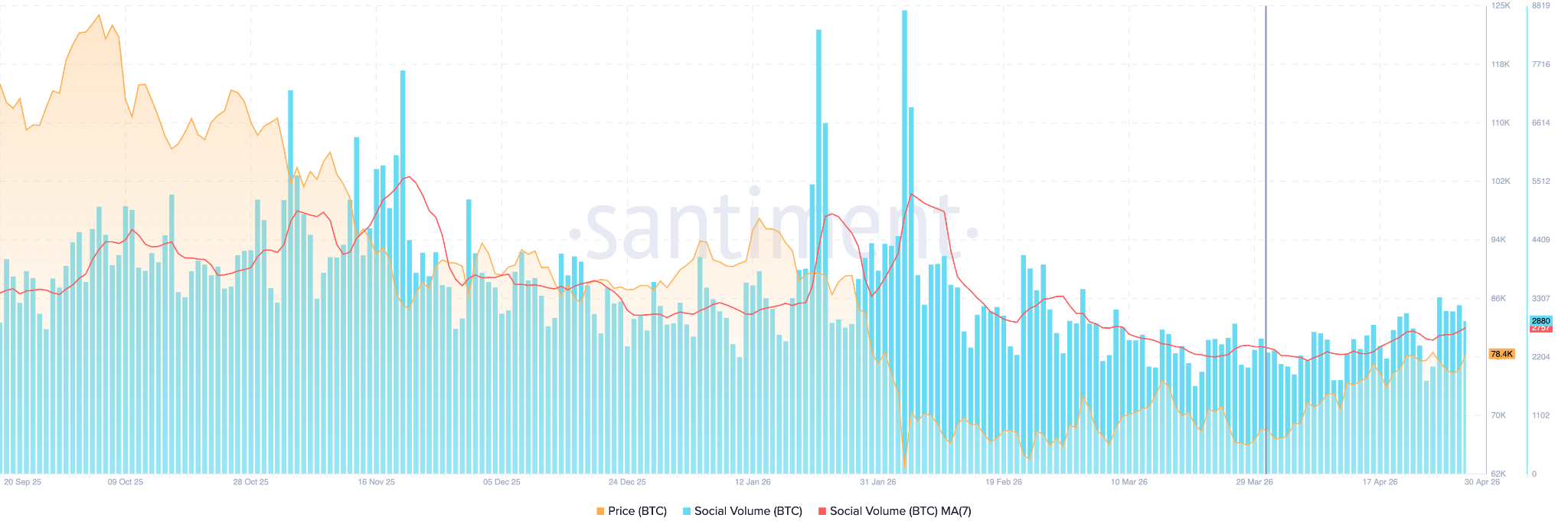
According to data from Santiment, the 7-day moving average for the Social Volumes metric rose from 2,375 to 2,757 for a 16% uptick. It is not much, but it is a start after months of a sustained downtrend.
Trading volumes are still quite thin, but liquidations point to a significant volume of short positions sitting on top of BTC’s long-dated resistance of $80,000. This level is, then, both psychologically and technically relevant.
Bitcoin’s RSI Flashes Buy Signal in the Weekly Time Frame
Our weekly chart continues to track Bitcoin’s performance after the Relative Strength Index (RSI) sent a major buy signal in this higher time frame (HFT). This signal has occurred three times in the past, every time the oscillator drops below 30.
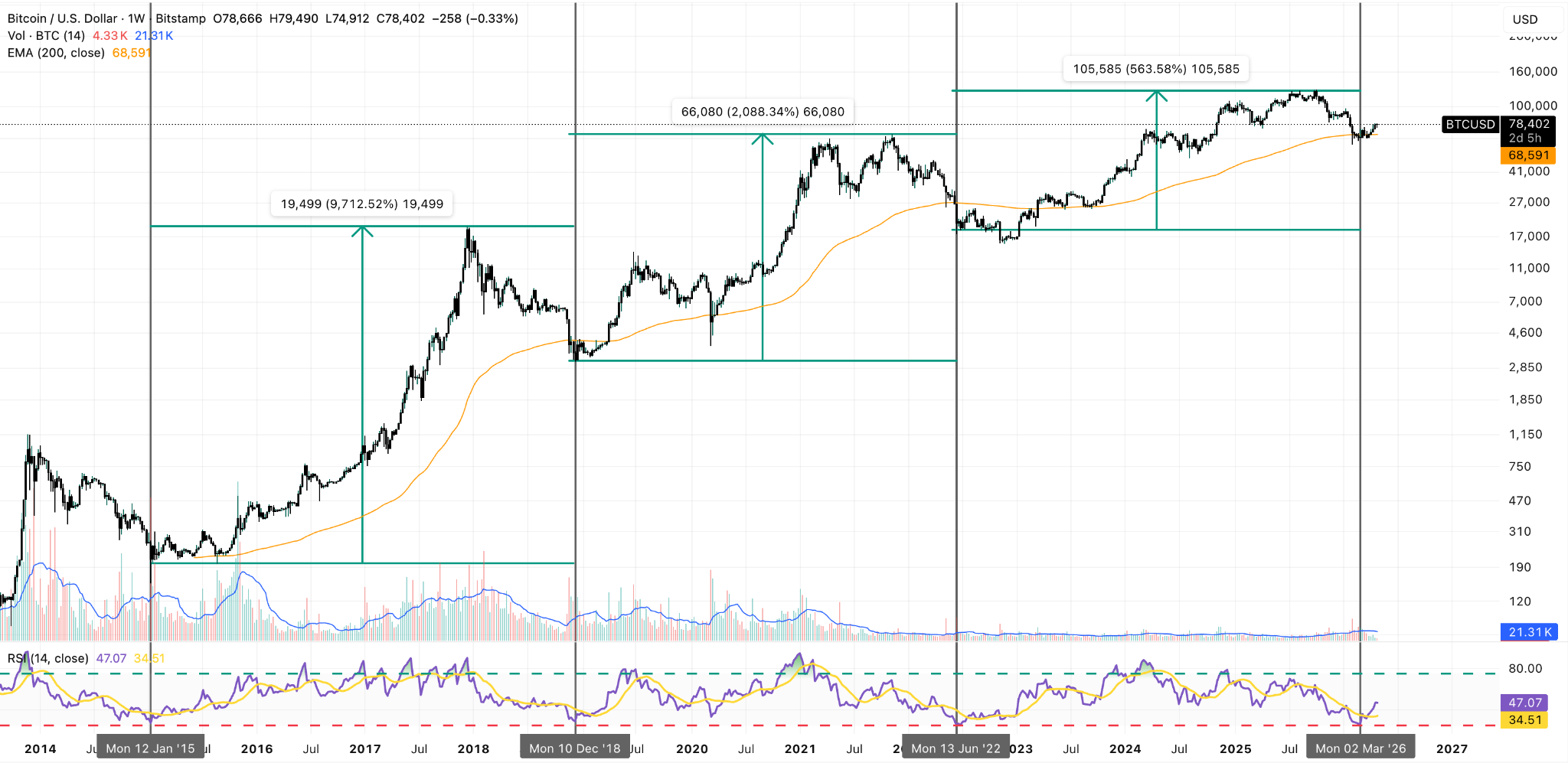
In all of these three instances, what has followed is a strong rally to new heights for the top crypto. What we like about this signal recently is that the price has started to move higher. Slowly, but steadily climbing after bouncing off the 200-week exponential moving average (EMA).
The RSI also crossed above the signal line, which has been the definite green light on these past three occasions. Keep in mind that after a brief rally, BTC has pulled back near its previous lows shortly afterward.
Hence, it is not a reason to panic if we get a strong drop, as that has not invalidated the signal historically. What has NEVER happened is that the price moves below the previous low.
If that happens, then this signal will no longer be valid, and that would imply a tectonic shift in a long-dated structure that has held up quite well since 2015. We give that scenario pretty low odds, as crypto adoption is at its highest point in history right now.
Wall Street is frantically incorporating cryptos everywhere they can, and top asset management firms had been launching new ETFs every month before this bear market started. The SEC is now a crypto-friendly entity and even the President of the United States supports crypto, and so on.
In the previous three occasions, BTC rallied by 9,700%, 2,100%, and 563% off its cycle lows. What to expect now? We see BTC rallying by 200% to 400% over the next 12 to 36 months, meaning that the top crypto could hit $320,000 at some point.
No Buy Signal in the Daily Chart Yet But Breakout of $77K Resistance Seems Imminent
Heading to the daily chart, we can see that BTC’s uptrend remains intact. The token has managed to stay above the $77,000 mark, which was a former ceiling, and it seems to be moving toward retesting the $80,000 mark.
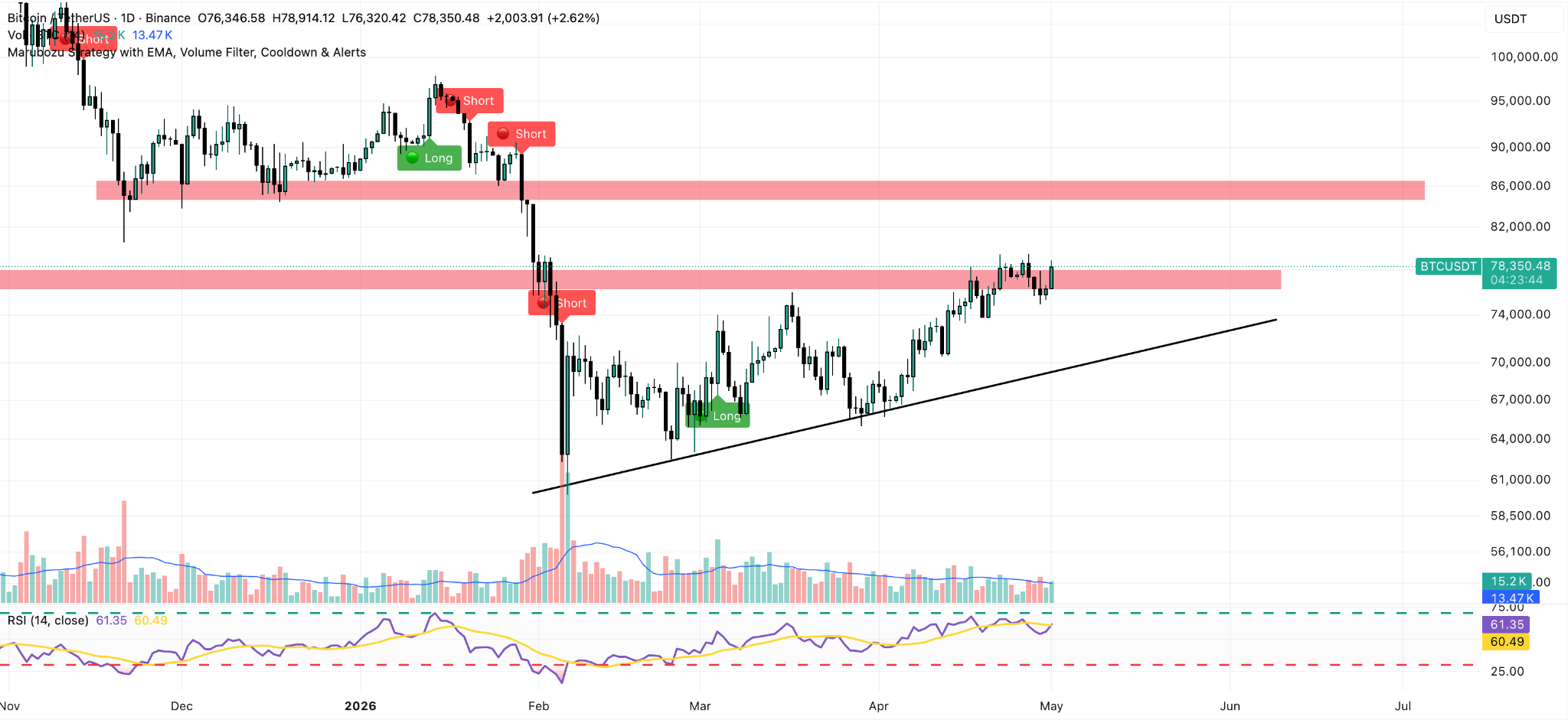
This is a key psychological threshold, and big volumes of stop orders may be sitting on top of that level. If we break it, that could unlock a fast rally to $85,000 – right above the 200-day exponential moving average (EMA).
BTC could explode like a rocket in that scenario, as the 200-day EMA tends to be closely watched by swing traders and buy-and-hold investors. Every time the price rises past that mark, most people think the asset is a “buy” and that becomes a self-fulfilling prophecy.
The Relative Strength Index (RSI) currently sits at 61, meaning that bulls are in control of the price action and momentum is accelerating. We have not yet spotted a buy signal in this higher time frame (HFT). If we get one, that would confirm institutional participation in this breakout.
Our signals system identified specific candle patterns and above-average volumes. As the price is on a clear uptrend, we are currently leaning toward taking buy signals only.