
Bulls seem to have lost their edge lately, as Ethereum (ETH) has been retreating ever since the token hit the $2,400 threshold.
Higher oil prices and a spike in inflation levels may have contributed to this decline, as macroeconomic conditions continue to be unfavorable for risky assets like cryptocurrencies.
This week, the U.S. Federal Reserve’s preferred inflation gauge, the annualized PCE Price Index, ended at 3.5%. Although this percentage was in line with analysts’ expectations for March, it assured the market that there will be no rate cuts this year if prices keep rising at that pace.
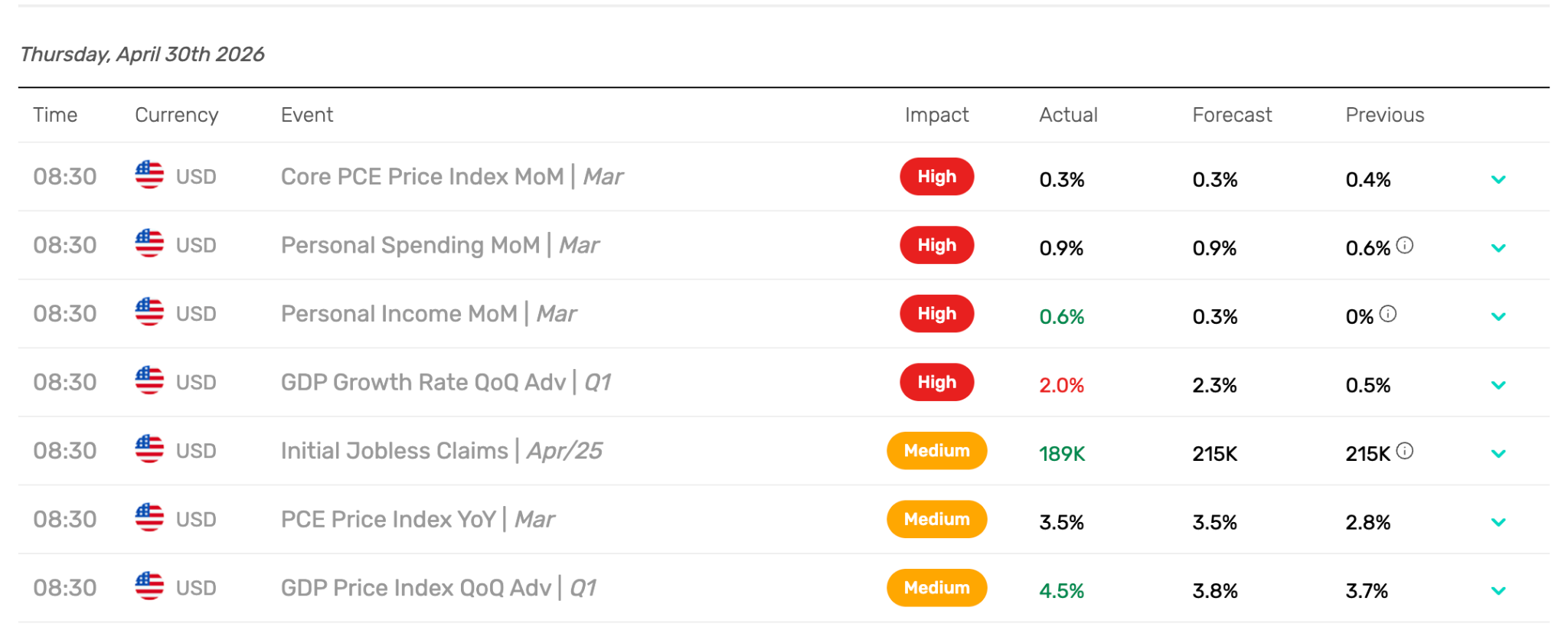
Rising energy costs are primarily responsible for that uptick in inflation levels. The war with Iran and the United States’ ongoing blockade of the Strait of Hormuz have kept oil prices above $100 lately.
Even though President Donald Trump vowed to put an end to the war “very soon”, those promises have not been fulfilled, and the war has dragged on for weeks now.
This is a cause of uncertainty and unrest among investors, as failing to negotiate an end to the war will lead to higher-for-longer oil prices, persistently high inflation, and zero rate cuts on the horizon.

Sentiment Sours But Traders Seem to Be Coming Back to the Market
Bitcoin (BTC) and Ethereum (ETH) have outperformed most of their peers this year, as investors seem to perceive these two as the only high-quality assets in the crypto market.
In the past 30 days, ETH generated an 8% gain while other altcoins like XRP (XRP) and Solana (SOL) booked a milder 2.5% and 1.5% advance.
However, interest in ETH has waned in the past week, as exchange-traded funds (ETFs) linked to this token booked four consecutive days of negative net inflows. In total, $184 million was withdrawn from these funds from Monday to Thursday, indicating a shift in sentiment.
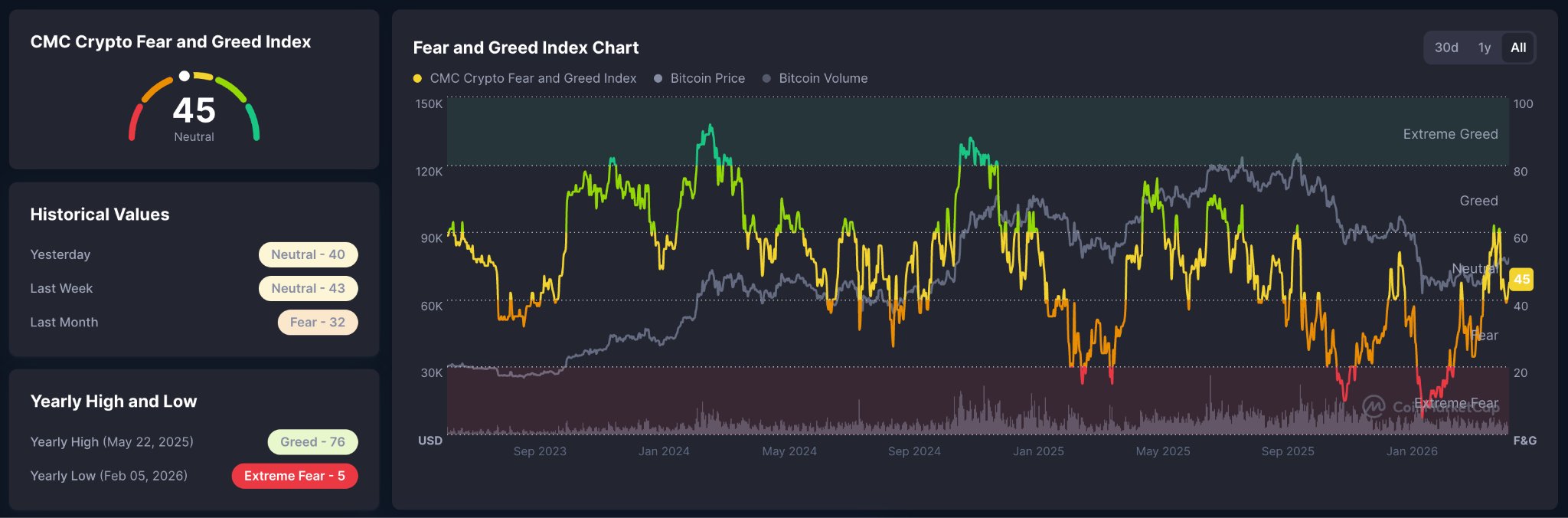
Just a few days ago, the Crypto Fear and Greed Index hit 62 for the first time since October 2025. This was strong evidence of growing confidence among market participants. However, this sentiment gauge is now back at 43 following the Fed’s latest interest rate decision.
No changes were made to the federal funds rate this time, but this was a key moment for the institution, as it will be the last meeting that Chairman Jerome Powell will preside. The long-tenured head of the U.S. central bank will be replaced this month by Kevin Warsh.
We have seen a mild recovery in the futures market, as open interest (OI) has been slowly but steadily rising. Traders seem to be coming back to their terminals as the selling pressure appears to be easing.
In dollar terms, open interest has recovered from a recent low of $23 billion in early February to $31 billion at the time of writing. Even though that means a 35% increase, keep in mind that this figure is still 55% below the $70 billion peak of August 2025.
Ethereum Price Forecast
Every new Ethereum analysis as it publishes, today's technical signal and key levels, live price — on one page.
See all Ethereum forecastsEthereum Social Volumes Rose for Two Weeks in a Row
Meanwhile, on-chain data from Artemis indicates that Ethereum’s network usage has been declining for two weeks in a row. The number of transactions processed by this blockchain dropped from a recent all-time high of 18.7 million during the week ended on April 12 to 14.2 million as of last week.
Even though this metric is still at a high point compared to historical levels, this drop in transaction volumes could be pointing to lower usage of Ethereum’s DeFi apps and a decline in stablecoin transactions.
That said, data from Santiment shows that there was a mild improvement in Ethereum’s social volume. From April 8 to April 22, the number of weekly mentions of Ethereum and ETH increased by 53%.
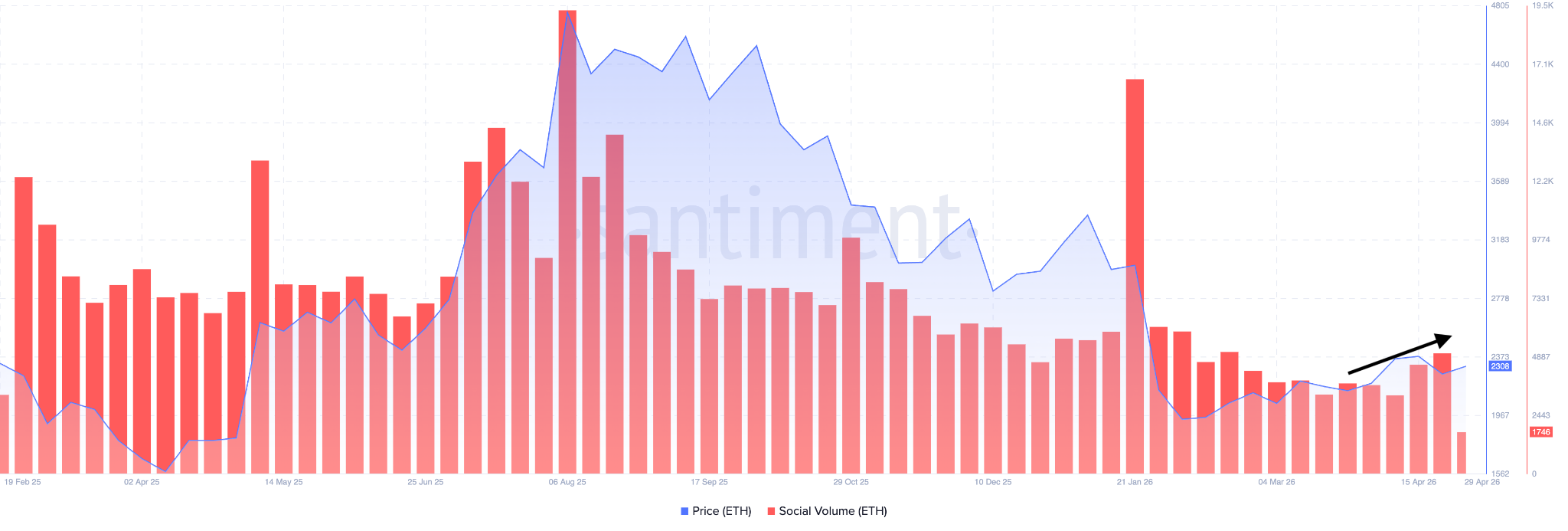
Social volumes are also sitting at dramatically low levels compared to last week, but this can be attributed to the fact that the token is trading below $3,000 – a key psychological level that has commonly drawn significant attention to it in the past.
This makes the $3K area the most relevant psychological target to keep an eye on for bulls. If this rally continues and pushes ETH to that level, some FOMO will likely kick in.
What could provide the necessary fuel for the price to get there would be a massive short squeeze prompted by a strong move above $2,400.
Weekly RSI Sends Strong Buy Signal that Could Propel ETH to $5,400
Heading to the weekly chart, we continue to track a key buy signal sent by the Relative Strength Index (RSI) that has yielded great results in the past.
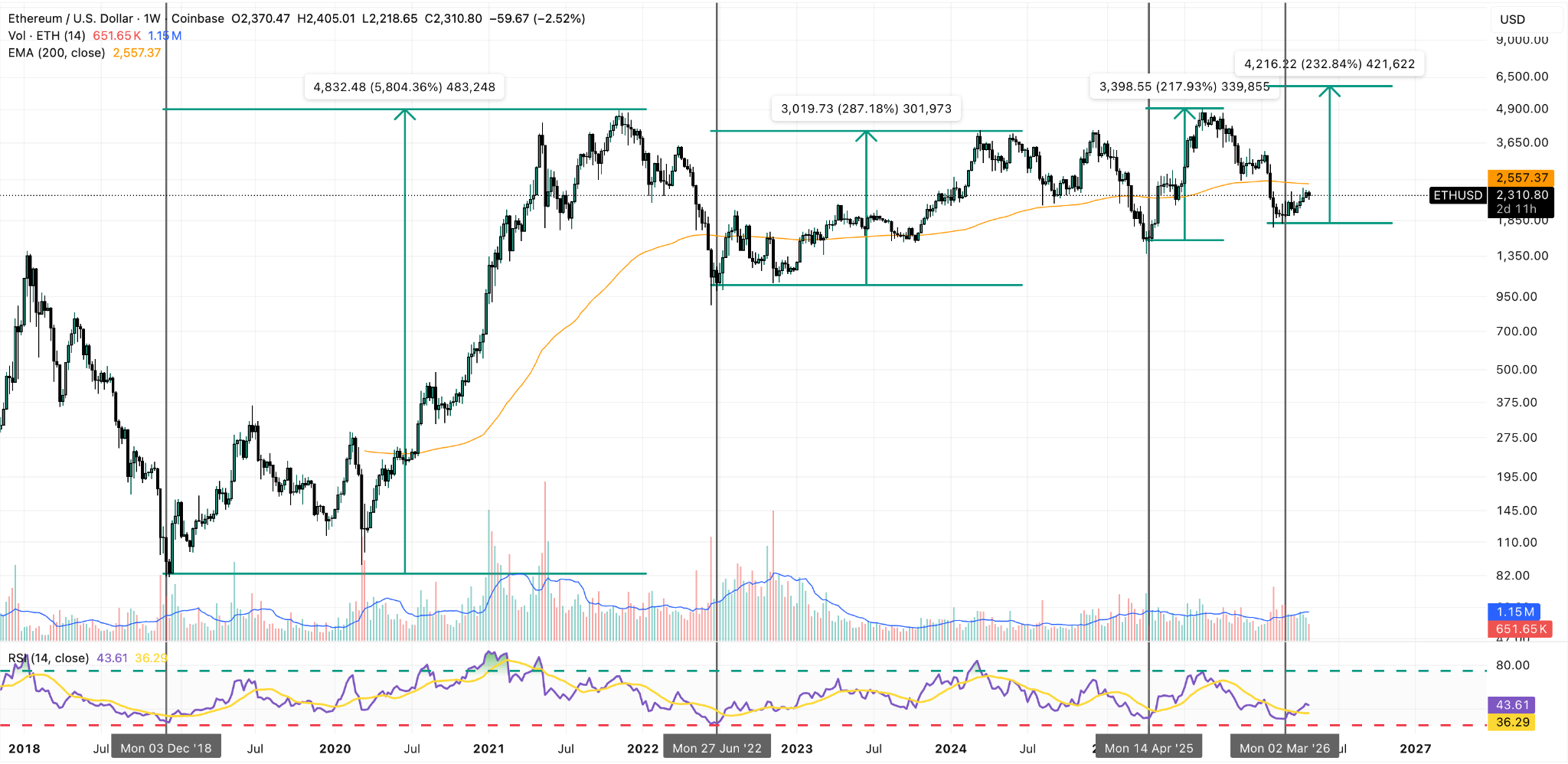
The last three times that this oscillator has hit 30, the price has started to recover, and it has marked the end of previous bearish cycles.
Ethereum’s average gains the last two times exceeded 200%. If we expect a similar performance this time, and identify the $1,800 as this cycle’s bottom, that could result in ETH rising to $6,000 over the next 12 to 24 months.
What is most encouraging about this signal is that we have already seen the price start to trend higher in the past 4 weeks. In addition, the RSI just moved above the signal line. This has been a tell for bulls the last three times, even though there have been some sharp retreats along the way.
If this historical trend repeats, we have no reason to expect that ETH will drop below $1,800 in the foreseeable future. Instead, this could be one of the best moments to buy for swing traders and buy-and-hold investors as the market is giving us early signals that a cycle bottom is already in.
ETH Should Rise to $2,600 Next if This Support Level Holds
Moving down to the daily chart, we still expect a retest of the $2,150 level, as this area is in confluence with a trend line support that has been building up since February.
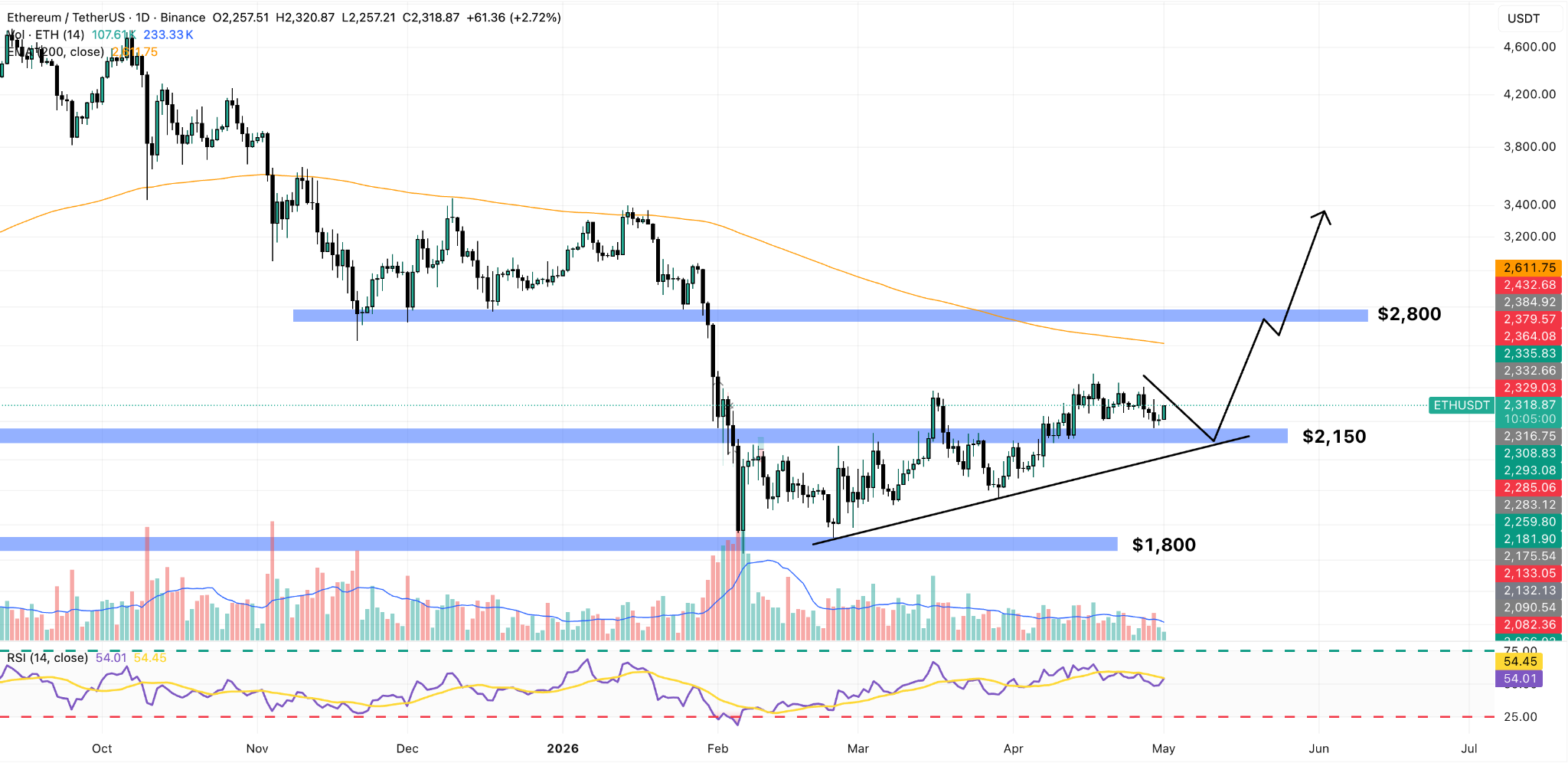
If this demand zone holds, the most likely target in the near term continues to be the 200-day exponential moving average (EMA) at $2,600, followed by a move toward our bullish target of $2,800.
Depending on what happens next, if the $2,800 barrier is broken, we expect this to be the definite end of this bear market, as the $3,000 psychological threshold will be next. When the price is on an uptrend, and it gets to that level, FOMO tends to kick in for Ethereum.
Shorts will be squeezed if the $2,600 barrier is broken as well, and that should drive volumes higher and increase the buying pressure via blown-up short orders.
The Relative Strength Index (RSI) is currently sitting above 50. As long as this momentum oscillator stays above 40 and the price stays above $2,150, this rally will still be alive.