
Spot Gold Holds Support But Yields Keep the Lid On
Spot Gold (XAUUSD) cannot get anything going into May 1. Every bounce this week has been sold. The 10-Year U.S. Treasury yield is not cooperating, the Federal Reserve is not shifting, and the U.S. Dollar Index is not giving ground. Weekly loss is where this is headed.

Yields Are Running This Market
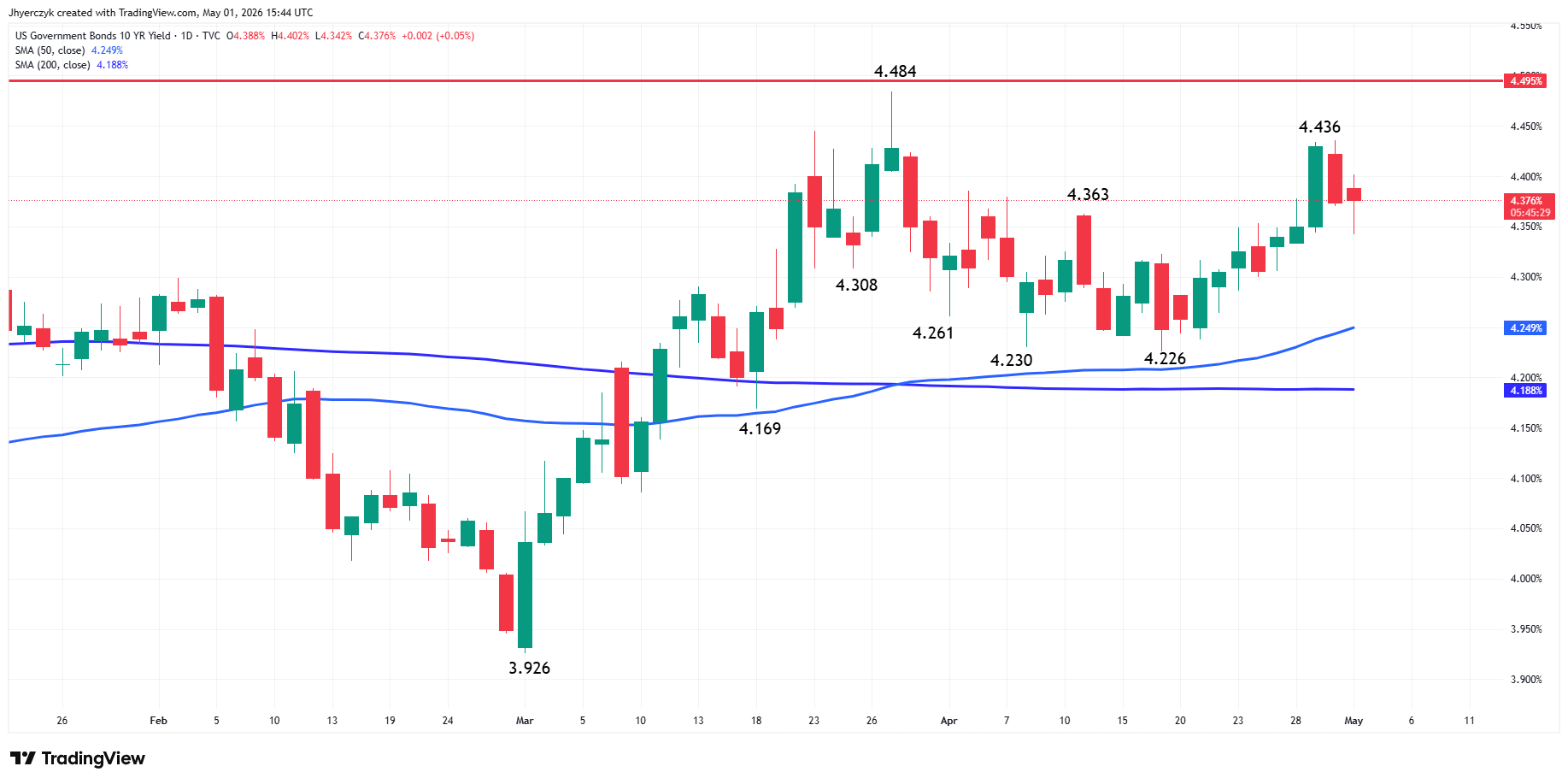
I’ve been watching the 10-Year U.S. Treasury yield sit just under 4.40% and that number is doing real damage to gold. Earlier this week crude spiked and pulled inflation expectations with it. Yields followed. They’ve come in slightly today but not enough to matter. The 4.30 to 4.40% zone is where gold lives or dies right now. Above it, buyers don’t have a reason to step in. We’re still above it and the bid is still missing.
The Fed Is Not Giving Gold a Reason to Rally
No rate cuts coming. That’s the message and the Fed is not softening it. Earlier in the year traders were betting on cuts and gold had something to lean on. Those bets got pushed out to late 2026 or further and that support left with them. Inflation is still the focus at the Fed. Real yields are elevated. That combination does not bring gold buyers back.
Oil Set the Sequence in Motion
June WTI crude spiked earlier this week and I knew exactly what was coming next. Higher crude, higher inflation expectations, higher yields, gold gets capped. That’s the chain and it ran exactly on schedule. Now crude is pulling back on supply headlines and yields are easing slightly. Gold is getting a bounce off that. I’ve seen this reaction move before. Pressure is coming off temporarily. That’s all this is.
Dollar Pullback Is Not Changing the Structure
The U.S. Dollar Index is softer today and that has given gold a little room. But the broader dollar trend is still firm and it is still pricing out international buyers. Today’s move stabilized the chart. It did not change the structure.
Gold Price Forecast
Every new Gold analysis as it publishes, today's technical signal and key levels, live price — on one page.
See all Gold forecastsTechnical Outlook
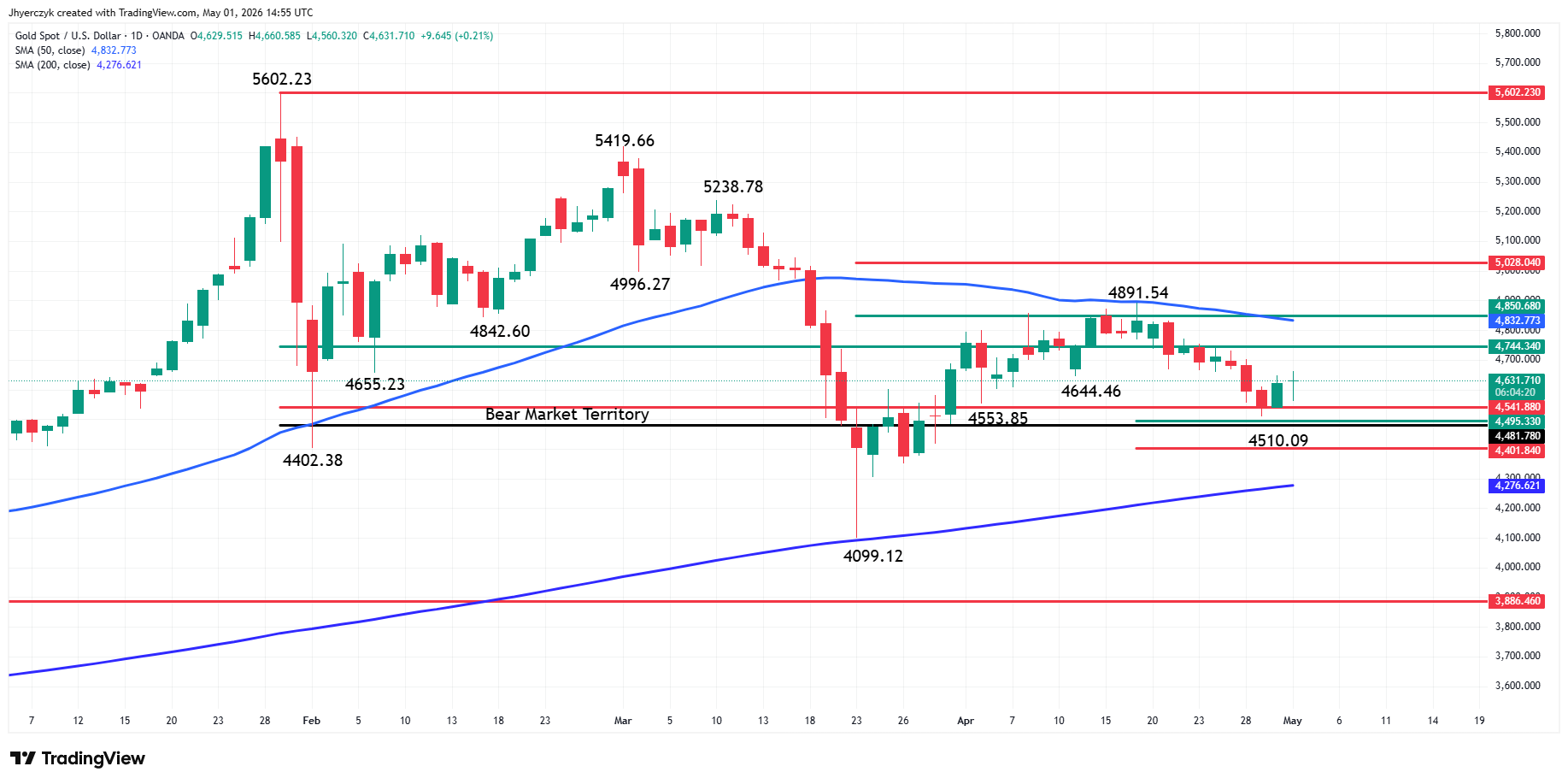
Spot Gold (XAUUSD) is edging higher on Friday after reversing earlier weakness. The trend is down according to the daily swing chart, but two days of higher-highs has created a new swing bottom at $4,510.09.
The market is now on the strong side of 61.8% support at $4,541.89, which is slightly above the short-term retracement zone support at $4,495.33 to $4,401.84. This area is above the 200-day moving average at $4,277.02, which is controlling the long-term uptrend.
The daily chart shows there is room to the upside to extend the current rally with the nearest resistance the long-term 50% level at $4,744.34. This price represents the mid-point of the October 28 bottom at $3,886.46 and the January 29 top at $5,602.23. This area has been controlling the price action for several months.
Also controlling the direction of the market for several months is the 50-day moving average at $4,832.81 and the 200-day moving average at $4,277.02. Prices are essentially being compressed by both sets of indicators. This isn’t necessarily a bad thing except for momentum traders who feed off of constant action. To chart-watchers, it’s a normal reaction following a hypersonic rally like we saw at the start of 2026.
If you’re not flexible enough in your trading to be able to switch from momentum to range then the last three months have been particularly frustrating, especially for those who treat gold as a safe-haven instead of an investment. Just accept the fact that commodity markets sometimes trend and sometimes consolidate.
There is a study by McKinsey that shows commodities spent the vast majority of their time in mean-reverting or range-bound states. It claims that commodities tend to trend about 20 to 30% of the time and trade sideways about 70 to 80%.
Studies by organizations like the World Gold Council show that gold’s volatility isn’t evenly distributed. It often enters “sleep” cycles where it moves sideways for years, followed by “vertical” cycles.
Last year, gold outperformed the S&P 500 significantly during months of high geopolitical stress, while moving sideways during risk-on periods. This year, it broke out of the long-term consolidation phase. That may have been the 30% trending phase. So brace yourself because we may be in the consolidation phase, but that doesn’t mean it’s untradeable.
Since the spike bottom on March 23 established support at $4,099.12 on the 200-day MA, I think that sends a signal that this indicator is support. Since it was rejected by the 50-day MA at $4,891.54 on April 17, we can say that it is resistance.
The price action this week shows it can still find support inside the moving averages. The current two-day rally may be telling us that we are in buy-the-dip mode. The recent reaction to the 50-day MA certainly told us that traders are selling rallies.
Once again, the market is giving you two choices: be active and take out offers, hoping for the breakout, or be passive and wait for the dip into value areas. I understand that traders like the “set it and forget it” trade, but that’s not happening now.
What I’m Watching
The way I see it, gold is still in sell-the-rally mode. Support is holding but buyers are not committing at these levels. The 10-Year U.S. Treasury yield and Fed rate expectations are the two levers that will decide this. Until one of them breaks in gold’s favor, this market grinds lower or goes nowhere. That is where we are.
If you’d like to know more about how to trade gold, please visit our educational area.