
Legislative news from Capitol Hill and resilient demand for US XRP-spot ETFs boosted XRP demand on the first day of 2026.
US lawmakers set a date for the Market Structure Bill, raising hopes of crypto-friendly legislation passing a Senate Vote in the first quarter.
Meanwhile, demand for US XRP-spot ETFs remained robust through the holidays, tilting the supply-demand balance in the token’s favor.
These two key price drivers continued to signal a bullish short- to medium-term price outlook for XRP.
Below, I will explore the key drivers behind recent price trends, the medium-term (4-8 weeks) outlook, and the key technical levels traders should watch.

US Lawmakers Set Market Structure Bill Markup Date
The US Senate Banking Committee reportedly set a Thursday, January 15, markup date for the Market Structure Bill on Wednesday, December 31, 2025.
Crypto in America host Eleanor Terrett shared the news on X, formerly Twitter, stating:
“Senators on the Banking Committee have landed on Thursday, January 15, for a highly anticipated markup of crypto market structure legislation that has been in the works for more than three months.”
While cautioning that it was unclear whether the legislation had bipartisan support, Crypto in America added:
“Before the recess, Banking Committee Chair Tim Scott said that strong progress had been made with Democrats. Several industry leaders who attended a bipartisan meeting with committee members echoed that optimism, saying they felt confident about where the bill stood heading into the new year.”
Democratic support for the bill will be crucial, given the 60 votes needed to get the legislation over the line.
XRP remains highly sensitive to US legislative developments, given the SEC vs. Ripple case, which officially concluded in August 2025. For context, XRP soared 14.69% on July 17, 2025, after the US House of Representatives passed the Market Structure Bill to the Senate. The token reached an all-time high of $3.66 on July 18, 2025, before retreating alongside the broader crypto market.
Bitcoin Price Forecast
Every new Bitcoin analysis as it publishes, today's technical signal and key levels, live price — on one page.
See all Bitcoin forecasts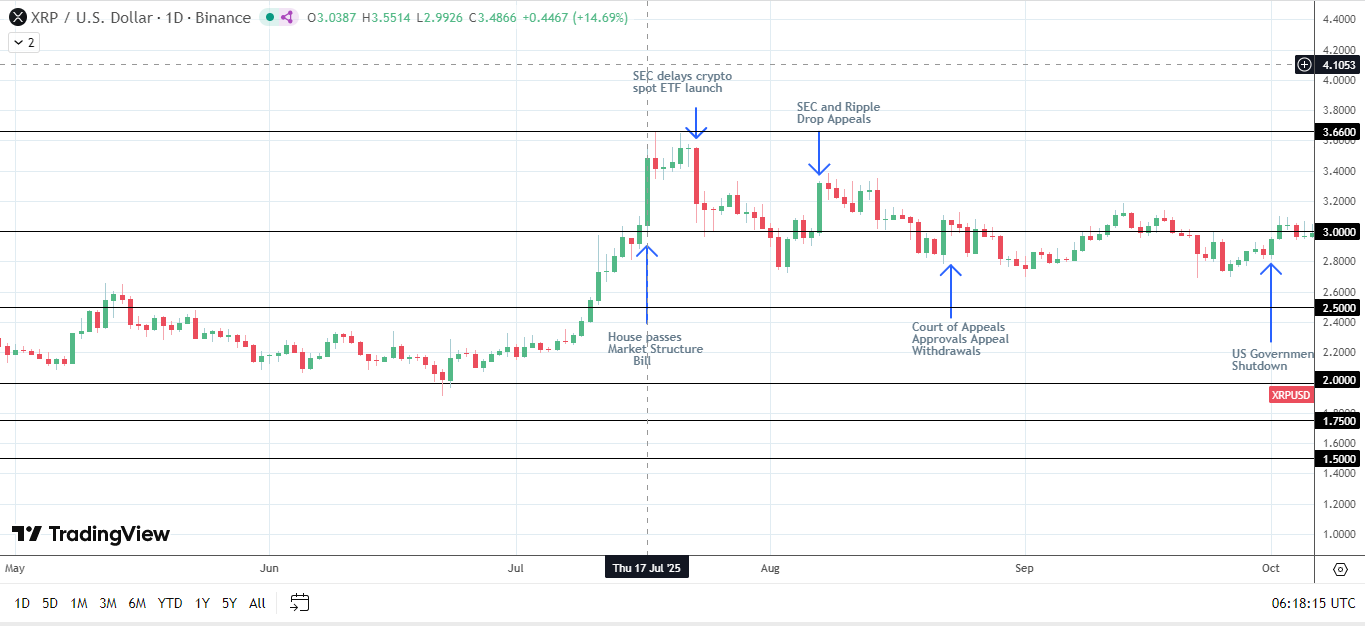
US XRP-Spot ETF Flows Underscore Robust Demand Backdrop
While legislative developments lifted sentiment, holiday demand for US XRP-spot ETFs added to the bullish momentum.
The US XRP-spot ETF market reported net inflows of $499.91 million in December 2025, following $666.61 million of inflows the previous month. By contrast, the US BTC-spot ETF market saw $1.09 billion in net outflows in December, following outflows of $3.47 billion in November.
Market experts have signaled a positive year ahead for XRP, citing crypto-friendly legislation and strong institutional demand. This week, Geoffrey Kendrick, Global Head of Digital Asset Research at Standard Chartered Bank, projected the token to end 2026 at $8 and $12.5 by the year-end of 2028.
Nate Garaci, President at NovaDius Wealth Management, shared the optimism toward the year ahead, stating:
“2025 started w/active SEC lawsuit against Ripple… Ended w/spot xrp ETFs trading. Now, we also have spot sol, hbar, & ltc ETFs. Plus crypto Index ETFs holding ada, sui, dot, link, & others. Huge progress. IMO, crypto truly goes mainstream in 2026.”
In September 2025, Geraci warned against underestimating demand for XRP-spot ETFs, as he had done regarding BTC-spot and ETH-spot ETFs. The US BTC-spot ETF market had net inflows of $22.4 billion in 2025, taking total net inflows since launching to $56.59 billion.
XRP Outlook Increasingly Bullish
The Market Structure Bill’s progress on Capitol Hill and resilient demand for XRP-spot ETFs reinforce the cautiously bullish short-term (1-4 weeks) outlook, with a $2.0 price target. Meanwhile, the prospects of increased utility, Fed rate cuts, and the Senate passing the Market Structure Bill affirm the positive longer-term price paths:
- Medium-term (4-8 weeks): $2.5.
- Longer-term (8-12 weeks) $3.0.
Key Risks Challenge Bullish Outlook
Several scenarios could unravel the positive outlook. These include:
- The Bank of Japan declares a neutral interest rate of between 1.5% and 2.5%, signaling aggressive rate hikes. A higher neutral rate may trigger a yen carry trade unwind, adversely impacting risk assets.
- US economic data and the Fed are tempering expectations of a March rate cut.
- The MSCI delists digital asset treasury companies (DATs). Delistings would likely dampen interest in XRP as a treasury reserve asset.
- Lawmakers oppose the Market Structure Bill.
- XRP-spot ETFs report outflows.
These scenarios would likely push the token toward $1.75, indicating a bearish trend reversal.
Technical Indicators Continue to Signal Caution
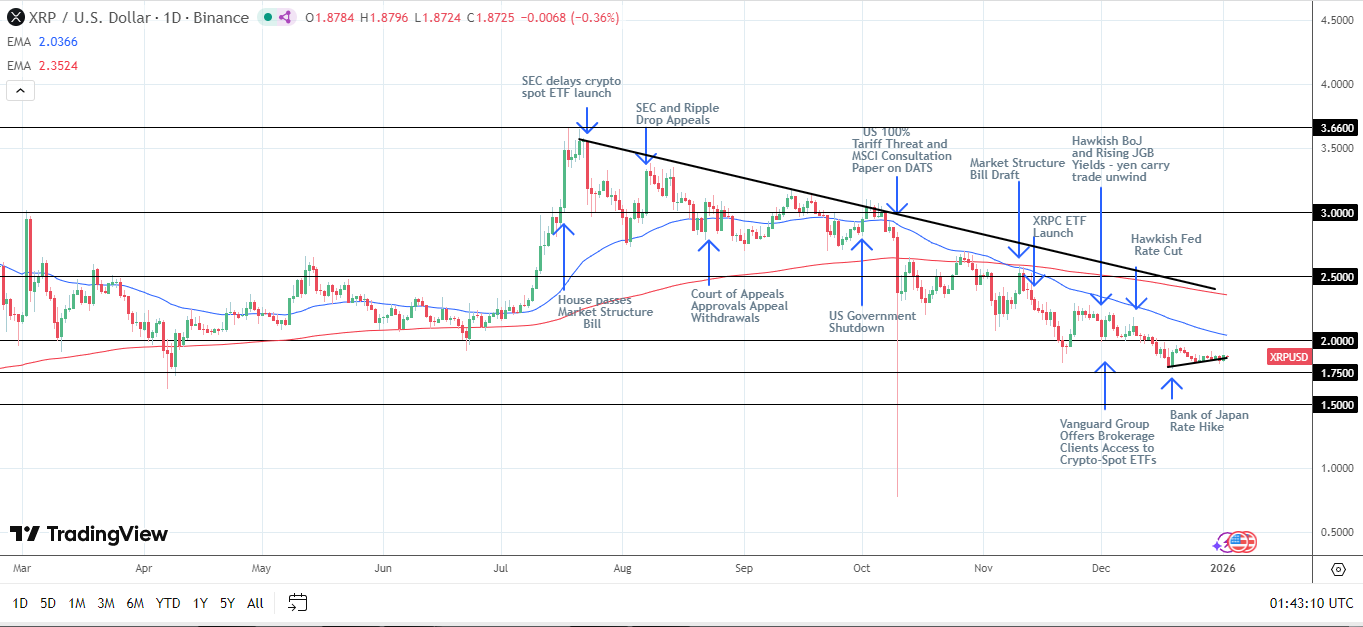
XRP gained 2.06% on Thursday, January 1, reversing a 1.86% loss from the previous day to close at $1.8793. The token outperformed the broader crypto market cap, which advanced 1.33%.
Despite Thursday’s rally, XRP remained below the 50-day and 200-day Exponential Moving Averages (EMAs), signaling a bearish bias. While technicals remained bearish, bullish fundamentals are building, countering the technical structure.
Key technical levels to watch include:
- Support levels: $1.75, and then $1.50.
- 50-day EMA resistance: $2.0366.
- 200-day EMA resistance: $2.3524.
- Resistance levels: $2, $2.5, $3.0, and $3.66.
Looking at the daily chart, a break above the $2.0 psychological level would open the door to testing the 50-day EMA. A sustained move through the 50-day EMA would suggest a near-term bullish trend reversal, paving the way toward the 200-day EMA and the $2.5 resistance level.
A breakout above the EMAs would reinforce the bullish medium-term outlook and the longer-term (8-12 weeks) $3.0 price target.
Fundamental Indicators: Fed, Legislation, and Spot ETFs
Near-term price drivers include:
- XRP-spot ETF flow trends.
- US economic data and expectations of a March Fed rate cut.
- US crypto-related legislative developments.
$2.0 Remains Key for the Bullish Outlook
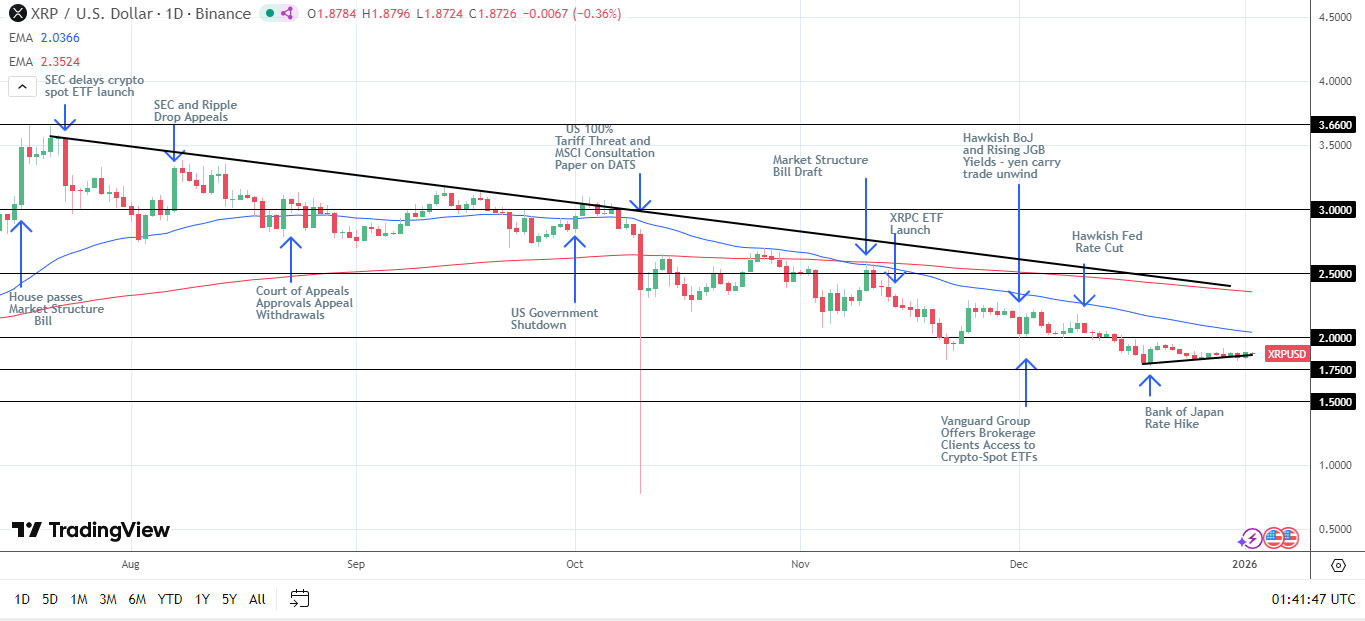
XRP has largely traded sideways at the turn of the year, indicating a potential move. Avoiding a drop below $1.8 since a December 19 rally suggests a breakout rather than a breakdown. These price dynamics affirm the bullish structure and the constructive price bias.
A break above $2.0 would enable the bulls to target the upper trendline and the $2.5 resistance level. A sustained move through the upper trendline would indicate a bullish trend reversal, supporting the price targets.
- Medium-Term (4-8 weeks): $2.5.
- Longer-term (8–12 weeks): target of $3.0.
However, rejection at $2.0 and a sustained drop below the lower trendline would invalidate the bullish structure and signal a bearish trend reversal.
Outlook:
Looking ahead, central bank rhetoric, US economic data, crypto-related legislative developments, and XRP-spot ETF flows will influence near-term demand.
Increasing expectations of a March Fed rate cut and cautious BoJ signals would likely lift sentiment. Strong inflows into XRP-spot ETFs and bipartisan support for the Market Structure Bill would add to the bullish outlook.
In summary, rising institutional demand for XRP-spot ETFs and crypto regulatory headlines support a medium-term (4–8 weeks) move to $2.5. A March Fed rate cut and the Senate passing the Market Structure Bill would affirm the longer-term (8–12 weeks) price target of $3.0.
Looking beyond the medium term, these positive price catalysts are likely to send XRP to its all-time high $3.66 over the 6-12 month time horizon.