



Within the oil trading hut, there are split views against the EIA/IEA views that we are facing a glut in 2027.
You have to tread carefully if you meet another oil trader at a dinner party or the pub these days. They will be the guys and girls that, while smartly dressed, will still look a little dishevelled for some mysterious reason. Bags under their eyes and a little twitchy if they hear the words ‘energy’ or Iran used within twenty feet of their general earshot. It would be well advised, to not talk about 2027 balances, and steer the conversation more towards something like enjoying Jeff Curries interviews, the 4th turning or what hybrid car you are thinking of buying.
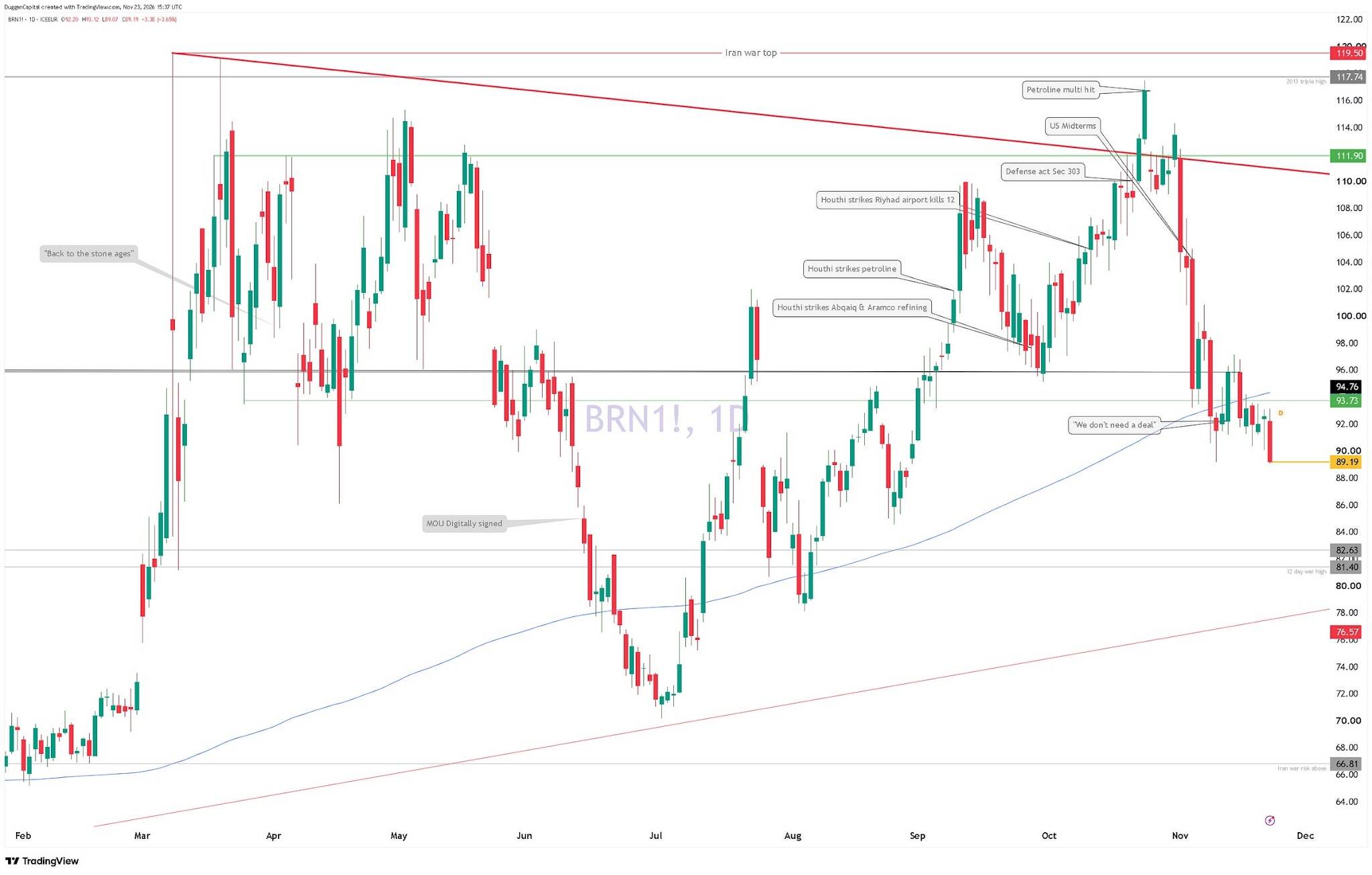
I get it. How can oil be so cheap after so much havoc and destruction across the last 9 months. Well, It all depends on when we need to price in more or less havoc from Iranian or Houthi attacks, or shut-ins continuing to fall or moving higher again. The standard ‘Hormuz disruption’ trade is dead. ‘‘Tell me when the war gets significantly hot again, and I’ll tell you when to get long’’ type stuff.
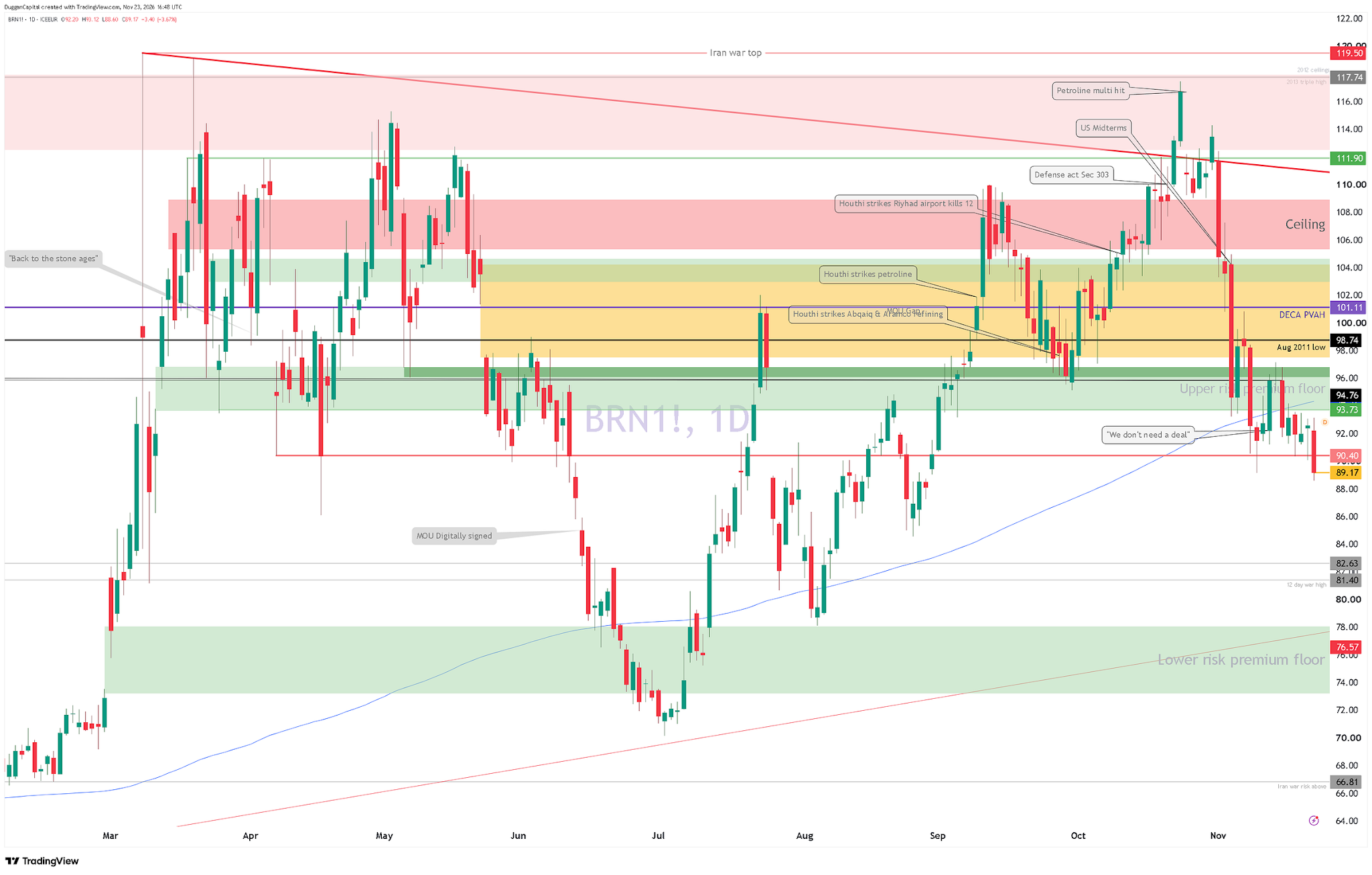
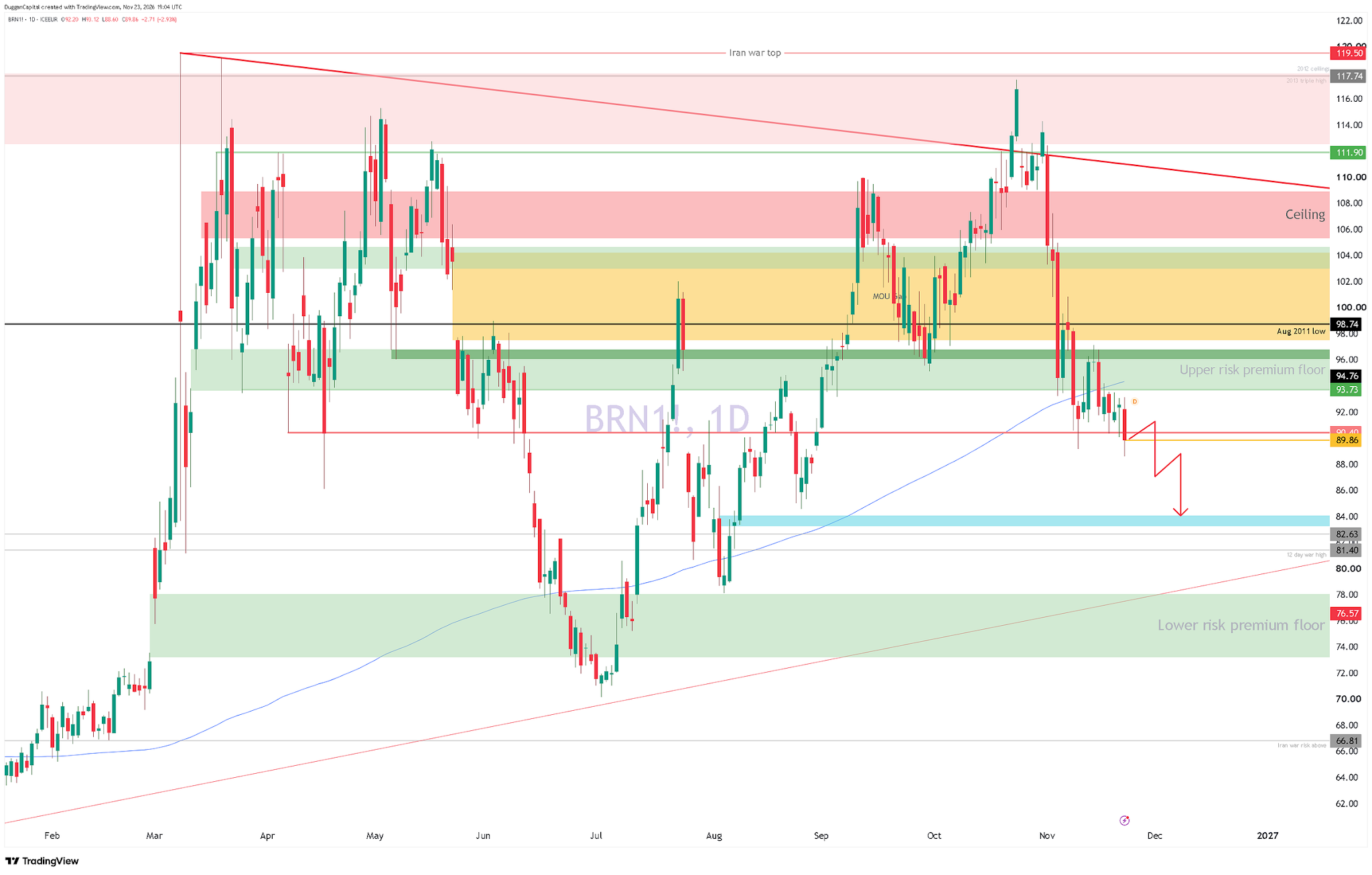
We are talking about The Middle East here, so essentially war is never more than 1000 km away, so you just have to learn to accept differing levels of war. Hot, Medium- hot or napalm. Form 9 months of war, we see that all and any levels of war have been sold. In the trade section I cover the lower risk floor again, which is extremely significant now as a target.
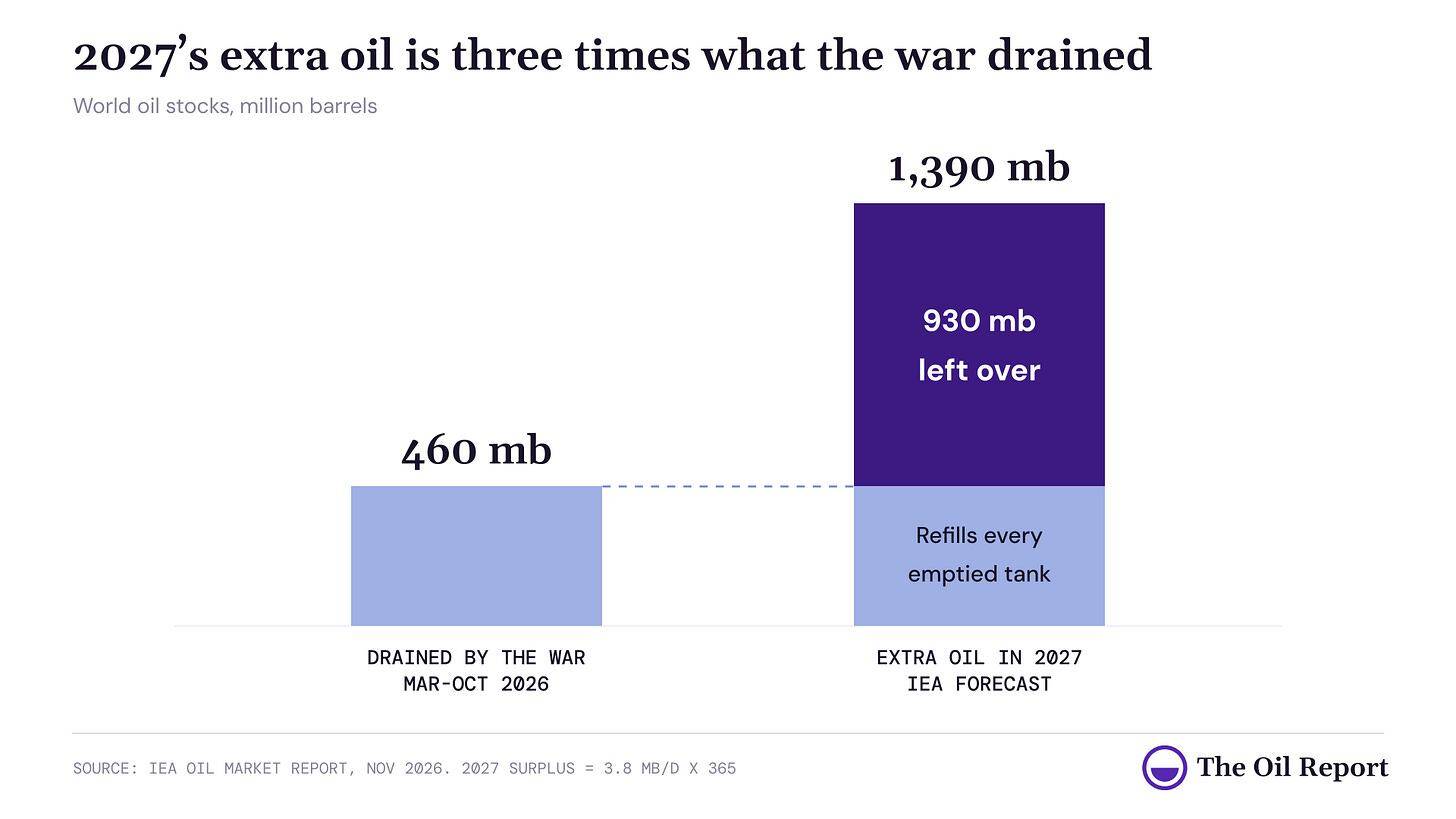
Added to the EIA/IEA glum, Goldman warned of a “sizable” surplus in 2027 (Bloomberg, 16 Nov 2026). JPMorgan has persistent oversupply holding Brent in the high $70s in 1H 2027 and the high $60s in 2H (OilPrice, 23 Nov 2026). Bank of America the hold out, has its 2027 Brent forecast at $80. BOA called the Dated Brent premium a sign of acute scarcity in the prompt physical market-adding also that water is indeed wet. Three banks, three calls. That split is the trade, and it is also the risk.
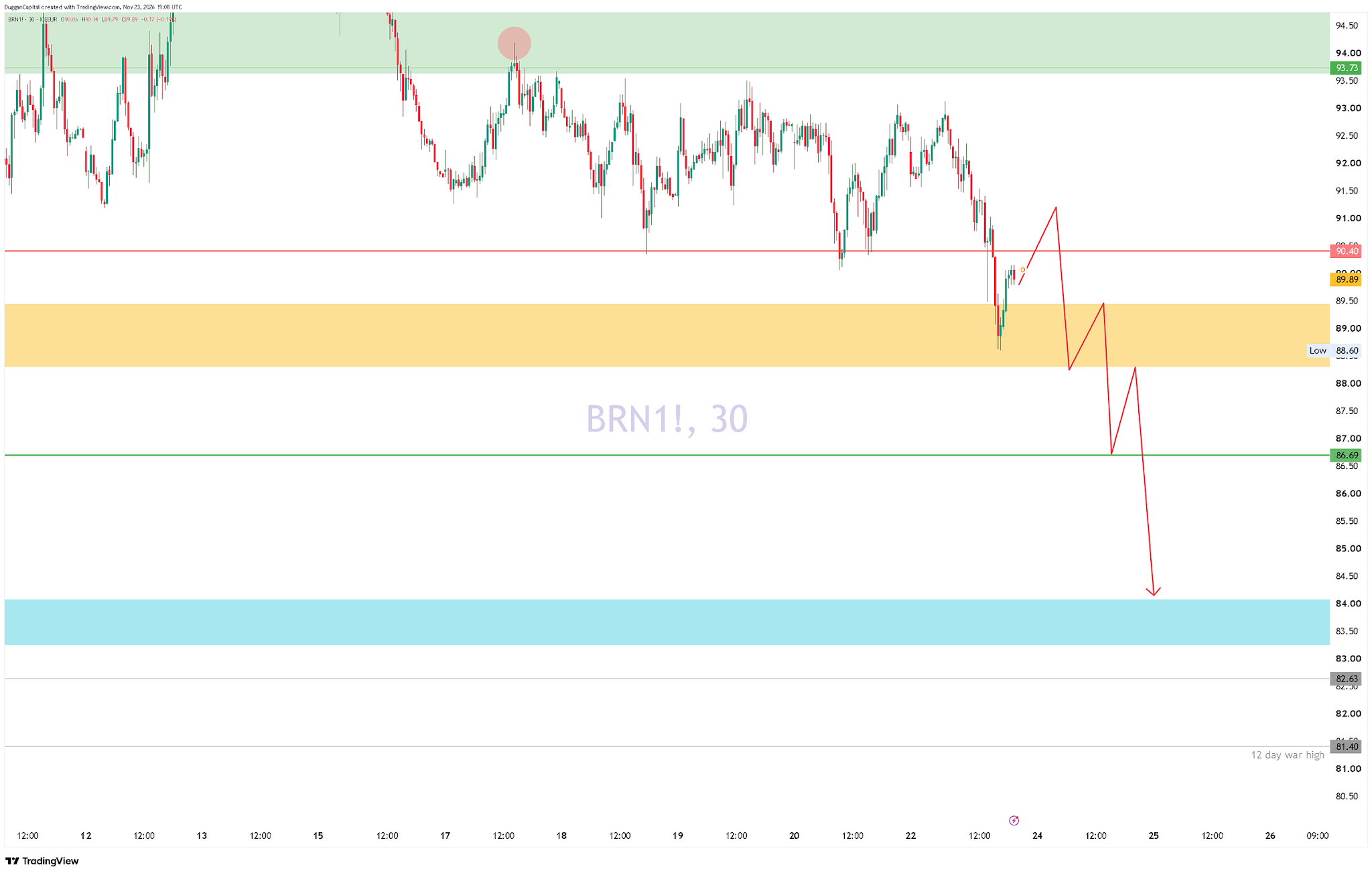
Regardless of who said what, the market topped out in October when the Petroline was hit. Successive hits thereafter, have also failed to interest the bulls. The EIA/IEA glut narrative is without a shadow of doubt, pricing in! So this is where you can talk all you want about balances, but at the end of the day, PRICE IS TRUTH!
The Evidence for Glut
Global observed stocks rose 52 mb in October and oil on water rose 86 mb (IEA OMR, Nov 2026). Derived: onshore stocks drew 34 mb, and the IEA says on-land stocks remain at their lowest in the IEA’s data back to 2016 (IEA OMR, Nov 2026). The glut is floating as it always is really. On land the picture is mixed. OECD crude stocks stood at 1,353 mb in September, up 23.8 mb on the year but only 0.1 mb on the month, while product stocks were 81.1 mb lower than a year ago at 1,458 mb (OPEC MOMR, 11 Nov 2026). Crude long, products short.
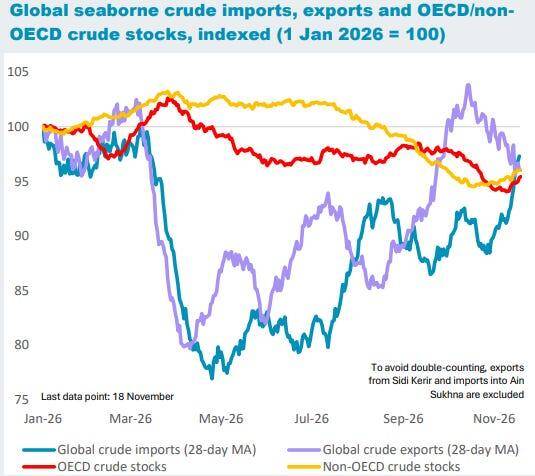
Vortexa sees the same barrels land. Crude in floating-roof tanks rose 28 mb in the week to 20 Nov, the first significant global stock build since March. Imports hit a wartime high of 43 mbd over 1 to 19 Nov, excluding Ain Sukhna (Vortexa weekly oil report, week to 20 Nov 2026). Exports have eased 3.5 mbd month on month as of 15 Nov (Vortexa, 28-day average, Nov 2026). Imports 3% below their 1 Jan level are still enough to build stocks (Vortexa, 28-day average to 17 Nov 2026). That is the bears’ evidence. BofA’s scarcity call has to beat it. Hormuz crude and product flows as per in-house satellite tracking systems in The Net Net section as below.
Brent Oil Price Forecast
Every new Brent Oil analysis as it publishes, today's technical signal and key levels, live price — on one page.
See all Brent Oil forecasts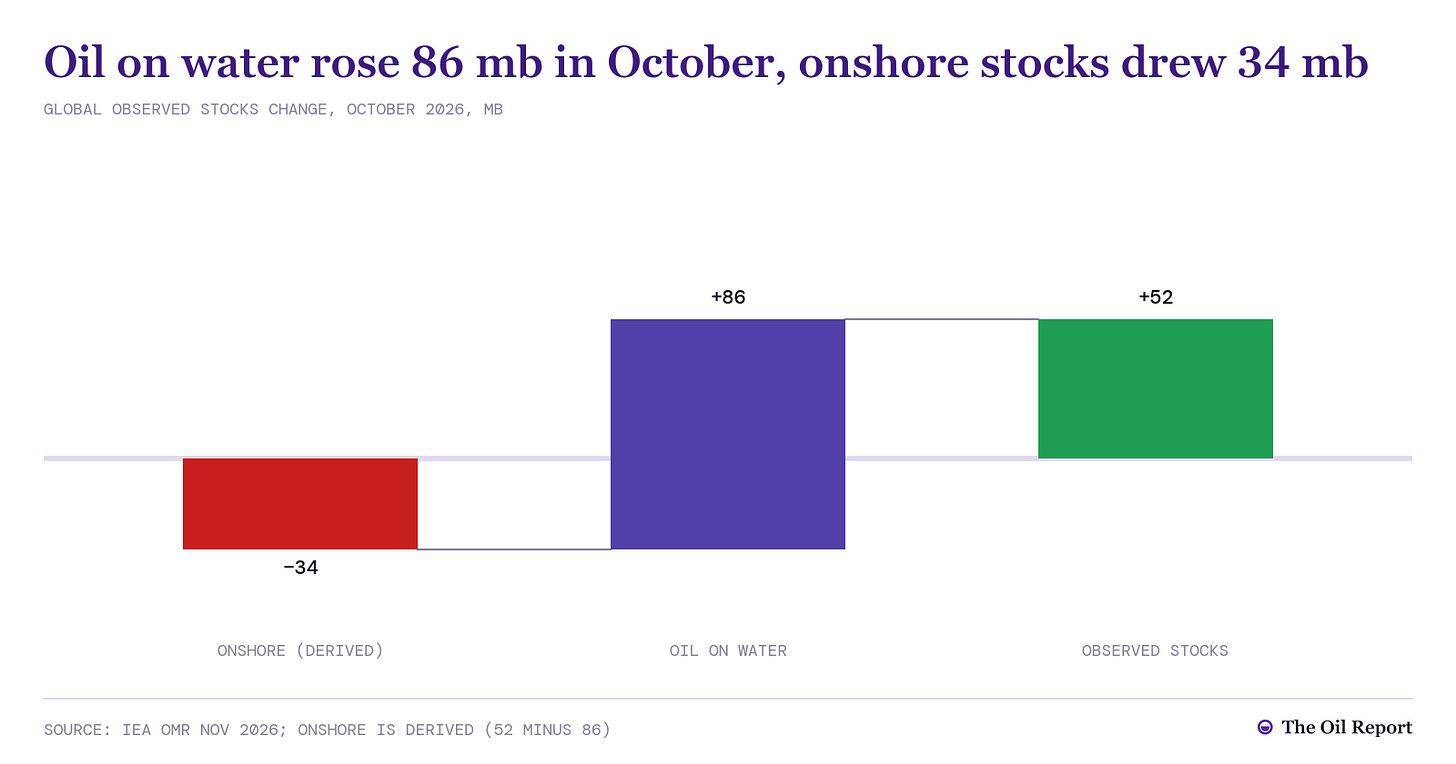
The Curve
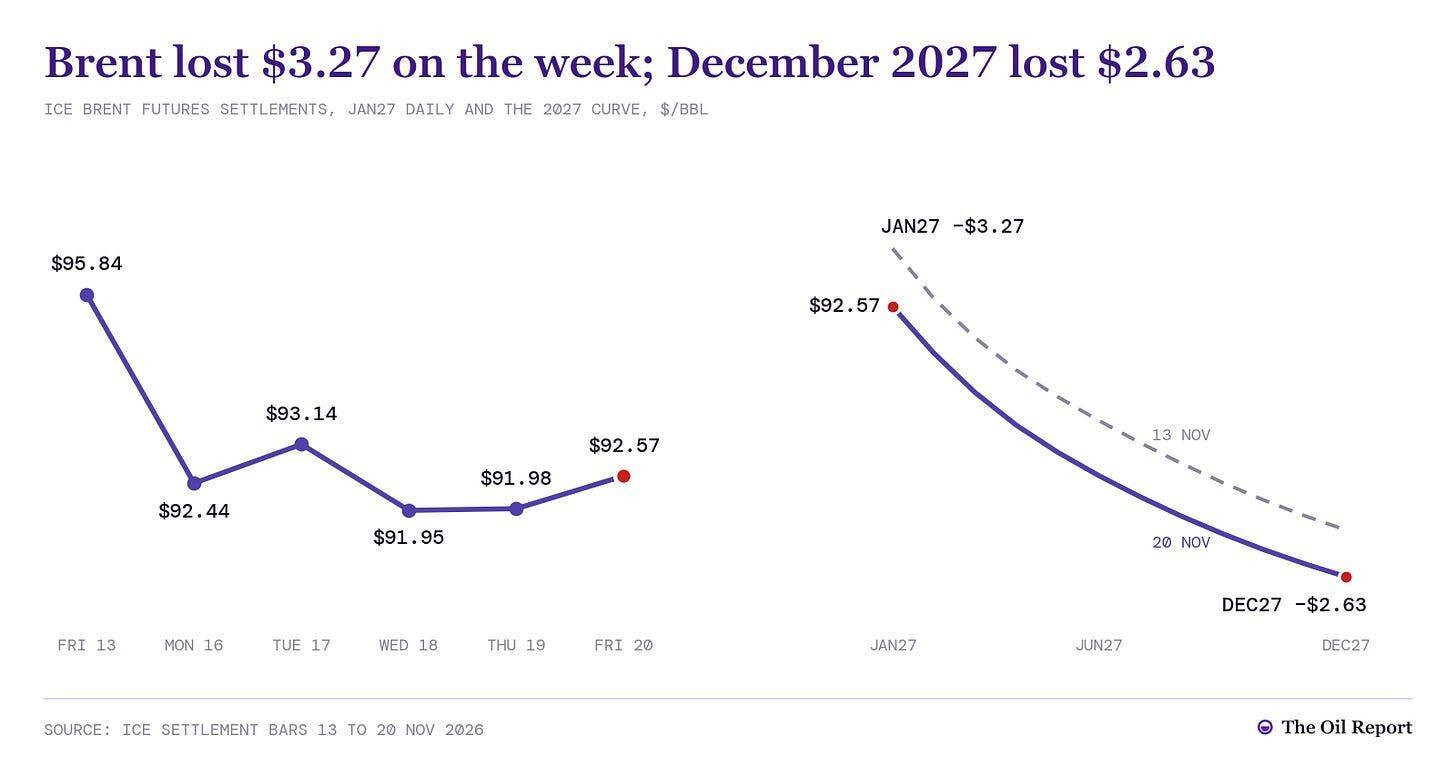
The curve has priced it already. The EIA has Brent near $100 for the rest of 2026 and $77 in the fourth quarter of 2027 (EIA STEO, Nov 2026). Now look at the futures. Dec27 closed at $77.35 on Friday, $15.22 under the front month at $92.57 (derived from ICE, 20 Nov 2026). One month against a quarterly average, but it is level with the EIA’s $77. The market is not waiting for the EIA. It already pays for the glut in 2027.
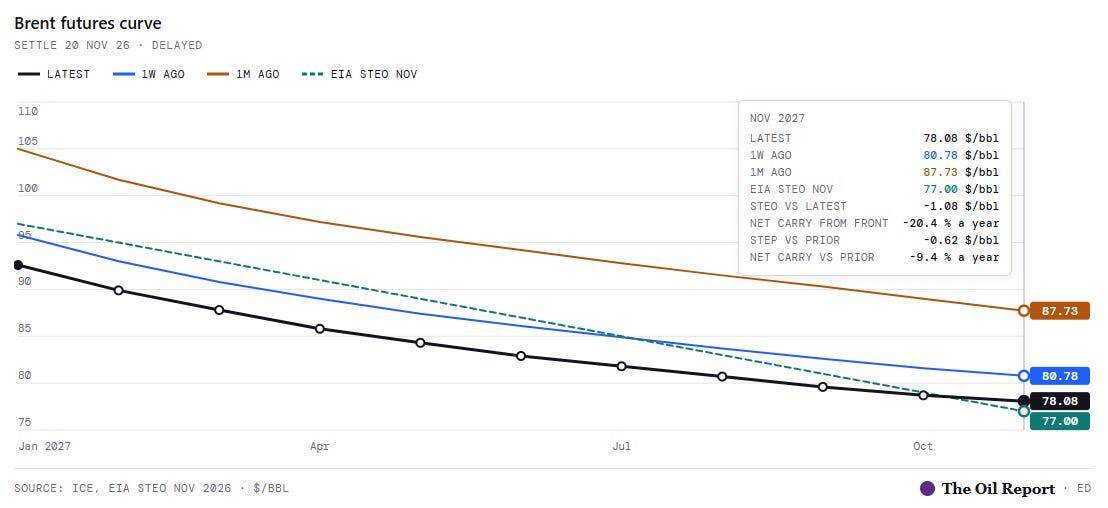
That $77 rests on one assumption: most Middle East production outside Iran is back to pre-conflict levels by mid-2027 (EIA STEO, Nov 2026). So every glut forecast is a Gulf forecast.
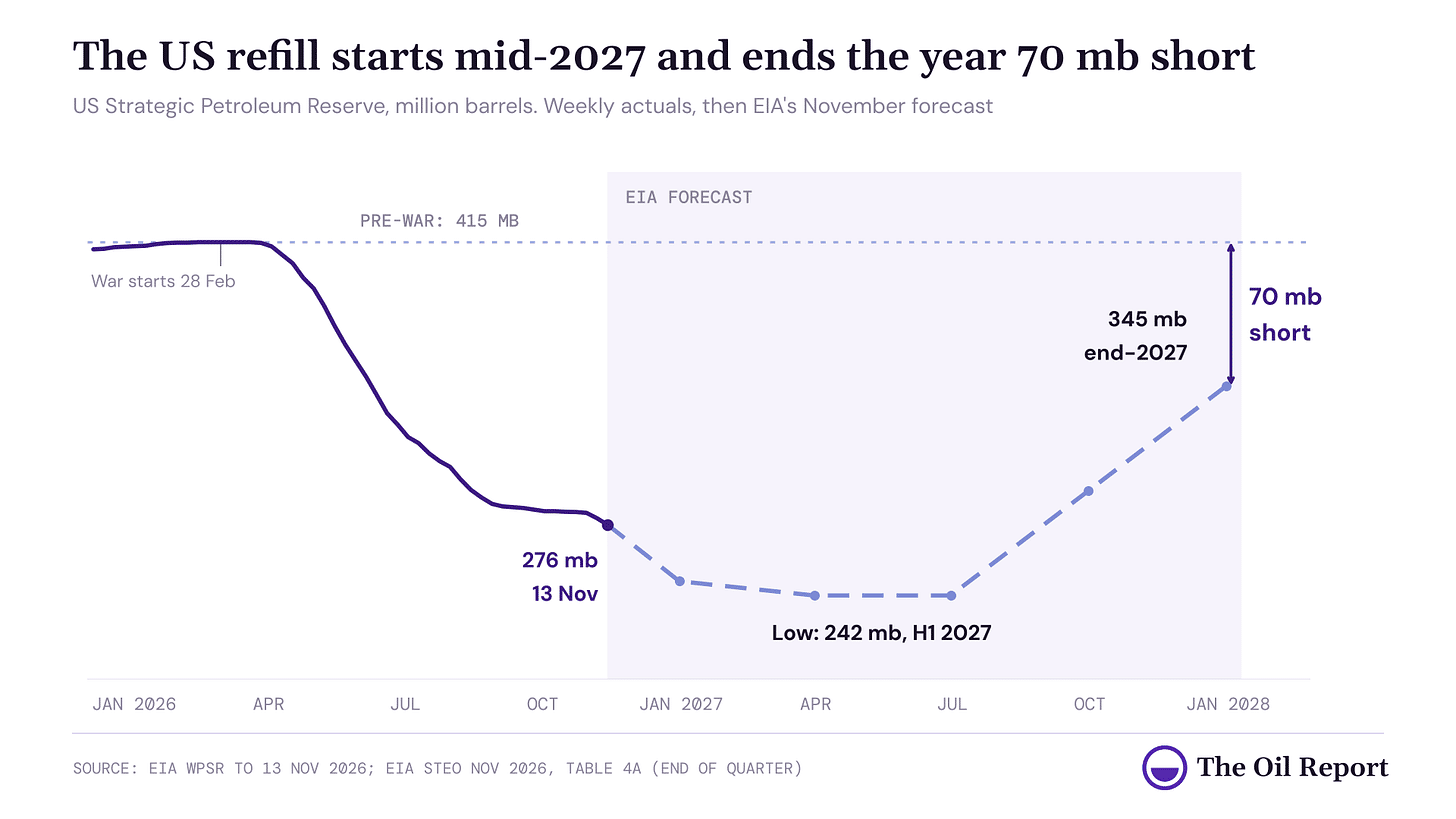
Counter-datum, straight after the EIA STEO was released: US commercial crude fell to 410 mb at the end of October, the lowest end-October level since 2014 (EIA STEO, Nov 2026). Inventory at home is not the glut.
The tap has to stay open. China took the discount so far and these prices are thoroughly designed to keep them on the sales floor: crude imports hit their highest level since the Iran war began. Gulf crude exports reached 15 mbd in October, 82% of pre-war (IEA OMR, Nov 2026). Oil on water is a pipeline effectively.
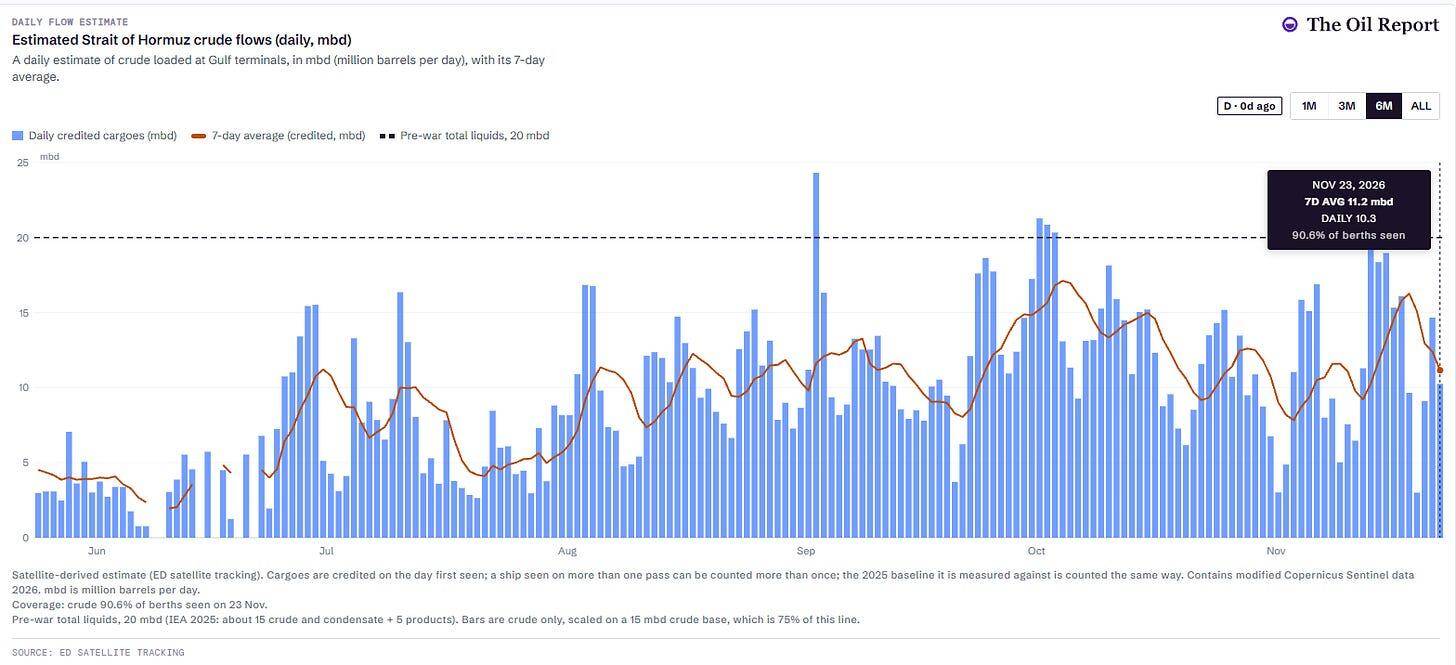
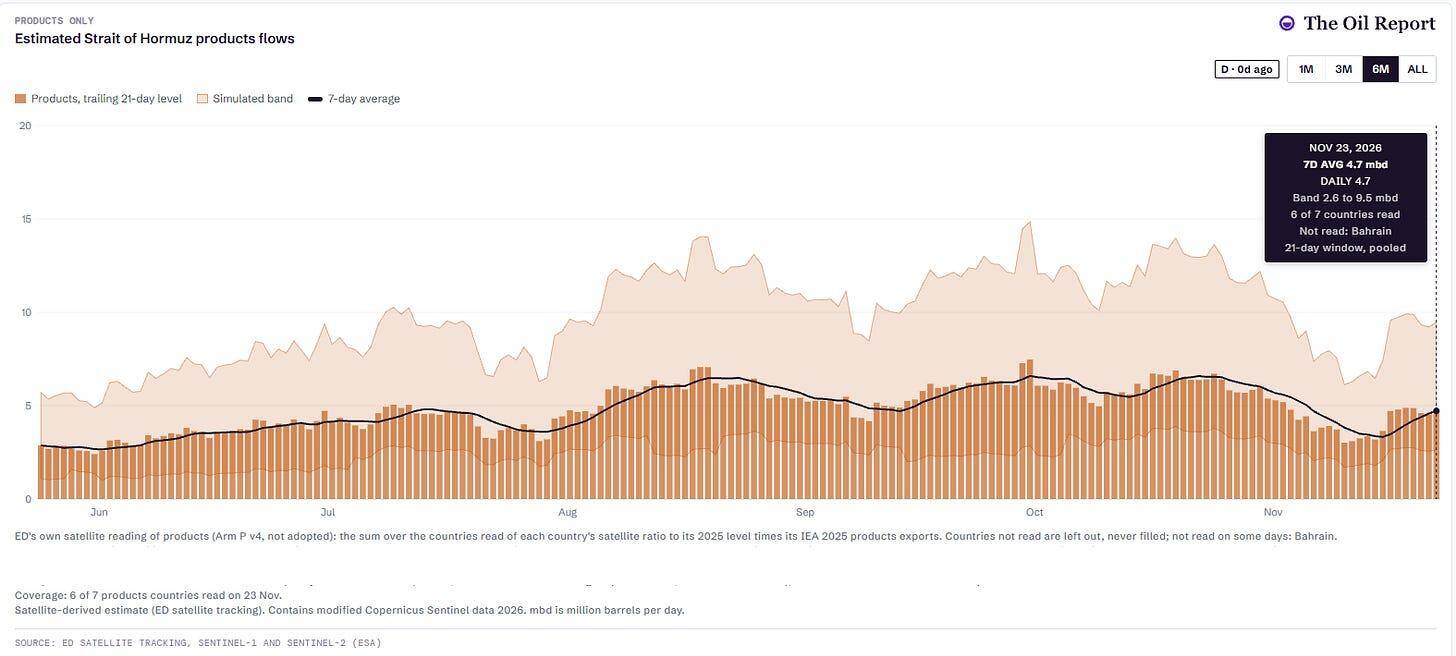
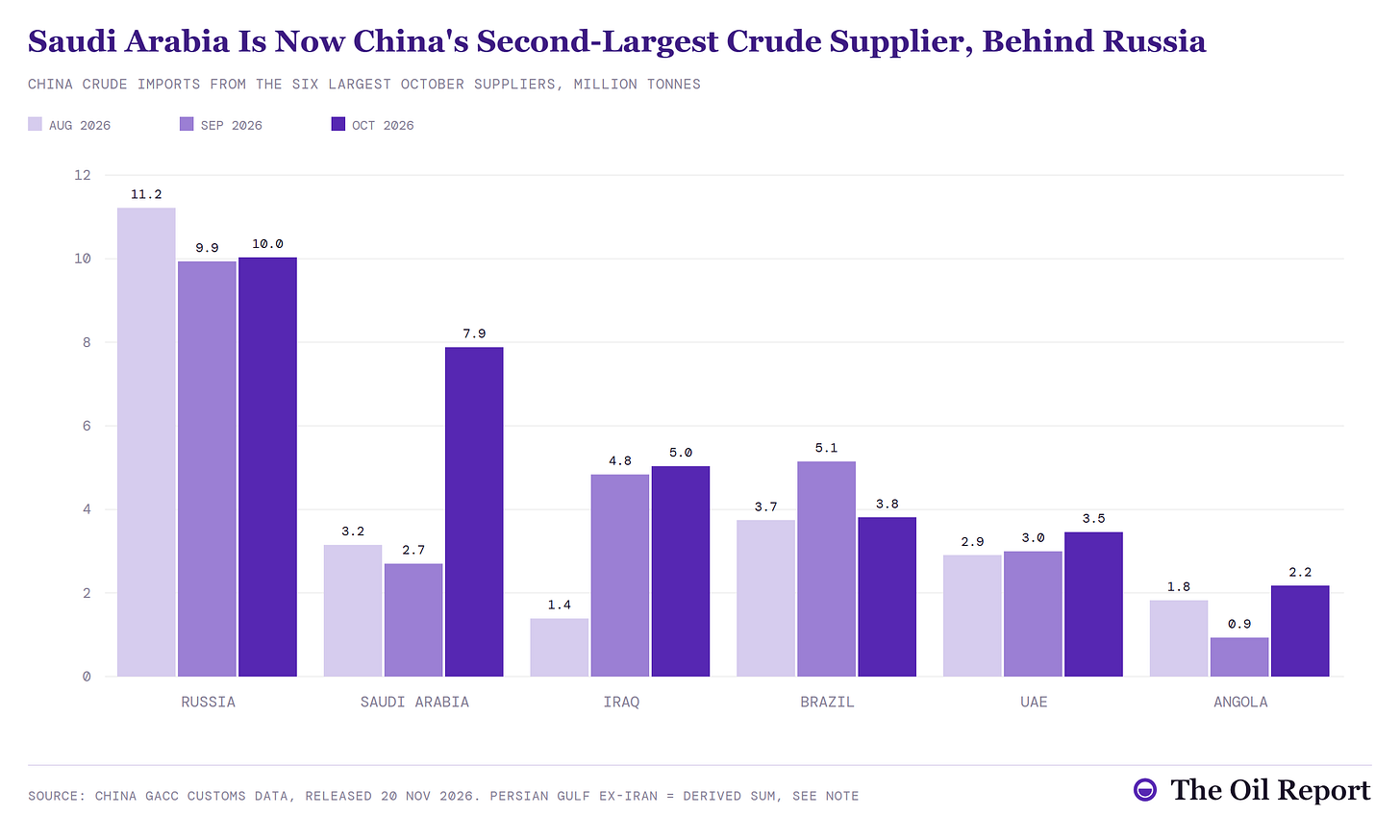
If you think oil is still as tight as it was back in March through June, you have to let that concept go. Flows essentially are telling us that for now, regardless of Hormuz barrel counting, it is over! The evidence is in the large increase in China purchasing. Inspired by the deep discounts mentioned over the last 2 reports on the Saudi and MEG grades. Prices so good China cannot say no.
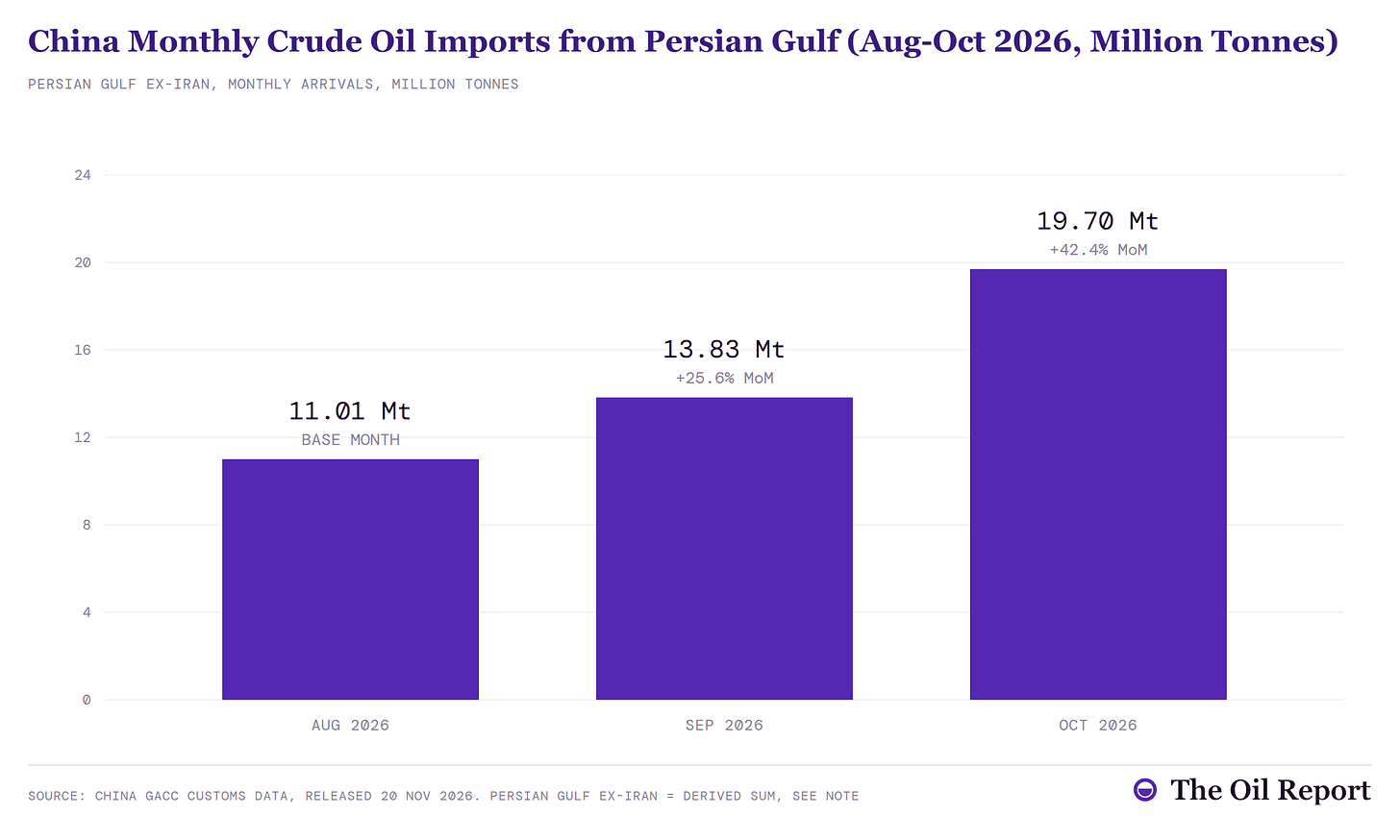
Something that is easy to miss in all this, is that these flows may contain the ‘Hormuz toll’. I can’t tell you. The last confirmed collection I can source is April (Tasnim, via Addis Standard on X). On 9 Nov Hayom reported Iran had dropped its fee demand, which I haven’t been able to confirm.
The falsifier to this concept of ‘over’ (ie I am bang wrong), is that we see a significant resurgence of kinetic warfare in the region, not limited to Hormuz. I’m talking about Suez, Bab al Mandeb, Abqaiq facility etc. If you were to ask me where a 15% upside shock would come from, it would be a large strike on Abqaiq OR Suez.
December, the print. The December IEA report gives Gulf crude exports for November. October was 15 mbd. At or above 15 mbd, Goldman and JPMorgan are right and BofA’s scarcity call goes in the bin. Below it, BofA is right. The 7 day average Hormuz flow is 11.2 mbd (in-house satellite tracking, 23 Nov 2026). That is a different measure: the IEA figure is Gulf crude exports, which include barrels that leave outside Hormuz.
Diesel is the tight leg whatever the crude does: Dated diesel was near $180/bbl in the November report, down 11% but 77% above pre-war. Cheap crude, expensive diesel. Get ready for a pump that does not care about your Brent chart!
Commitment Of Traders Report
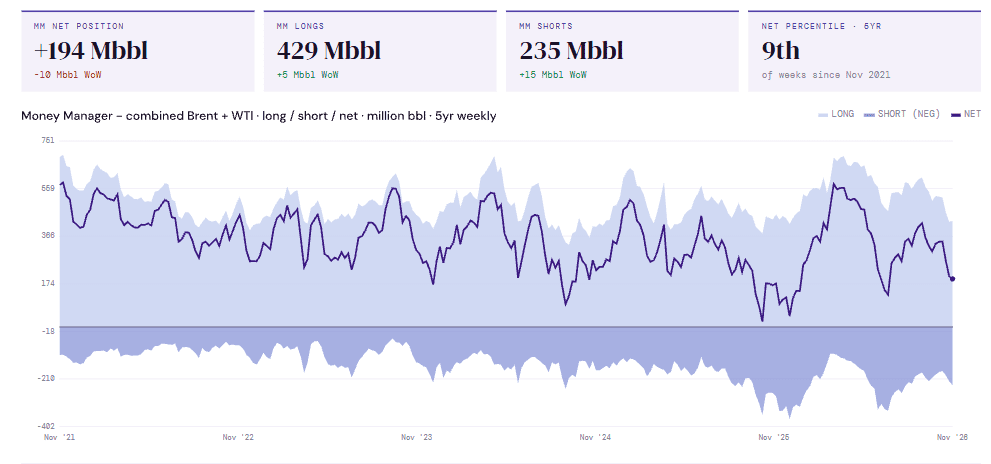
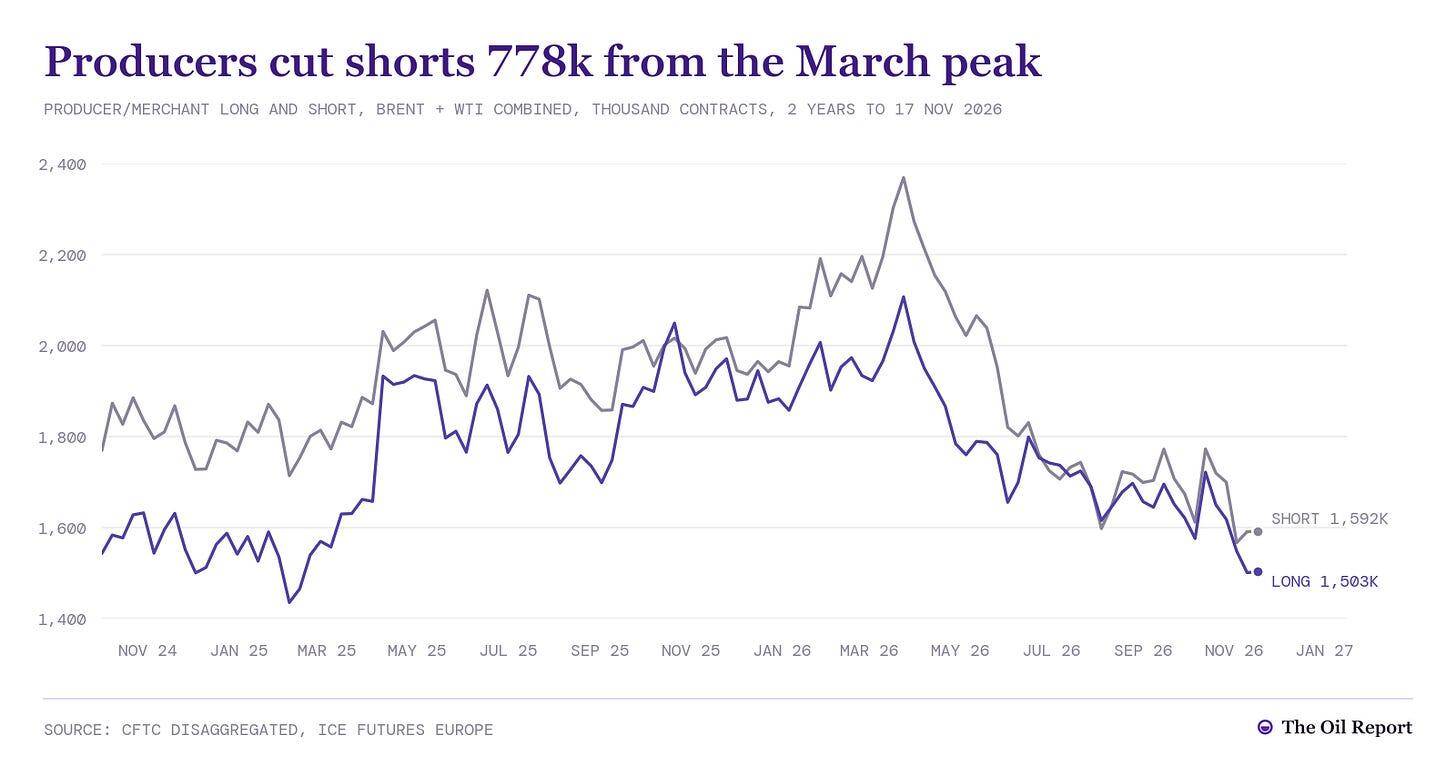
Commercials are on opposite sides of the two benchmarks. In my view WTI is where the glut meets resistance first.
Seasonally, I am always monitoring the refiners and producer cohort for insights. We are seeing on the combined exchange reports that they are back to levels last seen in Jan-March this year. Moving into a glut, this cohort should continue in the same fashion. I presume they are buying at the middle and back of the curve and selling product and crude in the front through continued war backwardation.
The Read
Net net, I’m not seeing any signal they are back filling stores yet for driving season. This will be the alpha signal as to when bulls can come back out of their pens to fight ‘The Glutters’
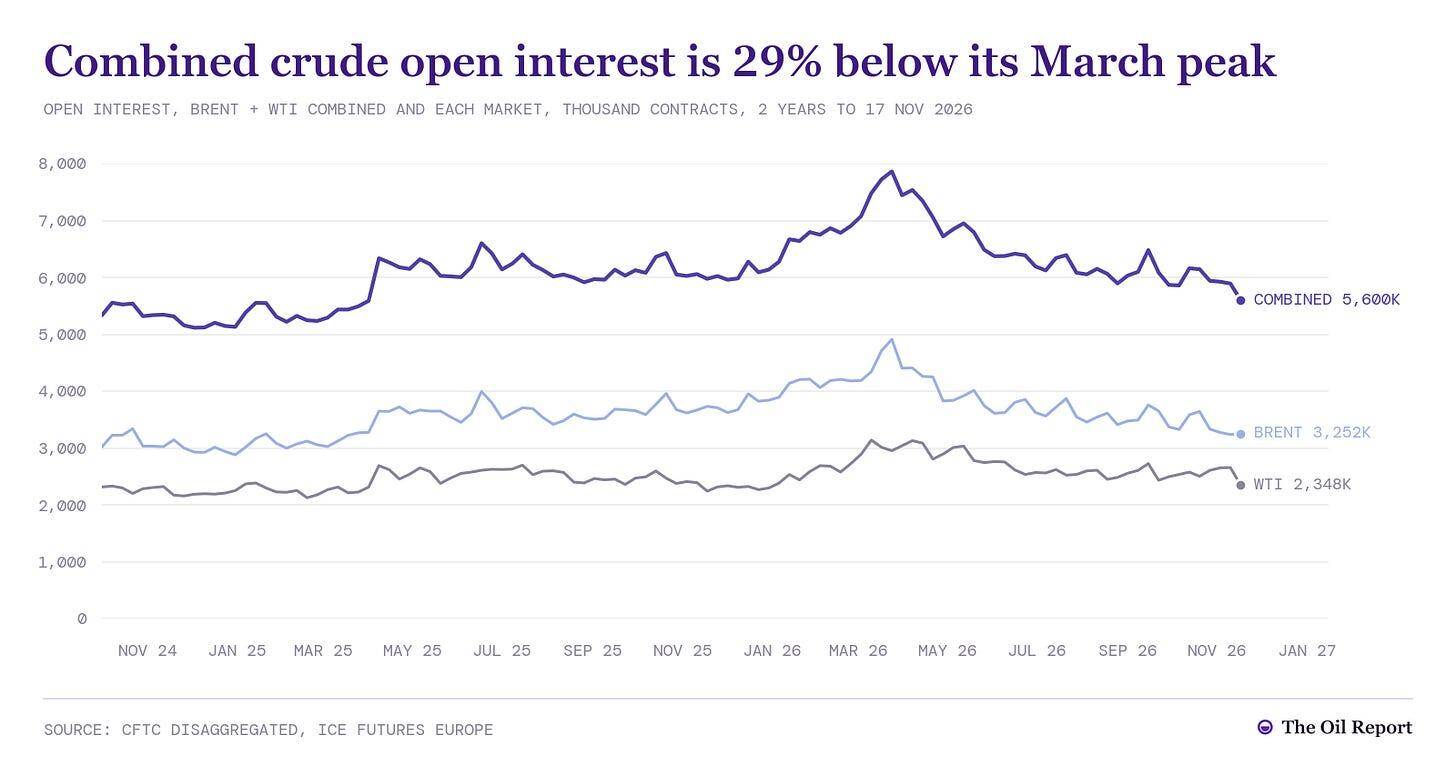
Open interest continues to drop back to 24/25 levels.
What’s the Next Move?
We move to the lower risk premium floor. There will be buying pullbacks on the aforementioned risks. Iran will know the shape of this pitch. Because of this, the next moves from Iran may be significant actions. They know now that small limited strikes and attacks cannot make Trump hurt any further and the market will price it out swiftly. The mid-terms outcome worked just as well as several missile attacks ever could have.
That’s the report!