
Ethereum (ETH) has shed 10.3% of its value in the past 30 days, effectively turning into the worst-performing asset of the top 5 during this period.
The selling pressure once again ramped up after the token hit the $2,400 level, but volumes have dropped significantly. At around $13 billion, they account for only 5% of the asset’s circulating market cap.
During the latest buying spree, volumes rose to at least 10% of ETH’s market cap. These thin volumes give sellers much more control over the price action. However, they do not indicate massive capitulation yet.
We have been tracking ETH’s key levels for weeks, and the $2,150 area is our ideal support area for a late entry. However, if this price level is broken, that could endanger the latest rally as it could trigger a cascade of liquidations.

ETF Inflows and On-Chain Data Turn Bearish
Net inflows to exchange-traded funds (ETFs) have been negative for 5 days in a row, indicating that investors are once again fearful. In total, market participants took out $256 million from ETFs after the price rejected that move above $2,400.
The Fear and Greed Index also reflects this, as this sentiment gauge has dropped to 42, already nearing “fear” territory.
Looking at on-chain data, a worrying spike in net inflows to exchanges could anticipate a strong decline for Ethereum.
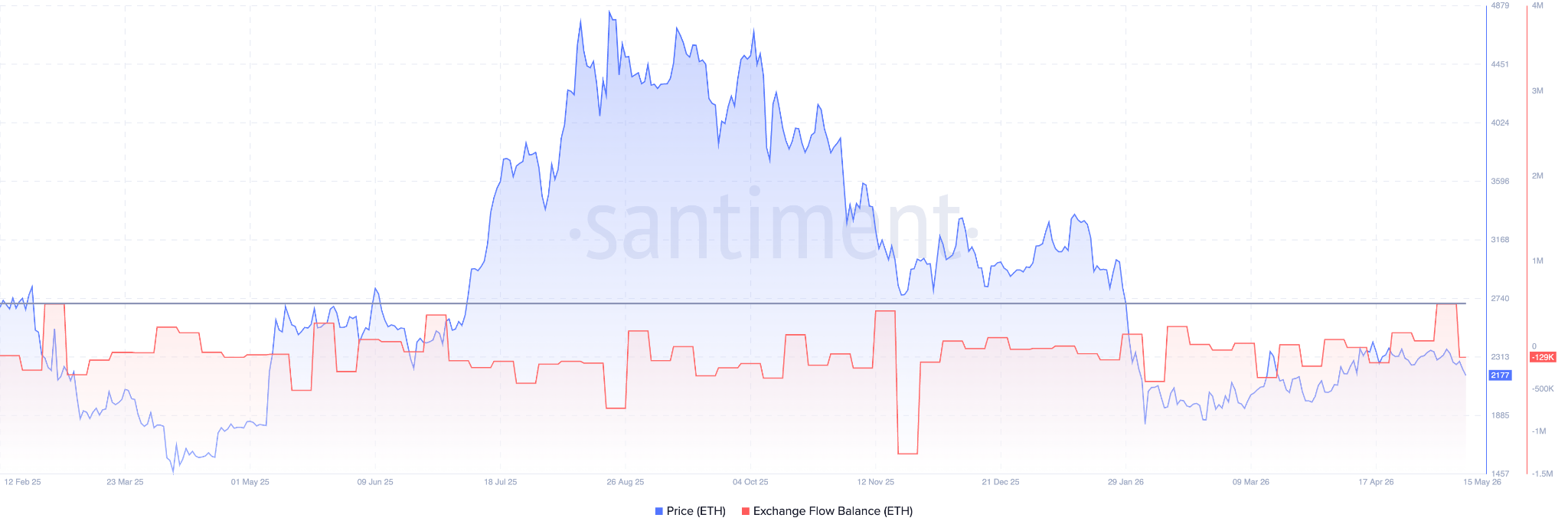
Approximately 500,000 ETH tokens flowed to exchanges during the first 10 days of May. This was the highest spike in inflows since March 2025, back when the market tanked, and ETH dropped to its cycle low of $1,400.
Paired with this week’s drop, we may either be witnessing a full-blown dump from whales that would confirm that this latest price spike was just a “bear market rally,” or this could be a natural reaction from cautious investors who don’t yet think that this bearish cycle is over.
Meanwhile, data from Artemis also shows a significant drop in transaction volumes, which indicates that network usage plummeted.
During the weekend ending on May 3, transaction volumes hit a new all-time high of 21.8 million. However, last week, they closed at 13.6 million, resulting in a 38% drop.
This could result in lower demand for ETH as a settlement token, and could also mean lower demand for DeFi apps. These are also bearish signals.
Weekly Buy Signal Still Stands Despite the Latest Drop
Heading to the weekly chart, we have been keeping track of a historical buy signal in the Relative Strength Index (RSI) that has yielded some strong gains in the past.
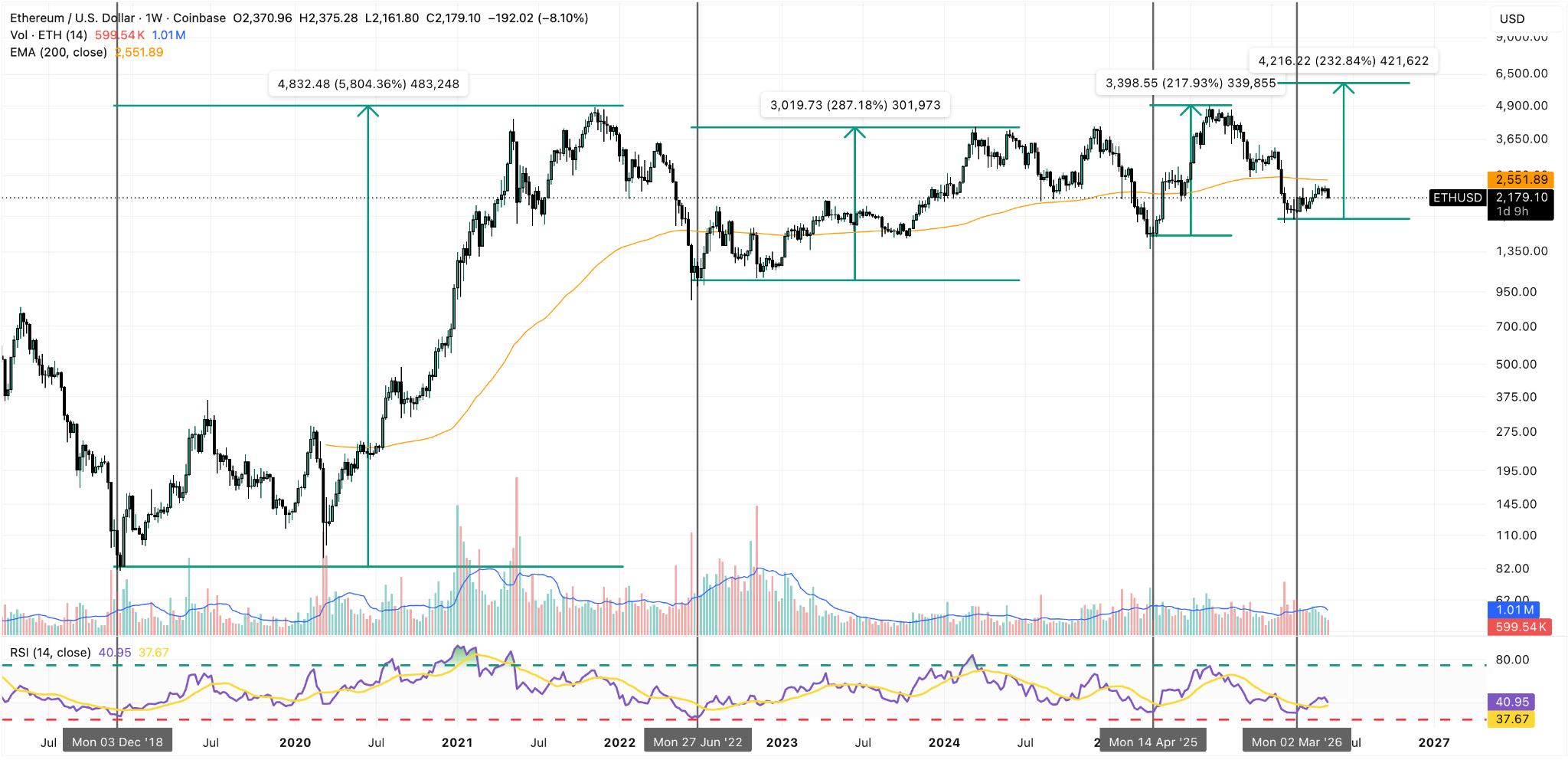
In the past 8 years, every time the RSI has dipped below 30, it has signaled a cycle bottom for ETH. Just a few months later, the token had delivered gains between 200% and 5,800% (extreme tail, of course).
The RSI just rose above the 14-week moving average, which has often marked the beginning of these rallies in the past. We have seen in previous instances that the price has come back down near previous lows even after this signal pops up.
Hence, even if ETH drops to $1,800 again, which should be the model’s “cycle bottom”, we can still expect it to rally over the next 6 to 12 months.
We still maintain our baseline scenario for ETH, which involves a rally to around $5,400 during the next bull market. Hence, the token is currently in “buy” territory for buy-and-hold investors, but not for swing traders.
ETH Could Hit $2K as Momentum Turned Bearish
Moving to the daily chart, we expected a full-blown reversion to the mean move if ETH broke past the $2,400 sell wall. However, that ceiling still stands and has become the key resistance to overcome.
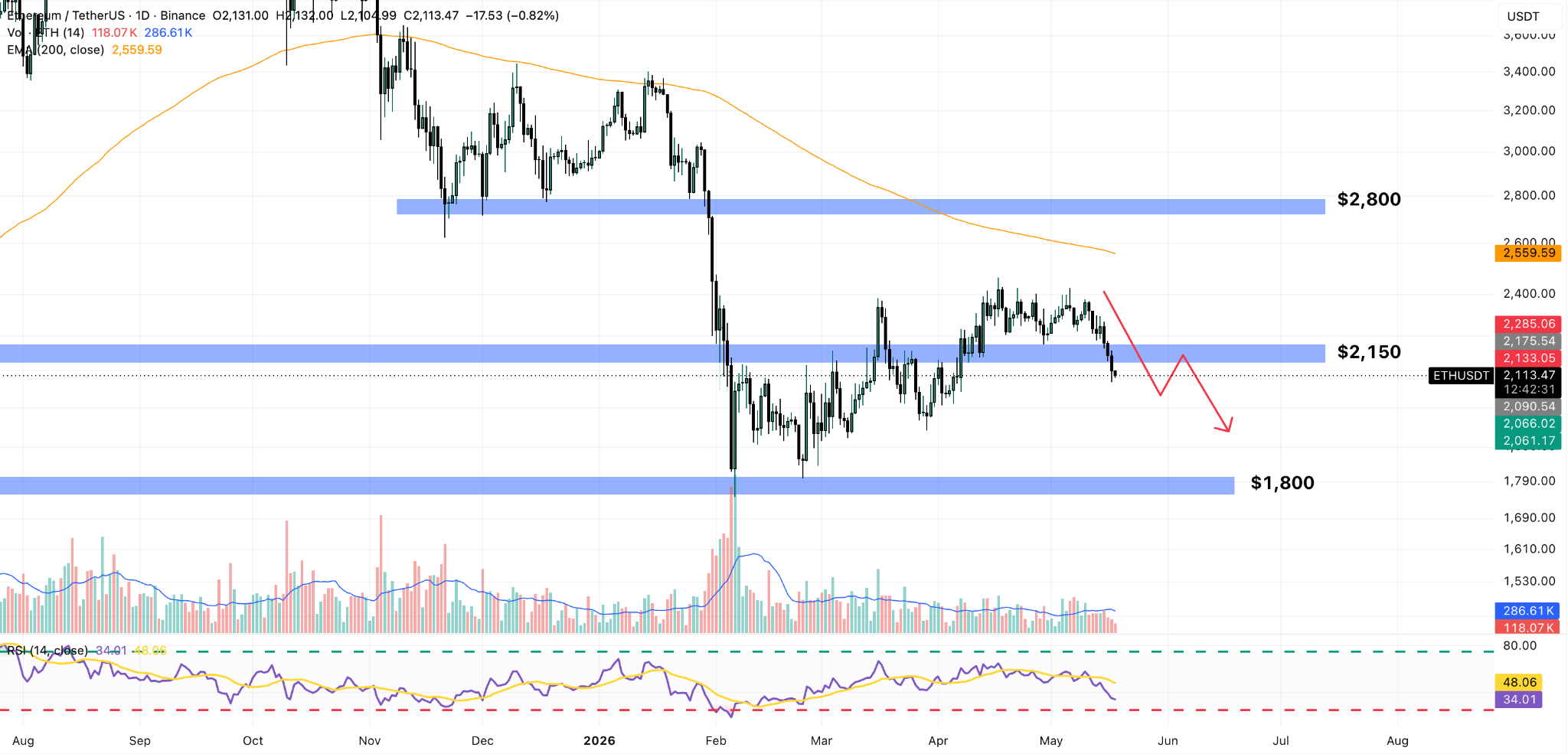
Now the price action has broken below a key area of resistance at $2,150. This was a test of buyers’ conviction and they failed. However, short-term price movements in the crypto market tend to be heavily influenced by liquidations.
Don’t be surprised if the price dips below this market, everybody starts to panic-sell, longs get blown up, and we get to $2,000 before ETH finally recovers. In the past 24 hours alone, over $600 million worth of long positions in the crypto market have been liquidated.
This is not a bloodbath yet, but it could turn into one if the price dips below this mark. Liquidity remains thin, and the market needs more fuel to keep rallying. It will probably find it below, and $2,000 is both a psychologically and technically relevant level. That might be where we are heading now that the price has dipped below $2,150.
The RSI just turned bearish in this higher time frame, dropping below 40 for the first time since February, but now the oscillator is on a downtrend and has broken below the signal line.
We also got a “sell” signal right after the rejection of the $2,400 level. That one yielded some positive results. However, we are not bearish yet, unless the $2K support is broken.
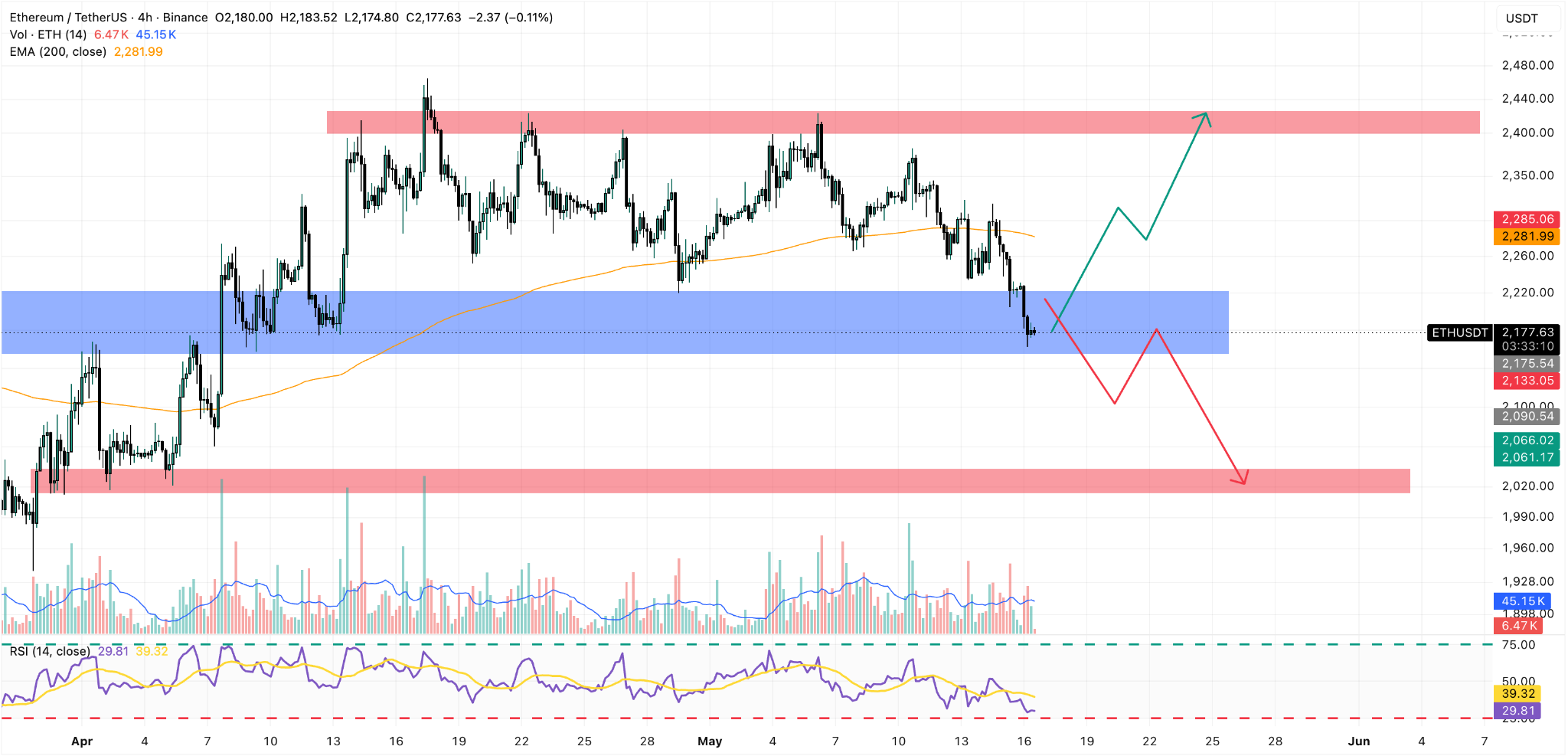
Heading to the 4-hour chart, this is how we are currently charting the price action. The price could drop to $2,000 and bounce off that psychological threshold to resume the rally.
A trading opportunity would emerge at that level, setting the $2,400 area as the next target. We are still bullish in the mid-term despite this retreat, due to ETH’s powerful buy signal in the weekly chart.
Meanwhile, in this lower time frame, we have already hit oversold levels in the RSI. That increases the odds of a bounce.
In contrast, if we get a bearish breakout below $2K, the odds that this rally will be over will increase dramatically and the downside potential would be much higher as ETH would likely aim at $1,800.