


It’s usually shocking when you first find out about it: ETFs typically don’t perfectly mirror the returns of the indexes they seek to track. Occasionally, the gap is only a shade off. Sometimes not even close.
If you buy an S&P 500 ETF, you’d assume you’re getting the same return you’d get if you bought the S&P 500. But, say, a year later, you check your statement. The index is up 10%, while the ETF only returned 8.3%. Where did the remaining 1.7 percentage point go?
It went into the places nobody ever bothers to look.
There’s the cost of rebalancing, the lag caused by when dividends are distributed and invested, the drag on performance that results from fees, the tracking error, the cash that sits idle while it’s waiting to be deployed, and the fact that securities lending revenues don’t all flow to the fund’s investors.
None of these are theft. They are mostly inevitable parts of the ETF business model, too. But they still eat away at your returns. And, by knowing where to look, you can dodge the worst-performing ETFs.
In the following section, I’ll go over what I’ve observed in my time analyzing and managing ETFs, some of the key metrics I evaluate before investing in a specific fund, and the specific structural elements that influence a fund’s realized returns.
Index Rebalancing and Its Real-World Impact
The most predictable source of return slippage starts with index rebalancing.
Indexes aren’t fixed. Instead, they operate on a series of guidelines that determine which stocks qualify for membership and which get kicked off. These criteria can include thresholds on:
- Market capitalization — does the company meet the minimum size requirement?
- Share price — some indexes drop stocks that fall below a price floor
- Daily trading volume and liquidity — minimum activity requirements
- Free float — how many shares are actually available for public trading, not locked up by insiders
- Listing standards — exchange requirements where stocks trade
The most predictable thing about index rebalancing is that the reconstitution dates are published, and the guidelines that trigger an addition or removal of stocks are published. Every professional investor in the market knows precisely when the next reconstitution of the Russell 3000 is, and approximately which stocks will be added or subtracted.
By the time a particular index fund actually needs to execute the trades, other market participants have already front-run it.
For instance, a company is identified as a likely addition to the S&P 500 index. The stock then rallies 5%, then 10%, or more, over the weeks prior to the official announcement. I remember watching Tesla in the months leading up to its index addition in late 2020. Shares surged as the market began to anticipate an increase in demand for its stock, leading to a large increase in market capitalization as a result. Then the day comes when the index funds do their purchases in the newly added stock. They pay the higher price.
The added cost then gets passed on to index fund owners as underperformance. Factor in the trading costs of the transaction itself, plus the commission, plus bid-ask spreads, plus the time that most index funds are buying (around market close, so they all have the same price for that day), and you effectively have a performance tax for ETF investors. The higher the turnover of constituents, the bigger the drag. Broad indexes like the S&P 500 have low turnover (around 25 out of 500 constituents per year), but the constituent turnover for sector and thematic indexes can be high, which is one explanation as to why some sector and thematic funds underperform their benchmark.
Dividend Reinvestment and Payouts: Where the Lag Comes From
This is the one that blindsides most people. In the index, dividends are reinvested at the close of the business day. ETFs can’t replicate that.
Even when the dividend is reinvested in the ETF (most do that), there is a delay between when the dividend arrives and when it is reinvested in the underlying stocks, ranging from days to weeks. Dividend income sits as cash and earns a yield of nearly 0% while the stocks rise (or fall), meaning the ETF lags (or beats) while cash sits idle during that time.
If the market rises during the cash dividend delay window, the ETF loses. If the market drops during that same period, the ETF makes more money because the lagged reinvestment allows it to buy in cheaper. However, stock markets rise more often than they fall (on average over a long period), meaning that the delay generally adds to the drag.
The lag time can increase significantly for dividends that are paid out in cash. Depending on whether you choose to reinvest the dividends through a DRIP provided by your online broker or simply buy the stock yourself, the delay in reinvestment can easily be weeks.
Foreign investors can have a slightly different experience, too. If a US-listed ETF pays a dividend but you’re a foreign investor outside the US, your dividend will often be subject to withholding tax, with rates from 0% to 30% depending on your tax country of residence and the treaty between that country and the US. Index benchmarks don’t typically assume withholding tax, meaning your return will fall further short of the benchmark as compared with what would be the case without tax.
The takeaway: in theory, the index benchmark assumes perfect and frictionless dividend reinvestment in an unhindered world, while reality in the ETF is that dividends are taxed, lagged, and paid out in cash.
Explicit vs. Implicit Costs: What’s the Difference?
There are essentially two layers of costs for ETF investors, which are often not clearly communicated to investors at the time of purchase. Here’s the full landscape:
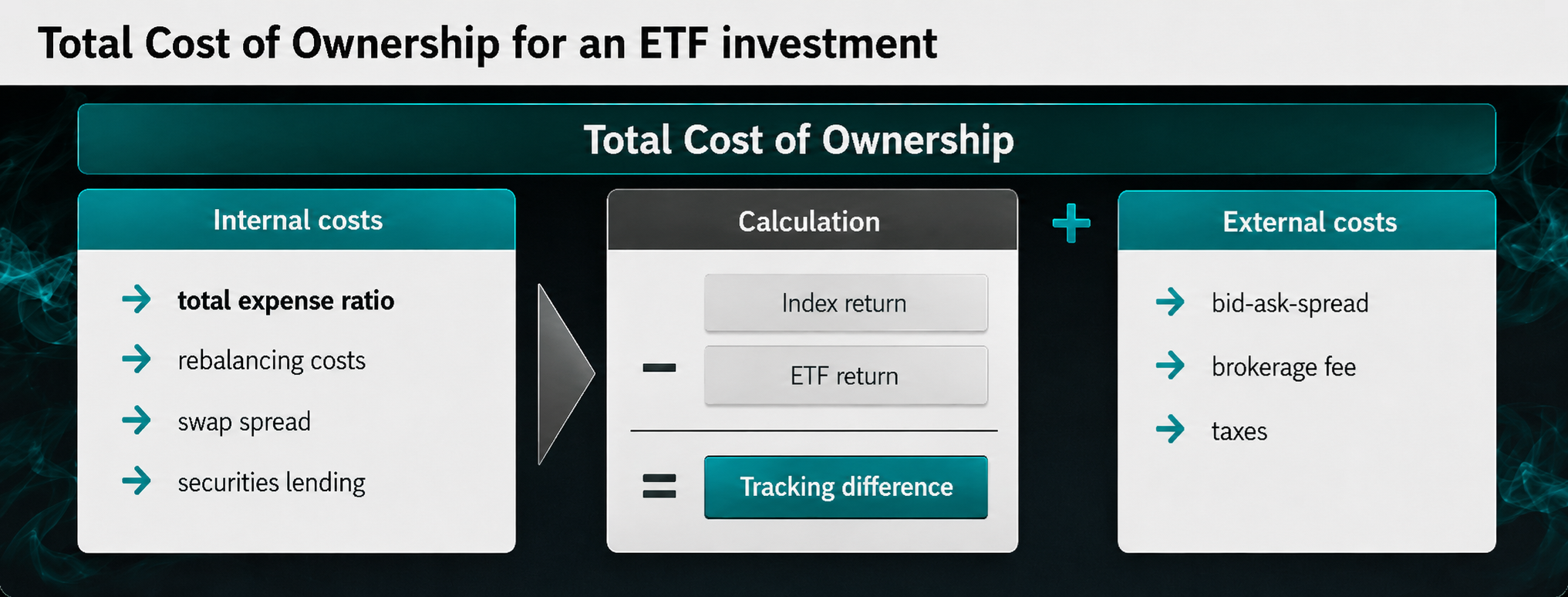
Total Cost of Ownership for an ETF investment.
Explicit Costs: The TER and Transaction Fees
The explicit costs are those you are clearly advised of when purchasing the ETF, specifically the total expense ratio (or TER) for the ETF and any transaction fees.
The TER is the annual fee for holding an ETF that is deducted from your account balance and paid directly to the fund manager, regardless of how that ETF performs in a given quarter or year. It covers the costs of managing the portfolio, legal fees, index licensing costs, and custodian fees.
TERs vary significantly across the industry. For example, the SPDR S&P 500 (ticker: SPY) has a TER of 0.0945%, while the Vanguard S&P 500 (VOO) and iShares Core S&P 500 (IVV) have TERs of 0.03%. Those are tiny differentials, but they add up. Consider the difference in fees across those three ETFs on a $100,000 position held over a 30-year period, which would amount to thousands of dollars between the most expensive and least expensive choice. It all boils down to the same index exposure, the same underlying components, but different real-world returns.
In addition to these management fees, there are any transaction costs associated with buying or selling that ETF in the marketplace. Depending on your account setup, you may be charged a commission, though most brokerage firms have largely eliminated commissions for buying individual stocks and ETFs. Additionally, when you execute the trade, your broker will offer you a price. While these transaction costs can add up for active traders or investors in less liquid ETFs, they generally don’t have much of a material impact on investors.
Implicit Costs: Spreads, Tracking Error, and Cash Drag
Next up are the charges no one seems to mention, which may actually dwarf the TER.
One of these is the bid-ask spread. Whenever the ETF makes trades — including for creations and redemptions, rebalancing, or deploying new cash — there is an amount by which the bid is smaller than the offer. On a heavily-traded ETF such as SPY or QQQ, this gap is just 1 cent on a $500+ stock. But on a thinly traded niche ETF, it can be 20, 50 or even 100 basis points, every transaction of which you incur by paying the difference.
The second implicit cost is tracking error. This is the difference between the ETF’s actual return and the index’s return. Here’s a visual example:
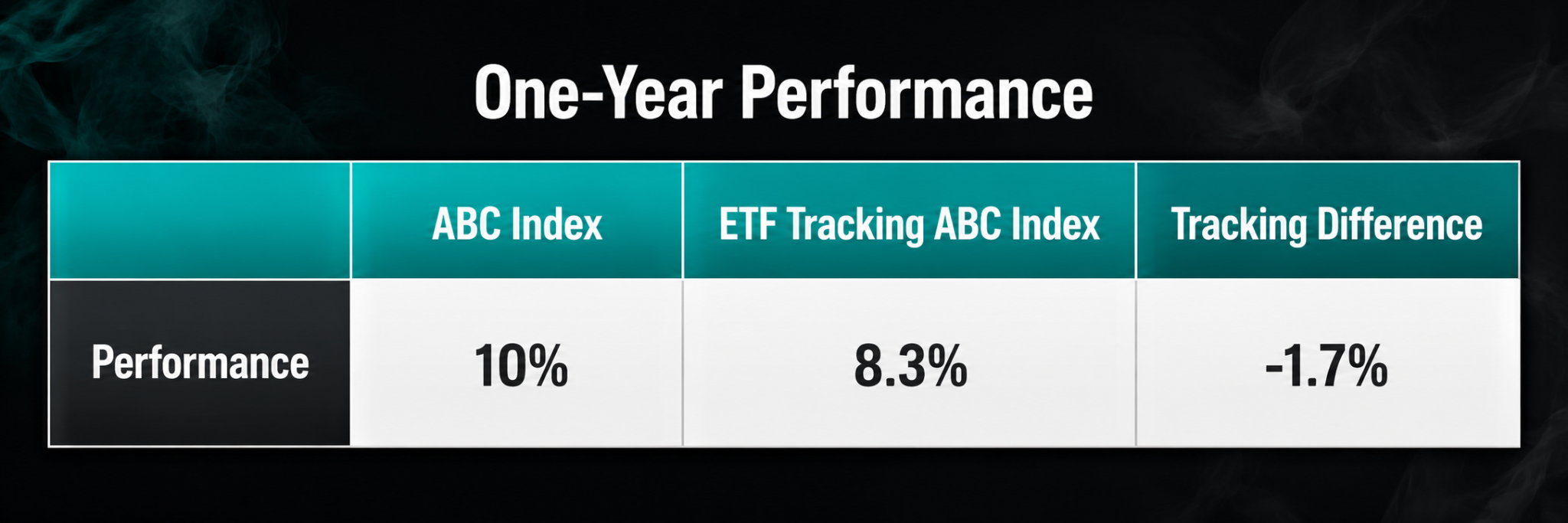
One-year performance comparison showing tracking difference between an index and an ETF tracking it.
The spread of 1.7% reflects tracking error not under control. For context:
- Under 0.5% tracking error → good (well controlled)
- 0.5% to 1% tracking error → acceptable (needs watching)
- Above 1% tracking error → warning for a passive ETF
A US large cap ETF should be within a hair of the S&P 500. Anything less indicates operational issues such as slow dividend reinvestment, bad execution on rebalancing or high implicit costs.
Tracking error can come from many sources: operational expenses, imperfect tracking of an underlying, cash drag, dividend timing and any other minor issues.
The third implicit cost, something that most people don’t know about, is cash drag. Indices operate as if 100% of a given fund is always invested into stocks, while this isn’t possible for an ETF because it must hold some cash on hand for redemptions, distributions, fees, and other operational needs. This cash essentially yields nothing (or precisely zero during low-rate environments), so it represents a drag. This drag is insignificant in any one month, but it adds up.
A more subtle case involves ETFs with underlying markets that are not liquid in general — small-cap emerging markets, frontier stocks, or some bond markets where an ETF doesn’t always have the ability to purchase exactly what the index does. Instead, the ETF employs optimized sampling: the ETF instead purchases a selection that reflects the actual portfolio in terms of statistical properties. This selection is similar, though imperfect, to the index. The smaller and less liquid this underlying market is, generally speaking, the wider the gap between the portfolio and the index.
A small number of ETFs have gone one step further and used synthetic replication. Instead of an actual underlying portfolio, the ETF holds derivatives of the underlying market(s). In a few cases, that can help reduce tracking error. However, it does introduce additional counterparty risk and complexity. Personally, I’d rather own the actual stocks when I can.
Securities Lending: The One Thing Working in Your Favor
There is one aspect of ETF mechanics that is actually favorable for you as an investor, and it’s called securities lending. Here’s how the structure works:
Securities lending structure showing the flow of securities, collateral, and fees. Source: UBS Asset Management
The ETF owns large holdings of various stocks. Some of the stocks within those holdings are sought after by short sellers, who borrow stocks to sell them in the market. The ETF lends out some of those stocks at a price, and the borrower provides collateral in return (usually 102% to 105% of the stocks’ value).
Then the ETF is credited the fee that was received from the short seller. The fee then goes into the ETF to offset some of the fees we discussed earlier. When an ETF holds a stock that’s in high demand from short sellers, the fee can be significant — sometimes 10% or 20% annualized. In a broad-market ETF, securities-lending receipts tend to be a small portion of the overall tracking difference, but still meaningful.
ETF issuers vary in how much they retain from the fees charged by short sellers. Some pass along most of the earnings to shareholders; some hold more of the earnings in their pockets. That kind of detail, which is tucked away in the ETF prospectus and is unlikely to be read by most investors, can have a measurable impact on your returns.
That process also has risk — the borrower might default on the obligation to return the stocks. That’s why the collateral buffer exists. In practice, major ETF issuers have had a strong track record in recovering from defaults, and their collateral management systems have proven their resilience through crises. Still, it’s one reason I’m more comfortable investing in ETFs from issuers that tend toward a more conservative approach to securities lending.
How to Compare ETFs: A Practical Framework
With all of that in mind, how should you actually evaluate an ETF?
Begin by doing the obvious comparison: check the returns on the ETF against the returns on the index, over different periods of time. Morningstar’s pages show this information right on the index page for an ETF. The issuer’s fact sheets also show returns against index over one year, three years and five years, but obviously an issuer is going to show the best possible results; so cross reference the information you find there.
What you want to see, in terms of both tracking difference and tracking error, is the lowest possible values.
More importantly, you want to see the smallest consistent difference between the two. In my opinion, an ETF that falls 0.15% behind the index every month is a more desirable track than one that is +0.3% one month and -0.5% the next. It may just be the costs being charged to the investor, and the result will be the same. With the latter scenario, it’s not clear at all what the result in the months to come will be, and that’s a risk that I can’t get excited about taking on.
To be thorough, you can compute the standard deviation of the monthly tracking difference; otherwise, just look at the chart. Does it resemble a narrow range around a mildly negative value, or is it quite erratic? Below are the rules of thumb I employ:
- Choose major issuers. Vanguard, BlackRock (iShares), State Street (SPDR), Invesco, and Schwab are all good candidates. These organizations are big enough, technologically proficient enough, and disciplined enough to control tracking error. Small issuers can have excellent funds, but on average, they don’t.
- Avoid ETFs with low liquidity. Wide bid-ask spreads, inefficient rebalancing, significant cash drag, higher “hidden” expenses. If average daily trading volume is in the single-digit thousands of shares, expect to incur these liquidity costs whenever you trade.
- Select funds that reinvest dividends automatically. This minimizes the cash-drag period. It’s more important in dividend-oriented funds.
- Pick from products on the same index. SPY, IVV, and VOO all track the S&P 500 index. They have distinct (albeit small) tracking-error numbers and expense ratios. If you do the research, you will find that one is clearly cheaper and more efficient than the others.
- Keep your positions for a long time. Any trade incurs some cost. You’ll see the full effect of your bid-ask spread, any commission, and potential taxable capital gains. However, as your holding period lengthens, your one-time transaction fees effectively approach zero.
The Bottom Line
That’s the short version.
ETFs represent one of the best innovations in investment. They’re low-cost, diversified, professionally managed, liquid throughout the day, and relatively tax-efficient. It’s no wonder they have grown so large.
However, ETFs do not track the performance of an index. They track an index, but not perfectly. The tracking error is very small in most cases. Still, it’s real. If it persists over a long period, it can add up to a meaningful sum of money.
Fortunately, the tracking-error components can be determined. You can examine the tracking error. Compare different ETFs that use the same index. Examine the ETF prospectus to determine how the fund handles securities lending. Focus on bigger funds, as they have had the time and resources to iron out the wrinkles in their operations.
My usual checklist when reviewing an ETF includes the following questions:
- What is the magnitude of the tracking error, and is it consistent?
- Is the explicit cost (TER) and the implicit cost (bid-ask spread, tracking error, and cash drag) acceptable for a given investment?
When you can answer those two questions in the affirmative, you can usually find an adequate ETF for any market or asset class. It won’t be perfect (nothing is), but it won’t be a major drag on your returns, either.
Those that end up with a fund that produces a very disappointing return almost never performed this analysis before buying. Now that you’re familiar with what to check, you won’t have to.