


Financial markets aren’t just a bunch of random occurrences. When you’ve been studying markets for a long time, you notice one thing that’s much more prominent than how random the prices can seem on any given day: the same patterns often occur year in and year out, on the same calendar dates, the same macro events, and the same structural flows.
None of these patterns are predictive of the future. The market still does many unexpected things. But to my mind, these are the most repeatable edges you, as a retail investor, can use in the marketplace, and they’re exactly the strategies I rely on in my own ETF work. Here, I’m going to share those calendar events, macro catalysts, and structural flows that are key in my analysis as well as the framework that helps me identify opportunities when they occur.
Calendar Events
The market often behaves in predictable ways throughout the year. Knowing those patterns will help you to make smarter trades.
Month-End and Quarter-End Rebalancing
Have you ever noticed the market volume spikes at the end of each month? It took me years of observation to determine that the reason behind the high volume is portfolio rebalancing. Portfolio managers need to make sure they are meeting their benchmarks.
For instance, take a pension fund manager tasked with keeping a portfolio split at a 60/40 split, 60% of the portfolio invested in the stock market and the other 40% invested in bond market funds. That’s a common split. Say the stock market rallies while the bond market remains unchanged or suffers a loss. The portfolio will have an excess of stocks compared with the required 60/40 split. The manager will have to sell off those stocks and purchase some bond market funds to get back to a proper split.
These rebalancing operations occur at the end of the month and the end of the quarter. As all the portfolio managers are selling at the end of the period, this causes a lot of selling pressure, and portfolio managers have to buy stocks at slightly higher prices than they would want. Some hedge funds try to profit in this pattern by shorting stocks the day or two prior to portfolio rebalancing, causing the prices to drop. That has been a repeatable pattern I have seen the market perform on almost every end-of-month for years now. It’s always the same.
Gold Price Forecast
Every new Gold analysis as it publishes, today's technical signal and key levels, live price — on one page.
See all Gold forecastsThe good news for long-term investors is that there is no real significance in this. The market price bounces back to the opening of the next month or quarter. While it may slow down your performance, you will still have gains for the long run. As a short-term investor, I do recommend avoiding any purchases, deposits, or withdrawals at the end of each month because of the high activity in trading volume and price volatility.
Sell in May
The market generally performs stronger in the winter compared to the summer. The trend has its roots in the 1700s with British aristocrats leaving their city homes during the summer for vacation spots where they did not trade as much. More recently, winter gains have been attributed to the holidays, bonuses and tax rebates, and even new-year resolutions. This is the origin of the oft-quoted market adage: “Sell in May and go away.” And it does have some historical merit.
It is historically true that stocks have, on average, performed better from November through April than May through October. November through April have been the S&P 500’s top-performing months since 1950, while the May through October window has been historically poor. Summer is broken up by July, and any particular year may look very different from the historical average.
That said, in this age of around-the-clock trading and quant trading, this has not held as true. I have seen the Sell in May phenomenon work about half of the years in my career. Following it as a rigid rule may have you sitting on the sidelines for significant portions of the market, such as the post-COVID summer of 2021 or the AI-led rally in 2023. Some have tried adapting it as a sort of offensive in the winter season and defensive strategy in the summer season, rotating into tech stocks in the colder months, and utilities and consumer staples in the summer, or indexes that alternate seasonally exposure twice a year such as SZNE.
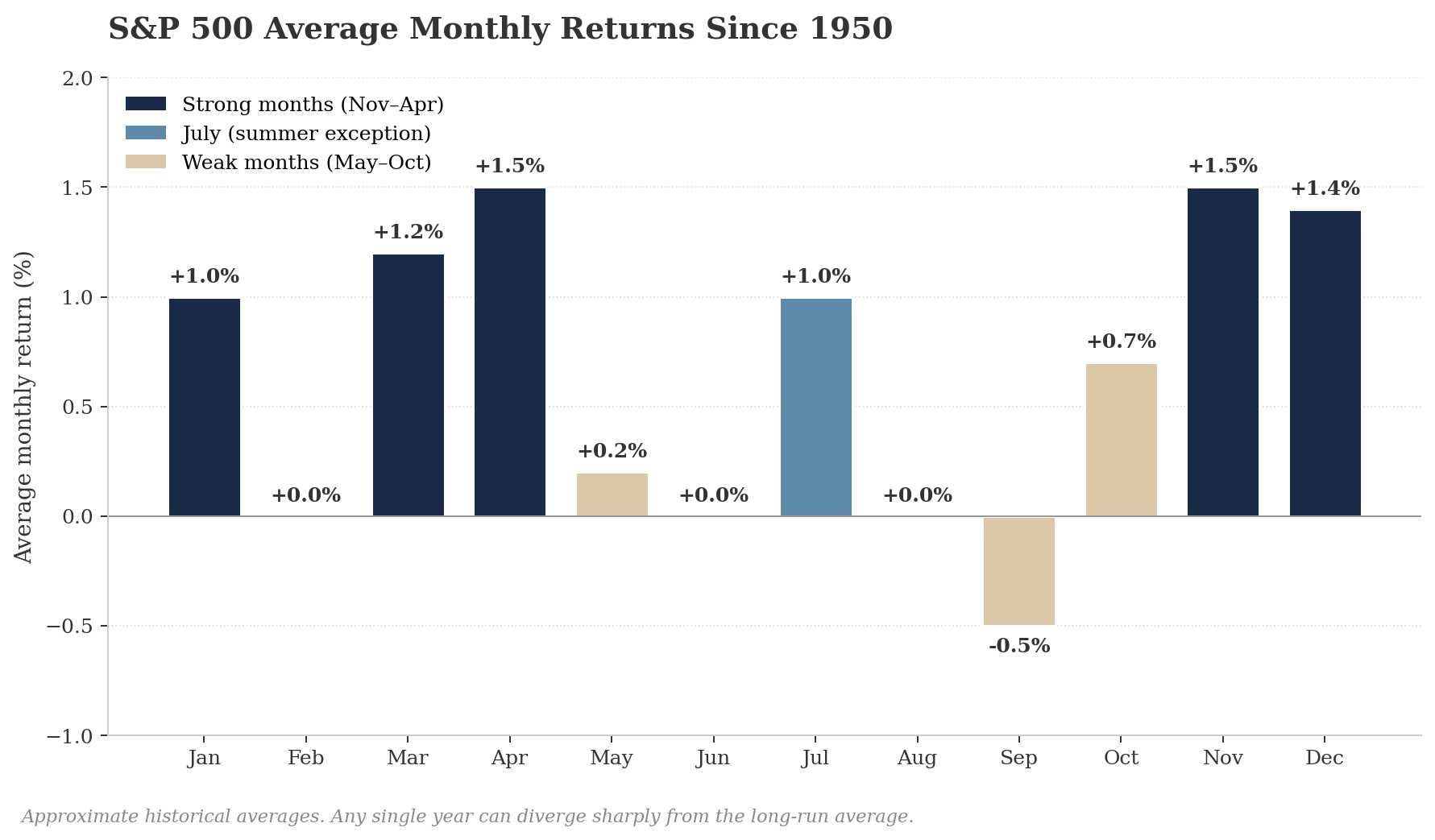
Since 1950, the S&P 500’s strongest months have clustered in November–April, while the May–October stretch has been notably weaker. July is the main summer exception, and any single year can diverge sharply from the long-run average.
The Santa Claus Rally
The related phenomenon, the “Santa Claus Rally,” occurs when stock prices rise during the last five days of the year and the first two of the new year. It was first described in the 1972 Stock Trader’s Almanac and has largely held true. The explanation has various components. Many institutions, which are often more conservative and short-side biased, go on vacation, lowering trading volume; what volume does exist tends to be more retail, and retail is often more optimistic. Bonus pay is also being deployed. Hence the saying: “If Santa Claus should fail to call, bears may come to Broad and Wall.”
If the market does not rally over this seven-day period, it may indicate weakness that could carry over into the new year. Over this seven-day Santa Claus Rally window, the S&P 500 is up 1.3%, on average, and up nearly 78% of years since 1950, beating out a regular week considerably.
The Santa Rally failed to deliver in 2024-2025, and again in 2025-2026. If it fails in the 2026-2027 window it will be the third year in a row where it failed. This would be the first 3-year loss streak since data collection started. Personally, I see this less as a tradable strategy and more as a barometer of market sentiment. When it is positive, the new year typically kicks off higher, but 3 years in a row of misses would suggest something is changing in the market.
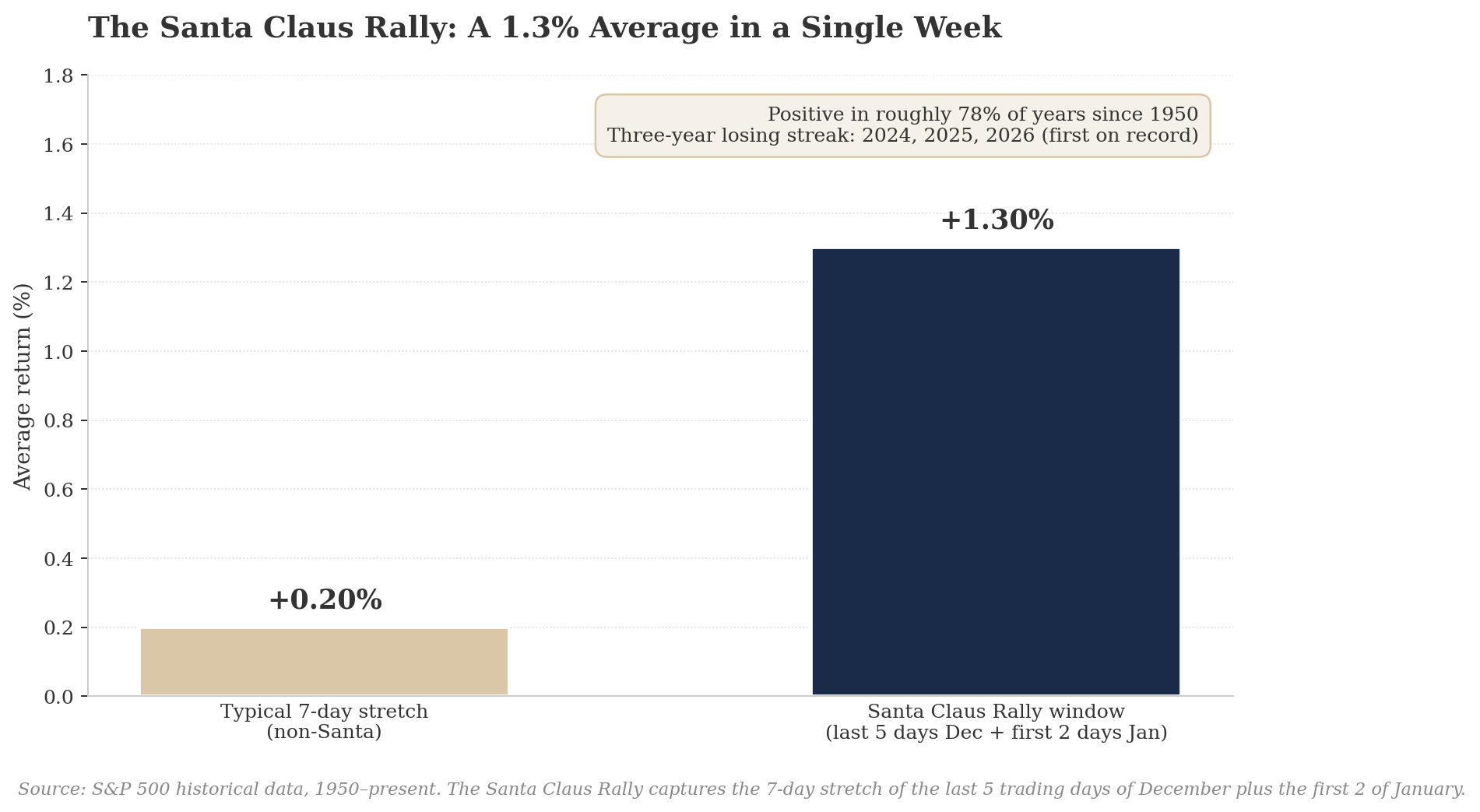
Across the seven-day Santa Claus Rally window, the S&P 500 has averaged a 1.3% gain and risen in roughly 78% of years since 1950 — well ahead of a typical week.
Macro Catalysts
The stock market has well-known seasonal moves that seem to happen in nearly every calendar year. But there are also macro catalysts which repeat on known, predictable schedules that will move the market.
FOMC Meetings and the CPI
At least eight times a year, the Federal Open Market Committee (FOMC) will meet and decide interest rates. Investors will sit on their hands waiting to hear whether the Fed will raise or lower rates. And some of the most interesting market mechanics I’ve observed occur in the 24 hours before the decision, not after it.
In fact, most of the market action will occur prior to the Fed actually speaking. Between 1994 and 2011, the S&P 500 would generate an average +0.49% excess return (i.e., above market average) on the 24 hours before an official FOMC announcement date, compared with approximately zero excess return on all other days.
I’ve noticed that the pre-FOMC drift effect had been slowly dying out as recently as ~2015. The original Lucca and Moench paper was reporting a +0.49% pre-announcement drift, however, once traders began to understand that this was possible, they would front-run that move and the edge pretty much disappeared. It’s the old adage that an anomaly can be arbitraged away when it becomes widely known.
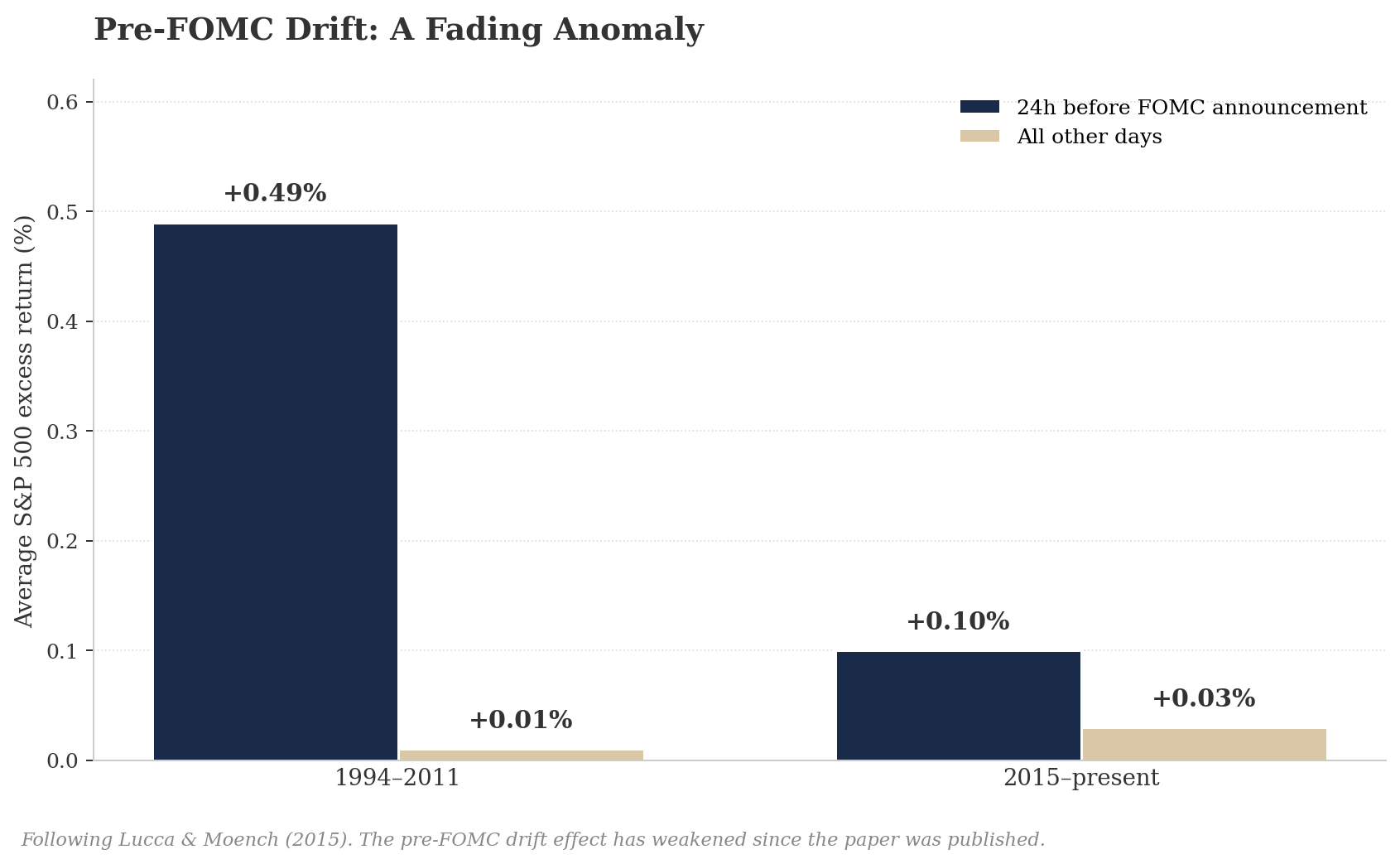
Much of the market’s reaction has historically come before the Fed speaks. From 1994 to 2011, the S&P 500 averaged a +0.49% excess return in the 24 hours ahead of scheduled FOMC announcements, versus roughly zero on other days. The drift has weakened since around 2015.
Regarding the announcement itself, if the Fed were to hike rates, tech stocks generally will decline. They’re heavily reliant on long-term, future earnings and the valuation of such future earnings is discounted more heavily at higher rates. High debt load small-cap stocks who are exposed to variable rates would also likely underperform the market.
Treasury bonds that were issued at lower rates will lose value when rates rise. Rates and bond prices move inversely in finance; it’s one of the few iron laws. But even if the Fed doesn’t raise rates, if they issue a Dot Plot where the Fed indicates they expect higher rates later this year, these same market dynamics will generally occur.
Whether the FOMC adopts a more hawkish or dovish stance will depend on the CPI. CPI = Consumer Price Index, which measures the change in inflation, and is issued monthly. Higher inflation usually correlates with the need to hike rates, which will negatively affect the stock market. At the same time, newly issued treasury bonds start looking more attractive at higher rates. The price of gold, oil, and other commodities tend to rise in periods of rising CPI, though the commodity to CPI relationship is complicated and multifaceted.
Earnings Season
At the end of every quarter, most public company will issue a report summarizing revenue, earnings per share, and their forward-looking expectations for the next quarter. In many sectors, this will have a significant impact on the broader market as well, particularly in ETFs that are very focused on a given sector, with technology being the most prominent example. That’s because in technology there are so many mega-cap companies that dominate the entire index.
If one or more of these mega-cap names misses the analyst targets, stock prices can drop hard and fast. I’ve noticed that broad-market ETFs barely move on earnings, while sector-concentrated ETFs can swing 5% or more in a single session when a marquee name misses. Even though broad-market ETFs are somewhat shielded, the end-of-quarter reporting cycle continues to influence the overall market direction through storytelling. Articles carrying headlines like “corporate margins are under pressure” or “consumer spending is down” are likely to influence sentiment for the week that follows.
Structural Flows
Aside from annual tendencies and macro factors, there are several institutional events that occur routinely and involve significant flows of capital and generate unique trading opportunities:
Index Rebalancing
An index will deliberately choose specific stocks to include based on stringent criteria, e.g. a minimum market cap, liquidity requirements, and financial viability. And then, every so often, those stocks are reviewed and either re-selected or re-excluded. Stocks which no longer adhere to the criteria are dropped from the index, and, if applicable, new stocks are brought on to fill those slots.
This is referred to as an index rebalancing (or reconstitution) and happens on established, pre-determined days. The S&P 500 reconstitutes on a quarterly basis. The Russell indexes have historically reconstituted on an annual basis, but, beginning in 2026, FTSE Russell is switching to a semi-annual basis.
Because every single index-tracking fund will be forced to reconstitute at the same time, reconstitutions become massive buying/selling events which can cause short-term mis-pricings of stocks. It’s happened at every single Russell reconstitution that I have witnessed: the front-running is real and predictable, and knowing which stocks are likely to be dropped from major indexes is possible for traders who take the time to study the publicly available reconstitution criteria.
Options Expiry Dates
There are options expiration dates that happen every week, month, and quarter. And for most options, they’re monthly and expire on the third Friday of each month. That leads to predictable, recurring fluctuations in prices.
As an options expiration date approaches, market makers must buy or sell shares of the underlying stock to hedge. With market makers buying/selling aggressively to do this, a stock’s price is more likely to stagnate, which is when the stock will likely be seen to trade sideways as the expiration date approaches. This is not a naturally occurring trading action; it’s the effect of artificial forces caused by hedging flows.
However, as those contracts expire, the stock price might surge and could rise or fall rather quickly in either direction. The sideways trading might have been masking underlying trading issues that then resurface once more. I have learned to exercise extra caution around monthly OpEx, which often brings outsized price movements that happen shortly after expiration.
Tax-Loss Harvesting
Tax-loss harvesting often occurs at the year’s end, most notably in November and December. This is where investors offload losers in order to offset some of the gains made from their winning stocks. In the US, investors can usually offset their regular income tax burden by up to $3,000 per year using losses.
You must sell your losers prior to the start of the new year to offset any losses, which is why most traders will execute sells a few days before the end of the year. Most tax-loss harvesting occurs prior to the Santa Rally, which means that this usually places predictable downside pressure on stocks that have done poorly over the year as a result of many investors offloading the same stocks all at once.
Yet, it does create one of my favorite seasonal patterns. In fact, beaten-down stocks tend to rebound in January once investors are free from year-end pressure and they start buying the same or similar ETFs. The IRS wash-sale window prohibits a tax deduction if you buy back the same security within 30 days after selling it, so many investors either sit and wait for the window to close, or they purchase similar, albeit not identical, alternative ETFs.
In January, tax-loss selling pressure on beaten-down stocks at the end of the year is often reversed; small caps have outperformed large caps on the back of it. The magnitude of that edge has depended on the period and diminished as markets became more efficient. While tracking the Jan bounce was one of the more reliable seasonal patterns I have been able to follow, the magnitude of the effect as you can see has declined through time as markets became more efficient. I am sure it is fair to say that tax-loss selling arbitrage trades are no longer like it was in the 1980s, but the directional pattern is present and, with other seasonal tendencies, can be a useful component of the framework.
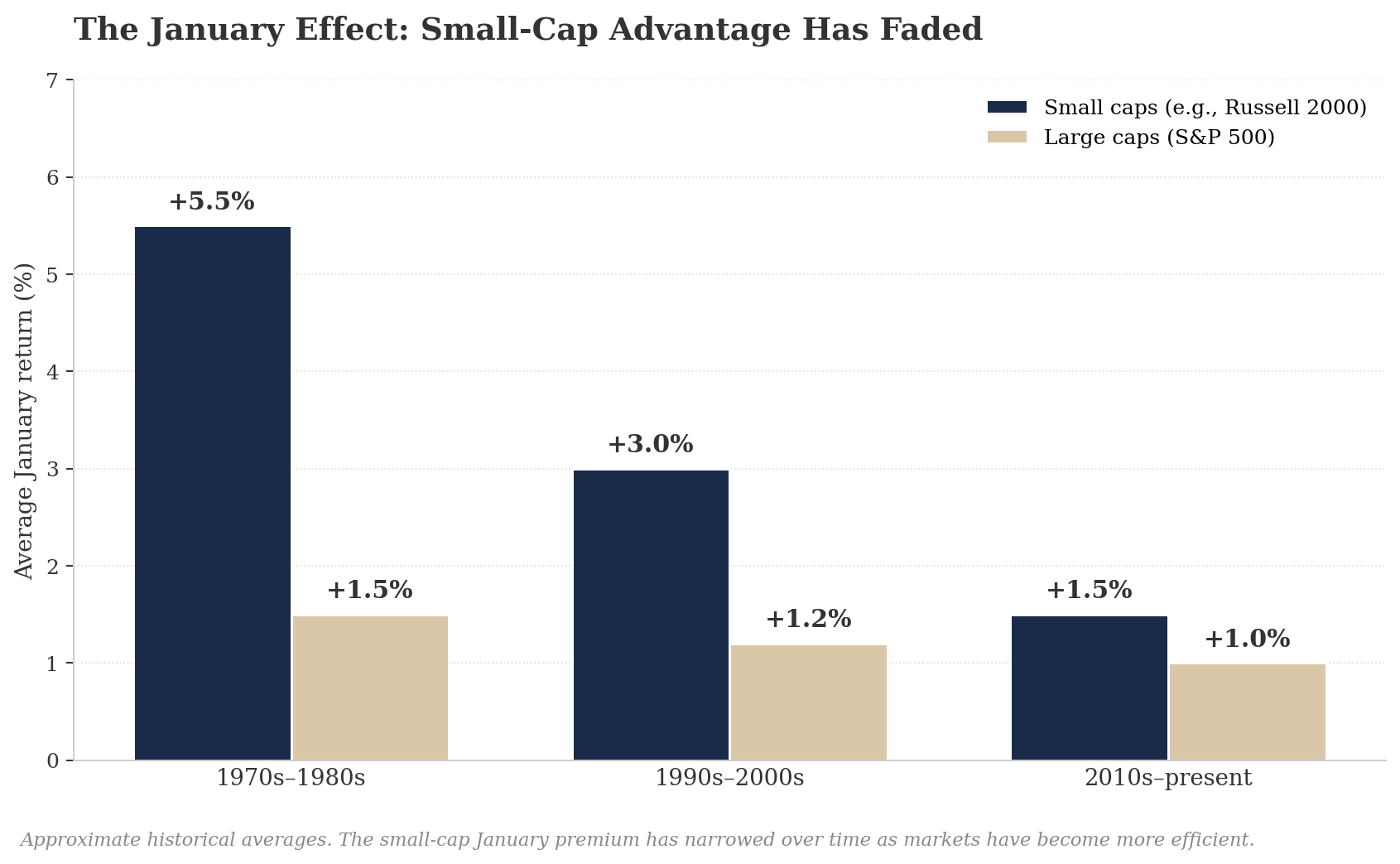
Tax-loss selling that pressures beaten-down stocks into year-end tends to reverse in January, when small caps have historically outpaced large caps. The size of that edge varies by period and has faded as markets have become more efficient.
A Simple Checklist for Identifying Trade Opportunities
Here’s my market-watch checklist to watch out for potential trade opportunities and to take advantage of them:
- End of month (particularly March, June, September, December): Monitor SPY and AGG, as portfolio rebalancing can affect both stocks and bonds.
- Third Friday of every month: Most options expire on this date, so we could see some sharp market moves immediately following expiration.
- Sell in May: Once summertime arrives, take a defensive, not aggressive, approach.
- Tax-loss harvesting: At the end of November and the beginning of December, some lower-performing securities tend to be sold in. Search for ETFs which suffered the most significant losses over the calendar year and watch them.
- Santa Rally: Typically, shares are up in value during the final five days of the year. You might decide to purchase them in the days prior or you might simply watch for the failure sign: If they don’t make an upswing at the end of the year, it could suggest the year ahead is in store for a bear.
- January bounce: Those ETFs which suffered the brunt of tax-loss selling in December can bounce in January. Buy them early in the year.
- Fed meeting dates: Decisions by the Fed can move markets significantly. Pay attention to SPY, TLT, and QQQ in particular.
- CPI release date: When the latest CPI report is released, it could have a major effect on SPY, QQQ, TLT, and it can also influence commodities, specifically gold and oil, as it relates to GLD and USO.
- Index reconstitution dates: Major indexes like the S&P 500 and the Russell indices have designated times when reconstitution occurs.
Below are the websites that I utilize to help me follow the calendar:
- FX Empire Earnings Calendar
- FX Empire Economic Calendar
- Federal Reserve calendars of FOMC meetings
- Bureau of Labor Statistics calendar of the CPI release
- Barchart Options Flow calendar
- New York Fed calendar of economic indicators
- NYSE Schedule of rebalancing
The Bottom Line
No individual seasonality effect should constitute the exclusive basis of an investment strategy. They are meant to be a framework within which to view when the market is likely to turn, and when opportunity can be expected to emerge. It isn’t intended to replace anything else that should be accomplished.
These seasonalities work best when superimposed on your existing framework. An example would be: If you are a buy-and-hold person, then you can use your knowledge of month end volatility to avoid trading at inopportune times, or if you have a more dynamic approach, you can use FOMC drift, OpEx flows, and tax-loss bouncing to refine when you enter and exit over the course of the year.
The investors that I have observed with the most success with these frameworks haven’t been those relying on any single pattern as gospel; rather, they’ve been the ones who have incorporated the framework into a more holistic approach to managing risk. The patterns exist. They just don’t constitute the sole factor.