


Traders remain cautious ahead of key data releases, including US Q2 GDP and PCE Price Index.
Gold Prices Rise Amid Weak US Economic Data and Fed Rate Cut Expectations
The US dollar’s decline from a two-week high has supported gold prices, driven by expectations of a Federal Reserve rate-cutting cycle in September and recent political developments. The Federal Reserve Bank of Richmond reported worsening manufacturing activity in July, with the composite manufacturing index dropping to -17 from -10 in June.
Additionally, the National Association of Realtors noted a 5.4% decline in US existing home sales in June, reaching an annual rate of 3.89 million units, the lowest since December.
These economic weaknesses increase the likelihood of a rate cut, boosting demand for gold as a safe-haven asset. Upcoming US GDP and PCE Price Index data are key market focuses.
Short-Term Forecast
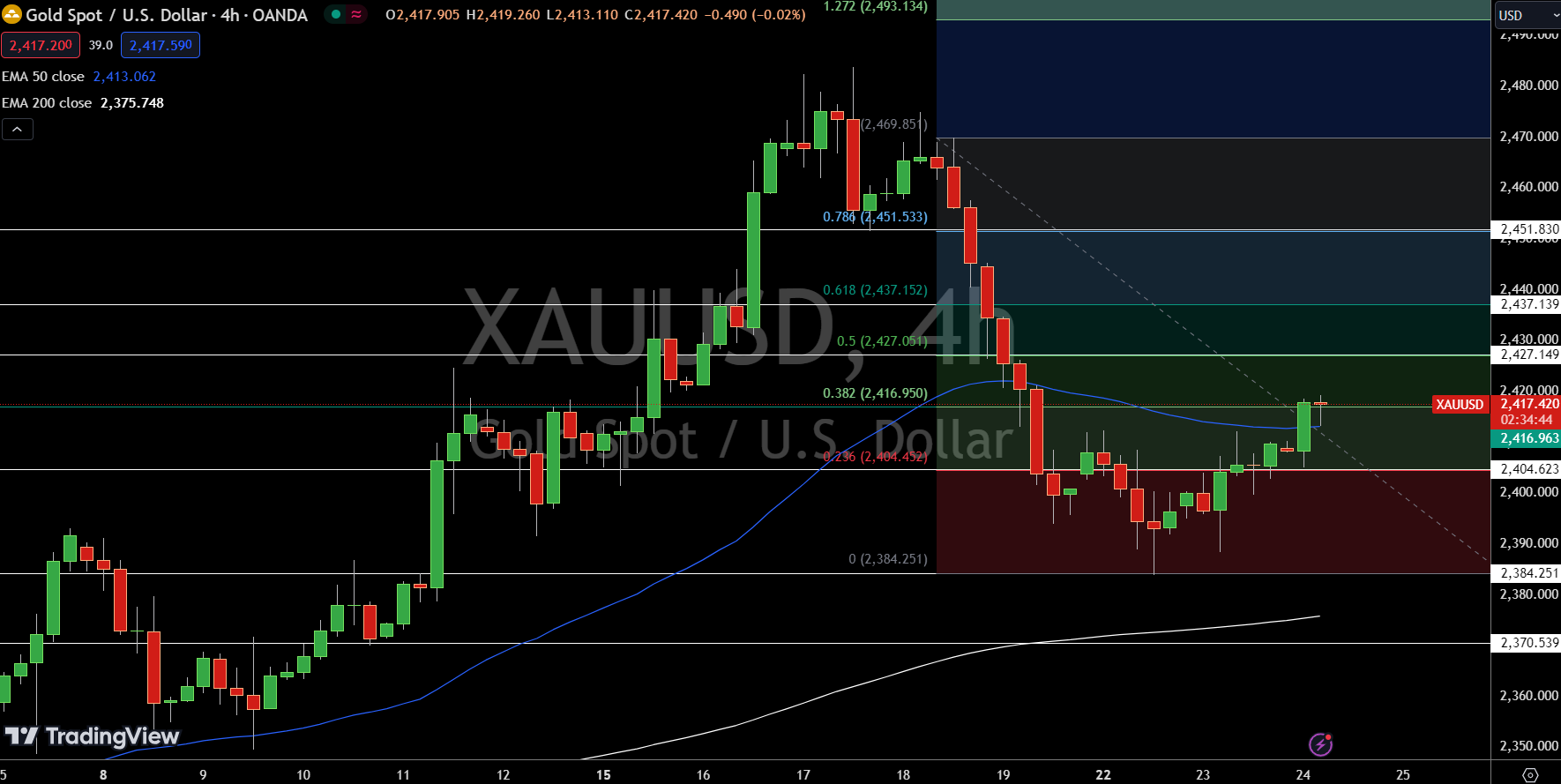
Gold (XAU/USD) prices have risen to $2417.42, marking a 0.29% increase. On the 2-hour chart, the pivot point is set at $2416.96. Immediate resistance levels are at $2427.15, $2437.14, and $2451.83, indicating potential upward movement if these levels are breached.
Support levels lie at $2404.62, $2384.25, and $2370.54, providing a safety net for price declines. The 50-day EMA stands at $2413.06, while the 200-day EMA is at $2375.75, both indicating a bullish trend as long as prices remain above $2415. However, a break below this pivot point could trigger a sharp selling trend.
Traders should closely monitor these key price levels and economic indicators, including US GDP and PCE Price Index data, for short-term market cues. The ongoing economic weakness and Federal Reserve rate cut expectations further support the bullish outlook for gold.