
However, expectations of a 50-basis-point Federal Reserve rate cut in September and ongoing geopolitical tensions are providing some support to the metal, limiting its losses.
US Economic Data and Fed Rate Cuts: Implications for Gold Prices
Despite expectations for Federal Reserve interest rate cuts, the US dollar gained traction due to rising Treasury yields, limiting gold’s gains. Recent data showing weaker manufacturing and job growth has heightened recession fears, causing Treasury yields to drop to their lowest since mid-2023.
Traders anticipate a 50-basis-point Fed rate cut in September. However, San Francisco Fed President Mary Daly stated that the job market slowdown is not alarming and that interest rates will balance employment and price stability.
These developments have pressured gold prices, as a strong dollar and rising yields limit gains despite expected rate cuts.
Middle East Tensions Bolster Gold Prices
Ongoing Middle East conflicts are likely to support gold prices. Iran, Hamas, and Hezbollah have vowed retaliation against Israel following the assassination of Hamas leader Ismail Haniyeh in Tehran.
This tension enhances gold’s appeal as a safe-haven asset, offering support despite pressure from a stronger US dollar and rising Treasury yields.
Short-Term Forecast
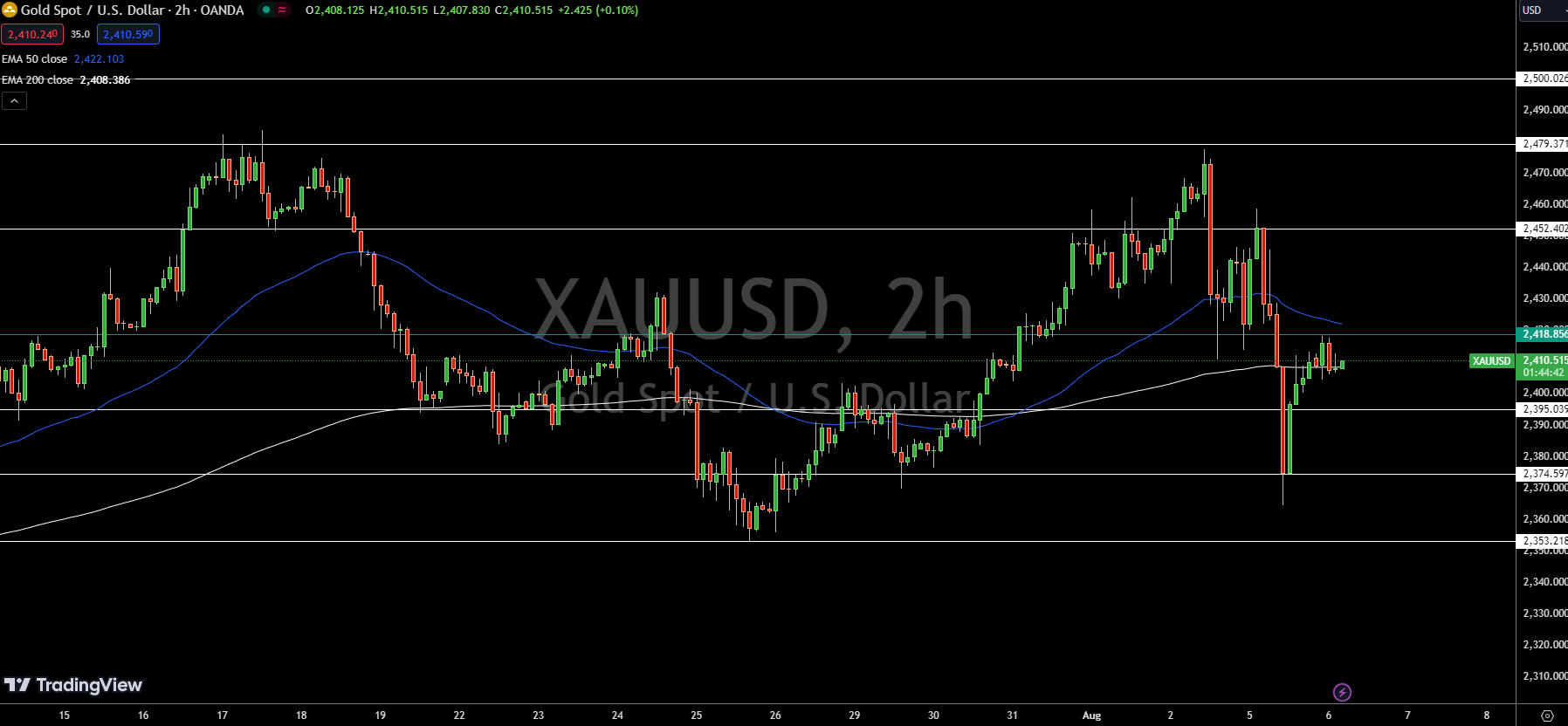
Gold (XAU/USD) is trading at $2410.51, down 0.03%, as bearish sentiment prevails in the market. The 4-hour chart analysis shows a pivot point at $2418.85, indicating the current price is below this critical level, which maintains downward pressure.
Immediate resistance is found at $2452.40, with further resistance at $2479.37 and $2500.02.

On the downside, immediate support lies at $2395.03, followed by $2374.59 and $2353.21. The 50-day EMA at $2422.10 is above the current price, while the 200-day EMA at $2408.38 supports a bearish outlook. A break above $2418.85 could signal a bullish reversal.